
What This Family Visa Covers — Brazil family reunion visa
#This visa allows you to join a close family member who is a Brazilian citizen or a lawful resident. It grants residence for a defined period and requires registration with the Federal Police (Polícia Federal – PF) after arrival in Brazil.
Who is covered
You qualify if you are a family member of a Brazilian citizen or a legal resident of Brazil.
The qualifying sponsor in Brazil may hold status such as:
- Brazilian citizenship
- Temporary residence (for example, Temporary Visa - Work (VITEM V))
- Temporary Visa - Student (VITEM IV)
- Temporary Visa - Researcher (VITEM I)
- Temporary Visa - Religious/Volunteer (VITEM II)
- Humanitarian Visa - Acolhida Humanitária (VITEM X)
- Form RER-Visa
Your eligibility depends on your relationship to that person and their valid immigration status in Brazil.
Brazilian consulates issue the visa abroad. After you enter Brazil, you must complete registration with the Federal Police (PF) to formalize your residence.
| Requirement Element | What You Must Have |
|---|---|
| Sponsor in Brazil | Brazilian citizen or legal resident |
| Relationship | Recognized family relationship |
| Status of sponsor | Valid and current immigration status |
| Post-arrival step | Registration with PF |
Scope and duration context
This is a temporary residence visa valid for up to 2 years.
The permitted stay aligns with your family reunification purpose. It does not automatically grant permanent residence.
Before the two-year period ends, you must review your options to maintain lawful status. Your residence remains tied to the qualifying family relationship and the sponsor’s legal status in Brazil.
| Feature | Details |
|---|---|
| Maximum validity | Up to 2 years |
| Type of status | Temporary residence |
| Issued by | Brazilian consulate (abroad) |
| Registration in Brazil | Required with PF |
You must maintain valid documentation and comply with PF registration rules throughout your stay.
Evidence Checklist
#You must submit identity documents, residence history, and properly completed forms to avoid delays. Incomplete files or missing signatures often lead to processing issues with the Federal Police (Polícia Federal) (PF) or the Brazilian consulate handling your visa.
Passport and identity documents
Your passport must meet strict format requirements. If it does not, the consulate will not issue your visa.
You must provide:
- A valid passport signed by you
- At least two contiguous blank visa pages
- Clear copies of your passport biographical page
Check that your passport will remain valid for the entire visa issuance process. Replace it before applying if it lacks blank pages.
Your visa category must match your purpose and supporting documents. Common categories include:
| Visa Category | Official Name |
|---|---|
| Work | Temporary Visa – Work (VITEM V) |
| Study | Temporary Visa – Student (VITEM IV) |
| Research | Temporary Visa – Researcher (VITEM I) |
| Religious/Volunteer | Temporary Visa – Religious/Volunteer (VITEM II) |
| Humanitarian | Humanitarian Visa – Acolhida Humanitária (VITEM X) |
| MERCOSUR Residence | Form RER-Visa |
Confirm that your selected category aligns with your eligibility before submission.
Residence and criminal-record evidence
You must document where you lived during the past 12 months. This evidence supports your criminal record review.
Upload proof of residence covering the full 12‑month period before filing. The documentation must clearly show:
- Your full name
- Your residential address
- Dates covering the required timeframe
Gaps in residence history create inconsistencies with your criminal record documentation and may delay processing.
Ensure the information you provide matches all identity records exactly. Use consistent spelling of your name and the same date format across documents.
If you are unsure whether your documentation is sufficient, review the current instructions on the official Federal Police (Polícia Federal) website before submitting.
Forms, signatures and submission steps
You must use the most current vitem-family form issued by the Federal Police (Polícia Federal). Do not rely on outdated versions.
Follow these steps:
1.2. Review the instructions for your specific eligibility category (such as VITEM V, VITEM IV, VITEM I, VITEM II, VITEM X, or RER-Visa).
-
Complete every required section accurately.
-
Sign where required.
-
Submit the form with all supporting evidence.
Incomplete forms, missing signatures, or omitted documents will delay your application.
Brazilian consulates issue visas abroad. The Federal Police (PF) handles immigration registration inside Brazil after entry.
The Two-Stage Process
#You complete the family reunion process in two distinct stages: filing inside Brazil with the Federal Police (Polícia Federal – PF) and visa issuance through a Brazilian consulate abroad. Different authorities control each step, and each has a separate role.
Filing with the issuing authority
You begin by submitting the required application form to the Federal Police (PF) in Brazil. This filing places your request into the national immigration system and starts the formal review process.
PF handles immigration registration inside Brazil. If your family member already holds a status such as:
- Temporary Visa – Work (VITEM V)
- Temporary Visa – Student (VITEM IV)
- Temporary Visa – Researcher (VITEM I)
- Temporary Visa – Religious/Volunteer (VITEM II)
- Humanitarian Visa – Acolhida Humanitária (VITEM X)
- Form RER-Visa
your filing connects the family reunion request to that existing status.
The processing time is not fixed. The Consular Authority determines the timeline, and it may vary depending on the case.
If you need current fees in BRL (R$) or updated procedural details, consult the official Federal Police guidance.
| Step | Authority | What You Do |
|---|---|---|
| File application | Federal Police (PF) | Submit required form and supporting documents |
| Await decision | Consular Authority | Processing time determined case by case |
Consular and police roles
Brazilian consulates issue visas abroad. PF manages immigration registration within Brazil.
If your family member is outside Brazil, the consulate handles visa issuance after the appropriate review. PF does not issue visas abroad.
Inside Brazil, PF records and manages immigration status. Outside Brazil, the consulate controls whether the visa is granted.
The processing time remains under the authority of the consulate. For current timelines or procedural updates, check official Brazilian government sources before you apply.
What You Can Do
#You can live in Brazil under the VITEM XI for a defined period and must complete mandatory registration steps after arrival. Your main responsibilities are tracking your stay limit and registering on time with the Federal Police (Polícia Federal – PF).
Length of initial stay
Your VITEM XI allows you to remain in Brazil for up to one year. The one-year period starts on the date of your first entry into Brazil, not on the date the visa was issued.
Track your entry date carefully. Border control stamps and travel records determine when your authorized stay begins.
| Item | Rule |
|---|---|
| Visa type | VITEM XI (Family Reunion) |
| Initial stay | Up to 1 year |
| Start date | Date of first entry into Brazil |
If you previously held another status, such as a Temporary Visa – Work (VITEM V), Temporary Visa – Student (VITEM IV), Temporary Visa – Researcher (VITEM I), Temporary Visa – Religious/Volunteer (VITEM II), Humanitarian Visa – Acolhida Humanitária (VITEM X), or a Form RER-Visa, your authorized period under VITEM XI still begins from your first entry using this visa.
You must not exceed the one-year period granted under this status.
Registration and compliance
You must register with the Federal Police (PF) within 90 days of your first entry into Brazil. This requirement applies to all VITEM XI holders.
Failure to register within the deadline places you out of compliance with Brazilian immigration rules.
Follow these steps:
-
Enter Brazil using your VITEM XI.
-
Count 90 days from your first entry date.
-
Complete your registration with the PF before the deadline.
| Requirement | Deadline | Authority |
|---|---|---|
| Immigration registration | Within 90 days of first entry | Federal Police (PF) |
The PF manages immigration registration inside Brazil. Brazilian consulates handle visa issuance abroad, but they do not complete your in-country registration.
Keep proof of your entry date and confirm your registration is finalized within the required timeframe.
Extending Your Family Visa
#If you already live in Brazil, you can request residence based on family reunion without leaving the country. The Federal Police (Polícia Federal – PF) manages this process and decides your status change.
Converting to residence from inside Brazil
If you hold a temporary status such as Temporary Visa - Work (VITEM V), Temporary Visa - Student (VITEM IV), Temporary Visa - Researcher (VITEM I), Temporary Visa - Religious/Volunteer (VITEM II), Humanitarian Visa - Acolhida Humanitária (VITEM X), or Form RER-Visa, you may request residence based on your qualifying family relationship.
You file the request directly with the PF, not at a consulate.
Follow these general steps:
-
Confirm that your family relationship qualifies under Brazilian family reunion rules.
-
Gather civil documents proving the relationship.
-
Submit your residence request to the PF in Brazil.
-
Complete registration requirements as instructed by the PF.
| Situation | Where You Apply | Authority in Charge |
|---|---|---|
| Inside Brazil | Local PF unit | Federal Police (PF) |
| Outside Brazil | Brazilian consulate | Brazilian consulate abroad |
Check the PF’s official guidance for current fees in BRL (R$) and required forms.
Typical next steps after temporary stay
After you apply for residence through family reunion, the PF will review your documentation and determine whether you meet the eligibility criteria. You must maintain lawful status in Brazil while your request is pending.
Once approved, you follow the PF’s instructions for registration and documentation issuance. This step formalizes your resident status inside Brazil.
If your temporary visa is close to expiring, act early. Do not wait until the last days of validity to begin the residence process.
Fees and Processing Times
#You must pay a government fee and plan for a processing period that typically ranges from one to three months. The exact timeline depends on the visa category and where you apply, and the Federal Police (Polícia Federal – PF) manages registration inside Brazil while consulates issue visas abroad.
Application fee
The current government filing fee for a Brazil family reunion visa is R$ 290.
This amount applies as of March 2026. You should confirm the latest fee with the Brazilian consulate handling your application or with the Federal Police if you are completing steps inside Brazil.
| Item | Amount (BRL) | Paid To |
|---|---|---|
| Family Reunion Visa Application | R$ 290 | Brazilian consulate (abroad) or PF (in Brazil, if applicable) |
You pay the consular fee when submitting your application outside Brazil. After arrival, you must complete registration with the Federal Police (PF) within the required timeframe.
If your sponsoring family member holds a different temporary status—such as:
- Temporary Visa – Work (VITEM V)
- Temporary Visa – Student (VITEM IV)
- Temporary Visa – Researcher (VITEM I)
- Temporary Visa – Religious/Volunteer (VITEM II)
- Humanitarian Visa – Acolhida Humanitária (VITEM X)
- Form RER-Visa
the family reunion fee remains the same unless the issuing authority states otherwise.
Standard processing window
Under standard processing, family reunion visa applications take 30 to 90 days.
This timeframe reflects typical handling from the date of submission to a decision. Some cases finish closer to 30 days, while others approach the 90-day mark.
| Processing Type | Estimated Time |
|---|---|
| Standard | 30–90 days |
The countdown generally begins once you submit a complete application with all required documents. Incomplete files can delay review.
If you apply abroad, the Brazilian consulate processes the visa. After entry into Brazil, you must complete your immigration registration with the Federal Police (PF).
Always confirm current timelines directly with the issuing consulate or the PF, as internal workloads can change.
Variable processing factors
Processing times hinge mostly on two things: visa category and processing location.
If your sponsor has a status like VITEM V (Work), VITEM IV (Student), or VITEM I (Researcher), the consulate often checks whether that status is still valid before moving forward on your family reunion visa. This kind of review can also happen for VITEM II, VITEM X, or RER-Visa holders.
Location matters, too. Some consulates deal with heavier workloads, and their internal review speeds can vary quite a bit.
You can help prevent hold-ups by:
- Submitting a complete, organized set of documents
- Making sure names and dates match everywhere
- Including solid proof of your family relationship
- Double-checking your sponsor’s immigration status is valid when you file
For the most accurate timeline, reach out to the Brazilian consulate handling your case or the Federal Police if you’re doing any steps inside Brazil.
From Family Visa to PR
#
A Brazil family reunion visa may lead to permanent residence, depending on your status and how you follow immigration rules.
You have to maintain lawful status and complete registration with the Federal Police (Polícia Federal or PF) after you arrive in Brazil.
Common pathways
Your path to permanent residence depends on your visa type and your relationship to the sponsor.
Many people move forward after holding a family-based residence authorization and keeping regular status with the PF. You’ll need to:
- Register with the Federal Police (PF) after you get to Brazil
- Keep your immigration record up to date
- Maintain your qualifying family relationship
- Avoid overstays or status violations
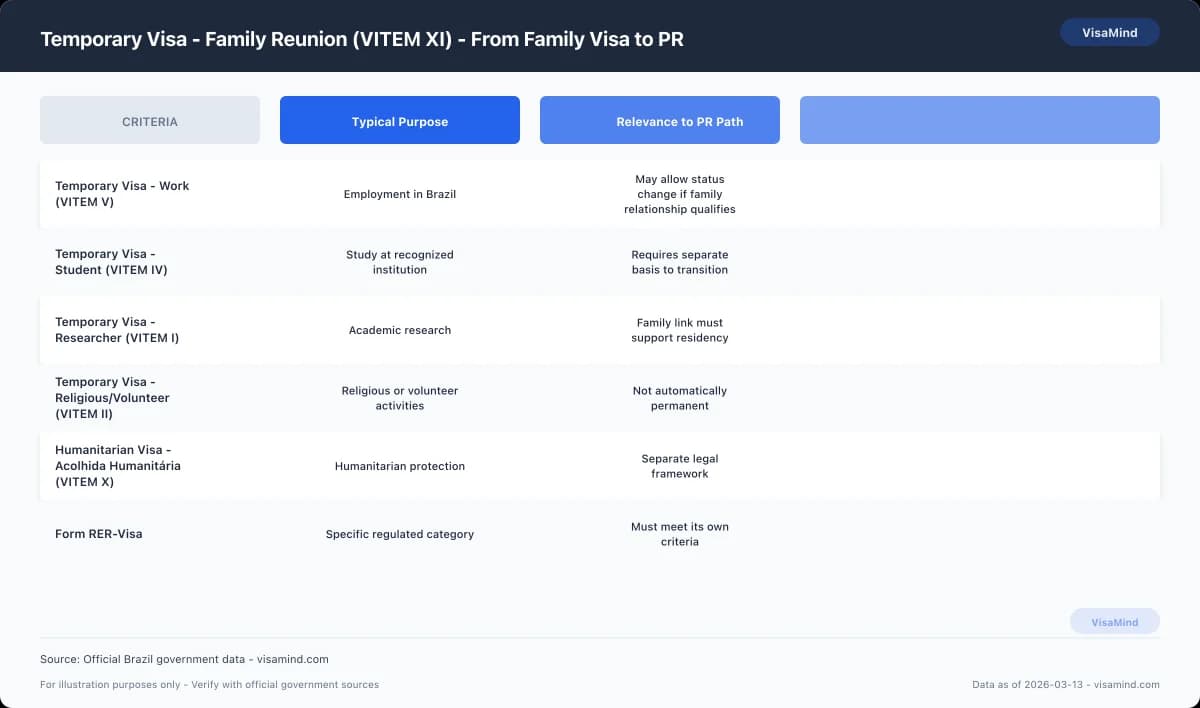
If you held another temporary visa before, your history can affect your options. Some common visa backgrounds include:
| Visa Type | Typical Purpose | Relevance to PR Path |
|---|---|---|
| Temporary Visa - Work (VITEM V) | Employment in Brazil | May allow status change if family relationship qualifies |
| Temporary Visa - Student (VITEM IV) | Study at recognized institution | Requires separate basis to transition |
| Temporary Visa - Researcher (VITEM I) | Academic research | Family link must support residency |
| Temporary Visa - Religious/Volunteer (VITEM II) | Religious or volunteer activities | Not automatically permanent |
| Humanitarian Visa - Acolhida Humanitária (VITEM X) | Humanitarian protection | Separate legal framework |
| Form RER-Visa | Specific regulated category | Must meet its own criteria |
Brazilian consulates issue visas outside Brazil. The PF manages residence authorization and status changes inside the country.
What follows after approval
Once your residence is approved based on family ties, you need to register in person with the PF. This step formalizes your status and gives you your national migration registration.
After approval, your steps are:
-
Schedule and attend your PF appointment.
-
Bring the required civil documents.
-
Give biometric data if they ask for it.
You must keep your address and civil status updated with the PF. Any change in marriage, divorce, or who counts as a dependent can affect your residency.
Permanent residence lets you live in Brazil under the terms granted in your approval. For up-to-date procedural details, document lists, and fee information (in BRL (R$)), refer to the Federal Police and the consulate that gave you the visa.
Complex Family Situations
#Some family reunion cases get complicated by overlapping visas, prior immigration status, or extra scrutiny. Both the consulate abroad and the Federal Police (PF) after you arrive may take a closer look at your file.
When approval is not guaranteed
Submitting a VITEM-family application doesn’t mean you’ll be approved. Each case is reviewed on its own, even if your relationship seems clear.
Uncertainty increases if your sponsor holds a temporary status, such as:
| Sponsor’s Status in Brazil | Possible Impact on Your Application |
|---|---|
| Temporary Visa - Work (VITEM V) | Validity of your stay may depend on the sponsor’s employment status |
| Temporary Visa - Student (VITEM IV) | Authorities may review financial capacity and duration of stay |
| Temporary Visa - Researcher (VITEM I) | Your eligibility may align with the research term |
| Temporary Visa - Religious/Volunteer (VITEM II) | Review may focus on the temporary nature of the activity |
| Humanitarian Visa - Acolhida Humanitária (VITEM X) | Case-by-case assessment is common |
| Form RER-Visa | Status conditions may affect derivative eligibility |
You still have to register with the PF after you arrive. The PF reviews your documents and status separately from the consulate’s decision.
If your sponsor’s status changes, expires, or isn’t resolved, your family reunion request may get delayed or refused.
When to seek expert help
Professional help is a good idea if your case involves status transitions or more than one visa category. Switching from a Temporary Visa - Work (VITEM V) to another type while sponsoring a family member can complicate timing and paperwork.
Legal advice is especially important if:
- Your sponsor’s visa is temporary and doesn’t last long
- Your relationship documents are incomplete or inconsistent
- You’ve held a different Brazilian visa type before
- You need to coordinate between consular processing and PF registration
Complex timelines can be risky. For instance, if your sponsor switches from Temporary Visa - Student (VITEM IV) to something else, your eligibility might need to be reassessed before or after you arrive.
A seasoned immigration attorney can help you coordinate your visa application at the consulate with the PF registration process. This helps avoid mistakes and unnecessary refusals.
Sponsor and Applicant Requirements (Brazil family visa)
#To qualify for the Temporary Visa – Family Reunion (VITEM XI), you have to meet clear sponsorship and relationship rules. The focus is on who your sponsor is and whether your marriage is legally recognized in Brazil.
Who can sponsor
Your sponsor must be one of the following:
- A Brazilian national, or
- A foreign national with a valid residence permit in Brazil
If your spouse is Brazilian, they can sponsor you directly for the Temporary Visa – Family Reunion (VITEM XI).
If your spouse is a foreign national, they need to already be a lawful resident in Brazil. This includes people holding residence permits linked to visas like:
- Temporary Visa – Work (VITEM V)
- Temporary Visa – Student (VITEM IV)
- Temporary Visa – Researcher (VITEM I)
- Temporary Visa – Religious/Volunteer (VITEM II)
- Humanitarian Visa – Acolhida Humanitária (VITEM X)
- Form RER-Visa
Brazilian consulates handle visa issuance abroad. After you arrive, you must register with the Federal Police (Polícia Federal – PF) inside Brazil.
| Sponsor Type | Must Hold Brazilian Nationality? | Must Hold Brazilian Residence Permit? |
|---|---|---|
| Brazilian citizen | Yes | No |
| Foreign national | No | Yes |
Relationship-based eligibility
The temporary visa for family reunion may be granted to a spouse or partner (without discrimination), child, stepchild, parent of a Brazilian child, ascendant or descendant up to the second degree, sibling, or guardian of a Brazilian national or of a foreign national who is already a beneficiary of a residence authorization in Brazil.
- A Brazilian national, or
- A foreign national who already has a valid residence permit in Brazil
The qualifying family relationship — including stable union and other relationships listed under the applicable rules — is the legal basis for eligibility. You’ll need to prove your marriage exists and that your spouse meets the sponsor requirements above.
| Applicant’s Relationship | Eligible for VITEM XI? |
|---|---|
| Married to Brazilian national | Yes |
| Married to foreign resident in Brazil | Yes |
| Stable partner or other qualifying relative | Yes |
Both elements are required: a qualifying family relationship (including stable union) and a qualified sponsor. If either is missing, the Federal Police won’t grant residence registration.
Why Family Visas Get Denied
#Consulates and the Federal Police (PF) refuse family reunion visas when the relationship isn’t credible or the documents don’t prove it. Most denials happen because of mistakes in how the marriage or family tie is presented.
Common relationship red flags
Authorities look at whether your marriage or family link is legally valid and genuine.
A major problem is how the marriage was performed. Brazil doesn’t grant a family reunion visa if the marriage was done by power of attorney. Proxy ceremonies aren’t accepted, and the consulate will refuse the application.
Officers also look for consistency across records from other visa categories, including:
- Temporary Visa – Work (VITEM V)
- Temporary Visa – Student (VITEM IV)
- Temporary Visa – Researcher (VITEM I)
- Temporary Visa – Religious/Volunteer (VITEM II)
- Humanitarian Visa – Acolhida Humanitária (VITEM X)
- Form RER-Visa
If your immigration history conflicts with your claimed family status, your case may get extra scrutiny. Inconsistent civil records, mismatched names, or contradictory statements can hurt your credibility.
| Red Flag | Why It Leads to Refusal |
|---|---|
| Marriage by proxy | Not accepted for visa issuance |
| Conflicting civil records | Raises doubts about legal validity |
| Inconsistent immigration history | Suggests possible misrepresentation |
Documentation and evidence shortfalls
Even a valid relationship won’t get you far without the right documents.
Consulates issue the visa abroad, and the PF handles registration inside Brazil. Both steps require accurate civil documents that match across all records.
Common issues include:
- Missing or incomplete marriage or birth certificates
- Documents with inconsistent personal details
- Not presenting required evidence at the consulate
- Inconsistent records during PF registration
Every document needs to back up the same facts: names, dates, marital status, and any past visa category.
| Documentation Issue | Impact on Application |
|---|---|
| Incomplete civil certificate | Application cannot be approved |
| Mismatched personal data | Triggers credibility concerns |
| Gaps between visa history and family claim | May result in denial |
Accuracy is more important than volume. A qualifying family relationship and consistent documents give the consulate and PF a solid basis to approve your visa.
Fees
#| Component | Amount |
|---|---|
| Application feeFamily reunion visa (VITEM XI) | $290 |
Fees change; always verify on PF.