The Document Review Process
#Before lodging your application for a Brazilian visa, it's essential to gather all required documents to meet the Polícia Federal criteria. This ensures your application process is smooth and efficient. The Polícia Federal plays a required role in processing visa applications within Brazil, while Brazilian consulates handle visa issuance abroad. Always refer to the official website for the most current requirements.
Philosophy Behind Brazilian Visa Docs
The Brazilian visa document requirements are designed to ensure that applicants provide a complete and accurate representation of their eligibility and intent. This rigorous documentation process helps maintain the integrity of Brazil's immigration system and facilitates the efficient processing of applications. Each document you gather serves a specific purpose, such as verifying your identity, financial stability, or the authenticity of your travel plans. By requiring these documents, the Brazilian authorities aim to protect both the applicants and the country's interests.
Criteria for Document Acceptance -
Documents must be original or certified copies. - All documents in a foreign language must be translated into Portuguese by a certified translator. - Ensure your documents are current and valid, as expired documents will not be accepted.
Important: Ensure all documentation is complete before submission to avoid delays or rejection of your visa application.
Understanding Brazilian Consulate Expectations
Brazilian consulates abroad expect applicants to present documents that clearly demonstrate their purpose of travel and their financial ability to support themselves during their stay. Consulates may also require additional documentation depending on the type of visa applied for, such as proof of enrollment for a Temporary Visa - Student (VITEM IV) or a work contract for a Temporary Visa - Work (VITEM V).
Tip: Check specific requirements of your local Brazilian consulate, as expectations can vary slightly depending on the country of application. For further information on the types of visas and their requirements, consider visiting the pages for Vivis Tourist and Vitem Work.
Financial Evidence
#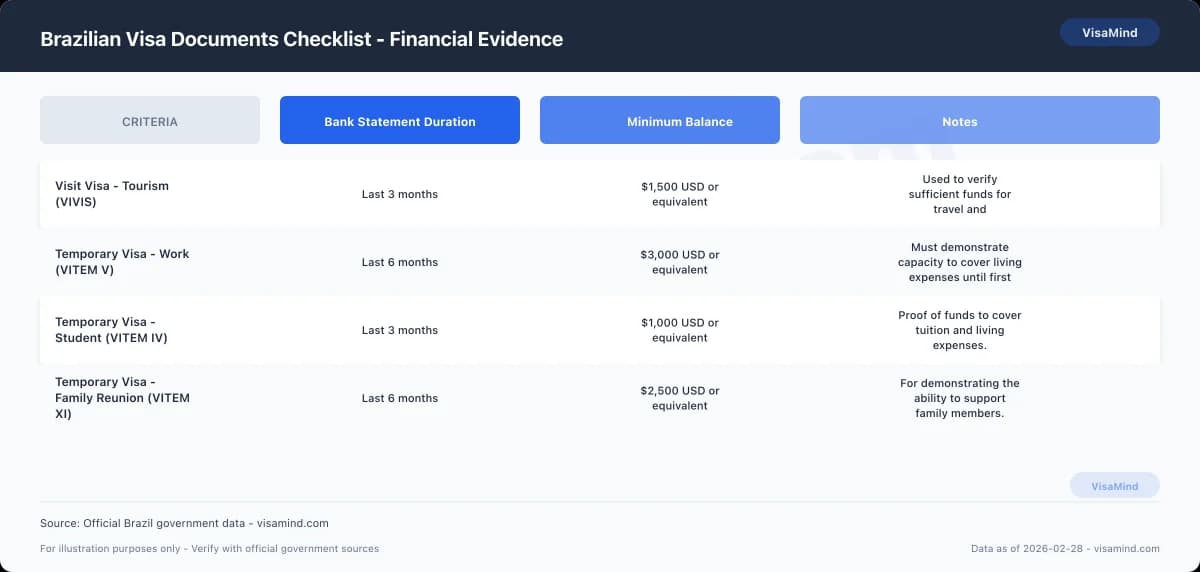
This involves providing specific financial documents to the Polícia Federal to prove your ability to support yourself during your stay in Brazil.
Minimum Bank Balance Requirements
The required minimum bank balance for a Brazilian visa varies depending on the type of visa you are applying for. Typically, applicants should demonstrate that they have enough funds to cover their stay, which is usually assessed on a monthly basis.
| Visa Type | Minimum Monthly Balance (in BRL) |
|---|---|
| Visit Visa - Tourism (VIVIS) | R$3,000 |
| Temporary Visa - Work (VITEM V) | R$5,000 |
| Temporary Visa - Student (VITEM IV) | R$2,500 |
| Temporary Visa - Family Reunion (VITEM XI) | R$4,000 |
Tip: Ensure that your bank statements reflect the minimum balance consistently to avoid any issues with your visa application.
Acceptable Financial Documents
To prove your financial capability, you must provide certain documents. These typically include bank statements, proof of income, and any additional financial guarantees. - Recent bank statements showing the required minimum balance. - Proof of employment and income, such as pay slips or a letter from your employer. - Financial affidavits or sponsorship letters if applicable.
Important: All financial documents must be translated into Portuguese by a certified translator if they are originally in a different language.
Duration of Financial Records The Polícia
Federal generally requires financial records to cover a specific time period. This is to ensure that applicants have consistently maintained the necessary financial resources.
| Visa Type | Required Duration of Financial Records |
|---|---|
| Visit Visa - Tourism (VIVIS) | 3 months |
| Temporary Visa - Work (VITEM V) | 6 months |
| Temporary Visa - Student (VITEM IV) | 6 months |
| Temporary Visa - Family Reunion (VITEM XI) | 3 months |
Warning: Failure to provide records for the required duration may result in delays or rejection of your application.
Documents for Your Visa Type
#Brazil's immigration process requires you to gather specific documents before applying for a visa with the Polícia Federal. Whether you're seeking a work, student, or family reunion visa, having the correct documentation is essential. Different visa types in Brazil demand unique supporting documents, from employment contracts to family relationship proofs. Ensuring you have these documents ready can help streamline your application with the Federal Police.
Required Documents for Work Visa For a Temporary Visa - Work (VITEM V)
securing an employment opportunity in Brazil is a prerequisite. This involves presenting documentation that verifies your job offer and ability to work in the country. - Signed work contract from a Brazilian employer
- Proof of professional qualifications or experience
- Work authorization from the Ministry of Labor
Tip: Ensure that your employment contract meets all Brazilian labor laws to avoid delays in your visa application.
Student Visa Acceptance Letters
A student visa (VITEM IV) requires proof of enrollment in a recognized Brazilian educational institution. This ensures your intent to study and commitment to the educational program. - Acceptance letter from a Brazilian university or school
- Proof of financial means to support your stay
- Evidence of accommodation arrangements
Important: Ensure your acceptance letter specifies the full duration of your study program, as this will impact your visa's validity period.
Proof for Family Reunion Visa
For those applying for a Family Reunion Visa (VITEM XI)
proving your familial relationship with a Brazilian resident or citizen is critical. This visa is designed to promote family unity. - Official marriage certificate or birth certificate
- Proof of family member's Brazilian residency or citizenship
- Evidence of financial support from your family sponsor
Warning: All documents should be translated into Portuguese and certified, if not originally issued in this language.
What to Double-Check
#In Brazil, the Polícia Federal plays a critical role in managing visa applications and immigration processes. Before you lodge your visa application, ensure all your documents meet the specific requirements outlined by the authorities.
Common Photo Submission Errors -
Ensure your photo is 3x4 cm, as required for most visa types. - Avoid wearing hats or head coverings unless for religious reasons. - Make sure your face is clearly visible and not obscured by hair or glasses glare.
Warning: Submitting photos that do not meet the specifications can delay your application process. Check the Polícia Federal guidelines for the most accurate requirements.
Avoid Expired Document Pitfalls -
Check that your passport is valid for at least six months beyond your intended entry date to Brazil. - Ensure all bank statements and financial documents are no older than three months. - Verify that any police clearance certificates are within the validity period specified by the Polícia Federal.
Tip: Set reminders to renew critical documents well ahead of their expiration dates to avoid last-minute issues.
Ensuring Proper Document Translation -
Translate any non-Portuguese documents into Portuguese by a certified translator. - Verify that translations are accurate and include all necessary seals and notations. - Check if the translated documents need to be notarized according to Polícia Federal standards.
Important: Ensure all translations are completed by a translator recognized by Brazilian authorities to prevent any delays.
Medical and Police Certificates
#In Brazil, obtaining a visa often requires specific medical and police certifications. The Federal Police (Polícia Federal) manages the immigration processes within Brazil, including verifying these essential documents. For certain visa types, you may need to undergo medical exams and obtain police clearances. This section will guide you through the necessary steps for these requirements.
Brazilian Medical Exam Procedures
The medical exam is a critical component for many visa applications in Brazil. These exams are typically conducted by a panel physician authorized by the Brazilian government.
-
Schedule an appointment with an authorized panel physician.
-
Bring your passport and any relevant medical history to the appointment.
-
Undergo the required tests and exams as directed by the physician.
Important: Ensure that the medical exam is completed at an authorized facility to avoid delays in your visa processing.
Required TB Test Details
A TB test may be required depending on your country of origin and the type of visa you are applying for. This test helps in assessing the risk of tuberculosis transmission. - Visit an authorized medical facility for TB testing. - Complete any additional testing as recommended by the physician. - Receive your TB test results and attach them to your visa application.
Tip: Check the Vitem Work visa requirements to see if a TB test is necessary for your application.
Obtaining Brazilian Police Clearance
A police clearance certificate is essential for verifying your criminal history (if any) and is required for most visa applications. This certificate can be obtained from the Polícia Federal.
-
Visit the nearest Polícia Federal office to request a police clearance certificate.
-
Provide necessary identification, such as your passport or Brazilian ID.
-
Pay any applicable fees, which may vary by region.
Warning: Ensure that your police clearance certificate is up-to-date, as it must be issued no more than three months prior to your visa application.
Photographs
#Brazil requires visa applicants to provide two recent photographs for their visa applications. These photos must meet specific criteria set by the Federal Police (Polícia Federal) to be accepted.
Brazilian Visa Photo Guidelines -
Photos must be in color and printed on high-quality paper. - The image should be clear with no visible damage or marks. - Photos should reflect your current appearance and be taken within the last six months.
Tip: Ensure your facial expression is neutral with your mouth closed and eyes open, as required by Brazilian authorities.
Required Photo Dimensions and Format
| Specification | Requirement |
|---|---|
| Size | 4cm x 5cm |
| Resolution | 300 dpi minimum |
| Format | JPEG or PNG |
Important: Incorrect dimensions or format may lead to delays in your visa process. Check your photo specifications carefully.
Acceptable Background Colors
The background for your visa photo must be plain and either white or light grey. This ensures that your facial features are clearly visible without any shadows or distractions.
Warning: Avoid using patterned or colored backgrounds, as these will not be accepted by the Federal Police (Polícia Federal).
Identity Documents
#The Federal Police (Polícia Federal) is responsible for handling immigration processes within Brazil, including the verification of identity documents.
Brazilian Passport Validity Rules
Your passport must be valid for at least six months beyond your intended stay in Brazil. This rule helps ensure that travelers have sufficient time to resolve any unforeseen circumstances that might extend their stay. - Ensure passport validity extends at least six months beyond entry date. - Verify that all personal information in the passport is current and accurate.
Warning: If your passport is damaged or has expired, renew it before applying for a Brazilian visa to avoid any processing delays.
Essential ID Document Criteria
In addition to a valid passport, other identity documents may be required depending on your visa type. These documents provide proof of identity and citizenship necessary for processing your visa. - A recent passport-sized photo meeting Brazilian standards. - Original and copies of birth certificate or equivalent document. - In some cases, a national ID card from your home country.
Tip: Always carry copies of your ID documents while traveling in Brazil. This precaution can help in case your originals are lost or stolen. For specific visa types, such as the Temporary Visa - Student (VITEM IV) or Temporary Visa - Work (VITEM V), additional documentation may be required. Check the specific requirements for your visa category.
Special Requirements
#Brazil's immigration system has specific requirements that may differ from other countries. Understanding these unique elements can ensure a smoother application process with the Polícia Federal.
Special Brazilian Visa Requirements
Applying for a Brazilian visa involves several unique conditions. Applicants must often provide proof of financial means or employment, tailored to the specific visa type. For instance, those applying for a Temporary Visa - Work (VITEM V) must present a work contract with a Brazilian company. - Proof of sufficient funds for the duration of stay. - Health insurance valid in Brazil. - Criminal background check from your home country.
Tip: Always verify the specific requirements for your visa category on the Polícia Federal's website before gathering documents.
Unique Document Needs for Brazil
In addition to common documents, Brazil requires specific items that cater to its legal and cultural environment. For educational visas such as the Temporary Visa - Student (VITEM IV), applicants must provide an acceptance letter from a recognized Brazilian educational institution.
| Visa Type | Unique Document |
|---|---|
| VIVIS Tourist | Detailed travel itinerary |
| VITEM IV | Institution acceptance letter |
| VITEM XI | Proof of family relationship |
Important: Ensure all documents are translated into Portuguese by a certified translator if required.