
What the Visit Visa - Transit (VIVIS) Covers — Brazil transit visa
#
The Visit Visa - Transit (VIVIS) lets you pass through Brazil on your way to another country. It is strictly for transit—not tourism, work, or study. The authorized stay duration depends on the consular post where you apply.
Purpose and issuing authority
The Visit Visa - Transit (VIVIS) exists for one reason: lawful transit through Brazil. The permitted stay duration depends on the consular post where you apply.
Brazilian consulates issue this visa abroad. Inside Brazil, the Federal Police (Polícia Federal – PF) handles immigration control and registration procedures.
This visa is for transit only. It doesn’t permit tourism, business, work, or study activities.
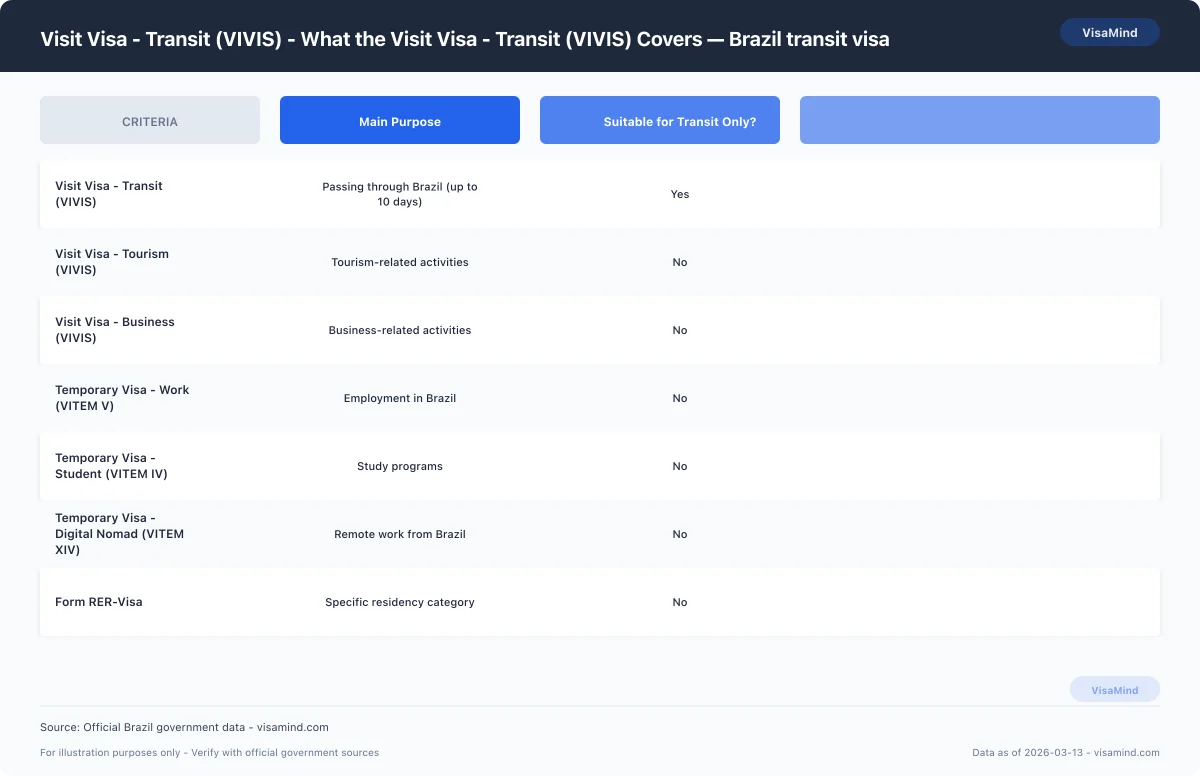
Here’s how it compares to other Brazilian visa types:
| Visa Type | Main Purpose | Suitable for Transit Only? |
|---|---|---|
| Visit Visa - Transit (VIVIS) | Passing through Brazil (duration depends on consular post) | Yes |
| Visit Visa - Tourism (VIVIS) | Tourism-related activities | No |
| Visit Visa - Business (VIVIS) | Business-related activities | No |
| Temporary Visa - Work (VITEM V) | Employment in Brazil | No |
| Temporary Visa - Student (VITEM IV) | Study programs | No |
| Temporary Visa - Digital Nomad (VITEM XIV) | Remote work from Brazil | No |
| Form RER-Visa | Specific residency category | No |
If you need to stay in Brazil for another reason or for longer, you’ll need to apply for the correct visa.
For current fees in BRL (R$) and application procedures, refer to the Brazilian consulate for your jurisdiction.
Who this stopover is for
You should apply for the Visit Visa - Transit (VIVIS) if your situation matches these criteria:
- You’re traveling to a final destination outside Brazil.
- Brazil is just a stopover on your journey.
- Your intended stay in Brazil is strictly for transit purposes, with the authorized duration depending on the consular post where you apply.
This visa is for travelers who need to enter Brazilian territory briefly before heading to another country. It isn’t convertible to tourism or business.
Do not use this visa if you plan to:
- Work in Brazil.
- Enroll in a study program.
- Conduct business activities.
- Stay in Brazil beyond the duration authorized by the consular post.
In those cases, you need the appropriate visa—such as the Visit Visa - Tourism (VIVIS), Visit Visa - Business (VIVIS), or a Temporary Visa (VITEM).
Confirm eligibility with the Brazilian consulate before travel to avoid issues at the border.
How to Apply
#Apply for a Brazil transit visa by completing the VIVIS–Transit form, submitting it to the Brazilian consulate, and paying the required fee. Processing times and fees vary by nationality and location, so confirm details with the issuing authority before filing.
Download the form and instructions
Get the current VIVIS–Transit application form and instructions from the Federal Police (Polícia Federal – PF). Visas are issued by consulates abroad, while PF manages immigration inside Brazil.
Before starting, make sure the transit visa fits your travel purpose. Compare your situation:
| Visa Type | Purpose |
|---|---|
| Visit Visa – VIVIS | Transit through Brazilian territory |
| Visit Visa – Business (VIVIS) | Business meetings and activities |
| Transit (VIVIS–Transit) | Passing through Brazil en route to another country |
| Temporary Visa – Work (VITEM V) | Employment in Brazil |
| Temporary Visa – Student (VITEM IV) | Study programs |
| Temporary Visa – Digital Nomad (VITEM XIV) | Remote work for foreign employer |
| Form RER-Visa | Specific residency-related category |
Read the eligibility rules for your nationality in the instructions. If you’ll leave the international transit area or stay longer than allowed, you may need a different visa.
Complete, sign and submit
Fill out every required field on the VIVIS–Transit form exactly as shown in your passport. Inconsistent names, passport numbers, or dates can delay processing.
Prepare the supporting documents listed in the instructions. At minimum, you’ll need:
- A valid passport
- Proof of onward travel
- Any additional documents required for your nationality
Sign the form. Unsigned applications won’t be processed.
Submit your application to the Brazilian consulate for your jurisdiction. Processing times vary, so check local procedures before booking appointments or sending documents.
If your travel purpose changes—say, to employment, study, or remote work—you’ll need to apply under the correct category (VITEM V, VITEM IV, or VITEM XIV) instead of a transit visa.
Fees and processing times
Transit visa processing generally takes 3–5 business days as of March 2026. Actual times may differ by consulate and nationality, so verify current timelines before booking travel.
| Item | Details |
|---|---|
| Standard Processing Time | 3–5 business days |
| Issuing Authority (Abroad) | Brazilian consulate |
| Immigration Authority (Inside Brazil) | Federal Police (PF) |
Visa fees depend on nationality and reciprocity agreements. Some nationalities pay a standard VIVIS fee; others, such as U.S. citizens, may pay higher reciprocity-based fees.
Fees are set in BRL (R$) and can change. Check the consulate fee schedule for your location before paying.
Official sources: https://www.gov.br/pt-br/servicos/obter-visto-para-viajar-ao-brasil
What Happens at Arrival — VIVIS transit
#On arrival, you’ll present your passport and visa to the Federal Police (Polícia Federal – PF) at the border. The officer verifies your visa category and checks that you meet the conditions for a Visit Visa – Transit (VIVIS).
Entry isn’t guaranteed. You must show documents that match the purpose and duration of your stop in Brazil.
Documents to carry to the border
Carry original documents in your hand luggage. The PF officer may request them during inspection.
Essential documents:
- Valid passport or travel document
- Visit Visa – VIVIS stamped in your passport
- Completed visa application confirmation
- Proof of payment of consular fees (in BRL – R$)
- International Certificate of Immunization, if required
Keep documents organized and accessible. Damaged, expired, or inconsistent documents can cause delays.
If you previously applied for another visa category, the visa in your passport must match your actual travel purpose. A VIVIS doesn’t authorize activities allowed under VITEM categories.
The PF checks that your visa was issued by a Brazilian consulate abroad and remains valid on entry.
| Document | What PF Checks |
|---|---|
| Passport | Validity and identity details |
| VIVIS visa | Category and validity |
| Fee receipt (R$) | Confirmation of consular processing |
| Immunization certificate | Compliance with health requirements |
Immigration questions to expect
The PF officer may ask about your transit. Answer clearly and ensure your responses match your visa type.
Expect questions like:
-
What’s the purpose of your stop in Brazil?
-
How long will you stay?
-
Where are you headed next?
Your answers must fit a transit purpose under the Visit Visa (VIVIS). Don’t describe work, study, or long-term plans unless you hold the appropriate visa.
The officer may confirm you understand the visa limits. A VIVIS for transit doesn’t convert into another category inside Brazil.
Remain factual and concise. The PF is interested in document validity, visa category, and consistency between your stated purpose and your visa.
Official sources: https://www.gov.br/pt-br/servicos/obter-visto-para-viajar-ao-brasil
Who Qualifies
#You qualify for a Brazil transit visa only if you hold the correct passport type and your visa category matches your travel purpose. You must apply through a Brazilian consulate before traveling.
Eligible passport types
The Visit Visa – Transit (VIVIS) applies to travelers with an ordinary passport needing to pass through Brazil on their way elsewhere.
It isn’t for tourism, business, work, study, remote work, or residency. Those require separate visas.
| Travel Purpose | Correct Visa Category | Transit Visa Eligible? |
|---|---|---|
| Airport transit only | Visit Visa – Transit (VIVIS) | Yes, if holding an ordinary passport |
| Transit | Visit Visa – VIVIS | No |
| Business meetings | Visit Visa – Business (VIVIS) | No |
| Employment | Temporary Visa – Work (VITEM V) | No |
| Academic study | Temporary Visa – Student (VITEM IV) | No |
| Remote work | Temporary Visa – Digital Nomad (VITEM XIV) | No |
| Regional/other residence status | Form RER-Visa | No |
If you want to enter Brazil for anything beyond transit, you need the correct visa. After arrival, the Federal Police (Polícia Federal – PF) oversees immigration inside Brazil.
Check eligibility before applying
Before applying, make sure your situation fits the transit category exactly. Consulates issue visas abroad and will refuse an application under the wrong purpose.
You qualify if:
- You hold an ordinary passport
- You are only transiting through Brazil
- You don’t plan to work, study, conduct business, or reside in Brazil
If your plans change, apply for the appropriate visa—such as Temporary Visa – Work (VITEM V) or Temporary Visa – Student (VITEM IV)—before travel.
A transit visa doesn’t allow other activities. A transit-purpose VIVIS does not convert into any temporary residence category.
If you’re unsure which visa applies, review the guidance from the Brazilian consulate responsible for your residence before applying.
How Long It Lasts
#The Brazil Visit Visa – Transit (VIVIS) is for short stays with strict time limits. You need to track both the length of each visit and your total time in Brazil within a year.
Maximum stay per visit
You may remain in Brazil for up to 90 days per visit under a transit VIVIS.
This limit applies each time you enter Brazil with this visa. Once you reach 90 days, you must leave.
The Federal Police (Polícia Federal – PF) monitors your stay. Overstaying risks penalties and future immigration problems.
| Visa Type | Maximum Stay Per Visit | Notes |
|---|---|---|
| Visit Visa – Transit (VIVIS) | 90 days | Applies to each entry |
Other visa categories, like Visit Visa – Transit (VIVIS), Visit Visa – Business (VIVIS), Temporary Visa – Work (VITEM V), Temporary Visa – Student (VITEM IV), Temporary Visa – Digital Nomad (VITEM XIV), or the Form RER-Visa, follow different rules.
Annual limits and transit context
In addition to the 90-day per-visit limit, you may stay no more than 180 days total within one year under the transit VIVIS.
You can divide your time across multiple entries, but your combined stays can’t exceed 180 days in a 12-month period.
| Rule | Time Allowed |
|---|---|
| Per visit | 90 days |
| Per year (total) | 180 days |
If your transit plans require a longer stay, another visa category—such as a VITEM or RER-Visa—may be more appropriate.
Brazilian consulates issue the visa abroad, and the PF oversees your stay once you’re in Brazil. You’re responsible for tracking your accumulated days.
Official sources: https://www.gov.br/pt-br/servicos/obter-visto-para-viajar-ao-brasil
Why You Might Be Turned Away
#A Brazil transit visa application can be refused even when you submit all the required forms. Approval is discretionary, and both Brazilian consulates abroad and the Federal Police (Polícia Federal – PF) inside Brazil have the power to deny entry if your status doesn’t match your stated purpose.
No guarantee of approval
Holding a Visit Visa (VIVIS) for transit purposes never secures entry; admission depends on meeting the conditions established by law at the border. A consulate can refuse your application if your stated purpose doesn’t clearly line up with a short airport transit.
You have to show that your stay fits the legal definition of a transit situation. If your itinerary suggests activities that fall under a different category—such as Visit Visa – Business (VIVIS), Temporary Visa – Work (VITEM V), Temporary Visa – Student (VITEM IV), Temporary Visa – Digital Nomad (VITEM XIV), or Form RER-Visa—the officer might deny the transit request.
Some common risk factors:
- Applying under the wrong visa category
- Providing inconsistent travel details
- Failing to show onward travel
Even if you get a visa, the PF has authority at the port of entry to check that your purpose matches the visa type.
| Authority | Role in Decision |
|---|---|
| Brazilian Consulate | Issues or refuses the visa abroad |
| Federal Police (PF) | Confirms compliance and may deny entry at arrival |
If a consulate refuses your transit visa, you won’t get authorization to board for Brazil using that visa category. Airlines usually require proof of valid authorization before you depart.
If the PF finds at arrival that you intend to work, study, or stay longer than allowed under a transit visa, they can deny entry. You could be sent back to your point of departure.
A mismatch between your documents and your real plans often leads to problems. For example:
- Holding a transit-type VIVIS but carrying business meeting materials
- Indicating remote work activities without a VITEM XIV (Digital Nomad)
- Arriving with documents that suggest study or employment
Your visa type must match your true purpose. Transit authorization doesn’t become permission for tourism, business, work, or study after arrival.
Fees
#| Component | Amount |
|---|---|
| Application fee (most nationalities)VIVIS fee from consular fee schedule; reciprocity exceptions apply | $80 |
| Application fee (US citizens)Reciprocity-based VIVIS fee listed by the Los Angeles consulate fee schedule | $250 |
Fees change; always verify on PF.