
What the International Experience Canada (IEC) Covers
#
IEC is for eligible young people from partner countries to work and travel in Canada through a few defined categories. IRCC manages the program and issues either an Open Work Permit or an Employer-Specific Work Permit, based on which category you choose.
Program types and purpose
IEC operates under three main categories. Each one focuses on cultural exchange and professional growth.
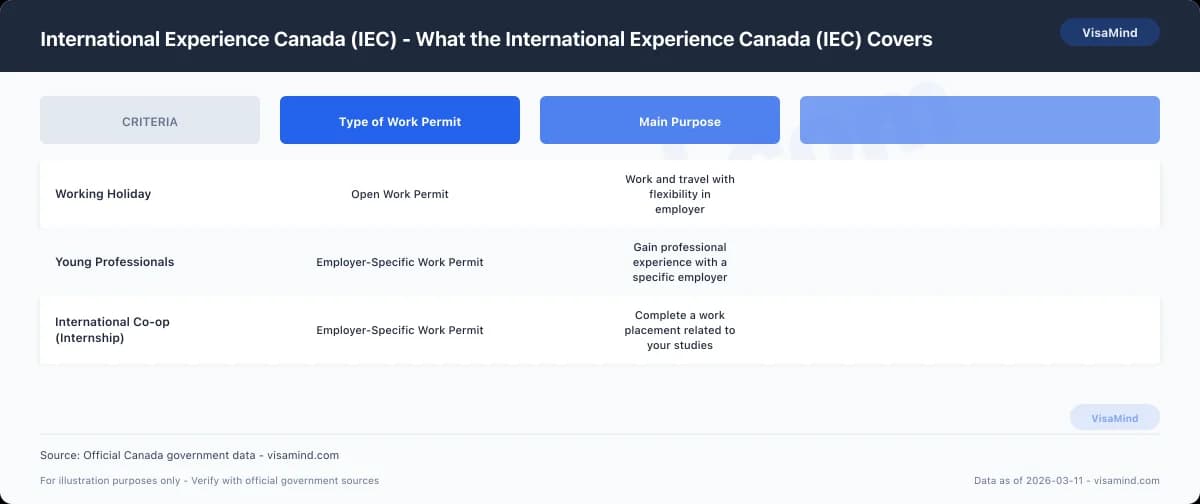
| Category | Type of Work Permit | Main Purpose |
|---|---|---|
| Working Holiday | Open Work Permit | Work and travel with flexibility in employer |
| Young Professionals | Employer-Specific Work Permit | Gain professional experience with a specific employer |
| International Co-op (Internship) | Employer-Specific Work Permit | Complete a work placement related to your studies |
A Working Holiday participant gets an Open Work Permit, allowing you to work for most employers in Canada.
The Young Professionals and International Co-op (Internship) categories require a job offer and lead to an Employer-Specific Work Permit.
You apply through IRCC and submit required forms, including Form IMM 1295, as part of your work permit application. IEC applications aren't guaranteed approval.
The processing time usually ranges from 2 to 5 months as of March 2026, depending on your country and the application pool.
IEC is not the same as the Post-Graduation Work Permit (PGWP). The PGWP is for graduates of eligible Canadian institutions, while IEC is based on youth mobility agreements.
Who the program serves
You can participate only if your country or territory has a youth mobility agreement (YMA) with Canada.
Eligibility depends on your country of citizenship, the specific IEC category, and meeting admissibility requirements.
IRCC reviews your application. The Canada Border Services Agency (CBSA) determines admissibility at the border. Both you and any accompanying family members must pass background checks.
The processing times differ by country and pool.
Scenario: Working Holiday applicant seeking flexibility
Lena, a citizen of a partner country, wanted to travel across Canada while working part-time. She applied through the Working Holiday category and submitted IMM 1295 to IRCC.
After approval, she received an Open Work Permit, which let her change employers during her stay.
Scenario: Young professional with a job offer
Mateo secured a job offer from a Canadian company in his field. He applied under the Young Professionals category and requested an Employer-Specific Work Permit through IRCC.
After processing within the posted 2–5 month range, he entered Canada to work for the named employer.
How to Apply (IEC work permit)
#Applying for International Experience Canada (IEC) happens in stages. First, you create a profile to receive an invitation. After that, you submit a complete work permit application to IRCC and provide biometrics if instructed.
Create your profile and get an invitation
You need to create an online IEC profile to be considered for a work permit. Only eligible candidates enter the pool and wait for an invitation.
You can't submit a work permit application until you receive an invitation from IRCC.
Key steps:
-
Make sure you meet the eligibility requirements for your IEC category.
-
Create and submit your IEC profile.
-
Wait for an invitation to apply.
IEC work permits are typically open, but some categories result in an employer-specific permit. This process is separate from the Post-Graduation Work Permit (PGWP).
| Stage | What You Do | Who Reviews It |
|---|---|---|
| Profile creation | Submit IEC profile | IRCC |
| Invitation | Accept invitation to apply | IRCC issues invitation |
| Application stage | Submit full work permit application | IRCC |
If IRCC invites you to apply, you must act within the deadline shown in your account.
Complete and submit the form and application
Once you accept your invitation, you need to submit a work permit application to IRCC. Most applicants complete Application for Work Permit Made Outside of Canada (Form IMM 1295).
Each applicant fills out their own form.
If you complete IMM 1295 on a computer, you must validate it electronically. Validation creates a barcode page, which you include with your application. If you apply on paper and you're 18 or older, sign the form. A parent or legal guardian signs for applicants under 18.
Prepare all required supporting documents before submission.
Checklist:
- Completed and validated IMM 1295
- Barcode page (if completed electronically)
- All supporting documents requested by IRCC
- Required signatures
Submit your complete application package as instructed in your IRCC account.
Biometrics and submission details
Many IEC applicants must provide biometrics—fingerprints and a digital photo.
Check your IRCC account to confirm if you need to give biometrics.
If required:
- Gather any biometric instruction documents from IRCC
- Attend a biometric collection appointment
- Provide fingerprints and a digital photo
Submit your work permit application only after you've completed all required forms and collected the necessary documents. Incomplete applications can delay processing or lead to refusal.
IRCC processes your application. The Canada Border Services Agency (CBSA) assesses admissibility when you arrive in Canada.
Know When to Get Help
#IEC applications move quickly, and small mistakes can cause delays or refusals. If your situation doesn't fit a standard online application or you're pressed for time, consider getting help.
When to use a Recognized Organization (RO)
A Recognized Organization (RO) can help you plan your IEC participation and prepare documents. This support is useful if you're unfamiliar with IRCC document standards or need help gathering paperwork before deadlines.
You remain responsible for your application, including forms like Form IMM 1295 and uploading documents through your IRCC account. An RO doesn't replace IRCC or approve your work permit.
Use an RO if you:
- Need structured guidance before submitting your IEC profile
- Require help organizing supporting documents
- Want assistance preparing for arrival in Canada
You must still:
-
Submit your own application to IRCC
-
Provide biometrics if instructed
-
Review IRCC instructions carefully
Expert tip:
Follow IRCC document checklists exactly. Missing documents can lead to requests for more information or refusals.
| Situation | Consider an RO? |
|---|---|
| First IEC participation | Yes, if you need planning support |
| Confident with IRCC online forms | Usually not necessary |
| Tight document deadline | Yes, if you need help organizing quickly |
Complex cases and extra time
Professional guidance is valuable when your case involves unusual selections or travel issues.
Examples include:
- Applying to work for a foreign mission or international organization recognized under the Foreign Missions and International Organizations Act (select "Other")
- Applying for a Post-Graduation Work Permit (PGWP) after graduating from a Canadian institution
- Submitting an application with a refugee travel document
If you don't meet entry requirements after receiving your port of entry letter of introduction, you must leave Canada and re-enter from a country other than the United States or Saint-Pierre-et-Miquelon to activate your work permit.
Complex category selection can affect whether you receive an Open Work Permit or an Employer-Specific Work Permit. Incorrect choices may lead to delays or new applications.
When IRCC requests additional documents or grants extra time, respond fully and within the deadline.
Extending or Transitioning
#You can't extend most IEC work permits beyond the approved validity. To stay in Canada, you must qualify for a new status and apply through IRCC before your current status expires.
Common next steps after IEC
Many IEC participants move to a different Work Permit (Employer-Specific) or apply for an Open Work Permit if eligible under another program.
You may also transition to a Post-Graduation Work Permit (PGWP) if you finish an eligible Canadian study program and meet PGWP requirements set by IRCC.
Common options:
- Applying for an employer-specific work permit with a valid job offer
- Applying for an open work permit under a separate public policy or program
- Changing your status to student before applying for a PGWP
- Applying for permanent residence if you meet eligibility criteria
You must submit the correct application form, such as Form IMM 1295 (Application for Work Permit Made Outside Canada) when required by IRCC.
| Pathway | Requires Job Offer | Employer Restricted | New IRCC Application Required |
|---|---|---|---|
| Employer-Specific Work Permit | Yes | Yes | Yes |
| Open Work Permit | Not always | No | Yes |
| Post-Graduation Work Permit (PGWP) | No (based on study) | No | Yes |
Category-specific transition requirements
Your transition options depend on the IEC category you used—Working Holiday, Young Professionals, or International Co-op (Internship).
If you held a Working Holiday open work permit, you must qualify independently for any new work permit. IRCC doesn't automatically extend open work authorization.
If you participated in Young Professionals or International Co-op, your permit was employer-specific. To keep working, you must apply for a new Employer-Specific Work Permit supported by the required documentation.
Check before applying:
- Your current status expiry date
- Whether you need to restore status
- Whether your new permit requires a job offer
- Which IRCC form applies (such as IMM 1295)
- Current IRCC processing instructions and fees
IRCC assesses eligibility and issues permits. The Canada Border Services Agency (CBSA) determines admissibility at the port of entry if you travel.
Who Can Apply
#You can apply only if you meet both country-based rules and category-specific requirements set by IRCC. Your citizenship, chosen work category, and supporting documents determine eligibility.
Country and agreement requirements
Your country or territory of citizenship must have a youth mobility agreement with Canada. IEC accepts applicants only from partner countries.
If your country doesn't have an agreement, IRCC won't approve your application.
You're not eligible if you hold a refugee travel document, regardless of the country that issued it. IEC participation requires a valid passport from an eligible partner country.
| Requirement | What You Must Have |
|---|---|
| Citizenship | Passport from an IEC partner country |
| Agreement | Active youth mobility agreement with Canada |
| Travel document | Cannot apply with a refugee travel document |
IRCC assesses eligibility based strictly on citizenship and agreement status. Border admissibility decisions are made separately by CBSA when you enter Canada.
Category- and document-based eligibility
IEC includes different work categories. Your eligibility depends on the specific category and the documents you provide.
Some categories lead to an Open Work Permit, allowing you to work for most employers. Others result in an employer-specific Work Permit, limiting you to one employer.
You must submit complete and accurate forms, including Form IMM 1295, and provide personal details such as:
- Telephone number and email
- Employment history
- Financial details
- Medical information, if required
- Background and admissibility information
Certain categories may require proof of your post-secondary diploma, certificate, or degree.
IEC is separate from the Post-Graduation Work Permit (PGWP). Eligibility for one doesn't make you eligible for the other.
| Category Type | Work Authorization | Key Documents |
|---|---|---|
| Open category | Open Work Permit | IMM 1295, personal and background details |
| Employer-specific category | Work Permit (Employer-Specific) | IMM 1295, employer details, supporting documents |
IRCC reviews your documents to confirm that you meet both the category rules and Canada’s admissibility standards.
Second Year and Beyond
#You may qualify to participate in IEC more than once, but eligibility depends on your country and category. You must meet IRCC rules again and complete a new application process.
Eligibility for additional participation
Not every country allows repeat participation. Some countries permit only one participation, while others allow two participations in different categories.
Your eligibility to apply again depends on your country of citizenship, the IEC category you used before, and whether your country’s agreement allows multiple participations.
| Scenario | Can You Apply Again? |
|---|---|
| Country allows one participation only | No second application |
| Country allows two participations in different categories | Yes, if you choose a different category |
You’ll need to create a new IEC profile and wait for a new invitation before submitting another application to IRCC.
If approved, you get a new letter of introduction (LOI) from IRCC. You can’t use a previous LOI again.
Depending on your category, you may receive an Open Work Permit or a Work Permit (Employer-Specific). IEC participation is separate from a Post-Graduation Work Permit (PGWP); the rules are different.
Processing usually takes about 2 weeks after you’ve submitted all required documents and completed biometrics.
Prepare for entry and activation
To enter Canada, you need a valid letter of introduction (LOI) from IRCC. At the border, Canada Border Services Agency (CBSA) officers check your admissibility and issue your work permit.
Before you travel, follow these steps:
-
Create your IEC profile.
-
Submit your application if invited.
-
Provide biometrics.
-
Wait for IRCC to issue your LOI.
Seven Recognized Organizations (ROs) may help with travel planning and preparation. However, IRCC still decides on your application.
Bring your LOI with you when you travel. CBSA will issue your Open Work Permit or Employer-Specific Work Permit at entry if you meet the requirements.
Fees and Processing Times
#You pay specific government fees when applying for International Experience Canada through IRCC. Processing times depend on your category and where you apply from.
Application and biometrics fees
Most applicants pay the standard work permit fee of CA$155 per person. This applies to work permit extensions, including Open Work Permits and Employer-Specific Work Permits.
If you use Form IMM 1295, the filing fee is CA$
- Most applicants also pay a biometrics services fee of CA$85 per person.
| Fee Type | Amount (CAD) | Notes |
|---|---|---|
| Work permit (including extensions) | CA$155 | Per person |
| IMM 1295 filing fee | CA$155 | Per application |
| Biometrics services fee | CA$85 | Per person |
You might qualify for a maximum family fee of CA$500 if all family members apply together and your children meet the definition of dependants.
There’s a separate group fee for three or more performing artists and their staff applying together. Check current fee details with IRCC before you submit your application.
How processing times are calculated
IRCC starts counting your processing time from the day it receives your complete application. The clock stops when IRCC makes a decision.
The published processing time reflects the month and year you applied, the estimated time for routine cases, and any additional time for non-routine files.
If you’re applying from outside Canada and the United States, add 3 to 4 months for mailing.
The processing times for International Experience Canada vary by category and location. Your timeline may increase if application volumes exceed the number of people Canada can admit that year.
Work Limits and Travel Freedom
#Your right to work in Canada under International Experience Canada depends on the type of work permit you receive and the conditions on it. You must also meet strict identity, medical, and background requirements before IRCC approves your application.
Work and employer requirements
IRCC issues either an Open Work Permit or a Work Permit (Employer-Specific) under International Experience Canada.
| Permit Type | What It Means for You | Employer Details Required |
|---|---|---|
| Open Work Permit | You can work for most employers in Canada. | No single employer tied to your permit. |
| Work Permit (Employer-Specific) | You can work only for the employer listed on your permit. | Full employer name, address, and contract details required. |
If your permit is employer-specific, you must provide the complete legal name and address of your Canadian employer, detailed job information, and an original employment contract if a Labour Market Impact Assessment is required.
List your employment history for the past 10 years, including all positions and gaps.
Submit your work permit application using Form IMM 1295 through IRCC. The conditions on your permit control where and for whom you can work. If you later qualify for a Post-Graduation Work Permit (PGWP), different rules apply.
Health, identity and background requirements
IRCC requires biometric data for work permit applications.
You must provide fingerprints and a digital photograph.
A valid medical examination may also be needed. If your family applies with you, each person’s medical results must be valid at the same time.
IRCC reviews your health history, criminal and legal background, and past immigration compliance.
Answer all background questions completely and accurately.
If your marital status has changed or custody arrangements apply to your child, submit official legal documents confirming those changes. Incomplete or inconsistent information can delay processing or result in refusal.
Common Rejection Reasons
#IRCC refuses many International Experience Canada applications because of avoidable mistakes. Most refusals involve missing documents, incomplete forms, or not meeting specific program requirements.
Frequent application mistakes
You must meet your country’s specific eligibility rules under International Experience Canada. If you apply without confirming those requirements, IRCC will refuse your file.
Many applicants submit Form IMM 1295 with missing fields, no signature, or no date. Completing the form by hand means the system can’t validate it electronically, which can delay or invalidate your submission.
Incomplete employment history for the past 10 years is another frequent issue. IRCC expects a full record, including gaps, short-term jobs, or unemployment.
Biometrics are a common pitfall. You must provide complete and correct biometric information when required.
If you apply for a Work Permit (Employer-Specific), include your employment contract if instructions require it. Missing this document leads to refusal. Open Work Permits don’t require an employer contract. Don’t confuse IEC with a Post-Graduation Work Permit (PGWP); they have separate criteria.
| Common Error | Result |
|---|---|
| Missing signature on IMM 1295 | Application returned or refused |
| Incomplete 10-year work history | Processing delay or refusal |
| No required employment contract | Refusal for Employer-Specific permit |
| Incorrect or missing biometrics | Processing stopped |
How to avoid common pitfalls
You can prevent most refusals by reviewing every field and document before submission. Don’t rely on memory—check each entry against your records.
Follow this checklist:
- Confirm your country-specific IEC eligibility before applying
- Complete IMM 1295 electronically and validate it
- Sign and date all required forms
- Provide a full 10-year employment history
- Upload your employment contract if applying for a Work Permit (Employer-Specific)
- Submit complete biometric information when instructed
Keep your answers consistent across forms and documents. Inconsistent information triggers delays while IRCC checks your file.
Read the official instructions from Immigration, Refugees and Citizenship Canada (IRCC) line by line. Small omissions can result in refusal, even if you otherwise qualify for an Open Work Permit under International Experience Canada.
Plan a working holiday Canada trip
#Confirm your identity, family details, and permit category early. Prepare your documents carefully and bring your Letter of Introduction (LOI) when you travel.
Before you go: contact and identity details
You must keep your personal information accurate with Immigration, Refugees and Citizenship Canada (IRCC) throughout your International Experience Canada application.
Review and update your full legal name, date of birth, passport details, and addresses (including any PO Box). Also check your email, phone number, marital status, and information about family members and dependants.
If your marital status changed after you applied, submit proof like your marriage certificate. Report new dependants right away.
When completing Application for a Work Permit Made Outside of Canada (Form IMM 1295), make sure every field matches your passport and supporting documents. Inconsistent details can delay your file.
Confirm which permit category you received. International Experience Canada participants may get an Open Work Permit or a Work Permit (Employer-Specific). These are different from a Post-Graduation Work Permit (PGWP).
| Item to Verify | Why It Matters |
|---|---|
| Passport details | Must match IMM 1295 and your LOI |
| Contact information | IRCC uses it to communicate decisions |
| Family/dependants | Affects eligibility and documentation |
| Marital status updates | Requires supporting evidence |
Submit all requested documents before any stated deadline.
Arrival preparation and LOI
IRCC issues a Letter of Introduction (LOI) if your work permit application is approved. This letter confirms approval but isn’t the work permit itself.
Before you travel, print your LOI, carry the passport used in your application, and bring copies of supporting documents submitted to IRCC. Also keep proof of any updated marital or family information.
At the port of entry, border officials determine admissibility. They review your documents and issue your work permit if you meet the conditions.
Check that the permit matches your category:
- Open Work Permit – not tied to one employer.
- Work Permit (Employer-Specific) – lists your approved employer.
If permit details are incorrect, ask for clarification before leaving the inspection area.
Gather required documents and forms
#You must submit complete, accurate documents to avoid delays with Immigration, Refugees and Citizenship Canada (IRCC). Your application must include identity details, required forms, and any information related to admissibility or security concerns.
Identity, biographic and family documents
Provide clear biographical and identity details in your International Experience Canada profile and work permit application. This means your full legal name, date of birth, and nationality, exactly as shown on your passport.
Prepare the following:
- Valid passport (biographic page with photo)
- Recent photographic evidence that meets IRCC specifications
- Details about your family members
- Information addressing any security or criminal admissibility issues
If IRCC requests a work permit application form like Form IMM 1295, complete it fully and make sure all answers match your supporting documents. Errors or missing information often delay processing.
Your documents must reflect the correct permit type.
| Permit Type | Document Focus |
|---|---|
| Open Work Permit | No employer-specific details required |
| Work Permit (Employer-Specific) | Employer information must match your offer |
| Post-Graduation Work Permit (PGWP) | Must reflect your education history accurately |
Submit your complete application through the appropriate Canadian embassy, high commission, or consulate when instructed. IRCC won’t start processing until it receives a complete application package.
Processing-time notes and special cases
IRCC calculates processing times from the day it receives your complete application. The clock stops when a final decision is made.
The processing times are an estimate of how long IRCC expects to finalize an application received today. If you apply for permanent residence later, the estimate reflects the month and year you submitted that application.
Incomplete applications delay processing. Processing times can change without notice. Some regions don’t have reliable estimates due to changing conditions.
For example, IRCC cannot currently provide accurate timelines for some applicants affected by conditions in Afghanistan and nearby countries.
If you apply for a minor (under 18) who lives outside Canada and the United States, confirm the specific processing stream before submission.
Fees
#| Component | Amount |
|---|---|
| Filing fee (IMM-1295)Work permit (outside Canada). | CA$155 (approx $113 USD) |
| BiometricsBiometrics: CA$85 (approx $62 USD) (as of 2026-02). Verify the current fee on the official schedule before filing. | CA$85 (approx $62 USD) |
Fees change; always verify on IRCC.
Required forms
#Plan your International Experience Canada (IEC) with free Canada tools
#Itemized government fees for International Experience Canada (IEC) and other Canada categories.
See how your profile scores against International Experience Canada (IEC) and other Canada visas.
Typical wait times and stage breakdowns for International Experience Canada (IEC) and related Canada visas.
Common interview questions and feedback for Canada visa applicants.