
Overview — Canada work permit
#A Canada work permit lets you take temporary employment in Canada, but you need authorization from IRCC. Approval isn’t automatic.
The processing times usually fall between 2 to 5 months, depending on where you apply.
What this permit is
A Canada work permit is official authorization to work in Canada for a limited period. You apply through Immigration, Refugees and Citizenship Canada (IRCC), submitting the required forms and supporting documents.
If you’re outside Canada, you generally file Form IMM 1295 for temporary employment authorization. Submitting the form doesn’t guarantee approval.
Work permits come in a few main categories:
Each category has different criteria and documentation. Review the specific instructions that fit your situation before you file.
The processing times are usually 2–5 months, and the country you apply from matters.
| Key Element | What You Should Know |
|---|---|
| Authority | Immigration, Refugees and Citizenship Canada (IRCC) |
| Main Form (outside Canada) | IMM 1295 |
| Processing Time | 2–5 months (country-dependent) |
| Approval Guarantee | No |
Who uses it
You’ll need a Canada work permit if you want to work in Canada temporarily and you’re applying from abroad. This applies whether you’re seeking an LMIA-Based Work Permit for a specific employer or an Open Work Permit for more flexibility.
Many temporary foreign workers later look into permanent residence pathways, such as:
A work permit by itself doesn’t grant permanent residence. Canadian work experience, though, may become relevant if you later apply under Express Entry.
You must apply before starting any job. Working without authorization can affect future immigration applications.
Key cautions
Submitting a work permit application doesn’t guarantee approval. IRCC reviews each case individually, looking closely at your documents and eligibility.
You must:
- Complete IMM 1295 accurately if you’re applying from outside Canada
- Submit all required supporting documents
- Monitor current processing times through IRCC
Processing can take 2–5 months, depending on your country. Avoid making non-refundable commitments until you receive a decision.
For current fees in CAD (CA$) and detailed requirements, refer to IRCC’s published information before you apply.
Choose the Right Work Permit Type
#Canada has two broad work-permit structures. Choosing the wrong one can lead to missing employer documents or applying under a category for which you are not eligible.
Employer-specific work permits
An employer-specific permit limits you to the employer, occupation, and location printed on the permit. Before you apply, the employer normally needs either:
- A positive Labour Market Impact Assessment (LMIA), or
- An LMIA-exempt offer of employment number submitted through the Employer Portal
The worker then submits the personal work-permit application and evidence matching the employer-side record. Review the LMIA-Based Work Permit and LMIA vs IMP guide to identify the correct process.
Open work permits
An Open Work Permit is not tied to one employer, but it is only available under specific eligibility categories—for example, certain spouses or partners, graduates, bridging applicants, or vulnerable workers. You cannot choose an open permit simply because you prefer flexibility.
| Permit structure | Job offer | Employer-side step | Work conditions |
|---|---|---|---|
| Employer-specific | Usually required | LMIA or LMIA-exempt offer, depending on category | Named employer and approved conditions |
| Open | Depends on eligibility category | Usually no employer-specific submission | Broad employment authorization, subject to restrictions |
Applying from India
Applicants in India use IRCC's online process and must follow the document checklist generated for their answers. Depending on the case, this can include biometrics through a Visa Application Centre, proof of legal status, employment documents, qualifications, and evidence supporting temporary intent. Processing times vary by permit category and application location; use IRCC's live processing-time tool rather than relying on a fixed estimate.
A consultant or lawyer cannot replace missing eligibility. Confirm the permit category first, then make sure the employer and worker documents describe the same job, wage, location, and exemption or LMIA basis.
When to Get Professional Help
#Certain errors cause immediate processing delays or refusals by IRCC. Legal guidance is especially useful if your case involves multiple permits or future permanent residence plans such as the Canadian Experience Class (CEC) or Express Entry (Federal Skilled Worker).
Common technical errors
Many refusals stem from avoidable mistakes with forms and documents. IRCC systems reject incomplete or improperly validated applications.
Pay close attention to Form IMM 1295 and related documents. Some common problems:
- Not validating the form on a computer, so barcode pages don’t generate
- Entering initials instead of your full legal name as shown on your passport
- Omitting a marriage certificate if you declare you’re married
- Not providing proof of legal status in your country of residence when applying outside your citizenship country
- Leaving out a written explanation if you rely on a passport validity extension
Here’s how small errors can escalate:
| Error | Likely Consequence |
|---|---|
| No barcode after validation | Application returned or delayed |
| Name does not match passport | Identity concerns and processing delays |
| Missing civil documents | Incomplete application refusal |
| No proof of legal status abroad | Application refusal |
| No explanation for passport extension | Concerns about document validity |
A lawyer reviews your file line by line before you submit and can spot these issues early.
Situations that benefit from a lawyer
Legal help is especially valuable when your work permit strategy connects to long-term immigration plans or involves complex eligibility.
For example, you may need guidance if:
- You apply for an LMIA-Based Work Permit and need to align employer documents with your personal application
- You’re not sure if you qualify for an Open Work Permit under your circumstances
- You plan to use Canadian work experience later under the Canadian Experience Class (CEC)
- You want to transition to permanent residence through Express Entry (Federal Skilled Worker)
A lawyer can help you:
-
Match your work permit type to your future permanent residence goals
-
Keep your IRCC applications consistent
-
Spot risks before you file
Strategic errors can affect more than one application. If you’re planning beyond a single permit, professional advice lowers your long-term risk.
Changing Employers
#You can’t freely move between employers unless your work permit allows it. The permit type and job details listed on your application decide what you can change and when you need to notify IRCC.
Employer information on the form
If you’re applying under an LMIA-Based Work Permit, your application must clearly identify your intended employer. You provide this on Form IMM 1295, including the employer’s name and other details.
To change employers under an employer-specific permit, you must submit a new application to IRCC before starting the new job. You can’t rely on your existing approval if it names a different employer.
An Open Work Permit doesn’t tie you to one employer, so you usually don’t need to update IRCC when you change jobs.
| Work Permit Type | Employer Listed on IMM 1295 | New Application Required to Change Employers |
|---|---|---|
| LMIA-Based Work Permit | Yes | Yes |
| Open Work Permit | No specific employer | Usually No |
Always double-check what’s on your approval documents. IRCC issues your permit based on the employer information you provide.
Implications of job details
The job details you submit—position, employer—define your authorization to work in Canada. If you have an employer-specific permit, you must stick to the conditions IRCC approved.
Changing employers without proper authorization can impact future immigration plans. This includes applications through Express Entry (Federal Skilled Worker) or the Canadian Experience Class (CEC), where accurate work history and authorized employment are important.
Before switching jobs, confirm:
- Your work permit type
- The employer listed on your permit
- Whether a new application through IRCC is required
If you need to change employers under an employer-specific permit, file a new work permit application and wait for approval before starting the new job. IRCC reviews your eligibility based on the updated employment details you provide.
How to Renew
#Apply before the expiry date printed on your permit. An extension is still a work-permit application: IRCC reassesses your eligibility and the conditions you request.
Which application do you use?
People applying from inside Canada to extend a stay or change work-permit conditions generally complete IRCC's online process associated with Form IMM 5710. IMM 1295 is for applications made outside Canada and is not the standard extension form.
If IRCC receives an eligible extension application before your current permit expires, you may have maintained status while it is processed. You must continue to follow the existing permit's conditions unless IRCC authorizes different work.
When employer conditions change
An employer-specific permit names the approved employer and other job conditions. To move to a different employer, you normally need to apply for a new employer-specific permit and obtain authorization before starting the new job. The new employer may also need an LMIA or an LMIA-exempt Employer Portal submission.
An Open Work Permit generally allows employer changes without amending the permit, but occupation or medical restrictions can still apply.
Fees and timing
Pay the work-permit fee shown by IRCC when you submit. Open-work-permit applications can include an additional holder fee. Processing times change and depend on whether the application is inside or outside Canada.
Use the Canada work permit extension guide for the detailed checklist. Do not let a permit expire based only on an estimated processing time.
Fees and Processing Times — Canada employment visa
#You’ll need to pay government filing fees to IRCC when you submit your work permit application. Your total cost depends on whether you provide biometrics and if you’re applying alone or as part of a group.
The processing times depend on application type and where you apply from.
Filing and biometrics fees
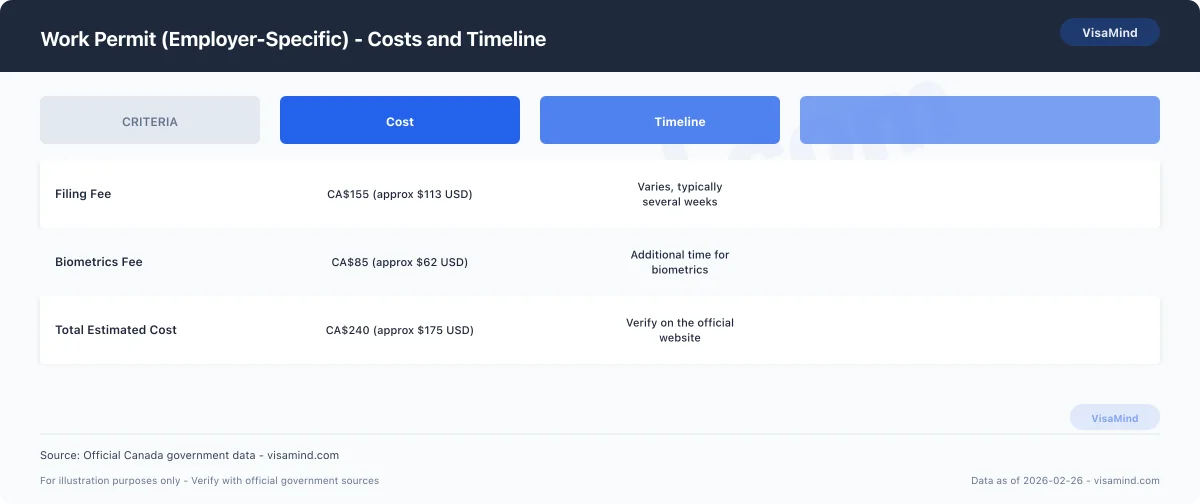
IRCC charges a CA$155 processing fee for most applications submitted with Form IMM 1295. This applies to both LMIA-Based Work Permits and Open Work Permits.
You also pay a CA$85 biometrics services fee if IRCC requires fingerprints and a photo. IRCC will send instructions after you submit if biometrics are needed.
| Fee Type | Amount (CAD) | Who Pays |
|---|---|---|
| Work permit processing (IMM 1295) | CA$155 | Principal applicant |
| Biometrics services | CA$85 | Each person required to give biometrics |
You pay these fees directly to IRCC when you apply. If you later apply for permanent residence through the Canadian Experience Class (CEC) or Express Entry (Federal Skilled Worker), those programs have separate fees.
IRCC won’t start processing until you’ve paid the correct amount.
Group fee conditions
When you apply with family members, each person pays the processing fee individually. Biometrics fees are also per person unless IRCC confirms an exemption.
For example:
- Each worker submitting IMM 1295 pays CA$155.
- Each person required to provide biometrics pays CA$85.
| Scenario | Processing Fee | Biometrics Fee |
|---|---|---|
| Single worker | CA$155 | CA$85 (if required) |
| Worker + spouse | CA$155 each | CA$85 each (if required) |
Group applications don’t lower the base work permit fee. IRCC calculates fees for each applicant, even if you file together.
How processing times are calculated
#IRCC measures work permit processing times from when it receives your complete application to when a decision is made. Your category and where you apply from both matter.
What starts the clock
The processing time starts the day IRCC receives your complete application and ends when a decision is made.
A complete application includes:
- The correct application form (such as Form IMM 1295 for work permits outside Canada)
- All required supporting documents
- Payment of the required fees in CAD (CA$)
- Any category-specific documents (for example, for an LMIA-Based Work Permit or Open Work Permit)
If your file is incomplete, IRCC won’t start processing in a meaningful way. Officers need everything before making a decision.
| Stage | When It Begins | When It Ends |
|---|---|---|
| Processing time | Date IRCC receives your complete application | Date IRCC makes a decision |
Applying from outside Canada and the United States? Add 3 to 4 months for mailing time.
Factors that affect processing times
The processing times depend on work permit type and where the application is processed.
For example:
- LMIA-Based Work Permit applications may need review of employer documents
- Open Work Permit applications involve eligibility checks linked to your status in Canada
- Applications tied to permanent residence pathways like Canadian Experience Class (CEC) or Express Entry (Federal Skilled Worker) may require coordination between programs
Routine and non-routine files are handled differently. Non-routine applications can take longer if extra review is needed.
Annual immigration levels also play a role. If more people apply than Canada can admit that year, wait times might go up.
Employer and Worker Application Steps
#Both you and your employer have specific roles in an employer-specific work permit process. IRCC cannot assess the worker application until the required employer-side steps are complete and the personal application includes matching supporting documents.
Employer-side process and worker application
For an LMIA-Based Work Permit, the employer obtains the LMIA before the worker applies. For an LMIA-exempt employer-specific permit, the employer normally submits the offer through the Employer Portal and gives the worker the offer number. The worker cannot replace the employer's required record with personal documents.
| Party | Main responsibility | Submitted to |
|---|---|---|
| Employer | Complete the applicable LMIA or LMIA-exempt offer process | ESDC/Service Canada or IRCC, depending on category |
| Worker | Submit the work-permit application and matching personal evidence | IRCC |
If you qualify for an Open Work Permit, there is usually no employer-specific submission, but you must prove eligibility for the open-permit category.
Complete the application required for your location
Applicants outside Canada commonly use Form IMM 1295. In-Canada applicants and extensions use different forms or online questions. Follow the personalized IRCC checklist rather than assuming IMM 1295 applies to every situation.
For a PDF form that requires validation:
-
Download the current version from IRCC.
-
Complete every required field on a computer.
-
Validate the form so barcode pages are generated.
-
Revalidate after making any change.
-
Upload or submit every page listed by IRCC.
Include the passport, employer or category evidence, relationship or status evidence where relevant, and any country-specific documents in the generated checklist. Names, job details, wages, location, LMIA number, and exemption information must agree across the employer and worker submissions.
IRCC decides the application. The Canada Border Services Agency separately assesses admissibility and issues the physical permit at the port of entry when applicable.
Eligibility Requirements
#IRCC reviews both you and, sometimes, your family members before issuing a work permit. Eligibility depends on your admissibility and whether your job offer and employer meet the standards set for your permit type.
Who may be ineligible
A work permit can be refused if you or a family member doesn’t meet IRCC’s eligibility standards. IRCC examines your forms, including Form IMM 1295, and all supporting documents to decide if you qualify.
Reasons for ineligibility include:
- Incomplete or inconsistent information
- A required family member not meeting eligibility standards
- Not meeting the specific criteria for your permit type (like an LMIA-Based Work Permit or Open Work Permit)
Each applicant is assessed individually. Still, your spouse or dependent child’s status can affect your file if they apply with you or are examined as part of your application.
If you later apply for permanent residence through programs like Canadian Experience Class (CEC) or Express Entry (Federal Skilled Worker), IRCC will assess your admissibility again under those rules.
Job and employer conditions
Your job offer and employer must fit the requirements for your type of work permit. The standards differ for LMIA-Based and Open Work Permits.
| Permit Type | Job Offer Required | Employer-Specific |
|---|---|---|
| LMIA-Based Work Permit | Yes | Yes |
| Open Work Permit | Not always | No |
For an LMIA-Based Work Permit, the job must match the approved position and employer in your application. Any mismatch can lead to refusal.
For an Open Work Permit, you’re not restricted to one employer, but you still need to meet the eligibility rules for your category.
IRCC checks that your employment conditions align with your selected permit type. If they don’t, your application will fail.
Dependents
#You can include your spouse and dependent children in your work permit plans, but each needs a complete and coordinated application. IRCC reviews every family member’s documents and medical validity together.
Bringing your spouse and children
You must submit proof of your relationship with your spouse. Include a valid marriage licence or certificate in your package.
Under an LMIA-Based Work Permit or other permit category, your spouse and children file their own applications linked to yours. Your spouse may apply for an Open Work Permit; you submit your own work permit form, such as Form IMM 1295, if required.
IRCC assesses each applicant separately, even if you apply as a group.
Key documents to prepare
- Marriage licence or marriage certificate
- Separate application forms for each family member
- Any supporting documents required by IRCC
If you later apply for permanent residence (for example, through Canadian Experience Class (CEC) or Express Entry (Federal Skilled Worker)), you must continue to declare your spouse and dependent children in your profile and applications.
| Family Member | Must Apply Separately | Relationship Proof Required |
|---|---|---|
| Spouse | Yes | Yes – marriage document |
| Dependent child | Yes | Yes – as requested by IRCC |
Medicals and timing
IRCC may require medical exams for each person. Medical results for all family members must be valid at the same time.
If one person’s exam expires, you can’t rely on another’s valid result. IRCC reviews the group’s medical validity as a whole.
Plan the timing of your exams. If an exam expires before submission or decision, you might need to repeat it so all results line up.
Important timing rule
- All required medical exams must remain valid for every applicant at the same time.
Common Work Permit Application Challenges
#Delays often come from preventable filing mistakes. Submitting complete, accurate forms and every required document for your permit type helps avoid them.
Frequent mistakes causing delays
Applications get delayed when incomplete or incorrect information is sent to IRCC. Even small gaps on Form IMM 1295 or missing signatures can halt processing.
These errors show up in both LMIA-Based Work Permit and Open Work Permit applications. It’s not about the permit type—it’s about following the document checklist.
Common issues include:
- Leaving required fields blank on IMM 1295
- Entering inconsistent dates for employment or personal history
- Uploading unclear or partial documents
- Missing documents listed in IRCC’s instruction guide
- Submitting forms that aren’t fully validated when validation is required
These mistakes can also affect permanent residence applications later if you go through Express Entry (Federal Skilled Worker) or Canadian Experience Class (CEC) after working in Canada.
| Mistake Type | How It Causes Delay |
|---|---|
| Missing information | IRCC cannot assess eligibility |
| Incorrect details | IRCC may request clarification |
| Omitted documents | Application may be returned or paused |
| Inconsistent answers | Officer must verify information |
How to avoid issues
Review every field before you submit. Treat the application as a legal document.
Checklist before submission:
-
Every question on IMM 1295 is answered
-
All dates and job details match across forms and documents
-
Each document listed in the IRCC checklist for your permit category is uploaded
-
Names, passport numbers, and contact details are accurate
Don’t assume IRCC will fix minor errors. Officers review what you submit.
If you’re applying for an LMIA-Based Work Permit, your documents must match the job details you provide. For an Open Work Permit, include all required supporting documents, even if employer-specific details aren’t needed.
Before filing, compare your package against IRCC’s official instructions. Checking for completeness yourself is better than relying on memory.
What documents do I need?
#You must submit documents proving your identity and supporting your work permit type. IRCC checks identity details first, then reviews forms and work-related evidence for your permit category.
Identity and personal details
You have to provide clear proof of identity that matches your application.
Include:
- Valid passport or travel document
- Your full legal name as shown on your passport (no initials)
- Date of birth
- Gender
- Marital status
- Country of citizenship
Your passport details need to be consistent across all forms, including Form IMM 1295 (Application for Work Permit Made Outside Canada). Even minor spelling differences can cause delays.
If you use a Post Office Box, mark it as “P.O. Box” in your address. Make sure your phone number and email are current—IRCC uses these to contact you.
If you’re a Venezuelan national with an expired Venezuelan passport, you must:
- Confirm the passport’s been extended by 5 years, and
- Include a signed letter stating:
“I am a Venezuelan national with a Venezuelan passport, which has been extended for 5 years.”
Work and supporting documents
Your supporting documents must match the type of work permit you request. For example, an LMIA-Based Work Permit or an Open Work Permit will each require different evidence.
At minimum, submit:
- IMM 1295 completed and signed
- Any residence documents requested
- Supporting documents relevant to your employment
- Additional personal information if required (for example, work or financial details)
IRCC may ask for more evidence depending on your situation. If you later apply for permanent residence through programs like the Canadian Experience Class (CEC) or Express Entry (Federal Skilled Worker), your past work authorization records need to line up with your permit application.
| Document Type | What It Must Show |
|---|---|
| Passport | Identity and citizenship |
| IMM 1295 | Correct work permit category and personal data |
| Employment support | Details tied to the specific permit type |
| Additional documents | Any extra evidence requested by IRCC |
Check IRCC’s document checklist and include every required item before you submit your application.
Path to Permanent Residence
#
A Canadian work permit often acts as a step toward permanent residence. This involves moving from temporary status to economic immigration programs managed by Immigration, Refugees and Citizenship Canada (IRCC).
Common next steps after a work permit
After working in Canada, many applicants move on to permanent residence through economic programs. The most common options include:
- Canadian Experience Class (CEC)
- Express Entry (Federal Skilled Worker)
- Provincial Nominee Program (PNP)
These programs operate under Canada’s economic immigration system and are processed by IRCC.
If you apply for permanent residence, IRCC starts processing when they receive your full application and finish when a final decision is made. Submit a complete file to avoid delays.
| Program | Managed By | Focus |
|---|---|---|
| Canadian Experience Class (CEC) | IRCC | Canadian work experience |
| Express Entry (Federal Skilled Worker) | IRCC | Skilled work factors |
| Provincial Nominee Program (PNP) | IRCC + Provinces | Provincial labor needs |
If you held an LMIA-Based Work Permit or an Open Work Permit, your Canadian employment history can help your permanent residence application.
Prior pathways that lead into work permits
Many workers first come to Canada with temporary status before applying for a work permit. Common starting points include:
- Temporary Resident Visa (Visitor Visa)
- Electronic Travel Authorization (eTA)
- Study Permit
From these, you may later apply for a work permit using the required IRCC forms, such as Form IMM 1295, when eligible.
Your progression might look like this:
-
Enter Canada as a visitor or student.
-
Obtain a work permit (LMIA-based or open).
-
Gain Canadian work experience.
-
Apply for permanent residence through an eligible economic program.
Each stage needs a separate application and approval from IRCC. You must keep valid status in Canada throughout.
Fees
#| Component | Amount |
|---|---|
| Filing fee (IMM-1295)Work permit (outside Canada). | CA$155 (approx $113 USD) |
| BiometricsBiometrics: CA$85 (approx $62 USD) (as of 2026-02). Verify the current fee on the official schedule before filing. | CA$85 (approx $62 USD) |
Fees change; always verify on IRCC.
Required forms
#Plan your Work Permit: Types, Requirements & Application with free Canada tools
#Itemized government fees for Work Permit: Types, Requirements & Application and other Canada categories.
See how your profile scores against Work Permit: Types, Requirements & Application and other Canada visas.
Typical wait times and stage breakdowns for Work Permit: Types, Requirements & Application and related Canada visas.
Common interview questions and feedback for Canada visa applicants.