
Canada SAWP — What the Seasonal Agricultural Worker Program (SAWP) Covers
#
The Seasonal Agricultural Worker Program (SAWP) is for Canadian employers who need to hire temporary foreign workers for seasonal farm work when local labour isn’t available. You apply through IRCC for a work permit linked to a specific employer and job.
How the program works
SAWP is a temporary foreign worker program for seasonal agricultural work. Canadian employers use it to fill short-term farming positions during busy times when they can’t hire enough local staff.
Before you apply, your employer must show there’s a need to hire from abroad. The job offer supports your application for a Work Permit (Employer-Specific), which restricts you to the named employer and position.
You submit your application to Immigration, Refugees and Citizenship Canada (IRCC). This is generally an LMIA-Based Work Permit, so your employer must meet federal requirements before you can get approval.
Your application usually includes:
- A valid job offer under SAWP
- A completed Form IMM 1295 (Application for Work Permit Made Outside Canada), if you’re applying from abroad
- Supporting documents requested by IRCC
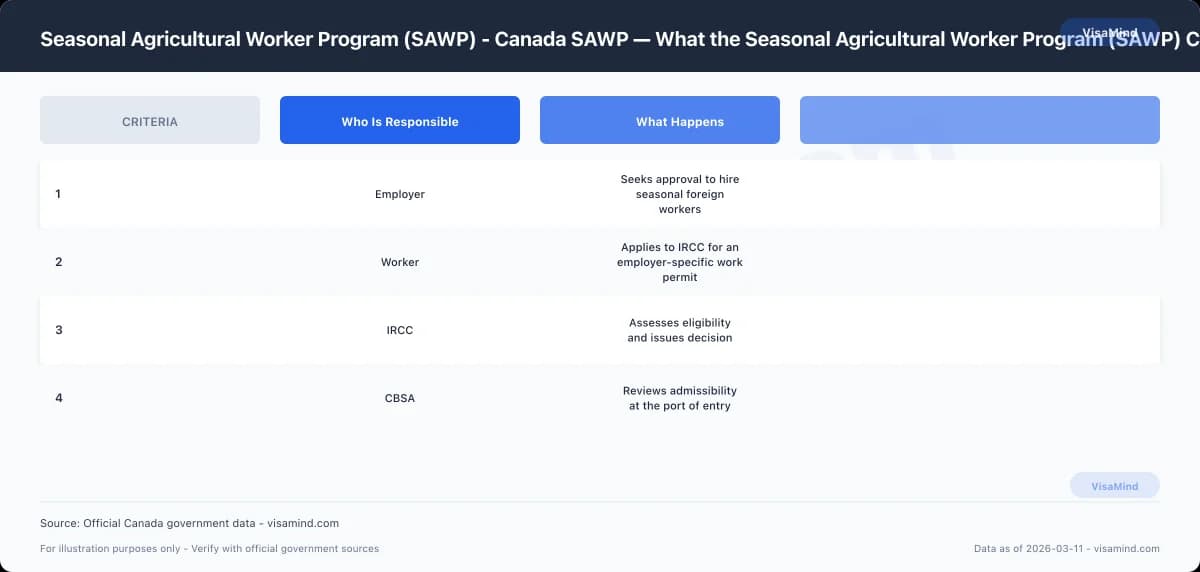
| Step | Who Is Responsible | What Happens |
|---|---|---|
| 1 | Employer | Seeks approval to hire seasonal foreign workers |
| 2 | Worker | Applies to IRCC for an employer-specific work permit |
| 3 | IRCC | Assesses eligibility and issues decision |
| 4 | CBSA | Reviews admissibility at the port of entry |
Who uses this route
SAWP is for people planning to work in seasonal agricultural employment in Canada. The program is meant for temporary farm work tied to certain seasons and production cycles.
Employers in agriculture rely on SAWP when they have predictable labour shortages. This isn’t a route for permanent or year-round jobs.
SAWP isn’t the same as permanent immigration programs like the Provincial Nominee Program (PNP). It only gives temporary status through an employer-specific permit.
This route fits if:
- Your job is seasonal and agricultural
- A Canadian employer has offered you a position under SAWP
- You intend to work temporarily, not immigrate permanently
If you want permanent residence, look into other options like the Provincial Nominee Program through IRCC.
Key program features
SAWP provides employer-specific work permits, not open work permits. You’re only allowed to work for the employer listed on your permit.
The program is designed to protect the Canadian labour market while letting employers address seasonal shortages. Employers must meet federal requirements before you can apply.
Key features:
- Seasonal agricultural positions only
- Temporary status tied to one employer
- Application processed by IRCC
- Border admissibility reviewed by CBSA
| Feature | What It Means for You |
|---|---|
| Employer-Specific Permit | You can’t change employers without a new permit |
| Seasonal Work | Your job must line up with a defined agricultural season |
| Federal Oversight | IRCC reviews your eligibility before approval |
| Labour Market Protection | Employer must justify hiring a foreign worker |
You’re required to follow the conditions on your work permit. Working outside those conditions can affect your status in Canada.
Eligibility Requirements
#You have to meet strict nationality, sector, and employer conditions to use SAWP. IRCC issues the LMIA-Based Work Permit as an Employer-Specific Work Permit, and both worker and employer must follow program rules before approval.
Worker nationality & participating countries
SAWP only accepts workers who are citizens of Mexico or certain Caribbean countries. If you’re from another country, you aren’t eligible.
The participating countries:
| Eligible Country | Region |
|---|---|
| Mexico | North America |
| Anguilla | Caribbean |
| Antigua and Barbuda | Caribbean |
| Barbados | Caribbean |
| Dominica | Caribbean |
| Grenada | Caribbean |
| Jamaica | Caribbean |
| Montserrat | Caribbean |
You must prove your citizenship when applying to IRCC.
Workers apply for a Work Permit (Employer-Specific) using form IMM
- IRCC checks your nationality as part of the assessment. If you’re not a citizen of one of these countries, consider another pathway, such as a different LMIA-Based Work Permit stream or the Provincial Nominee Program (PNP), if you qualify.
CBSA officers check your admissibility when you enter Canada.
Commodity sectors & activities
Your job must involve on-farm primary agriculture. SAWP doesn’t cover food processing, packaging plants, or off-farm industrial work.
The agricultural work must fall within approved commodity sectors. Employers need to show that:
- The work takes place on a farm
- Duties involve primary agricultural production
- The commodity is within SAWP-approved sectors
Primary agriculture generally means work directly related to growing or harvesting crops or similar farm-based production.
IRCC won’t approve a SAWP work permit if the job falls outside these parameters. If your work includes non-agricultural or secondary processing tasks, you may need a different LMIA stream.
Employer eligibility checks
Before hiring you under SAWP, the employer must:
-
Hire only citizens from Mexico or participating Caribbean countries
-
Operate within approved agricultural commodity sectors
-
Offer work that qualifies as on-farm primary agriculture
Employers must check your nationality before starting the work permit process. They also have to confirm that their activities meet SAWP rules.
IRCC reviews whether the job offer fits SAWP criteria when looking at the LMIA-Based Work Permit application. If the employer doesn’t meet requirements, IRCC will refuse the application, even if you personally qualify.
The Dual-Track Application
#You need to complete two coordinated applications: the employer submits a Labour Market Impact Assessment (LMIA) through the LMIA Online portal, and you apply to IRCC for an employer-specific, LMIA-Based Work Permit.
Both applications require accurate documents and consistent information.
Employer LMIA application (LMIA Online)
Your employer begins by creating an account in the LMIA Online portal and submitting the LMIA application electronically.
The application asks for details about the business, the job offer, and the employer’s compliance history.
Your employer uploads:
- Proof of recruitment and advertising efforts
- Evidence about production in agriculture sectors (if needed)
- Documents showing workplace policies and operations
- Declarations about efforts to prevent abuse
- Information about any third-party representatives
- Declarations about recruiters
The employer must pay any required LMIA processing fees in CAD (CA$). For current fee amounts, refer to Employment and Social Development Canada’s official guidance.
| Employer Responsibility | What It Involves |
|---|---|
| Recruitment proof | Evidence of job advertisements and hiring efforts |
| Compliance disclosure | History of meeting program rules |
| Workplace standards | Steps taken to prevent abuse |
| Representative details | Identification of paid or unpaid representatives |
Missing or incomplete documentation can delay or affect the LMIA decision.
Worker work-permit application with IRCC
After the employer files the LMIA application, you apply to IRCC for a Work Permit (Employer-Specific) that’s LMIA-based.
You can’t submit a complete LMIA-based work permit application without the LMIA details from your employer.
Your application must match the job information in the LMIA. If there are inconsistencies between the employer’s LMIA and your work-permit application, you risk refusal.
IRCC checks:
- If you meet the job requirements described in the LMIA
- If the LMIA supports the specific employer and position
- If your application forms and declarations are complete
IRCC processes the work permit. The Canada Border Services Agency (CBSA) reviews admissibility at the port of entry.
What to upload and submit
Accuracy and consistency are more important than the number of documents. Only submit what’s required.
Employer uploads through LMIA Online:
- Recruitment and advertisement evidence
- Business and sector documentation
- Compliance and workplace policy declarations
- Representative and recruiter disclosures
- Fee payment confirmation
You submit to IRCC:
- Completed work-permit forms
- Employer and LMIA information as issued
- Supporting documents required by IRCC
- Applicable work-permit fees in CAD (CA$)
| Application Track | Submitted To | Core Documents |
|---|---|---|
| LMIA | LMIA Online portal | Recruitment proof, compliance records, declarations |
| Work Permit (Employer-Specific) | IRCC | Work-permit forms, LMIA details, supporting documents |
Review every entry before submitting. Errors in names, job titles, or employer details can delay both applications.
Prepare the Required Documents
#You need to show that your business can legally hire under SAWP and that you’re able to meet all program conditions. Gather corporate, recruitment, housing, and worker records before submitting any application related to an LMIA-Based Work Permit or Employer-Specific Work Permit processed by IRCC.
Business legitimacy & compliance evidence
You have to show your operation is active, legal, and financially sound.
Prepare:
- Most recent business licence
- Canada Revenue Agency tax documents
- Employer registration certificate (if your province requires one)
- Evidence that you can offer work consistent with SAWP requirements
- Records confirming worker nationality, as required under program rules
Document your recruitment policies and workplace safety measures. Outline how you prevent abuse and how workers can report concerns.
If you use representatives, disclose:
- Whether they are paid or unpaid
- Their roles and authority
- The nature of your relationship
- Any actions they take for you
Keep written agreements with recruiters. Show transparency and control over recruitment activities.
Recruitment, advertising and housing records
You need to document how you recruited workers and how you arranged housing, if needed.
Maintain records of:
- Recruitment efforts and activities
- Names and details of recruiters
- Contracts or agreements with recruiters
- Communications about hiring
If you provide off-site housing, include:
- A signed housing contract
- An official housing inspection report
If there’s no standard inspection form in your area, use Schedule F – Housing Inspection Report (Seasonal Agricultural Worker Program and Agricultural Stream) to record results.
| Housing Document | What It Must Show |
|---|---|
| Signed contract | Address, terms, and occupancy details |
| Inspection report | Date, inspector authority, compliance findings |
| Schedule F (if required) | Formal inspection results for SAWP purposes |
Keep copies of all inspection outcomes. You must show housing meets standards before workers arrive.
Worker personal and supporting documents
Each worker submits accurate personal information to support a Work Permit (Employer-Specific) application with IRCC. Often, this is an LMIA-Based Work Permit.
Workers typically provide:
- Personal details (telephone, email, identification data)
- Employment details linked to the job offer
- Any required residence or status documents
- Financial, medical, or work-related information, if requested
Applications may include Form IMM 1295 when applying for a work permit from outside Canada.
Protect sensitive information like SINs, financial records, and medical details. Only authorized staff should access these records, and they need to be stored securely.
If a worker later applies through a Provincial Nominee Program (PNP), make sure employment documents remain consistent with the original SAWP job offer. Inconsistent information can delay or affect IRCC processing.
What Your Employer Must Do
#Your employer has to meet strict recruitment, safety, and compliance standards before you can get an LMIA-Based Work Permit under SAWP. These obligations affect your job offer, your housing, and your legal status tied to an Employer-Specific Work Permit issued by IRCC.
Recruitment and advertising duties
Before hiring you, your employer has to try to recruit Canadians and permanent residents first.
They must advertise the position for at least 14 consecutive days within the three months before submitting the Labour Market Impact Assessment (LMIA) application.
Proof of these efforts must be kept for inspection.
Starting January 1, 2026, employers hiring for primary agriculture positions must again submit proof of advertising with the LMIA application.
Your employer must:
- Advertise for the required period
- Show genuine efforts to hire or train Canadians and permanent residents
- Keep records of recruitment activities
- Submit proof of advertising when required
If IRCC approves your LMIA-Based Work Permit, your authorization stays tied to that specific employer.
If you later apply under a different pathway, such as a Provincial Nominee Program (PNP) stream, different recruitment rules could apply.
Workplace safety, housing and abuse prevention
Your employer must provide adequate housing and transportation for you as a temporary foreign worker.
They’re also expected to take reasonable steps to keep the workplace free from abuse, covering physical, psychological, financial, and sexual mistreatment.
If your employer hasn’t hired a temporary foreign worker in the past six years, they face extra scrutiny.
They must show clear efforts to prevent workplace abuse and could be reviewed when submitting the LMIA.
Key employer obligations include:
- Providing adequate housing
- Arranging transportation
- Demonstrating active abuse-prevention measures
- Showing a history of compliance if previously participating
Your Employer-Specific Work Permit and application forms, including Form IMM 1295, depend on a valid and compliant LMIA.
If your employer fails these requirements, your work authorization can be affected.
Records, compliance history and third‑party reps
Your employer must maintain detailed records for inspection.
Authorities may request proof that recruitment and workplace obligations were met.
They must not be affiliated with any employer who’s ineligible under the Temporary Foreign Worker Program or has unpaid administrative monetary penalties.
If your employer uses a paid third-party representative, they have to follow provincial and territorial rules for recruiters.
Before switching to a new paid authorized representative, they must provide a letter confirming they no longer use the previous one.
| Compliance Area | Employer Requirement |
|---|---|
| Recruitment records | Keep proof of advertising and hiring efforts |
| Program eligibility | No affiliation with ineligible employers |
| Monetary penalties | No outstanding administrative penalties |
| Recruiter rules | Follow provincial and territorial laws |
| Representative changes | Provide written notice before hiring a new paid representative |
You depend on your employer’s compliance for your legal status.
If they fall out of compliance, your LMIA and work permit may be at risk.
Fees and Processing Times
#You must pay government fees when applying for a Work Permit (Employer-Specific) under the Seasonal Agricultural Worker Program.
The processing times depend on the seasonal agricultural worker category and where you apply.
Government filing fees
You submit your work permit application to IRCC using Form IMM 1295 for an LMIA-Based Work Permit.
The standard government filing fee is:
| Application Type | Form | Fee (CAD) |
|---|---|---|
| Work Permit (Employer-Specific) | IMM 1295 | CA$155 |
You pay this fee when you submit your application.
IRCC won’t process your application without full payment.
If you apply under another pathway, such as a stream connected to the Provincial Nominee Program (PNP), fees may differ.
You must confirm current amounts using the official IRCC fee schedule before you file.
For seasonal agricultural workers under standard processing, IRCC lists an estimated processing time of 2 to 5 months.
The processing times vary by season and country of application.
Biometrics and related fees
Most applicants must provide biometrics as part of the work permit process.
The biometrics fee is:
| Service | Fee (CAD) |
|---|---|
| Biometrics services | CA$85 |
You pay this in addition to the CA$155 work permit filing fee.
After IRCC issues a biometrics instruction letter, you must attend an appointment at an authorized collection site.
Delays in booking or attending your biometrics appointment can extend overall processing beyond the typical 2 to 5 month range.
Always confirm whether biometrics apply to you by reviewing your specific instructions from IRCC before completing payment.
Understand Processing Times
#IRCC publishes estimated processing times for work permits, including the Work Permit (Employer-Specific) used under the Canada SAWP.
These timelines start when IRCC receives your complete application and end when a decision is made.
How IRCC calculates processing time
IRCC measures processing time from the date it receives your complete application to the date it makes a decision.
If you submit Form IMM 1295 for an LMIA-Based Work Permit, the clock starts only after IRCC receives all required forms and documents.
IRCC posts an estimate based on applications submitted in a specific month and year.
This estimate reflects how long similar applications took to finalize.
It is not a guarantee.
For permanent residence applications, including those under the Provincial Nominee Program (PNP), IRCC uses the same approach.
The timeline begins when your complete file arrives and ends when IRCC issues a final decision.
If you apply from outside Canada or the United States, you must add 3 to 4 months for mailing time.
| Key Point | What It Means for You |
|---|---|
| Start date | The day IRCC receives your complete application |
| End date | The day IRCC makes a decision |
| Estimate basis | Applications submitted in the same month and year |
| Outside Canada/U.S. | Add 3–4 months for mailing time |
Situations that can affect timelines
The processing time can increase if IRCC must review a non-routine application.
This can happen if your file is incomplete or requires extra assessment.
High application volumes also affect timelines.
If more people apply to immigrate or work in Canada than annual intake levels allow, IRCC may take longer to finalize cases.
Mailing delays matter if you apply from abroad.
Living outside Canada or the United States adds 3 to 4 months before IRCC can fully process your submission.
You reduce delays by ensuring your IMM 1295 and supporting documents are complete when filed.
IRCC does not begin full processing until your application meets completeness requirements.
Dependents
#You cannot automatically include family members under your Seasonal Agricultural Worker Program status.
Each dependant must apply separately with Immigration, Refugees and Citizenship Canada (IRCC) and meet specific eligibility and fee rules.
Family members and group fee notes
If your spouse or dependent children apply for a Work Permit (Employer-Specific) at the same time and place as you, IRCC charges fees per person unless you qualify for a capped family fee.
Standard work permit fee
| Applicant | Fee (CAD) |
|---|---|
| Work Permit (including extensions) – per person | CA$155 |
A maximum family fee of CA$500 may apply only if:
- All family members apply at the same time
- All applications are submitted at the same location
- Each child meets IRCC’s definition of a dependant
If any family member applies later or separately, IRCC charges CA$155 per person instead.
The “group fee” rule for three or more performing artists and their staff does not apply to SAWP workers.
That provision is limited to qualifying artistic groups and requires all exams to remain valid at the same time.
Each family member must submit their own application forms, which may include Form IMM 1295 for a work permit, depending on what they request.
Eligibility notes for dependants
Your family members do not receive status automatically because you hold an LMIA-Based Work Permit under SAWP.
Each dependant must:
- Submit a complete application to IRCC
- Qualify independently under the category requested (for example, a work permit)
- Meet admissibility requirements
IRCC may determine that you or a family member is not eligible, even if your SAWP work permit is approved.
If your spouse seeks their own Employer-Specific Work Permit, it must be supported by the appropriate authorization, such as a Labour Market Impact Assessment where required.
Programs such as the Provincial Nominee Program (PNP) follow separate eligibility rules and do not form part of SAWP dependant processing.
For current definitions of “dependant” and updated fee details, consult IRCC’s official guidance.
Renewal and Extension
#You can only extend your placement within strict seasonal limits.
IRCC assesses renewal requests against the original LMIA-based approval and the terms of your Employer-Specific Work Permit.
Maximum placement length and timing rules
Under the Seasonal Agricultural Worker Program, your employer may hire you for up to 8 months in a calendar year.
Your authorized work period must fall between January 1 and December 15.
IRCC will not approve a renewal that exceeds these limits, even if your employer requests additional time.
| Rule | Requirement |
|---|---|
| Maximum duration | 8 months per year |
| Valid work window | January 1 – December 15 |
| Minimum work guarantee | 240 hours within 6 weeks or less |
Your employer must guarantee at least 240 hours of work within a period of 6 weeks or less.
If this condition is not met, renewal may not proceed.
If you apply to extend your LMIA-Based Work Permit, you must submit the required forms, including Form IMM 1295, and ensure your employer’s approval remains valid.
IRCC will only extend your Employer-Specific Work Permit within the authorized seasonal timeframe.
The Provincial Nominee Program (PNP) is separate from SAWP and does not extend seasonal placements.
Common reasons for renewal delays or refusal
Renewal does not happen automatically.
IRCC reviews each request independently.
Common problems include:
- Failure to provide proof of required recruitment or advertisement
- Requests that exceed the 8-month seasonal cap
- Applications filed outside the January 1–December 15 window
- Incomplete forms, including IMM 1295
If your employer cannot show proof of required advertising, processing will be delayed.
Delays can push your requested start date beyond the permitted seasonal window.
Approval is never guaranteed.
Filing a seasonal agricultural worker application does not ensure IRCC will issue or extend your Employer-Specific Work Permit.
You must confirm that your employer meets all program conditions before you submit a renewal request.
Path to Permanent Residence
#Seasonal Agricultural Worker Program (SAWP) jobs are temporary and tied to a specific employer.
If you want to stay in Canada permanently, you must qualify under a separate immigration program managed by Immigration, Refugees and Citizenship Canada (IRCC).
Your path usually involves extending your legal status first, then applying through a federal or provincial program that accepts agricultural work experience.
Typical next steps after the SAWP placement
SAWP workers hold an Employer-Specific Work Permit, often issued as an LMIA-Based Work Permit.
This permit limits you to the employer listed on the document.
If your employer wants to keep you:
-
The employer must secure a valid Labour Market Impact Assessment (LMIA), if required.
-
You apply to IRCC to extend or change your Work Permit.
-
You submit the required application forms, which may include Form IMM 1295 for work permit applications made outside Canada.
You must maintain valid status at all times.
IRCC processes work permit applications, while the Canada Border Services Agency (CBSA) determines admissibility at the port of entry.
If you want to pursue permanent residence, you typically:
- Confirm you meet eligibility criteria under a federal or provincial program
- Gather proof of work experience and employment
- Submit a permanent residence application to IRCC
| Step | Authority | Key Action |
|---|---|---|
| Work permit extension | IRCC | Apply before status expires |
| Admissibility review | CBSA | Assessed at entry to Canada |
| Permanent residence application | IRCC | Submit full PR application package |
Links to provincial pathways
Many agricultural workers look to a Provincial Nominee Program (PNP) as a pathway to permanent residence.
Each province sets its own eligibility criteria.
A province may nominate you if you:
- Have valid status in Canada
- Work in an eligible agricultural occupation
- Have a job offer from a provincial employer
- Meet language or settlement requirements set by the province
A provincial nomination does not grant permanent residence by itself.
You must still apply to IRCC for permanent residence after receiving a nomination.
The process generally follows this sequence:
-
Apply to the province under a PNP stream.
-
Receive a nomination certificate if approved.
-
Submit your permanent residence application to IRCC.
| Stage | Who Decides | What You Receive |
|---|---|---|
| Provincial application | Provincial government | Nomination (if approved) |
| PR application | IRCC | Permanent resident status (if approved) |
Each province publishes its own criteria and intake rules.
Review the specific Provincial Nominee Program requirements on the relevant provincial website and confirm final application steps with IRCC.
Conditions and Portability
#Your status under the Seasonal Agricultural Worker Program (SAWP) depends on an employer-specific authorization and clear evidence that your workplace meets basic safety and anti-abuse standards.
You must also understand how third parties act on your behalf and what documentation IRCC expects.
Work conditions & abuse‑prevention evidence
Your Work Permit (Employer-Specific) limits you to the employer named on your approval. Under an LMIA-Based Work Permit, the employer must show active steps to keep the workplace free from abuse.
IRCC wants proof of real, proactive efforts—not just general statements. Employers should be able to show:
- Written workplace policies prohibiting physical, psychological, and financial abuse
- Clear complaint procedures available to workers
They also need:
- Records of training or briefings provided to employees
- Evidence that concerns are documented and addressed promptly
Ongoing monitoring of workplace conditions is expected. These measures, when documented and consistently applied, protect both workers and employers.
If you later pursue a Provincial Nominee Program (PNP) pathway, your employment history and workplace compliance record may become relevant. IRCC reviews compliance through documentation and demonstrated effort.
Employers must show they actively maintain, not just promise, an abuse‑free environment.
| Evidence Type | What It Should Show |
|---|---|
| Written policies | Clear definitions of prohibited conduct |
| Training records | Workers informed of rights and reporting steps |
| Complaint logs | Issues recorded and resolved |
| Internal reviews | Ongoing monitoring of conditions |
Documentation about third‑party representatives
If someone helps you with your application—such as completing Form IMM 1295—you must clearly identify that representative to IRCC. Transparency protects you from unauthorized or misleading advice.
You should confirm:
- The representative’s full legal name and contact details
- The scope of authority granted to them
Keep copies of all forms submitted on your behalf. Make sure information provided to IRCC matches what you reviewed.
IRCC expects accurate disclosure of any third‑party involvement. Failure to document representation properly can delay processing or raise credibility concerns.
Keep personal copies of every document submitted under your name. You remain responsible for the accuracy of your application, even if someone else prepares it.
When Self-Preparation Isn't Enough
#Some SAWP applications fail because of preventable employer or paperwork errors. When issues involve eligibility, LMIA requirements, or incorrect forms, you need to act quickly and precisely.
Complex employer or recruiter situations
You cannot fix certain employer-side problems on your own. If an employer tries to hire workers from countries that do not participate in the program, IRCC will not approve the related LMIA-Based Work Permit.
Errors in the LMIA stage also cause refusals or delays. Common problems include:
- Submitting an incomplete LMIA application
- Failing to meet the minimum required advertising requirements
Not providing a required employer registration certificate in provinces where it is mandatory is another common pitfall. If your employer uses a third-party representative and later changes representatives, the file must include a letter confirming the end of the prior arrangement.
Missing this document can delay both the LMIA decision and your Employer-Specific Work Permit. Confirm that the employer completed every required step before you submit Form IMM 1295 to IRCC.
| Employer Issue | Likely Impact on Your Work Permit |
|---|---|
| Incomplete LMIA application | Processing delay or refusal |
| No proof of required advertising | LMIA refusal |
| Missing provincial registration certificate | LMIA returned or delayed |
| No letter ending prior representative services | File delay |
If the LMIA is flawed, your work permit application cannot succeed.
Application errors and when to get help
IRCC frequently delays applications because of incomplete or inconsistent information. Even small omissions can stop processing.
Review every field in IMM 1295. Supporting documents listed in the official IRCC instructions must be included.
Employer information must match the LMIA details exactly. Common mistakes include leaving sections blank, uploading the wrong document, or failing to include every required attachment.
These errors lead to processing delays and, in some cases, refusals. If you already submitted an application and discover a mistake, seek guidance immediately.
Waiting makes correction more difficult, especially if IRCC begins assessment. Self-preparation works only when you follow the official instructions exactly and include every required document.
When to consult a qualified professional
You should consult a qualified immigration professional when your situation involves more than a standard SAWP application.
Examples include:
- Employer compliance concerns
- Prior use of a third-party recruiter
- Questions about whether your application aligns with another pathway, such as a Provincial Nominee Program (PNP)
- Repeated delays caused by documentation problems
A professional can review the LMIA documentation, confirm that your Employer-Specific Work Permit application matches the approved job offer, and ensure your IMM 1295 contains complete and accurate information.
IRCC decides work permit applications based on the documents submitted. If your case includes irregularities, missing paperwork, or employer-side complications, professional review reduces the risk of preventable refusal.
Common Petition Challenges
#Most SAWP problems come from incomplete documentation, missed program rules, or communication gaps with Service Canada and IRCC. You reduce risk by reviewing requirements carefully and documenting every change in representation, hours, and timing.
Top application errors
You must meet all program conditions before you submit an LMIA-Based Work Permit or an Employer-Specific Work Permit application to IRCC. Small omissions often trigger refusals or long delays.
Common errors include:
- Failing to prove minimum work hours required under the program
- Applying outside the January 1 to December 15 operational window
- Not informing Service Canada when a worker seeks to benefit from a public policy change
- Changing paid or unpaid third-party representatives without submitting a signed letter confirming the previous representative is no longer authorized
- Overlooking provincial or territorial recruiter compliance rules
- Submitting incomplete forms, including Form IMM 1295
Some employers also misunderstand fee exemptions. The LMIA processing fee does not apply to certain primary agriculture occupations and specific NOC codes.
| Error | Likely Consequence |
|---|---|
| Missing representative change letter | Application returned or delayed |
| No proof of minimum hours | Refusal or request for more documents |
| Filing outside program dates | Ineligibility |
| Ignoring recruiter rules | Non-compliance findings |
How to avoid common delays
Start by confirming that your job offer and occupation qualify under SAWP rules before filing an LMIA-Based Work Permit request. Then verify whether the LMIA processing fee applies to your NOC code.
Take these steps:
-
Review all SAWP program requirements in detail.
-
Confirm compliance with provincial and territorial recruiter laws.
-
Submit a formal letter if you replace or remove a third-party representative.
-
Ensure IMM 1295 is complete and consistent with your LMIA documents.
-
Track program timing to stay within the January 1–December 15 window.
If processing times are unclear, IRCC may not provide accurate estimates in certain situations. Monitor official IRCC updates for changes.
Clear documentation and strict adherence to program rules prevent most avoidable setbacks.
Fees
#| Component | Amount |
|---|---|
| Filing fee (IMM-1295)Work permit (outside Canada). | CA$155 (approx $113 USD) |
| BiometricsBiometrics: CA$85 (approx $62 USD) (as of 2026-02). Verify the current fee on the official schedule before filing. | CA$85 (approx $62 USD) |
Fees change; always verify on IRCC.
Required forms
#Plan your Seasonal Agricultural Worker Program (SAWP) with free Canada tools
#Itemized government fees for Seasonal Agricultural Worker Program (SAWP) and other Canada categories.
See how your profile scores against Seasonal Agricultural Worker Program (SAWP) and other Canada visas.
Typical wait times and stage breakdowns for Seasonal Agricultural Worker Program (SAWP) and related Canada visas.
Common interview questions and feedback for Canada visa applicants.