
Canada spousal open work permit: Overview
#The Canada spousal Open Work Permit allows some spouses or partners of temporary residents to work legally in Canada. It gives you access to the labour market without tying you to one employer.
You can apply if you are the spouse or partner of a temporary foreign worker or an international student in Canada. This permit is for family members of individuals who already hold valid temporary status.
It supports families who want to stay together while one partner studies or works. You must fall into one of these categories:
- Spouse or partner of a temporary foreign worker in Canada
- Spouse or partner of an international student in Canada
IRCC processes these applications. If you’re applying from inside Canada to extend or change your status, you typically use Form IMM 5710 (Application to Change Conditions, Extend my Stay or Remain in Canada as a Worker).
This permit is not the same as Spousal/Partner Sponsorship, which is for permanent residence. The spousal open work permit is temporary.
| Situation | Eligible for Spousal Open Work Permit |
|---|---|
| Spouse of temporary foreign worker | Yes |
| Spouse of international student | Yes |
| Applicant under permanent Spousal/Partner Sponsorship | Separate process |
What it allows
A Spousal Open Work Permit authorizes you to work in Canada on a temporary basis. Unlike an employer-specific work permit, you aren’t restricted to one employer.
You can generally work for most employers in Canada, subject to standard admissibility and work authorization rules. Key features include:
- Legal authorization to work while your spouse or partner holds valid temporary status
- No requirement for a specific job offer tied to the permit
- Temporary status only
You remain subject to Canadian immigration laws while in Canada. IRCC manages your work authorization, and the Canada Border Services Agency (CBSA) assesses admissibility at the border.
This permit does not automatically lead to permanent residence. If you later pursue Spousal/Partner Sponsorship, you must file a separate application through IRCC for permanent residence.
How to Apply
#You apply for a Canada Open Work Permit through IRCC using the correct form and supporting documents. Accuracy, complete evidence, and valid documents for everyone included are essential.
Start and forms
You must complete Form IMM 5710 (Application to Change Conditions, Extend my Stay or Remain in Canada as a Worker) if required for your situation. Download the most current version directly from IRCC.
Provide full and accurate details, such as:
- Legal name and any previous names
- Current address and contact information
- Immigration status and entry history in Canada
- Personal details like telephone and email
- Work and background information
All answers should match your existing immigration records. Sign and date the form where required.
If you previously held a Work Permit (Employer-Specific), make sure your employment history matches what you declare in the application.
Required evidence
You must include documents that prove your identity, status, and eligibility for a Spousal Open Work Permit. Missing documents delay processing.
Prepare at minimum:
- Proof of your current immigration status in Canada
- Proof of your relationship under Spousal/Partner Sponsorship (if applicable)
- Identity documents (such as passport biographical pages)
- Any additional residence or status documents requested by IRCC
Everyone included in the application must have documents that are valid at the same time. Expired documents can lead to refusal.
Use this checklist to organize your file:
| Category | Examples of Documents |
|---|---|
| Identity | Passport biographical page |
| Status in Canada | Current permit or status document |
| Relationship | Sponsorship-related proof |
| Supporting records | Residence or other requested documents |
Include everything listed for your category.
Submitting your application
Complete all required sections before submission. Incomplete forms or unsigned applications are returned without processing.
Follow these steps:
-
Download and complete IMM 5710 (if required).
-
Gather all required evidence.
-
Review your answers for accuracy and consistency.
-
Sign and submit your application with supporting documents to IRCC.
All forms, identity documents, and status documents must still be valid when you submit. IRCC will assess your eligibility and supporting evidence after you file.
Conditions and Limitations
#IRCC does not approve every application. You must meet eligibility requirements, and approval remains discretionary.
Approval and limits
Submitting an Open Work Permit application as a spouse or partner doesn’t guarantee IRCC will approve it. Officers assess your file and may refuse it if you or your family member doesn’t meet eligibility requirements.
You must ensure that:
- You qualify under the applicable spousal or partner category
- Your supporting documents are complete and accurate
- You properly submit the required form, including Form IMM 5710 when applicable
An open work permit is not tied to one employer. Still, “open” does not mean automatic approval.
| Factor | What It Means for You |
|---|---|
| Application filed | IRCC reviews but does not guarantee approval |
| Incomplete or incorrect forms | Risk of refusal |
| Ineligibility of you or your spouse/partner | Application may be refused |
You’re responsible for proving you qualify. Filing alone does not create status or permission to work.
Status considerations
Your work authorization depends on your immigration status. If your status expires or becomes invalid, your open work permit can be affected.
You must maintain valid temporary resident status while IRCC processes your application, unless you qualify under a specific category that allows otherwise. If you lose status, you risk refusal.
If you apply from inside Canada using IMM 5710, your current status must remain valid at the time of submission. IRCC assesses both your eligibility and your legal status in Canada.
| Status Issue | Possible Impact |
|---|---|
| Expired temporary status | Refusal of work permit |
| Ineligible spouse or partner | Refusal of application |
| Incorrect application type (e.g., wrong permit category) | Processing delays or refusal |
IRCC decides work permit applications. The Canada Border Services Agency (CBSA) determines admissibility at the border.
What It Costs
#You pay a standard work permit processing fee and, in most cases, a biometrics fee. The exact total depends on who applies with you and whether you qualify for a group rate.
Application fees
IRCC charges a CA$155 processing fee for a work permit, including extensions. You pay this amount when you submit your Open Work Permit application, usually using Form IMM 5710 if you apply from inside Canada.
You also pay a CA$85 biometrics services fee if IRCC requires your fingerprints and photo.
| Fee Type | Amount (CAD) | Who Pays |
|---|---|---|
| Work permit (including extensions) | CA$155 | Per person |
| Biometrics services fee | CA$85 | Per person (if required) |
If your spouse or partner applies under a Spousal/Partner Sponsorship process and you apply for an open work permit at the same time, you still pay the separate work permit and biometrics fees.
IRCC updates fees periodically.
Group and special fee notes
Most spousal open work permit applicants pay fees per person. IRCC sets specific maximums for certain group applications.
For work permits, a maximum group fee may apply only if:
- You are a group of three or more performing artists and their staff
- You apply at the same time and place
This group cap does not apply to most spouses or partners applying for an Open Work Permit based on a spouse’s status.
IRCC also sets a maximum total of CA$500 for some family applications when:
- All family members apply at the same time and place
- All children qualify as dependants
These caps only apply if you meet every listed condition. If not, IRCC charges the standard per‑person fees.
Who Qualifies
#You can qualify for a Canada spousal Open Work Permit if your spouse or partner holds specific temporary status in Canada. Eligibility depends on whether your spouse works in a high-skilled occupation classified under TEER categories 0, 1, select TEER 2, or select TEER 3, or studies full time with a valid study permit issued by IRCC.
| Your Spouse’s Status | Basic Requirement | Your Permit Type |
|---|---|---|
| Skilled worker | Job in TEER 0, 1, select TEER 2, or select TEER 3 occupation | Open Work Permit |
| International student | Valid study permit and full-time enrollment | Open Work Permit |
Skilled-worker stream
You qualify if your spouse works in Canada in any high-skilled occupation in TEER categories 0 or 1, select high-skilled occupations in TEER 2, or select high-skilled occupations in TEER 3.
IRCC assesses the principal worker’s job classification, not just their job title. The position must fall within one of the eligible NOC categories at the time you apply.
Key eligibility points:
- Your spouse holds valid worker status.
- The job is in any high-skilled occupation in TEER 0 or 1, or a select high-skilled occupation in TEER 2 or TEER 3.
- You apply for an Open Work Permit, not an employer-specific permit.
An Open Work Permit allows you to work for most employers in Canada. It’s not the same as a Work Permit (Employer-Specific), which restricts you to one employer.
If you apply from inside Canada, you typically use Form IMM 5710 to request or extend your work authorization under this stream.
International student stream
You qualify if your spouse studies in Canada full time and holds a valid study permit issued by IRCC.
The student must keep active full-time status. If their study permit expires or they stop studying full time, your eligibility may end.
To qualify:
- Your spouse holds a valid study permit.
- They’re enrolled as a full-time student.
- You apply for an Open Work Permit tied to their student status.
This permit lets you work for most employers in Canada. It doesn’t require a job offer and does not bind you to one employer, unlike an employer-specific work permit.
When applying from within Canada, you generally submit IMM 5710 to request your Open Work Permit based on your spouse’s student status.
Official sources: https://www.canada.ca/en/immigration-refugees-citizenship/services/work-canada/special-instructions/spouses-dependent-children/eligibility.html
Path to Permanent Residence
#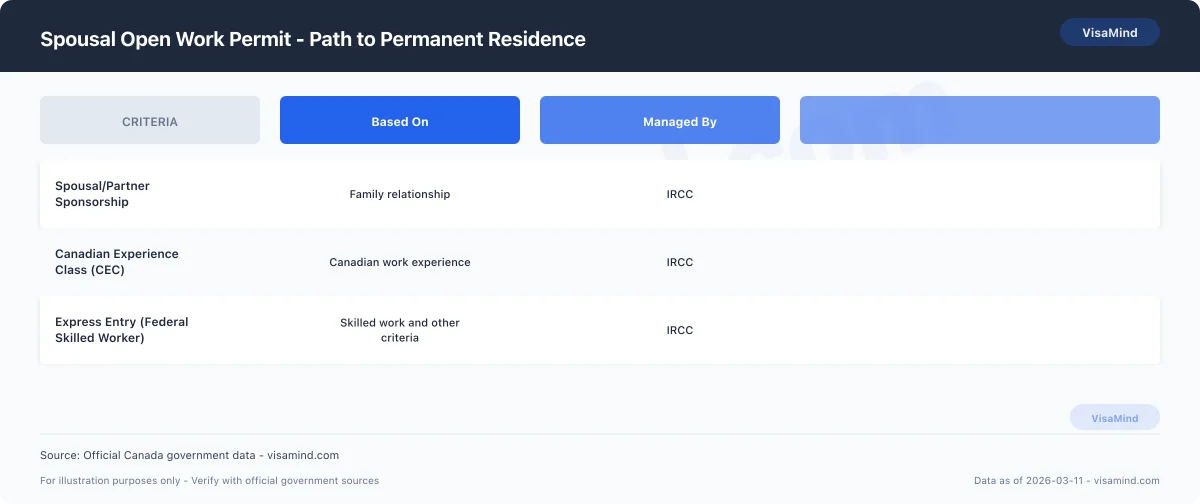
A Canada spousal Open Work Permit often serves as a bridge to permanent residence. Most applicants move forward through Spousal/Partner Sponsorship and may later qualify under federal economic programs such as Express Entry streams.
Sponsorship link
Your most direct path to permanent residence is Spousal/Partner Sponsorship through IRCC.
If your spouse or partner is a Canadian citizen or permanent resident, they may sponsor you so you can become a permanent resident and live, study, and work in Canada without time limits.
The processing time for permanent residence starts on the day IRCC receives your complete application and ends when IRCC makes a final decision.
Key elements of Spousal/Partner Sponsorship include:
- A qualifying relationship
- A complete permanent residence application package
- Ongoing eligibility until a final decision
- Admissibility review (with border enforcement handled by CBSA)
If you hold an Open Work Permit, you may continue working while your permanent residence application is in process, provided your status remains valid.
Federal and provincial pathways
After or alongside sponsorship, you may qualify under federal economic programs managed by IRCC.
Common next steps include:
- Canadian Experience Class (CEC)
- Express Entry (Federal Skilled Worker)
These programs assess factors such as your Canadian work experience, education, and other selection criteria. If you gained skilled work experience while holding an Open Work Permit or a Work Permit (Employer-Specific), that experience may support an economic permanent residence application.
| Pathway | Based On | Managed By |
|---|---|---|
| Spousal/Partner Sponsorship | Family relationship | IRCC |
| Canadian Experience Class (CEC) | Canadian work experience | IRCC |
| Express Entry (Federal Skilled Worker) | Skilled work and other criteria | IRCC |
You must submit a separate permanent residence application for these programs. Approval of a work permit does not automatically grant permanent resident status.
PR processing notes
IRCC starts processing your permanent residence file only after you submit a complete application. Missing forms or documents will delay review.
The processing time:
- Begins when IRCC receives your complete application
- Ends when IRCC issues a final decision
If you need to extend your temporary status while waiting, you can apply to extend your work authorization using the appropriate form, such as Form IMM 5710, if you’re extending a work permit from inside Canada.
Maintain valid temporary status until you receive permanent residence approval. Losing status complicates your immigration record and may delay your long-term plans.
When to Get Help
#You increase your risk of refusal when eligibility is unclear or your forms contain errors. Most issues come from incomplete answers, missing documents, or confusion between different permit types.
Seek professional guidance if your situation doesn’t fit a straightforward Spousal/Partner Sponsorship with an accompanying Open Work Permit application.
Complexity increases if:
- You’re unsure whether you or your spouse meet eligibility requirements.
- You previously held a Work Permit (Employer-Specific) and now want to change to an Open Work Permit.
- You’re completing Form IMM 5710 and don’t know how to answer status or employment history sections.
- Your family composition changed and you must update IRCC records.
Small errors cause long delays. IRCC can return or refuse an application with incomplete fields or missing required documents.
Use this comparison to assess risk:
| Situation | Risk Level | Why It Matters |
|---|---|---|
| All fields complete, documents included | Lower | IRCC can process without follow‑up |
| Missing documents | High | Application may be returned |
| Incorrect or inconsistent information | High | Credibility concerns or refusal |
| Unclear eligibility | High | You may apply under the wrong category |
If you hesitate on key sections of IMM 5710, don’t guess.
Issues that usually need a pro
Some issues require careful legal review because mistakes directly affect approval.
Consider help if:
- IRCC previously refused an application.
- You suspect you or your spouse may not be eligible.
- You submitted incorrect information and need to correct it.
- You’re unsure which documents IRCC requires for your Open Work Permit.
Incomplete or inaccurate details are a common cause of delay. Double-check every field and confirm you included each required document listed in the official instructions.
Professional support can help you:
-
Review eligibility before filing.
-
Audit your completed IMM 5710.
-
Confirm document completeness.
If your application involves uncertainty about status, sponsorship stage, or permit category, resolve those issues before submitting anything to IRCC.
Eligibility Pitfalls
#Small filing mistakes can derail your Canada spousal Open Work Permit application. Most refusals at this stage stem from incomplete forms or weak proof of your relationship.
Common filing errors
You must prove your relationship is genuine and qualifies under Spousal/Partner Sponsorship rules. Without clear documentation of your marriage or partnership, IRCC can’t assess your eligibility for an Open Work Permit.
Common issues include:
- Missing marriage certificates or partnership proof
- Inconsistent names or dates across documents
- Failing to show the connection between you and your sponsoring spouse or partner
IRCC also rejects applications with incomplete or unsigned forms. Submitting Form IMM 5710 without a signature or leaving required fields blank may get your application returned or refused.
| Filing Issue | Result |
|---|---|
| No proof of relationship | IRCC cannot confirm eligibility |
| Unsigned IMM 5710 | Application may be returned |
| Incomplete answers | Processing delays or refusal |
Review every form carefully before submission. Even minor omissions can stop processing.
Timing and document mistakes
You must submit a complete and properly signed application at the time you apply. IRCC does not assess partial submissions.
Pay attention to document versions. Using an outdated IMM 5710 or failing to validate the form before submission can cause problems.
Avoid these timing and document errors:
-
Submitting forms before gathering full relationship evidence
-
Uploading unclear or incomplete scans
-
Forgetting signatures where required
If you previously held a Work Permit (Employer-Specific), make sure the details you provide match your prior records. Inconsistent employment history can trigger further review.
Confirm all documents are complete, legible, and consistent before you apply. This helps reduce the risk of delays and refusal.
Is a spouse open work permit right for your partner?
#You need clear proof of your relationship and solid evidence of your status in Canada before you apply. IRCC will check both elements closely when reviewing an Open Work Permit request connected to a spouse who works or studies in Canada.
Document checklist
Show that your relationship is genuine and that your spouse currently works or studies in Canada. IRCC expects organized, consistent documentation.
Core documents typically include:
- Proof of your relationship to your spouse (such as a marriage certificate or evidence of a recognized partnership).
- Documents confirming your spouse’s employment or student status in Canada.
- A completed Form IMM 5710 application form, if applying from inside Canada.
- Copies of identity documents for both of you.
Present documents in a clear format. Make sure names and dates match across records.
| Document Type | Purpose |
|---|---|
| Relationship proof | Confirms eligibility as a spouse or partner |
| Employment or study evidence | Shows your spouse’s qualifying status in Canada |
| IMM 5710 | Formal request for a Work Permit |
An Open Work Permit allows broader employment options than a Work Permit (Employer-Specific), but you still need to meet IRCC’s documentary standards.
Confirm the sponsor's status
Your spouse’s status in Canada directly affects eligibility. Confirm that your spouse currently holds valid authorization as a worker or student.
Collect recent proof showing active employment or enrollment. These documents should clearly identify your spouse and confirm their current role or study status.
| Sponsor Situation | What You Need to Show |
|---|---|
| Working in Canada | Evidence of ongoing employment |
| Studying in Canada | Evidence of active student status |
If you’re also pursuing Spousal/Partner Sponsorship for permanent residence, keep the applications consistent. Names, dates, and relationship details must match across all forms and supporting records submitted to IRCC.
How long does processing take?
#IRCC publishes estimated processing times based on the type of Open Work Permit and where you apply. As of March 2026, most spousal open work permit applications take 2 to 5 months, but the exact timeline depends on your stream and processing location.
Standard timelines
For a Spousal Open Work Permit, IRCC lists a current processing range of:
| Application Type | Estimated Processing Time (March 2026) |
|---|---|
| Spousal Open Work Permit | 2 to 5 months |
This estimate applies to standard, complete applications. Processing time starts the day IRCC receives your full application and ends when an officer makes a decision.
Times vary by:
- Whether you apply inside or outside Canada
- The specific stream under Spousal/Partner Sponsorship
- The office processing your file
IRCC calculates these timelines based on current workload and how long similar applications recently took to finalize. If application volumes increase beyond annual immigration targets, processing may take longer.
Exceptions and calculations
IRCC only commits to processing complete applications within the published timeframe. If you submit an incomplete form—such as Form IMM 5710 for in‑Canada applicants—IRCC may return or delay your file.
The processing time:
-
Starts when IRCC receives your complete application
-
Ends when IRCC makes a decision
-
Does not include mailing time
If you apply from outside Canada or the United States, add 3 to 4 months for mailing and document transfer times.
Non-routine cases take longer. IRCC may require extra review if your background information needs clarification or documents are missing. A Spousal Open Work Permit is different from an employer-specific Work Permit, and each category may move at a different pace depending on demand.
How to check current times
You can check current timelines directly with Immigration, Refugees and Citizenship Canada (IRCC) before you apply.
Follow these steps:
-
Go to the IRCC processing times tool.
-
Select “Work Permit.”
-
Choose the appropriate category (such as spousal open work permit).
-
Enter your application location.
The tool shows how long IRCC expects to process an application received today. It reflects recent averages and updates regularly.
If IRCC cannot provide accurate timelines due to global events or operational disruptions, the tool will indicate that processing times are temporarily unavailable. In that case, expect delays beyond the standard 2 to 5 months.
Fees
#| Component | Amount |
|---|---|
| Filing fee (IMM-5710)Work permit extension/change conditions (in Canada). | CA$155 (approx $113 USD) |
| BiometricsBiometrics: CA$85 (approx $62 USD) (as of 2026-02). Verify the current fee on the official schedule before filing. | CA$85 (approx $62 USD) |
Fees change; always verify on IRCC.
Required forms
#Plan your Spousal Open Work Permit with free Canada tools
#Itemized government fees for Spousal Open Work Permit and other Canada categories.
See how your profile scores against Spousal Open Work Permit and other Canada visas.
Typical wait times and stage breakdowns for Spousal Open Work Permit and related Canada visas.
Common interview questions and feedback for Canada visa applicants.