
Is This Comparison for You?
#The Opportunity Card offers non-EU/EEA nationals a chance to enter Germany for job-seeking or self-employment purposes. It requires meeting specific qualifications such as recognized vocational or academic training. In contrast, the Job Seeker Visa allows you to stay in Germany for up to six months to look for a job and does not require a points system.
Who Benefits from This Guide?
This guide is beneficial for non-EU/EEA nationals who are considering relocating to Germany for employment opportunities. If you are unsure whether to apply for the Opportunity Card or the Job Seeker Visa, this comparison will help you understand which option aligns with your qualifications and career goals.
Understanding Your Immigration Needs
Before deciding between the Opportunity Card and the Job Seeker Visa, assess your qualifications and career intentions. If you have recognized academic or vocational qualifications, the Opportunity Card may suit you. Alternatively, if you are solely focused on finding employment in Germany, the Job Seeker Visa could be appropriate.
Tip: Review the Opportunity Card and Job Seeker Visa requirements on the BAMF website to ensure you meet the necessary criteria.
Ideal Candidates for Comparison
Ideal candidates for this comparison are those who have completed vocational or academic training and are from outside the EU/EEA. If you are interested in the flexibility of becoming self-employed while job seeking, consider the Opportunity Card. If your primary goal is to secure a job, the Job Seeker Visa might be more suitable.
Important: Ensure you have the required financial resources and language proficiency as these are critical for both visa options.
Converting Between Options
#Germany offers multiple pathways for non-EU/EEA nationals seeking employment opportunities, including the Opportunity Card and the Job Seeker Visa. These options provide distinct routes for entering the German labor market.
Process of Switching Options
Switching from an Opportunity Card to a Job Seeker Visa, or vice versa, involves specific processes. Both options initially require you to demonstrate eligibility through qualifications or scoring points in a system managed by BAMF. - Ensure your qualifications are recognized in Germany. - Meet the financial requirements for the new visa type. - Gather necessary documentation, such as proof of language proficiency.
Important: Consult the Federal Office for Migration and Refugees (BAMF) for up-to-date requirements before initiating any switch.
Legal Implications of Converting
Converting between these visa types may affect your legal status in Germany. It's key to maintain valid residency throughout the process to avoid legal issues.
Warning: Failure to switch appropriately might lead to a lapse in your legal stay, potentially resulting in penalties or deportation.
Timeline for Transitioning
The timeline for transitioning between an Opportunity Card and a Job Seeker Visa depends on various factors, including document preparation and processing times. Typically, changes might take several weeks.
| Process | Estimated Time |
|---|---|
| Document Preparation | 2-4 weeks |
| Application Processing | 4-8 weeks |
Tip: Check the Processing Times Guide for updated timelines to avoid unexpected delays.
What Really Sets Them Apart
#Germany offers different pathways for non-EU/EEA nationals seeking employment opportunities. The Opportunity Card and the Job Seeker Visa are two primary options designed to facilitate this process. While both visas aim to help candidates find jobs, they differ significantly in eligibility criteria and long-term benefits. Understanding these differences can help you make an informed decision about which option best suits your career goals and qualifications. Let's explore the key factors that set these two options apart.
Eligibility Criteria Variations
The eligibility criteria for the Opportunity Card and the Job Seeker Visa are distinct. The Opportunity Card employs a points-based system requiring applicants to accumulate at least six points based on their qualifications and other factors. Opportunity Card - Recognized vocational or academic training
- German or English language proficiency
- Proof of financial means In contrast, the Job Seeker Visa doesn't use a points-based system. Instead, applicants must demonstrate a recognized academic qualification and sufficient financial resources. This focus on academic credentials can be advantageous for those with strong educational backgrounds.
Tip: Consider your qualifications and language skills when choosing between the two options, as these factors significantly impact eligibility.
Job Search vs Skill Recognition
While both visas allow you to enter Germany for job-seeking purposes, they differ in how they facilitate employment. The Opportunity Card not only allows job search activities but also permits self-employment, making it a flexible option for entrepreneurs. The Job Seeker Visa, on the other hand, is exclusively focused on finding employment within Germany. It does not offer the self-employment option, which can limit your opportunities if you are considering starting your own business.
Important: If you are considering self-employment, the Opportunity Card offers a more suitable pathway.
Impact on Permanent Residency
Both the Opportunity Card and the Job Seeker Visa can serve as stepping stones towards permanent residency in Germany. However, the pathways they offer differ.
The Opportunity Card, with its flexible employment options, might provide a broader range of experiences that can be beneficial when applying for permanent residency. Job Seeker Visa Conversely, the Job Seeker Visa focuses on transitioning to a work visa once employment is secured, which may lead directly to permanent residency if the job meets the necessary criteria.
Tip: Consider your long-term residency goals in Germany when selecting between these options to ensure alignment with your career path.
Common Misconceptions
#The Opportunity Card and the Job Seeker Visa are two distinct pathways for non-EU/EEA nationals to explore employment opportunities in Germany. Despite their popularity, there are several misconceptions surrounding these options that can lead to confusion. Understanding the differences between these options is required for making an informed decision. Both options have distinct requirements and purposes, which are often misunderstood.
Visa vs Card: Common Mix-Ups - The Opportunity
Card is often incorrectly referred to as a visa. In fact, it serves as a residence permit under Section 20a of the Residence Act (AufenthG).
- The Job Seeker Visa is a national visa, which allows entry into Germany for the purpose of finding employment. - Some believe that both options provide the same privileges. However, they differ in terms of validity duration and specific eligibility criteria.
Important: Always verify whether you need a visa or a residence permit based on your nationality and the purpose of your visit to Germany.
Myths About German Work Visas -
A common myth is that the Job Seeker Visa guarantees a job in Germany. It only allows you to enter Germany to search for employment. - There is a misconception that proficiency in German is not required. While some roles may not require it, having language skills can enhance job prospects significantly. - Another myth is that the Opportunity Card and Job Seeker Visa are interchangeable. They cater to different needs and have varied requirements.
Tip: Check the Job Seeker Visa and Opportunity Card pages for detailed eligibility criteria and application procedures.
Confusions About Eligibility -
Many assume that having any qualification is enough for eligibility. However, the qualifications must be recognized in Germany (F2, F8).
- Scoring six points in the points system alone is not sufficient for the Opportunity Card. Other criteria must also be met (F3, F6).
- There is often confusion regarding financial requirements. Both options require proof of sufficient financial resources to cover living expenses.
Warning: Failure to provide recognized qualifications or demonstrate sufficient financial resources can lead to application denial (F19, F20).
At a Glance
#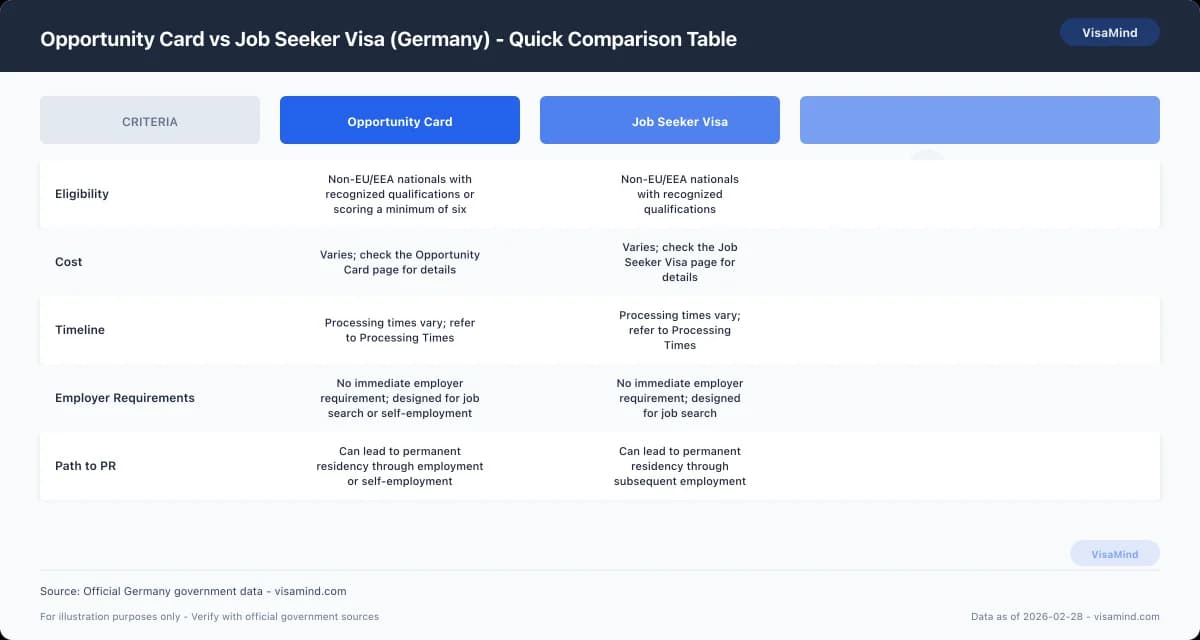
Germany offers two main pathways for job seekers from outside the EU/EEA: the Opportunity Card and the Job Seeker Visa. Each option caters to different profiles with distinct eligibility criteria and processes.
Eligibility Requirements
Eligibility for the Opportunity Card is determined through a points system, where applicants must score at least six points and meet additional criteria such as recognized vocational or academic training. The Job Seeker Visa requires a recognized academic degree and sufficient financial resources to support your stay in Germany.
| Criteria | Opportunity Card | Job Seeker Visa |
|---|---|---|
| Points System | Yes (min. 6 points) | No |
| Recognized Qualifications | Yes | Yes |
| Financial Resources | Yes | Yes |
| German/English Language | Recommended | Yes |
Important: Ensure your qualifications are recognized in Germany to avoid delays.
Cost and Fees Overview
The application fee for both visas is typically around €75 as of 2026, but this may vary depending on your specific situation and country of residence. Verify on the official website for the most accurate fee details.
Processing Timeframes
The processing time for the Opportunity Card can range from 4 to 12 weeks, depending on the completeness of your application and the workload of the German consulate handling your case. The Job Seeker Visa generally takes 6 to 12 weeks to process. It is advisable to check the Processing Times guide for updated timelines.
Employer Involvement Needed Neither the
Opportunity Card nor the Job Seeker Visa requires prior employer involvement to apply. Both visas allow you to enter Germany to seek employment independently.
Tip: While employer involvement is not required, having job leads or offers can expedite your job search process once you arrive in Germany.
Option A Is Better When...
#Germany's Opportunity Card is designed for skilled professionals from non-EU/EEA countries to enter the country with the flexibility to seek employment or start a business. This option is particularly beneficial for those who meet certain qualifications and want to explore opportunities in Germany without a pre-existing job offer.
Best for Skilled Professionals The Opportunity
Card is particularly advantageous for skilled professionals who have recognized qualifications. If your academic or vocational qualifications are acknowledged in Germany, this card allows you to explore various job opportunities upon arrival. - Allows entry without a job offer, ideal for those with recognized qualifications. - Supports both job-seeking and self-employment pathways. - Provides flexibility to explore diverse career options in Germany.
Tip: Ensure your qualifications are recognized in Germany to maximize your chances of securing employment. Check the Qualification Recognition process for more details.
When No Job Offer Exists
For individuals who are interested in moving to Germany but don't yet have a job offer, the Opportunity Card offers a viable solution. This visa allows entry into Germany for job-seeking purposes, which is necessary when a job offer is not yet secured. - Ideal for candidates who want to explore the job market onsite. - Offers the ability to network and attend interviews in person. - Suitable for those considering self-employment or entrepreneurial ventures.
Important: You must demonstrate sufficient financial resources to support yourself while searching for employment in Germany. This often requires proof of funds, such as a blocked bank account.
Faster Entry to Germany The Opportunity
Card can provide a quicker pathway to Germany for those eager to start their job search or entrepreneurial activities. Unlike the Job Seeker Visa, which might have more stringent entry requirements, this card offers a streamlined entry process. - Facilitates faster entry without the need for a pre-arranged job offer. - Allows immediate start of job search or business planning upon arrival. - Reduces pre-departure preparation time compared to other visa types.
Tip: Check the Federal Foreign Office's Consular Services Portal for detailed application steps and timelines.
When to Pick the Second Option
#In 2026, Germany issued over 20,000 job seeker visas to individuals from non-EU/EEA countries, highlighting the significant demand for opportunities in the German job market. For those planning to work in Germany, understanding the advantages of the Job Seeker Visa over other options like the Opportunity Card is required in making an informed decision.
Ideal for Direct Job Seekers The Job Seeker
Visa is a perfect fit for individuals who have a clear professional path and are ready to engage directly with potential employers upon arrival in Germany. This visa provides a dedicated six-month period to actively seek employment. - You have a recognized qualification and a targeted job sector in mind. - You prefer to engage directly with companies through interviews and networking events. - You are prepared to convert your visa to a work permit upon securing a job.
Important: Ensure your qualifications are recognized in Germany to avoid complications during the job search phase.
When Employer Sponsorship Available
If you have an employer ready to sponsor your work permit, opting for the Job Seeker Visa can streamline your transition. This visa allows you to be on the ground in Germany, making it easier to finalize job offers and contracts. - You have a tentative job offer and need to complete formalities in person. - Your employer needs you to start work as soon as possible. - You plan to apply for a work permit or Blue Card once employed.
Warning: Without a solid job offer, relying solely on employer sponsorship can be risky. Ensure you have sufficient savings to cover your stay.
Long-term Residency Opportunities The Job Seeker
Visa can be a strategic step towards long-term residency in Germany. Once you secure employment, transitioning to a work permit or Blue Card opens pathways to permanent residency. - You aim to stay in Germany beyond the initial job-seeking period. - You are eligible for the EU Blue Card, with plans for permanent residency. - You have long-term career goals in Germany that align with residency opportunities.
Tip: Consider the Blue Card EU as a pathway to permanent residency if your job meets the required salary threshold.
Real Scenarios
#In Germany, the Opportunity Card and Job Seeker Visa offer distinct pathways for non-EU/EEA nationals aiming to explore employment opportunities. Both options cater to different profiles and have unique requirements, making it required for prospective applicants to understand which aligns best with their circumstances. The Opportunity Card allows individuals to search for employment or become self-employed, whereas the Job Seeker Visa is more targeted towards those with a clear professional direction. Understanding these scenarios helps in making informed decisions.
Case Study: Tech Worker
A software engineer from India, who recently completed a Master's degree in Computer Science, is interested in relocating to Germany to explore job opportunities in the tech industry. With a recognized degree and language skills in English, he is eligible for both the Opportunity Card and the Job Seeker Visa. However, he opts for the Opportunity Card due to its flexibility in allowing self-employment. He applies through the Consular Services Portal of the Federal Foreign Office and gathers his documents, including proof of his qualifications and financial resources. Within a few months, he receives his Opportunity Card, providing him six months to secure employment or start a tech consultancy.
Real-life Example: Skilled Tradesperson
A skilled electrician from Brazil holds a vocational qualification recognized in Germany and wants to explore job opportunities in the thriving German construction industry. With his qualifications verified, he considers both the Opportunity Card and Job Seeker Visa. He decides on the Opportunity Card due to its provisions for self-employment, aligning with his long-term goal of starting a business. After applying through the Federal Foreign Office's portal and presenting his qualifications and financial documentation, he receives the card and secures a job within three months, eventually transitioning to self-employment.
Tip: The Opportunity Card can be especially beneficial for skilled tradespersons looking to explore both employment and entrepreneurship in Germany.