
Germany EU Blue Card: Overview
#The Germany EU Blue Card is a residence permit for highly skilled non-EU nationals who want to work in Germany.
It’s designed for university graduates with a qualifying job offer that meets a required salary threshold, offering a faster path toward permanent settlement.
Germany EU Blue Card: Quick summary
The EU Blue Card lets you live and work in Germany as a highly qualified professional from outside the European Union.
You qualify if you:
- Are a non-EU citizen
- Hold a university degree
- Have an employment offer in Germany
- Meet the applicable salary threshold
The salary requirement isn’t optional.
Check the current threshold with the responsible authority before submitting your Form Blue Card Application.
Under Germany’s Skilled Immigration Act, the EU Blue Card is part of the framework for attracting qualified professionals.
It’s distinct from the Opportunity Card, Opportunity Card (Chancenkarte), Self-Employment Visa, and Freelance Visa, since it’s focused on employed, degree-holding professionals.
| Feature | EU Blue Card |
|---|---|
| Target group | Highly qualified non‑EU professionals |
| Education requirement | University degree |
| Employment required | Yes |
| Salary threshold | Yes |
| Settlement track | Fast‑track available |
If you’re applying from abroad, the Federal Foreign Office processes your visa.
Inside Germany, your local Ausländerbehörde issues the residence permit.
Who it's for
The EU Blue Card is meant for professionals with formal academic qualifications who have secured employment in Germany.
You must hold a recognized university degree.
If your qualification needs review, a Form Recognition Application may be required before or during your Blue Card process.
This permit fits if:
- You have a concrete job offer in Germany.
- Your position meets the required salary level.
- You want a structured path toward long-term residence.
It doesn’t apply to self-employed individuals.
If you plan to work independently, look at the Self-Employment Visa or Freelance Visa.
If you’re still searching for work, the Job Seeker Visa or Opportunity Card (Chancenkarte) may be a better fit, since those allow entry to look for employment.
The EU Blue Card requires a qualifying job offer from the start.
Legal context
Germany regulates the EU Blue Card under its Skilled Immigration Act.
The law focuses on attracting highly qualified workers with university degrees.
It sets a binding salary threshold and provides a faster route to settlement than standard residence permits.
Several authorities have distinct roles:
| Authority | Responsibility |
|---|---|
| Federal Foreign Office | Visa processing abroad |
| Local Ausländerbehörde | Residence permits inside Germany |
| Federal Office for Migration and Refugees (BAMF) | Asylum matters |
The EU Blue Card is one part of Germany’s broader skilled migration system.
You must submit a formal Blue Card Application and meet all statutory requirements before approval.
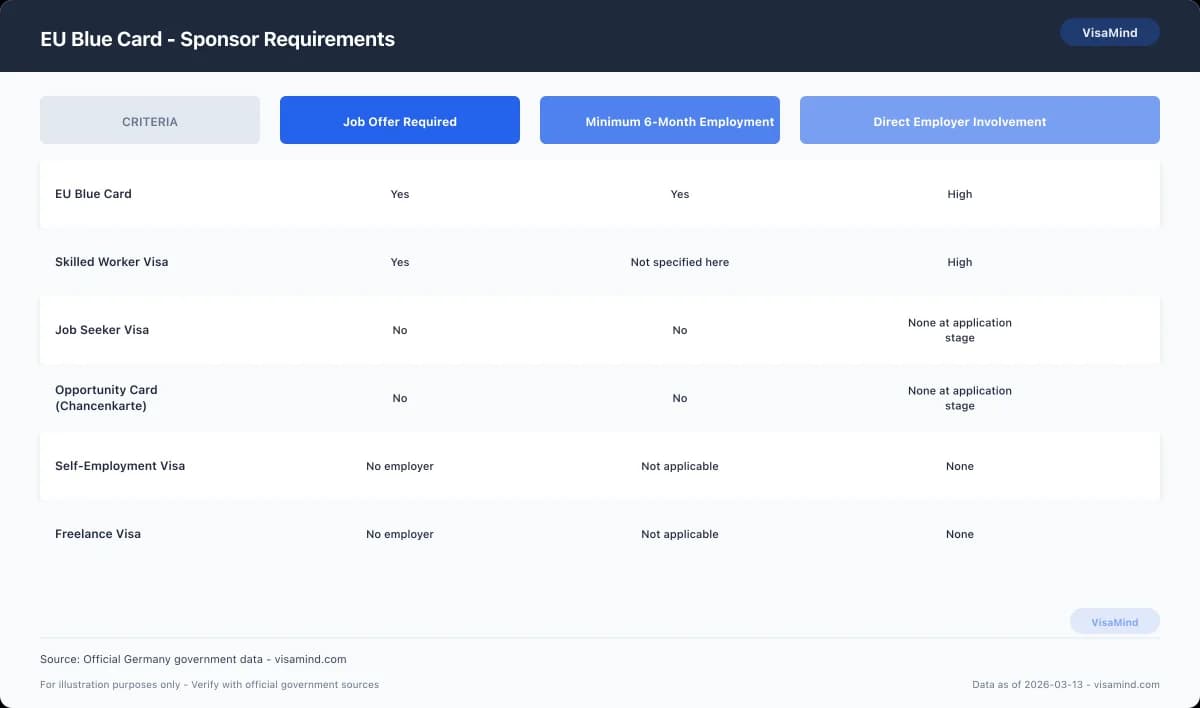
Sponsor Requirements (EU Blue Card Germany)
#Your employer is central to your EU Form Blue Card Application.
In some cases, government approval of your employment conditions is needed before you receive your residence permit.
When employer approval is needed
Employer approval is relevant if you apply for the EU Blue Card with a salary below the standard threshold because your role is a shortage occupation.
In that case, the Federal Employment Agency reviews and approves your employment conditions.
This review checks if your salary meets the reduced threshold allowed for shortage occupations.
Confirm the following with your employer before submitting your Blue Card Application:
- Your role qualifies as a recognized shortage occupation.
- Your salary matches the lower permitted threshold.
- The employment contract clearly states salary, position, and working hours.
If you’re applying under other residence titles—Skilled Worker Visa, Opportunity Card (Chancenkarte), Opportunity Card, Self-Employment Visa, or Freelance Visa—different rules apply.
Those categories have separate approval structures and don’t follow EU Blue Card salary thresholds.
| Situation | Federal Employment Agency Approval Required? |
|---|---|
| Standard EU Blue Card salary | No special approval tied to reduced threshold |
| Reduced salary (shortage occupation) | Yes |
Employer steps and interactions
Your employer must provide a formal job offer or signed employment contract.
This document is the basis for review if approval is required.
If you’re using the lower salary threshold, authorities send your employment details to the Federal Employment Agency for assessment.
You don’t control this step, but your documents must be complete and accurate.
Expect the process to include:
-
Submission of your employment contract.
-
Review of salary level under shortage occupation rules.
-
Confirmation or refusal of approval.
The Federal Foreign Office handles visa applications abroad.
Your local Ausländerbehörde issues the residence permit inside Germany.
The Federal Office for Migration and Refugees (BAMF) doesn’t process EU Blue Card approvals but oversees other migration areas.
Work closely with your employer to avoid inconsistencies between your contract and application.
Mistakes can slow down your case.
The Dual-Track Application
#You’ll complete part of the process abroad and finish it in Germany.
The German mission handles your entry visa, and your local Foreigners Authority issues the EU Blue Card after you arrive.
Apply from your current country (visa application)
If you need a visa, submit your visa application to the German mission in your current country.
The Federal Foreign Office manages consular applications abroad.
You apply for a national visa that lets you enter Germany and later get the EU Blue Card.
This is different from the Skilled Worker Visa, Opportunity Card, Opportunity Card (Chancenkarte), Self-Employment Visa, or Freelance Visa.
A visa waiver applies only in limited cases:
| Passport Type | Visa Exemption Condition |
|---|---|
| Biometric passport holders | Eligible for visa waiver (exception: Serbian passports issued by the Serbian Coordination Directorate) |
| Taiwan passports | Must include an identity card number |
If you qualify for visa-free entry, you still need to apply for the EU Blue Card after arrival.
Requirements can change, so check with the Federal Foreign Office before filing.
After arrival: foreigners authority & registration
After entering Germany, register your address at the Residents’ Registration Office.
Complete this step promptly, since the Foreigners Authority requires proof of registration.
Next, apply for the EU Blue Card at the competent local Ausländerbehörde (Foreigners Authority).
This authority issues residence permits inside Germany.
Your in-country process usually includes:
-
Registering your residential address.
-
Booking an appointment with the Foreigners Authority.
-
Submitting your Form Blue Card Application and supporting documents.
The Federal Office for Migration and Refugees (Bundesamt für Migration und Flüchtlinge – BAMF) provides the official form for the EU Blue Card.
BAMF oversees migration matters at the federal level, but your local authority decides your residence permit.
If you completed a Form Recognition Application for your qualifications, bring confirmation documents to your appointment.
Form, instructions and submission steps
Always use the latest version.
Before filling out the form, review the instructions for your eligibility category.
Requirements may differ depending on your qualification and employment situation.
Follow these steps:
-
Complete all required sections of the form.
-
Sign where indicated.
-
Prepare the required supporting evidence.
-
Submit the application to your competent Foreigners Authority.
Use the checklist in the official instructions to make sure your file is complete.
If you previously held or considered another residence title—like the Skilled Worker Visa or Opportunity Card—apply specifically for the EU Blue Card to get the correct residence permit.
From Work Visa to PR
#The EU Blue Card can lead to permanent residence and, eventually, German citizenship.
You move from a temporary residence title to a settlement permit, and then—if eligible—to naturalization.
Settlement permit (Niederlassungserlaubnis)
A settlement permit gives you permanent residence in Germany.
It removes time limits on your stay and expands labor market access.
You apply at your local Ausländerbehörde.
The Federal Office for Migration and Refugees (Bundesamt für Migration und Flüchtlinge – BAMF) sets the legal framework, but the local authority issues the permit.
In practice, you must show:
- A valid EU Blue Card
- Secure livelihood without relying on public benefits
- Adequate living space
- Contributions to the statutory pension system
- Basic German language skills
- No serious criminal record
If you previously held a Skilled Worker Visa, your time in Germany may count toward eligibility, depending on your residence history.
Time spent on a Opportunity Card or Opportunity Card (Chancenkarte) doesn’t count as fully as employment-based residence.
Your qualifications should already be recognized through your prior Form Recognition Application linked to your Form Blue Card Application.
The Ausländerbehörde may review your employment continuity and salary level before approving permanent residence.
Check guidance from your local Ausländerbehörde for current document checklists and fees in EUR (€).
Naturalization (German citizenship)
After holding lawful residence for the required period, you may apply for German citizenship through naturalization.
You submit your application to your local citizenship authority.
You must generally demonstrate:
- Lawful residence in Germany for the required number of years
- A valid settlement permit or another qualifying permanent residence title
- Financial self-sufficiency
- Adequate German language proficiency
- Knowledge of Germany’s legal and social order
- No serious criminal convictions
Time spent on the EU Blue Card counts as lawful residence.
Periods under other titles, such as the Skilled Worker Visa, may also count if they were continuous and lawful.
You must provide proof of identity, residence history, and integration.
The authority reviews your tax records and employment background before making a decision.
For current eligibility periods, language standards, and fees in EUR (€), consult your local naturalization authority.
Typical next steps after the Blue Card
Most Blue Card holders follow a structured path from temporary residence to long-term status.
-
Maintain qualifying employment under your EU Blue Card.
-
Renew your residence title on time through the Ausländerbehörde.
-
Track pension contributions and residence periods.
-
Apply for a settlement permit once eligible.
-
Consider naturalization after meeting residence and integration requirements.
You may also change your residence purpose.
For example:
| Current Status | Possible Next Title |
|---|---|
| EU Blue Card (employed) | Settlement permit |
| EU Blue Card (career change) | Skilled Worker Visa |
| Employed professional | Self-Employment Visa |
| Employed professional | Freelance Visa |
If you plan to start a business, you must apply for a Self-Employment Visa or Freelance Visa before changing your activity.
Your Blue Card doesn’t automatically cover self-employment.
Always confirm requirements with your local Ausländerbehörde before changing employers, job roles, or residence purpose.
Fees and Processing Times
#You must pay a government fee and expect a processing period that can stretch over several months.
Timelines depend on where and how you apply, so confirm details with the responsible authority before submitting your documents.
Application fee
You must pay €75 for a Form Blue Card Application.
This fee applies to the EU Blue Card residence permit.
The amount is set in EUR and applies as of March 2026.
| Item | Amount (EUR) |
|---|---|
| EU Blue Card application fee | €75 |
If you apply from outside Germany, you submit your visa application through the Federal Foreign Office at the German embassy or consulate.
If you apply inside Germany, you file your residence permit application with your local Ausländerbehörde.
Fees for other immigration routes—like the Skilled Worker Visa, Opportunity Card, Opportunity Card (Chancenkarte), Self-Employment Visa, or Freelance Visa—may differ.
Confirm the exact amount with the authority handling your case before payment.
Authorities do not begin processing until you complete payment.
Standard processing time
A standard EU Blue Card application typically takes 1 to 3 months to process.
| Application Type | Standard Processing Time |
|---|---|
| EU Blue Card | 1–3 months |
This estimate applies as of March 2026. It’s based on the usual pace for standard cases.
If you’re applying from abroad, the Federal Foreign Office handles the visa stage. For those applying inside Germany, the local Ausländerbehörde issues the residence permit.
Processing only begins after you submit a complete Blue Card application. Missing documents inevitably slow things down.
If your case needs a separate recognition procedure for foreign qualifications, that step can impact the total timeline—even if the Blue Card itself is processed on time.
Processing-time variations & verification
Processing times shift depending on several factors:
- Which application category you’re in
- The city or region managing your file
- Whether you apply from abroad or within Germany
Local workload at the Ausländerbehörde matters. Some consular posts also handle cases faster than others.
The Federal Office for Migration and Refugees (Bundesamt für Migration und Flüchtlinge – BAMF) doesn’t issue Blue Cards, but it’s involved in the broader migration system. Your issuing authority is either the Federal Foreign Office (for applicants abroad) or the local Ausländerbehörde (for those in Germany).
Check the current processing times with your responsible authority before making travel plans, quitting your job, or moving.
When to Get Professional Help
#
Not every EU Blue Card case calls for a lawyer. Whether you need legal help depends on who’s preparing your file and the complexity of your situation—especially if recognition or a visa switch is involved.
When the employer usually handles the case
Many large employers in Germany take care of the EU Form Blue Card Application through HR or relocation teams.
They’ll coordinate with the local Ausländerbehörde for residence permits in Germany or with the Federal Foreign Office for visa applications abroad.
Employer support is typically reliable when:
- The job offer meets Blue Card criteria
- Your qualifications match the role
- No separate Form Recognition Application is needed
- You’re applying directly for an EU Blue Card, not switching from a Opportunity Card, Opportunity Card (Chancenkarte), or Skilled Worker Visa
In these scenarios, accuracy is your main job. Double-check every required document and follow the instructions set by your authority.
| Situation | Who Usually Leads | Your Role |
|---|---|---|
| Applying from abroad | Federal Foreign Office + employer | Provide complete documents |
| Applying inside Germany | Local Ausländerbehörde + employer | Confirm document accuracy |
| No recognition issues | Employer HR | Supply verified credentials |
If your case is straightforward and your employer is organized, legal representation is rarely needed.
Situations where a lawyer helps most
Consider an immigration lawyer when your case is legally or procedurally complex.
Mistakes can slow down your residence permit or force you to switch visa categories.
Professional help is valuable if:
- You need a Recognition Application for foreign qualifications
- You’re switching from a Self-Employment Visa or Freelance Visa to an EU Blue Card
- You previously held an Opportunity Card (Chancenkarte) or Job Seeker Visa and need to change status
- The local Ausländerbehörde questions your eligibility
- You’re getting inconsistent answers from different authorities
A lawyer checks your documents against requirements from the Federal Foreign Office and clarifies the legal framework for your residence status.
They’ll help you file under the correct category and avoid delays or rejections due to the wrong permit type.
Conditions and Portability
#EU Blue Card holders must meet ongoing legal requirements. Timing, especially the 180‑day rule, affects your residence rights and any planned changes.
180-day timing considerations
The 180-day period is a key factor for your stay in Germany with an EU Blue Card.
Track any absences or changes in status closely. Hitting the 180-day mark in certain contexts can have consequences for your residence.
Keep it simple:
-
Record departure and re-entry dates.
-
Save travel evidence.
-
Watch your total days away—don’t lose track of the 180-day limit.
The local Ausländerbehörde manages residence permits inside Germany. If you’re unsure about the 180-day rule, ask them for written clarification.
| Issue | Why It Matters |
|---|---|
| Reaching 180 days | May affect validity of your EU Blue Card |
| Poor documentation | Harder to prove compliance |
| Late action | Fewer options to fix status problems |
If you’re planning to switch to another residence title—like a Skilled Worker Visa, Self-Employment Visa, Freelance Visa, or Opportunity Card (Chancenkarte)—check how the 180-day rule might affect your timing before submitting a new Form Blue Card Application.
Other ongoing conditions
You need to keep meeting the conditions under which your EU Blue Card was granted.
That means maintaining the basis on which your application was approved. If anything changes, notify the Ausländerbehörde immediately.
Key steps for compliance:
- Keep your residence permit valid at all times.
- Report relevant personal or employment changes.
- Maintain documentation tied to your Form Recognition Application, if you had one.
- Follow instructions from your Blue Card Application process.
If you entered Germany with a Opportunity Card or another residence title, make sure your transition to the EU Blue Card is properly documented.
For asylum-related cases, the Federal Office for Migration and Refugees (Bundesamt für Migration und Flüchtlinge) (BAMF) is the responsible agency. For employment-based residence, the local Ausländerbehörde is in charge.
Missing these ongoing conditions can affect your ability to keep or change your EU Blue Card status.
Eligibility Requirements
#You’ll need a recognized academic qualification, a qualifying job offer in Germany, and you must meet salary thresholds. Some exceptions exist for IT professionals and recent graduates.
Education & recognized qualifications
You qualify if you have:
- A German university degree, or
- A foreign degree comparable to a German degree, or
- A tertiary-level qualification (at least three years, recognized in Germany)
Your degree has to be formally recognized or deemed equivalent before or during your Form Blue Card Application. If it’s unclear, you might need a Form Recognition Application with the right authority in Germany.
Your qualification must fit the job you’re offered. Authorities check if your academic background matches your job duties.
If you entered Germany on a Opportunity Card, Opportunity Card (Chancenkarte), or Skilled Worker Visa, you can switch to the EU Blue Card once you meet the degree and salary requirements.
Here’s a summary of acceptable qualifications:
| Qualification Type | Requirement |
|---|---|
| German degree | Automatically qualifies |
| Foreign degree | Must be comparable to a German degree |
| Non-traditional tertiary qualification | At least 3 years, recognized in Germany |
The Federal Foreign Office handles visa issuance abroad. Inside Germany, the local Ausländerbehörde decides on the residence permit.
Job offer requirements and salary thresholds
A binding job offer or employment contract in Germany is mandatory.
Your position must match your academic qualification. Unrelated jobs won’t be approved.
For 2026, the minimum gross annual salary thresholds are:
| Category | Minimum Gross Salary (2026) |
|---|---|
| Standard occupations | €50,700 |
| Shortage occupations | €45,934.20 |
| New labor market entrants (degree <3 years) | €45,934.20 |
Shortage occupations and recent graduates (degree less than three years old) qualify for the lower threshold.
Authorities use gross annual income for calculations. Your contract should state this amount.
If you want to be self-employed, look at the Self-Employment Visa or Freelance Visa instead. The EU Blue Card is for salaried work.
Special qualification routes (IT, newcomers)
Some applicants without a traditional academic degree can still qualify.
As an IT professional, you may be eligible if you:
- Have at least three years of relevant professional experience
- Hold a job offer with a gross annual salary of at least €45,934.20 (2026)
Your experience must be directly related to the IT role. Authorities decide if your background is equivalent to a university graduate.
Recent graduates also benefit from the reduced salary threshold if their degree is less than three years old.
If you don’t meet these criteria, other residence options like the Opportunity Card (Chancenkarte) or a Skilled Worker Visa might be necessary before applying for the EU Blue Card.
Common Petition Challenges
#Most EU Blue Card issues come from missing documents, unclear job details, or not meeting eligibility rules. Double-checking your degree comparability, job offer, and submitting a complete application can prevent many headaches.
Top reasons petitions are questioned
Authorities look closely at whether your qualifications meet German standards. If you can’t prove your foreign degree is comparable—usually through a Form Recognition Application—your request can stall or fail.
Incomplete employment contracts also cause problems. The job offer must clearly state the role, salary, and conditions; anything vague or missing leads the local Ausländerbehörde to ask for more information.
Sometimes, approval from the Federal Employment Agency is required. If you skip this step when it’s needed, your application can’t proceed.
A concrete job offer is mandatory. The EU Blue Card isn’t for job seekers; it’s for people with a clear offer in hand.
| Common Issue | Why It Causes Problems |
|---|---|
| No proof of degree comparability | Authorities can’t confirm qualifications |
| Incomplete job offer details | Salary and role can’t be assessed |
| Missing Federal Employment Agency approval | Legal employment unverified |
| No binding job offer | Core eligibility not met |
How to avoid delays and denials
You’ll avoid most delays by filing a complete and accurate Form Blue Card Application from the start. Even small mistakes can trigger requests for corrections.
Before you file, make sure you have:
- Proof of a recognized or comparable academic qualification
- A signed job offer with all position and salary details
- Federal Employment Agency approval, if it’s needed
- All required forms filled out, no missing fields
Check that names, dates, and job details match across all documents.
If you’ve considered a Skilled Worker Visa, Self-Employment Visa, or Freelance Visa, apply under the correct category. Filing under the wrong residence title can mean rejection and starting over.
Applications from abroad go through the Federal Foreign Office. Inside Germany, the local Ausländerbehörde processes your residence permit.
What approval is not guaranteed
Submitting a Blue Card Application doesn’t mean you’ll get approved. Each case is checked individually against statutory requirements.
Even with employer support, the decision is up to the immigration authority. They’ll look at your qualifications, job terms, and any labor market approval needed.
Eligibility for a Opportunity Card or Opportunity Card (Chancenkarte) does not guarantee you’ll qualify for an EU Blue Card. Each status has its own criteria.
You’re responsible for providing proof. If your documents are incomplete or inconsistent, the authority might refuse your application rather than ask for more evidence.
Follow guidance from the Federal Foreign Office or your local Ausländerbehörde for up-to-date requirements.
What documents do I need?
#You’ll need to prove your identity, qualifications, and that you have a concrete job offer in Germany. A solid EU Blue Card application depends on clear evidence in each area.
Identity, personal details and background
Submit documents confirming your identity and personal history. Authorities will check that your details match your job offer and qualifications.
You should prepare:
- A valid passport
- Completed visa or residence permit application forms
- Your current address and contact details
- Information about your educational and professional background
If you’re applying from abroad, your application goes to the Federal Foreign Office through the German mission for your area. If you’re already in Germany, you apply at your local Ausländerbehörde.
Make sure your personal data is consistent across all documents. Misspelled names, missing middle names, or mismatched birth dates can delay your case.
The Federal Office for Migration and Refugees (BAMF) oversees broader migration policies, but your residence permit is decided locally. Double-check that your background information matches your employment documents.
Proof of qualifications and comparability
You’ll need to prove you hold a recognized university degree. The EU Blue Card hinges on showing your academic qualification matches a German degree.
Provide:
- Your university degree certificate
- Academic transcripts, if available
- Evidence that your qualification is comparable in Germany
If your degree needs formal assessment, you might have to complete a Form Recognition Application before or along with your Form Blue Card Application.
Comparability means your education meets German standards for skilled employment. Make sure the name on your degree matches your passport.
If you’ve changed your name, include official documentation showing the change. Without clear proof that your qualifications are comparable, the authorities won’t approve your EU Blue Card.
This requirement sets the EU Blue Card apart from options like the Opportunity Card or Opportunity Card (Chancenkarte), which use different selection criteria.
Job offer evidence
You must show a concrete job offer in Germany. A general intention to work won’t suffice.
Submit:
- A signed job offer or employment contract
- Details of your position
- Information about your employer in Germany
Your job offer must clearly identify:
| Required Detail | What It Should Show |
|---|---|
| Employer information | Legal name and location in Germany |
| Position | Specific role or job title |
| Employment terms | Confirmation of employment arrangement |
The authorities will compare your job offer with your academic background to confirm the role matches your qualifications.
This alignment is central to the EU Blue Card. Unlike the Self-Employment Visa or Freelance Visa, the EU Blue Card requires an employment relationship with a German employer.
Your documentation needs to make that structure obvious.
Fees
#| Component | Amount |
|---|---|
| Application feeApplication fee: €75 (approx $81 USD) (as of 2026-02). Verify the current fee on the official schedule before filing. | €75 (approx $81 USD) |
Fees change; always verify on AA.