
What the Mexican Citizenship (Naturalization) Covers
#Mexican citizenship through naturalization formalizes your legal status based on residency, family ties, origin, marriage, or recognized contributions. You apply using the Form DNN-3 form and complete the process under the authority of the National Immigration Institute (INM).
Routes to citizenship
Mexico grants naturalization through specific legal categories. Your eligibility depends on your circumstances and immigration history.
You may qualify under one of the following routes:
- Naturalization by residency
- Naturalization for having Mexican-born children
- Naturalization for nationals of Latin American countries or the Iberian Peninsula
- Naturalization through marriage to a Mexican citizen
- Naturalization for providing distinguished services or notable contributions
Many applicants first hold a Permanent Resident Visa, including:
Some begin with a Temporary Resident Visa (Family Unity) before moving to permanent status.
| Route | Qualifying Basis |
|---|---|
| Residency | Legal residence in Mexico |
| Mexican-born children | Parent of a child born in Mexico |
| Latin America/Iberia origin | Citizen of eligible country |
| Marriage | Legally married to a Mexican citizen |
| Distinguished service | Recognized contributions or services |
You must submit the DNN-3 application and supporting documents as required by your category.
Who this covers
This process applies to foreign nationals who do not already hold Mexican nationality by birth.
You may qualify if you:
- Hold lawful immigration status issued through INM
- Have a qualifying family relationship to a Mexican citizen
- Are from a Latin American country or the Iberian Peninsula
- Are married to a Mexican citizen
- Have provided recognized services or significant achievements
If you entered Mexico through a family-based residency route, such as Permanent Resident Visa (Family) or Temporary Resident Visa (Family Unity), you may later pursue naturalization if you meet the requirements.
INM manages your immigration status inside Mexico. Mexican consulates issue visas abroad, but naturalization is handled under Mexico’s federal authority once you qualify.
Language and Integration Requirements
#
Mexico requires you to show functional Spanish ability and basic knowledge of the country’s history and culture when you apply for citizenship. The National Immigration Institute (INM) administers immigration status, and citizenship-related testing is part of the naturalization process submitted with Form DNN-3.
Language test
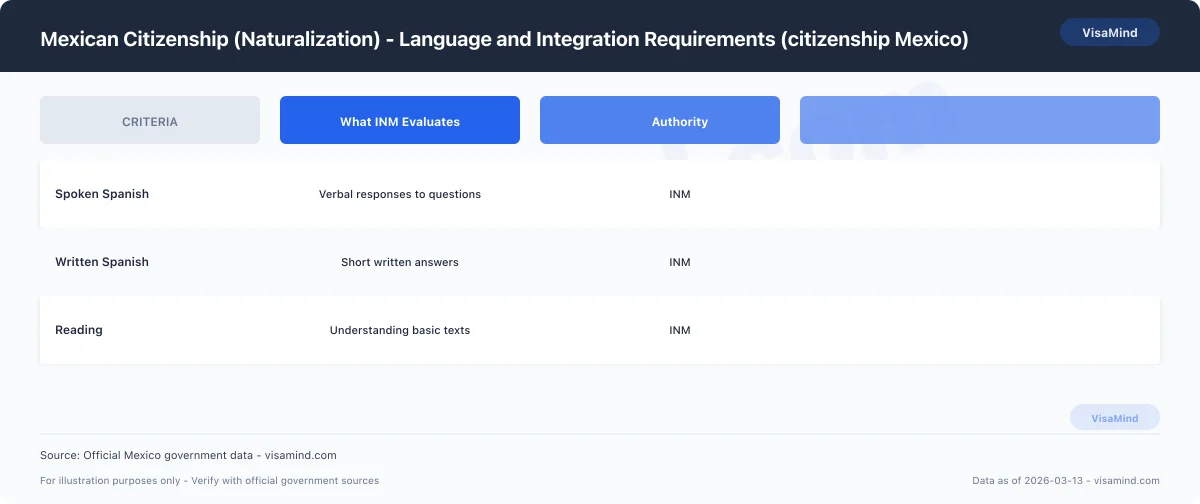
You must demonstrate the ability to understand, speak, read, and write Spanish at a practical level.
The evaluation is included in your naturalization file and supports your DNN-3 application. INM officers check whether you can communicate clearly in everyday situations, not whether you speak perfectly.
You should expect:
- Basic conversation in Spanish
- Reading comprehension
- Writing short responses in Spanish
If you hold or previously held status such as:
- Permanent Resident Visa
- Permanent Resident Visa (Family)
- Permanent Resident Visa (Points System)
- Temporary Resident Visa (Family Unity)
you still need to meet the language requirement unless a legal exemption applies. Confirm any exemption directly with INM before filing.
Mexican consulates issue visas abroad, but language assessment for citizenship happens through the naturalization process in Mexico.
Civic and cultural knowledge
You must show knowledge of Mexican history, culture, and national values as part of your integration.
The assessment confirms that you understand key historical events, constitutional principles, and national symbols. INM evaluates this knowledge during your naturalization review tied to Form DNN-3.
You should prepare to demonstrate familiarity with:
- Major historical milestones
- Structure of the Mexican government
- National symbols and civic traditions
- Basic constitutional principles
| Requirement Area | Evaluated During Naturalization | Authority |
|---|---|---|
| Spanish language ability | Yes | INM |
| History and cultural knowledge | Yes | INM |
| Visa issuance abroad | No | Mexican consulates |
Application Process
#You must complete online pre-registration, prepare the correct forms, and attend an appointment with the National Immigration Institute (INM). Accuracy at each step prevents delays or rejection.
Pre-registration and forms
Start with the National Immigration Institute (INM).Review the instructions before entering any information. Requirements differ depending on your underlying status, such as:
- Permanent Resident Visa
- Permanent Resident Visa (Family)
- Permanent Resident Visa (Points System)
- Temporary Resident Visa (Family Unity)
Complete the online pre-registration. You must:
- Validate your CURP number
- Enter full biographical data
- Provide details about your legal residency status
Download the Form DNN-3 form before scheduling your appointment. Fill out every required section and sign where indicated.
| Required Item | Action You Must Take |
|---|---|
| CURP | Validate during online registration |
| Citizenship form | Download and complete |
| DNN-3 | Download and complete before booking |
| Supporting evidence | Gather according to your category |
Incomplete forms or missing signatures can prevent you from moving forward.
Booking and submitting
After pre-registration, schedule your appointment with INM. Don’t book until you’ve finalized your forms and gathered all required evidence.
Bring the following to your appointment:
- Printed and signed application form
- Completed DNN-3 form
- Supporting documents tied to your residency category
- Any additional documents listed in the official instructions
Submit all materials in the format specified by INM. Follow the checklist for your category.
If you apply based on a residency path such as Permanent Resident Visa (Family) or Temporary Resident Visa (Family Unity), ensure your legal residency information matches INM records.
If you’re unsure about documentary specifications, consult the official INM instructions before attending your appointment.
What the INM handles
The National Immigration Institute (INM) manages immigration permits and border control within Mexico. It processes your citizenship-related filings after you submit them.
INM will:
- Receive and review your completed forms
- Verify your legal residency history
- Confirm that your category requirements are met
- Process documentation connected to your immigration status
INM does not issue visas abroad. Mexican consulates handle visa issuance outside Mexico.
Your responsibility is to submit accurate, complete documentation. INM’s role is to evaluate what you provide under the applicable legal category.
How to apply for citizenship Mexico
#You apply through the National Immigration Institute (INM) and must appear in person with complete documentation. Your passport, residency status, financial records, and registration data must match the information INM has on file.
Documents to bring
Bring original documents and printed copies to your confirmed appointment with INM.
Required identification and registration documents:
- Valid passport or valid identity and travel document recognized under international law
- Printed appointment confirmation
- Biographical data, including place of birth, city, and country
- Your current address as registered with INM
- Details of your legal residency status in Mexico
- Valid CURP for registration validation
Your passport must be valid on the day you attend the appointment. Expired documents can lead to immediate rejection.
If you hold status through a Permanent Resident Visa, Permanent Resident Visa (Family), Permanent Resident Visa (Points System), or Temporary Resident Visa (Family Unity), ensure your residency information matches INM records.
| Document | Must Be Valid | Notes |
|---|---|---|
| Passport or travel document | Yes | Recognized under international law |
| CURP | Yes | Required for registration validation |
| Appointment confirmation | Yes | Printed copy required |
Proofs and conditional items
INM reviews your financial and personal records to confirm eligibility.
You must provide documents showing:
- Employment or pension income exceeding the equivalent of $1,500 per month
- Information about any property you own in Mexico
Financial documents must clearly identify you and show consistent monthly income. Pension statements or employer-issued letters should match your registered personal data.
If your residency category required prior financial qualification—such as under the Permanent Resident Visa (Points System)—your income documentation must remain consistent with that record.
You may also need to complete and submit forms such as Form DNN-3, as instructed by INM during your appointment process. Always verify current procedural requirements directly with INM before attending your appointment.
Fees and Processing Times
#You must pay a government filing fee and prepare for a processing period that often lasts more than a year. The exact timeline depends on your category and where you file.
Application and certificate fees
As of February 2026, the citizenship application fee is MX$10,000. You pay this amount as part of your naturalization filing.
| Item | Government Fee (MXN) |
|---|---|
| Mexican citizenship application | MX$10,000 |
The National Immigration Institute (INM) manages immigration status in Mexico, including residence documents such as the Permanent Resident Visa, Permanent Resident Visa (Family), Permanent Resident Visa (Points System), and Temporary Resident Visa (Family Unity). Mexican consulates issue visas abroad.
If you previously paid immigration-related fees, such as those for residence or the Form DNN-3 document, those payments do not replace the citizenship fee. Verify current fee amounts directly with INM before you pay, as government fees can change.
Keep proof of payment. You must submit it with your application file.
Processing time expectations
Standard processing for Mexican citizenship currently ranges from 12 to 24 months as of March 2026. Expect your case to remain pending for at least one year in most cases.
| Processing Type | Estimated Time |
|---|---|
| Standard naturalization | 12–24 months |
Processing times vary based on:
- Your eligibility category
- The office handling your case
- Overall application volume
Your prior status—such as holding a Permanent Resident Visa, Permanent Resident Visa (Family), Permanent Resident Visa (Points System), or Temporary Resident Visa (Family Unity)—does not guarantee faster adjudication. Each naturalization case moves on its own timeline.
Confirm current processing estimates with INM before filing. Local workload and administrative factors can affect how long your application remains under review.
The Citizenship Ceremony
#After approval of your naturalization application, you attend a formal ceremony and receive your Carta de Naturalización. You must pay the issuance fee and complete any final administrative steps before you can exercise full rights as a Mexican citizen.
Receiving the certificate
You receive your naturalization certificate in person once the authority finalizes your case. The document confirms your status as a Mexican citizen and serves as official proof for future identification procedures.
You must pay the certificate issuance fee before collection.
| Item | Amount (MXN) |
|---|---|
| Naturalization certificate (Carta de Naturalización) | MX$900 |
Verify the current amount directly with the Secretaría de Relaciones Exteriores (SRE) before payment, as government fees can change.
If you previously held status through the Permanent Resident Visa, Permanent Resident Visa (Family), Permanent Resident Visa (Points System), or Temporary Resident Visa (Family Unity), your immigration record with INM remains part of your file history. The Form DNN-3 payment receipt for prior immigration services does not replace the naturalization certificate fee.
Bring official identification and any receipt required by the SRE when you collect your certificate.
Post-approval steps
After you receive your certificate, update your legal status across government records. Your naturalization certificate becomes the basis for obtaining Mexican identity documents.
Complete these steps promptly:
-
Safeguard the original certificate in a secure place.
-
Use the certificate to request national identification documents.
-
Notify relevant institutions of your change in nationality where required.
If you previously held a resident card issued through the INM, confirm whether you must formally close or update that record. The INM manages immigration permits and border control, but naturalization documentation falls under the SRE’s authority.
Keep copies of your certificate and payment receipt. You’ll need the certificate number and issuance details for future administrative procedures.
Who Can Apply for Citizenship
#Mexican citizenship requires first obtaining lawful residence through an approved immigration pathway. Most people qualify either by holding long-term residence or through close family ties to a Mexican national.
Typical Pathways
Legal immigration status, issued by the National Immigration Institute (Instituto Nacional de Migración) (INM), is required before seeking citizenship. In most cases, this means permanent resident status.
Common residence routes:
- Permanent Resident Visa
- Permanent Resident Visa (Family)
- Permanent Resident Visa (Points System)
- Temporary Resident Visa (Family Unity) (which can lead to permanent status)
The visa process begins at a Mexican consulate abroad. After entering Mexico, INM manages your resident status.
| Pathway | Who It Is For | Issued By | Managed In Mexico By |
|---|---|---|---|
| Permanent Resident Visa | Applicants who qualify under economic or other criteria | Mexican consulate | INM |
| Permanent Resident Visa (Points System) | Applicants meeting points-based criteria | Mexican consulate | INM |
| Temporary Resident Visa (Family Unity) | Applicants joining qualifying family | Mexican consulate | INM |
| Permanent Resident Visa (Family) | Close relatives of Mexican citizens or residents | Mexican consulate | INM |
You must keep lawful status and comply with INM requirements. INM oversees immigration permits and border control within Mexico.
Mexican authorities may request the Form DNN-3 form for document validation, confirming nationality records.
Family-based routes
Family relationships can create eligibility for residence and support a citizenship application later. You’ll need to prove the qualifying relationship with official civil documents.
Common qualifying relationships:
- Spouse of a Mexican citizen
- Parent of a Mexican citizen
- Child of a Mexican citizen
Typically, you apply first for a Permanent Resident Visa (Family) or a Temporary Resident Visa (Family Unity) at a Mexican consulate. Once in Mexico, INM issues your resident card.
| Relationship | Initial Visa Option | Authority Involved |
|---|---|---|
| Spouse of Mexican citizen | Permanent Resident Visa (Family) | Consulate + INM |
| Parent of Mexican citizen | Permanent Resident Visa (Family) | Consulate + INM |
| Child of Mexican citizen | Permanent Resident Visa (Family) | Consulate + INM |
Official civil records are required to establish the relationship. Mexican consulates issue visas abroad; INM grants and manages your status inside Mexico.
Why Citizenship Applications Get Denied
#Most denials happen because of filing errors or mismatched records with the National Immigration Institute (INM). Your personal data needs to match your immigration history exactly before you apply.
Common procedural mistakes
Clerical and registration errors are a frequent reason for rejection. INM examines your identity and immigration records closely, and even minor inconsistencies can stop your case.
Watch for these issues:
- Not validating your CURP before starting registration
- Listing an address that doesn't match INM records
- Submitting forms with data that differs from your INM file
If you’ve held a Permanent Resident Visa, Permanent Resident Visa (Family), Permanent Resident Visa (Points System), or Temporary Resident Visa (Family Unity) in the past, your address and identity details must match what’s on file with INM.
| Issue | Why It Leads to Denial |
|---|---|
| CURP not validated | INM cannot properly link your identity records |
| Incorrect registered address | Application data conflicts with INM system records |
| Inconsistent immigration history | Raises record verification problems |
Check your CURP status and registered address with INM before filing. Fix any errors ahead of time.
Other grounds for refusal
Submitting a citizenship application doesn’t guarantee approval. INM reviews each case on its own, even if you already obtained status through a Permanent Resident Visa.
Approval of a visa, including those issued after a Form DNN-3 or through family-based residency, doesn’t automatically lead to citizenship. Citizenship is a separate legal determination.
INM may refuse your application if your file doesn’t meet its internal review standards or if your records don’t fully support your request.
Before applying, make sure your immigration status history is consistent. Your personal data must match INM records exactly. Your residency pathway—whether Family, Points System, or another—should be clearly documented.
Citizenship is a new legal process, not simply an extension of your previous visa approval.
Fees
#| Component | Amount |
|---|---|
| Application feeExtracted from guide content — verify against official source | MX$10,000 (approx $580 USD) |
| Naturalization certificate feeCarta de naturalización — verify against SRE | MX$900 (approx $52 USD) |
Fees change; always verify on INM.