
Quick summary
#Applicants requesting national or EU long-term residence under a ground listed in section 4 of EX-11.
For the underlying long-term residence authorization, not merely for a TIE renewal.
File with the competent Oficina de Extranjería or through Mercurio; after approval, use EX-17 for the TIE.
The section 4 route and official information sheet Passport identity and immigration records Residence-period, absence, fee, and route-specific evidence
Overview (What is Form EX-11?)
#EX-11 combines two authorizations on one official form. National long-term residence generally gives indefinite residence and work rights in Spain after five years of qualifying continuous legal residence or through another ground listed on the form. EU long-term residence adds potential mobility under another member state's rules, but requires additional route-specific evidence such as fixed and regular resources and health insurance.
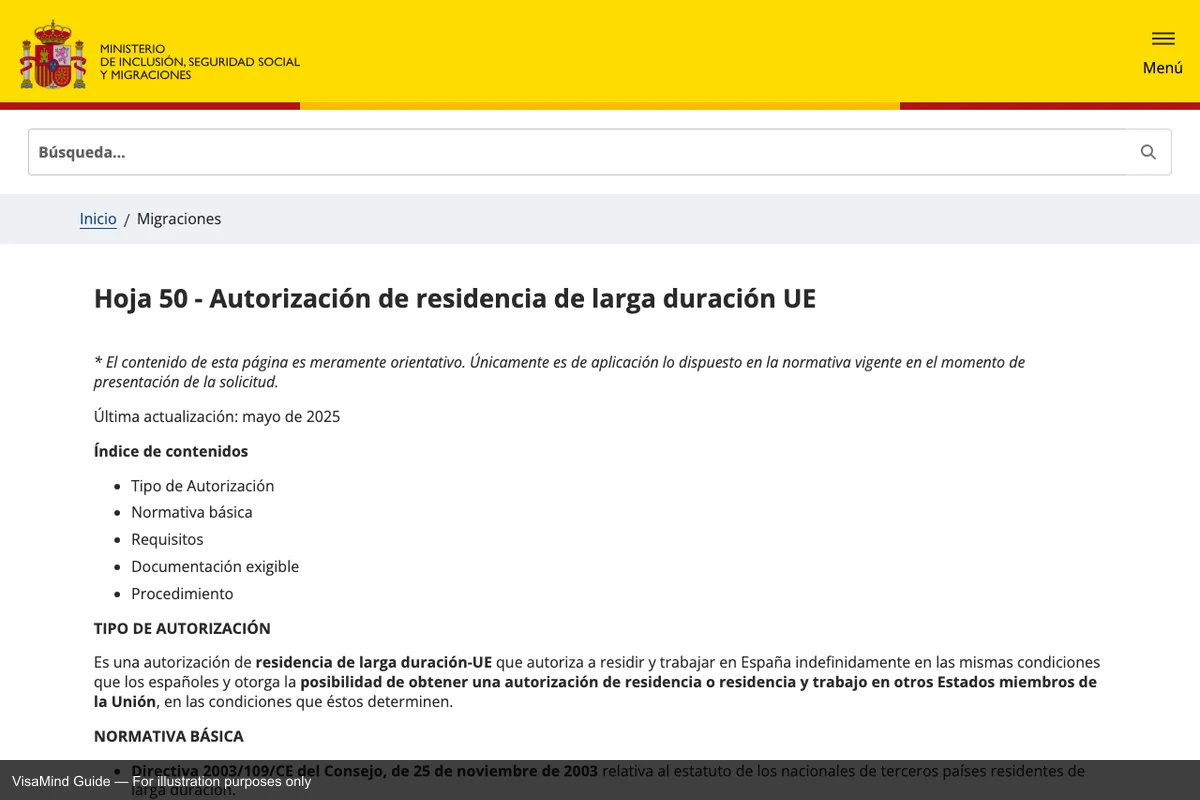
The ordinary five-year routes are not interchangeable. Review [Hoja 49](https://www.inclusion.gob.es/web/migraciones/w/49.-autorizacion-de-residencia-de-larga-duracion-nacional) for national long-term residence and [Hoja 50](https://www.inclusion.gob.es/web/migraciones/w/50.-autorizacion-de-residencia-de-larga-duracion-ue) for EU long-term residence before selecting section 4.
The ordinary resolution deadline is three months from the day after registration. Positive administrative silence generally applies if no decision is notified by then, although a narrow national route based on notable contribution to Spain has a different silence rule and is initiated ex officio. After approval, apply personally for the TIE using EX-17 within the applicable one-month period.
First page of EX-11 form
Source: EX-11 online portal
Context and workflow
#EX-11 requests national or EU long-term residence—not the physical TIE itself. Select the correct route, file the evidence required by Hoja 49 or Hoja 50, and keep the dated registration receipt for the three-month decision period.
Why this matters
- EX-11 determines which long-term residence status and qualifying ground the office assesses.
- Selecting the wrong route changes the evidence and can cause a requerimiento or refusal.
Where it fits in the workflow
- Choose national or EU long-term residence before completing section 4.
- Use Hoja 49, Hoja 50, or the special-route information sheet as the controlling checklist.
- Treat the TIE as a separate post-approval procedure.
Who uses it
EX-11 is for applicants requesting national long-term residence or EU long-term residence under a ground listed in section 4 of the current form. This includes ordinary five-year routes and specified special, accumulated-period, other-member-state, or recovery routes. The evidence and fee epígrafe depend on the selected ground.
When it is used
- To request national long-term residence after five years of qualifying continuous legal residence in Spain
- To request EU long-term residence after meeting the applicable residence-period, resources, and health-insurance rules
- To use an accumulated EU Blue Card, research, training, or other qualifying period where the current form and Hoja 50 permit it
- To request another national, other-member-state, family, or recovery route expressly listed in section 4
- Not to renew or replace a TIE card; the post-approval card application uses EX-17
Requirements snapshot
#- One form covers national and EU long-term residence, but the applicant selects one route and qualifying ground.
- Ordinary applications use signed EX-11, a full passport copy, the applicable Tasa 052 receipt, and route-specific evidence.
- The ordinary decision deadline is three months; after approval, the TIE application is a separate EX-17 step.
Failure prevention (What causes Form EX-11 rejections?)
#Technical rejections
- Use the current official EX-11 edition and sign the application.
- Pay the epígrafe that matches the selected ordinary or recovery route.
Substantive weaknesses
- Match the section 4 checkbox to the evidence submitted.
- Document every qualifying residence period and address absence-rule issues.
- Include resources and insurance evidence when requesting EU long-term residence.
What it asks for (What does Form EX-11 ask for?)
#- Applicant identity, NIE or passport number, nationality, birth details, marital status, and address in Spain
- Representative details when another person is authorized to file
- Postal or electronic notification address and consent
- One selected authorization route in section 4: national long-term residence or EU long-term residence
- The exact qualifying ground within the selected route
- Signature, place, and date of application
Sources for this section
What you need (What do you need for Form EX-11?)
#- The current official EX-11 form, completed and signed
- A complete copy of a valid passport, travel document, or cédula de inscripción
- Proof of the applicable Modelo 790 código 052 fee payment
- Evidence required by Hoja 49 or Hoja 50 for the selected residence-period or special route
- For the EU route, proof of fixed and regular resources and qualifying health insurance
- Criminal-record evidence, translations, and legalization or apostille when the selected route requires them
- Proof of representation if a representative submits the application
Checklist (What is the Form EX-11 checklist?)
#- Confirm whether national or EU long-term residence is the intended status.
- Download the current EX-11 from the Ministry of Inclusion.
- Mark one qualifying route in section 4 and follow its official information sheet.
- Prepare the full passport copy and route-specific supporting evidence.
- Generate and pay the correct Tasa 052 epígrafe and retain the receipt.
- Sign, file, and save the dated registration receipt.
Sources for this section
Fees
#| Component | Amount |
|---|---|
| Ordinary national or EU long-term residence — Modelo 790 código 052, epígrafe 2.6€21.87 under Orden PJC/617/2025. The fee is due when the application is admitted and must be paid within the official period. | See official schedule |
| Recovery or other special EX-11 routeFollow the route-specific information sheet; recovery uses epígrafe 2.7 rather than the ordinary 2.6 line. Verify the current amount before paying. | See official schedule |
| TIE card feeA separate police fee applies to the EX-17 card procedure after approval. | See official schedule |
Which Tasa 052 epígrafe applies to EX-11?
Ordinary national and EU long-term residence use epígrafe 2.6. Recovery procedures use epígrafe 2.7. Match the payment to the exact section 4 route.
When is the EX-11 fee paid?
The official information sheets state that the fee accrues when the application is admitted and must be paid within 10 working days. Keep the payment receipt.
Fee waiver: Fee exemptions can apply to specific categories recognized in the official instructions (for example, certain refugees and stateless persons). Confirm your eligibility with the Oficina de Extranjería before filing.
Fees are set by ministerial order and can change; always verify the current amount on the official Tasa 052 page before paying.
Processing times
#| Category | Processing time |
|---|---|
| EX-11 resolution deadline (national or EU long-term residence) | 3 months from the date the application is registeredas of per RD 1155/2024, in force since 20 May 2025 |
- Official resolution deadline for EX-11: 3 months, counted from the day after the application is registered with the competent office.
- If no decision is notified within 3 months, the application is deemed approved by positive administrative silence (silencio administrativo positivo) — keep your dated filing receipt as proof.
- If a requerimiento (request for missing documents) is issued, the 3-month clock pauses until you respond, so incomplete filings take longer in practice.
- After approval, you have 1 month to apply in person for your TIE at the corresponding police station.
- While pending: track your case status online using your expediente (case file) number, and update your contact details with the Oficina de Extranjería if they change.
Where to file
#File in person at the Oficina de Extranjería for the province where you reside, or telematically via the Ministry's Mercurio portal on the sede electrónica if you hold a digital certificate or Cl@ve. If you are outside Spain, file at the Spanish consulate for your place of residence, which forwards the application to the competent Oficina de Extranjería.
Submit application
Submit the completed EX-11, passport copy, Tasa 052 receipt, and supporting evidence in person at the Oficina de Extranjería of your province of residence (or at the Spanish consulate if filing from abroad).
File online
File telematically through Mercurio — the sede electrónica of the Ministry of Territorial Policy and Democratic Memory — which explicitly lists EX-11 among the authorizations that can be filed online. Requires an electronic certificate or Cl@ve.
Filing locations and the telematic system can change. Always verify current procedures on the official Ministry of Inclusion and sede electrónica websites before submitting.
Form sections (What sections does Form EX-11 have?)
#1) Datos de la persona extranjera (Applicant data)
Passport/NIE, identity, and household details.
- Passport or NIE number, first and second surname, first name
- Sex, date and place of birth, nationality, marital status
- Names of parents and address in Spain
- Phone/email and, if applicable, legal representative for a minor or dependent
- Whether you have school-age dependent children in Spain
2) Datos del representante (Filing representative — if any)
Complete only if someone other than the applicant is submitting the form.
- Representative's name/company and DNI/NIE/passport
- Representative's address in Spain
- Basis of representation (e.g., legal guardian, sole administrator)
3) Domicilio a efectos de notificaciones (Notification address)
Where official notices about your case will be sent.
- Name and address for notifications
- Consent checkbox for electronic notification via Dirección Electrónica Habilitada Única (Dehú), which requires a digital certificate or Cl@ve
4) Tipo de autorización solicitada (Authorization type — the key checkbox)
Mark exactly one route; this determines which evidence you must attach.
- RESIDENCIA LARGA DURACIÓN (national): general 5-year continuous residence, retiree/permanent-disability pensioner, born-in-Spain resident, former Spanish national, ward of a public entity, stateless/refugee, family-reunification renewal, or recovery of a lapsed long-term status
- RESIDENCIA LARGA DURACIÓN-UE: general 5-year route with sufficient economic means and health insurance, prior study/training periods counted at 50%, accumulated EU Blue Card residence, renunciation of EU long-term status held in another member state, or recovery
Choose your path
#Choose your path based on your eligibility category. Each block summarizes who qualifies, what to file, common mistakes, and typical processing time.
National Long-Term Residence — general 5-year route
national_general
Foreign nationals with 5 years of continuous legal residence in Spain (absences of up to 6 months at a time are allowed, capped at 10 months total within the 5 years, or 18 months if the absences are work-related).
File with:
- Copy of full passport, travel document, or cédula de inscripción
- Proof of the Tasa 052 fee payment (Modelo 790, epígrafe 2.6)
- Evidence of the continuous 5-year residence period
Common mistakes:
- Gaps in the 5-year residence record exceeding the permitted absence thresholds
Typical processing: up to 3 months (official resolution deadline; silencio administrativo positivo applies after that)
EU Long-Term Residence — general 5-year route
eu_general
Foreign nationals with 5 years of continuous legal residence in Spain who can additionally show sufficient fixed and regular income (150% of IPREM for a 2-person household, +50% per extra member, with lower thresholds for minors) and health insurance covering the same risks as Spanish nationals.
File with:
- Documentation of fixed and regular economic resources
- Proof of public or private health insurance
- Criminal record certificate from the country of origin and any country of residence in the last 5 years
Common mistakes:
- Income or savings evidence that does not meet the IPREM-based threshold for the household size
Typical processing: up to 3 months (official resolution deadline; silencio administrativo positivo applies after that)
EU Long-Term Residence — EU Blue Card / research / study accumulation route
eu_accumulated_periods
Foreign nationals who accumulated 5 years of legal EU residence as an EU Blue Card holder, under a national highly-qualified employment authorization, a research authorization, or a study/training authorization (counted at 50% of its duration), including at least 2 years of continuous residence in Spain as an EU Blue Card holder immediately before filing.
File with:
- Evidence of the qualifying periods held in Spain and other EU member states (Blue Card, research authorization, or study/training authorization)
- Proof of sufficient economic resources and health insurance
- Criminal record certificate from the country of origin and any country of residence in the last 5 years
Common mistakes:
- Missing documentation of residence periods held in other EU member states
- Not meeting the 2-year immediately-prior Spain residence requirement while holding EU Blue Card status
Typical processing: up to 3 months (official resolution deadline; silencio administrativo positivo applies after that)
Strategy tips
#Mistake severity
#| Mistake type | Severity | How to avoid |
|---|---|---|
| Insufficient supporting evidence | Delay | Verify: insufficient supporting evidence. |
| Inconsistencies between forms and documents | Delay | Verify: inconsistencies between forms and documents. |
| Failure to address all eligibility criteria | Delay | Verify: failure to address all eligibility criteria. |
| To avoid incomplete or incorrect information: Double-check all fields and include every required document per instructions. | Delay | Verify: to avoid incomplete or incorrect information: double-check all fields and include every required document per instructions.. |
| Failure to provide proof of 5-year residency in Spain. | Delay | Verify: failure to provide proof of 5-year residency in spain.. |
| Incomplete form sections | Delay | Verify: incomplete form sections. |
Examples (What are examples for Form EX-11?)
#- A resident with five qualifying years in Spain selects the national long-term route and follows Hoja 49.
- An applicant seeking EU long-term status selects that route and provides residence-period, resources, and health-insurance evidence under Hoja 50.
- An applicant whose long-term status ceased checks the recovery ground and follows the recovery information sheet rather than the ordinary five-year checklist.
Common misconceptions (What misconceptions surround Form EX-11?)
#- EX-11 is not only for EU long-term residence; it also covers national long-term residence.
- EX-11 does not renew the physical TIE card; EX-17 is used for the card step.
- Previous residence under a particular category does not mean the old category form is filed together with EX-11.
- Positive administrative silence is not a reason to skip obtaining formal proof and completing the TIE step.
- A fee waiver for EX-11 is not automatic — only specific qualifying categories are eligible, and a waiver request can be denied while the underlying form is still expected to be filed.
- EX-11 cannot always be filed in any way — the correct filing method depends on the applicant's category, and using the wrong channel can result in rejection.
Edge cases and variations
#- Recovery, other-member-state, family, and special national routes use route-specific instructions and may not use the ordinary checklist or fee line.
- The notable-contribution national route is initiated ex officio and has a different administrative-silence rule.
Scenarios
#A resident with five qualifying years selects national long-term residence and files the Hoja 49 evidence.
The office assesses the national route and, if approved, the resident proceeds to the EX-17 TIE step.
Select the national route when that is the status supported by the evidence.
An applicant selects EU long-term residence but omits proof of fixed resources and health insurance.
The office can request the missing EU-route evidence, delaying the application.
EU long-term residence has additional requirements beyond the ordinary residence-period test.
Key differentiators
#- Unlike EX-10: EX-11 requests long-term residence; EX-10 covers specified exceptional-circumstances residence routes such as arraigo.
- Unlike EX-17: EX-11 requests the underlying authorization; EX-17 is used for the physical TIE after approval.
- Unlike EX-18: EX-11 is for third-country national long-term residence routes; EX-18 registers qualifying EU citizens.
Why it matters
#What happens after you submit
#- Save the filing receipt and fee proof.
- Monitor postal, electronic, and TEU notifications as applicable.
- Respond to any requerimiento by its deadline.
- After approval, book the TIE appointment and file EX-17 within the applicable one-month period.
Verification
#This guide is based on official SEM instructions for the EX-11 form and is updated with any changes in form editions or filing rules. Always confirm current requirements on the official SEM website.