UK Bank Statements, Minimum Funds, and Sponsor Proof
#UK financial evidence is route-specific. A Student applicant, Skilled Worker applicant, partner applicant, and Standard Visitor are not assessed under one shared bank-balance rule. Before collecting statements, identify the exact route and use its current GOV.UK financial guidance.
Check four things:
- the amount or income test for the route
- how long funds or income evidence must cover
- whose account or income can be used
- the required document format and application-date window
A genuine statement can still be insufficient when it covers the wrong period, account holder, or route. Figures and evidence rules change, so this guide intentionally links to the current official page instead of treating one amount as universal.
Throughout this guide, "the financial requirement" means the money test the Immigration Rules set for your specific route. On the family routes it is expressed as a minimum income requirement, met through qualifying income, permitted savings, or a combination of the two. On the Student and points-based work routes it is expressed as maintenance funds that must sit in a qualifying account for a set period before the visa application is submitted. You meet the financial requirement only when the amount, the source of the money, the account holder, the document format, and the evidence window all match the rules for that route on the day you apply. Getting four of those five right is still a refusal risk, because caseworkers assess the evidence against the specified rules rather than against the overall impression that you can afford the move.
Two different rulebooks sit behind that test. Points-based routes such as Student and Skilled Worker take their money rules from Appendix Finance in the Immigration Rules, which defines what counts as a qualifying account, how long funds must be held, and when sponsor certification or an exemption removes the need to show funds at all. Family and partner applications run on Appendix FM and its evidence annex, Appendix FM-SE, which set the minimum income requirement and then specify, document by document, how each permitted income or savings source has to be proved. Knowing which appendix governs your visa application tells you which vocabulary to expect: maintenance funds and a held balance on one side, qualifying income and specified evidence on the other. Underneath both sits the same policy reason — most UK visas carry a no recourse to public funds condition, so UK Visas and Immigration wants evidence that you and any dependants can be supported without state help (GOV.UK visas and immigration).
How Much You Need by Visa Type
#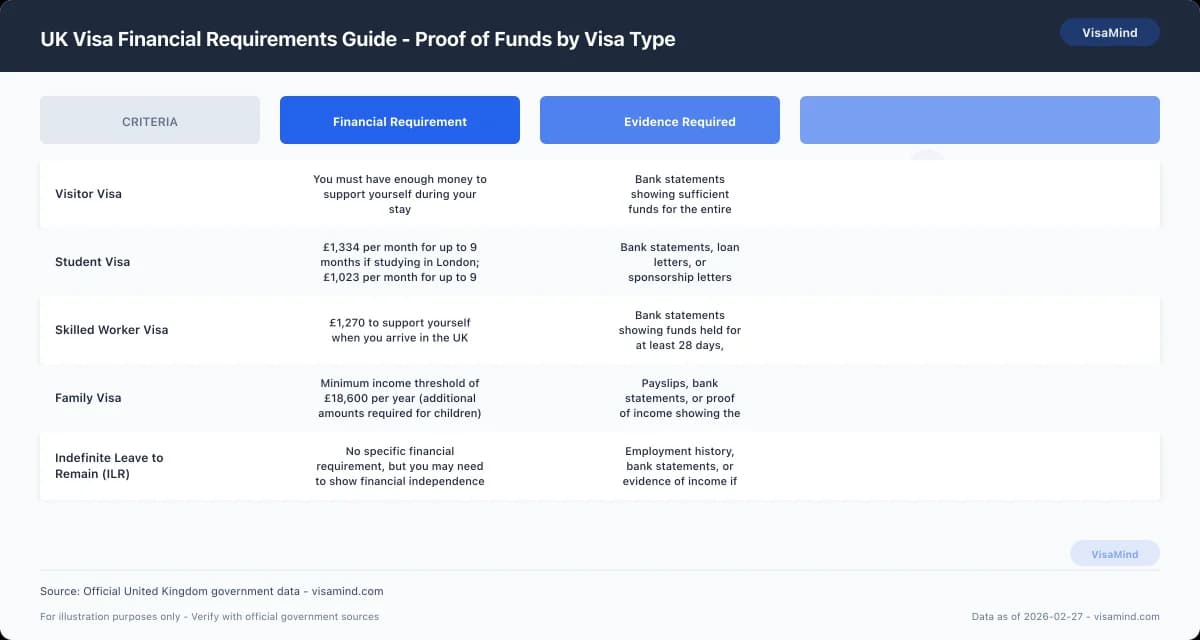
| Route | What the financial test generally covers | Official starting point |
|---|---|---|
| Standard Visitor | Whether you can cover the trip without working or using public funds; there is no universal published minimum balance. | Visitor eligibility |
| Student | Course fees and living costs, subject to route-specific holding-period and evidence rules. | Student Visa money |
| Skilled Worker | Maintenance funds unless an exemption or sponsor certification applies, plus the route's salary rules. | Skilled Worker costs and funds |
| Partner or spouse | The family-route financial requirement using permitted income and/or savings sources, with detailed evidence rules. | Partner income evidence |
Do not transfer a figure or evidence period from one row to another. Dependants, exemptions, sponsor certification, and transitional rules can change what applies.
The family minimum income requirement changed on 11 April 2024
The minimum income requirement for partner and family applications was raised on 11 April 2024, and transitional arrangements can apply to people who were already on the family route before that date. If you are working from a figure you read a while ago, or from an article written before the change, recheck the current requirement and the transitional wording on GOV.UK before you calculate anything: partner income evidence. Cash savings can substitute for income in defined ways, and different rules apply where the sponsor receives certain benefits, so the headline figure is only the starting point for whether you meet the financial requirement.
Income categories on the family route
Appendix FM-SE does not treat all money the same way. To meet the financial requirement on a partner application you first work out which lettered income category applies, because the category decides both the evidence and the period it has to cover:
- salaried employment with the same employer for the whole qualifying period, evidenced through payslips, bank statements, and an employer letter
- employment that does not cover the whole qualifying period, or non-salaried and variable earnings, assessed over a longer look-back window alongside current employment
- non-employment income such as rent from property or dividends
- pension income
- self-employment or income from a limited company, which carries the heaviest documentary burden
- cash savings held in a qualifying account for a specified continuous period, used alone or combined with income where the rules allow
Some combinations of categories are permitted and others are blocked, and each source carries its own specified evidence list. Work out the category before gathering a single bank statement: partner income evidence.
When adequate maintenance replaces the minimum income requirement
Not every family application is assessed against the minimum income requirement. Where the sponsor receives certain specified disability or carer benefits, the rules substitute an adequate maintenance test, which asks whether the household's income after housing costs is enough to support the family rather than measuring it against a fixed income threshold. It is a different calculation with its own evidence list, so confirm which test applies to your circumstances before concluding that you cannot meet the requirement.
Reading Between the Lines of Bank Statements
#Bank-statement rules depend on the route and the type of funds relied on. Check the official guidance for:
- the required statement period and the latest permitted statement date
- whether the balance must remain above a threshold for every day in a holding period
- whether personal, joint, parent, partner, or sponsor accounts are allowed
- required account-holder, account-number, bank, date, and balance details
- translation and currency-conversion rules
The Student and points-based work routes can use specific maintenance-fund rules. Family applications may require different periods and evidence under Appendix FM. Visitor applications are assessed against the planned trip and personal circumstances rather than a single universal maintenance amount.
The 28 days rule is route-specific, not universal.
On the Student route the money must be held for a consecutive period of 28 days, the balance must not fall below the required level on any day inside that window, and the closing balance must be dated within a set period before the visa application is made. That rule does not govern every UK visa: a Skilled Worker whose sponsor certifies maintenance may not have to show held funds at all, and a partner application relying on salaried employment is assessed on an income history rather than on one held balance. Confirm the holding period, the latest permitted statement date, and how many statements to submit on the official page for your route: Student visa money.
Not every applicant has to send the statements.
Under the differential evidence rules, some applicants are not required to submit financial documents with the visa application itself, depending on nationality and on where and how they are applying. That is a documentary concession, not an exemption from the money test: you still have to meet the financial requirement on the date of application, keep the evidence, and produce it if UK Visas and Immigration asks for it. Reading "you do not need to send documents" as "you do not need the funds" is a refusal waiting to happen, so check whether the concession actually covers your case on the official page for your route.
Accepted and Rejected Evidence
#Use only evidence permitted for the route. Depending on the category, that may include bank statements, payslips, employer letters, tax or self-employment records, pension evidence, cash-savings records, scholarship letters, or sponsor certification.
Do not assume that property value, investments, credit facilities, informal promises, or unexplained deposits count. Some routes permit particular forms of third-party support; others restrict whose funds can be relied on. Follow the official route guidance and Appendix evidence rules rather than a general internet checklist.
Documents not in English or Welsh normally need a translation meeting the published requirements.
Electronic and online bank statements are normally acceptable in place of a paper original, provided each statement carries the bank's name and logo, your name as the account holder, the account number, the statement date, and the running balance. Where a printout cannot show all of that, the official guidance points to a supporting letter from the bank on headed paper, or statements stamped on every page, as the way to confirm authenticity. Screenshots from a banking app, exported spreadsheets, and PDFs that have been edited or re-saved are the versions that create problems, because they break the chain between the document and the bank that issued it (Student visa money).
On the routes that test a held balance, the money also has to be genuinely available to whoever the rules allow to hold it. An overdraft facility, a credit limit, shares or an investment product you cannot draw on, or a balance sitting in an account belonging to someone the route does not permit will not satisfy the requirement even when the figure on the statement looks right.
Financial Evidence Pitfalls
#Common evidence problems include:
- using the correct amount for the wrong visa route
- statements that do not cover the required period
- a balance falling below the required level during a holding period
- salary deposits that do not match payslips
- relying on an account holder or sponsor the route does not permit
- missing employer, bank, tax, or translation details
- using an outdated threshold or evidence checklist
- sending a default 3 months of bank statements when the route sets a different evidence window
- assuming a rule you met before 11 April 2024 still describes the current minimum income requirement
Large or recent deposits are not automatically disqualifying, but the source of funds may need to be clear. Do not annotate or alter an official bank statement in a way that obscures the original document; provide a separate explanation where appropriate.
Each of these is a reason a visa application that looks affordable on paper still fails to meet the requirement as the rules define it. If a refusal has already happened, our guide to UK visa refusal reasons covers the next steps; the current evidence rules for every route start from GOV.UK visas and immigration.
Third-Party Financial Proof
#Third-party support is not interchangeable across UK visa routes. A Student may be able to rely on specified parent funds or official financial sponsorship. A Skilled Worker sponsor may be able to certify maintenance on the certificate of sponsorship. A visitor may provide evidence of support from another person, while a partner application follows the permitted-income and savings rules for that route.
Confirm:
- whether third-party support is allowed
- who may provide it
- which relationship or sponsorship evidence is required
- which financial documents must accompany it
A generic sponsor letter or notarized affidavit does not replace route-specific evidence.
Third-party money helps you meet the financial requirement only inside the route's own rules. A relative moving a lump sum into your account shortly before a visa application does not create a qualifying held balance where the route requires the money to have been held for a set period, and a promise of future support is not evidence of present funds. Where a route does allow a parent, partner, or official sponsor to provide the money, expect to evidence the relationship or the sponsorship as well as the bank statements themselves.
Switching Visas Inside the UK
#Many people can switch to a different route without leaving the UK, and a switching application is still a visa application that has to meet the financial requirement of the route being switched into. A Student moving into the Skilled Worker route once a sponsor issues a certificate of sponsorship is the common example (Skilled Worker visa).
Switching is not open to everyone. Standard Visitors, people on short-term study, and several other temporary categories generally cannot switch inside the UK and have to apply from outside. Check the switching rules for the route you want before you start assembling bank statements, because the route you can reach determines which financial test you have to satisfy, and our UK documents checklist sets out what the new application has to carry alongside the money evidence.
When switching is possible, the money test is the new route's test:
- the maintenance rules of your current visa do not carry over
- held funds may be waived where your sponsor certifies maintenance, or where you have already been in the UK long enough for the exemption to apply
- a partner application uses the minimum income requirement and permitted savings rather than a held balance
- your evidence window runs back from the date of the new application, not from your original entry to the UK
Our UK visa extension guide covers the difference between extending the visa you hold and switching into a different one.
Tips for Preparing Financial Evidence
#-
Open the current GOV.UK page for the exact route before calculating funds.
-
Work backward from the intended application date to determine the evidence window.
-
Match every payslip, deposit, account holder, and date across the application.
-
Keep source-of-funds evidence for unusual transfers or deposits when relevant.
-
Check dependant, exemption, sponsor-certification, and transitional rules separately.
-
Save the official guidance used and recheck it immediately before submission.
These steps improve organization; they do not guarantee a visa decision. Complex income, self-employment, prior refusals, or uncertainty about the applicable rule may require professional advice.