
UK Bank Statements, Minimum Funds, and Sponsor Proof
#UK visa financial requirements usually come down to four things: how much money you must show, how long you must hold it, which documents count as proof, and whether a sponsor can cover the requirement. UK Visas and Immigration (UKVI) checks those details differently for routes such as the Student Visa, Skilled Worker Visa, and Spouse or Partner Visa.
What UKVI usually checks first
UKVI normally starts by reviewing the evidence that matches your route:
- Bank statements showing the required balance for the correct holding period
- Payslips or employer letters when income is part of the test
- Sponsor evidence when a university, employer, or family member is allowed to cover costs
- Savings evidence when you rely on cash savings instead of salary
Important: A document can be genuine and still fail if the dates, balance period, account type, or visa category do not match the published UKVI rules.
Why applicants lose clicks and cases here
Most people searching this topic want a direct answer to questions like: How much do I need?, How many days do the funds need to sit in my account?, and Can a sponsor or joint account be used? The answer depends on the visa route, so you should cross-check the exact rule for your category before you upload evidence.
For example, a Standard Visitor Visa does not use the same maintenance test as a Student Visa, and the Spouse or Partner Visa uses a different income threshold from work routes.
How to meet the financial requirement
Every route comes down to the same test: can you meet the financial requirement UK Visas and Immigration sets for your category? For work and study routes that usually means holding a fixed maintenance amount; for partner and family routes it means the minimum income requirement (or an equivalent savings level). Because the rules differ, always confirm whether your route uses a maintenance amount, a minimum income requirement, or both before you try to meet the requirement. The minimum income requirement for partner and family applications last changed on 11 April 2024, and other route thresholds are reviewed periodically, so verify the current figure for your visa on the official GOV.UK guidance before you gather evidence rather than trusting an amount you saw elsewhere.
Best way to use this guide
Start with the comparison table below, then review the sections on bank statement rules, accepted evidence, and common mistakes. That gives you the fastest route to the exact proof UKVI is likely to scrutinize before a decision is made.
How Much You Need by Visa Type
#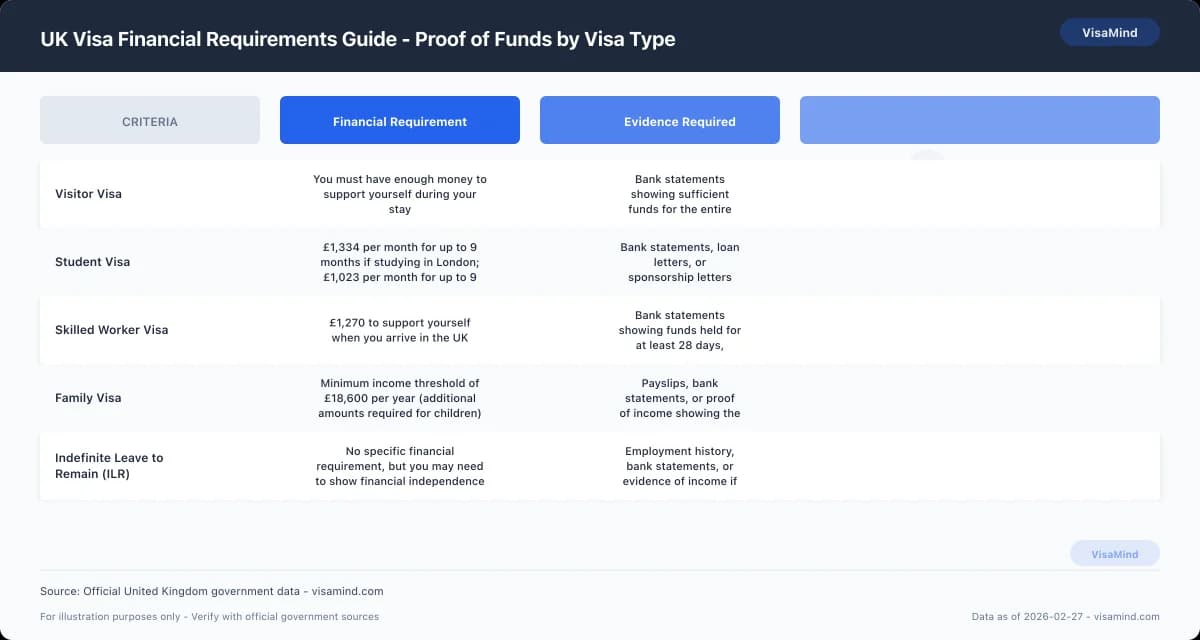
Understanding the specific financial requirements for different UK visa types is crucial when planning your immigration journey. This section outlines the financial criteria and evidence needed for various visa categories, including visitor, student, work, family, and permanent residency (PR) visas, helping you prepare your application effectively.
Financial Requirements by Visa Type
| Visa Type | Financial Eligibility | Evidence Required |
|---|---|---|
| Standard Visitor Visa | No specific amount, but you must prove you can support yourself without working or accessing public funds. | Bank statements, payslips, or a letter from a sponsor showing financial support. |
| Student Visa | £1,334 per month (up to 9 months) if you are in London, £1,023 per month elsewhere. | Confirmation of Acceptance for Studies (CAS), bank statements showing the required amount for 28 consecutive days. |
| Skilled Worker Visa | Must show maintenance funds of £1,270 unless exempt. | Bank statements or a sponsor letter if your sponsor can cover your costs. |
| Spouse or Partner Visa | You must meet the minimum income requirement set for partner and family routes. This threshold was raised on 11 April 2024, so confirm the current figure on GOV.UK before you apply. | Payslips, bank statements, or proof of cash savings if you do not meet the income requirement through employment. |
| Family Visa | Similar to Spouse Visa, depends on relationship and living conditions. | Income proof, savings, or sponsor support evidence. |
| Indefinite Leave to Remain (ILR) | No specific income requirement, but must not have accessed public funds previously. | Evidence of continuous residence and financial independence. |
How to Demonstrate Financial Sufficiency
When applying for any UK visa, it's imperative to gather comprehensive financial documents that can demonstrate your ability to support yourself and any dependents. This includes:
- Bank Statements: Typically showing your financial activity for the last 3 to 6 months.
- Payslips: Especially important for work-related visas like the Skilled Worker Visa.
- Sponsor Letters: If you're receiving financial support from a third party, a formal letter detailing the support is necessary.
- Savings Evidence: Required for some family visas if you don't meet the income threshold through employment.
Important: Ensure all financial documents are in English or accompanied by a certified translation. Incomplete or incorrectly formatted documentation can lead to delays or refusal.
Standard Visitor Visa
While there is no set financial amount, the UKVI expects you to demonstrate that you have enough funds to cover your stay, including accommodation and travel. This prevents reliance on public funds or work while in the UK.
Student Visa
A confirmed place at a licensed educational institution is mandatory, alongside proof of financial capability to support your studies and living expenses. The amount varies depending on your location in the UK.
Skilled Worker Visa
The maintenance funds requirement can be waived if your employer provides a certificate of sponsorship confirming they will cover your initial costs.
Spouse or Partner Visa
The financial threshold is a common pitfall for applicants. Understand the full range of acceptable evidence to meet the income requirement, or consider the savings route if necessary.
Indefinite Leave to Remain
While financial requirements are less stringent, maintaining a record of financial independence without public funds usage is essential to demonstrate your readiness for permanent residency.
By understanding and preparing the necessary financial documentation for your specific visa type, you can strengthen your application with UK Visas and Immigration (UKVI). Always verify the most current requirements on the official UKVI website, as these can change.
Reading Between the Lines of Bank Statements
#Demonstrating your financial stability is a key requirement. This often involves providing bank statements, which need to meet specific criteria set by UK Visas and Immigration (UKVI). Here's what you need to know about bank statements for a successful visa application.
Duration of Required Bank Statements
- Minimum Time Frame: You typically need to provide bank statements covering at least the last 28 consecutive days. This requirement applies to many visa categories, including the Student Visa and Spouse or Partner Visa.
- Submission Timing: Ensure your bank statements are dated no more than 31 days before the date of your visa application.
Balance Requirements
- Minimum Balance: For most visa types, you must show a minimum balance in your account. This amount varies depending on the visa category. For example, a Skilled Worker Visa applicant needs to demonstrate financial support, which might include a specific minimum balance.
- Average Balance vs. Minimum Balance: While maintaining a minimum balance is crucial, some applicants prefer to demonstrate an average balance over the required period to show consistent financial stability.
Eligible Accounts
- Personal Accounts: Only personal accounts can be used to demonstrate financial capability. Business accounts are not accepted.
- Joint Accounts: If you hold a joint account, it can be used as evidence, but make sure your name is clearly listed as an account holder.
Important: Ensure all bank statements are genuine and unaltered. Discrepancies or falsifications can result in visa refusal.
Types of Accounts Considered
- Savings Accounts: These are often used to demonstrate financial stability, as they reflect the funds you have readily available.
- Current Accounts: These can be used if they meet the minimum balance requirement and are in your name.
- Fixed Deposits: Some visa categories may accept fixed deposits, provided they meet the liquidity and accessibility criteria set by UKVI.
When preparing your bank statements for a UK visa application, it's essential to carefully review the requirements specific to your visa type. For detailed guidance on other financial aspects, consider referring to the Documents Checklist to ensure you have everything in order.
Accepted and Rejected Evidence
#Providing financial evidence is crucial to demonstrate that you can support yourself during your stay. Different types of evidence are accepted or rejected by UK Visas and Immigration (UKVI), depending on the visa category.
Accepted Financial Evidence
Here are some types of financial evidence generally accepted by UKVI:
-
Cash Savings:
- Must be held in your account for at least 28 consecutive days.
- The balance should not dip below the required amount during this period.
-
Investments:
- Stocks, bonds, or other investment accounts can be used if they can be liquidated easily.
- Provide a recent statement showing the current value and ownership details.
-
Property Ownership:
- Evidence of ownership, such as title deeds or mortgage statements.
- Recent property valuation may be required to prove the value.
-
Scholarships or Grants:
- Official letters from the funding body confirming the scholarship amount and duration.
- Details should include how the funds will be disbursed.
Rejected Financial Evidence
Certain types of financial evidence are typically not accepted:
-
Loans:
- Personal loans or credit card advances are not considered stable financial support.
- Business loans or overdrafts are also generally inadmissible.
-
Unverifiable Income:
- Income from informal or undocumented employment.
- Cash deposits without a clear source.
Important: Ensure your financial documents are in English or accompanied by a certified translation.
Tips for Providing Financial Evidence
- Consistency: Ensure all documents are consistent with the information provided in your application. Discrepancies can lead to rejections.
- Currency: Provide evidence in GBP or include conversion rates if in another currency.
- Verification: UKVI may verify financial documents, so ensure all information is accurate and up-to-date.
For those applying for a Skilled Worker Visa or Health and Care Worker Visa, understanding specific financial requirements is crucial. If you are uncertain about what constitutes acceptable financial evidence for your visa type, consult resources such as the Documents Checklist to ensure all requirements are met.
Tip: Regularly review your financial situation to ensure you meet the necessary criteria before applying.
Financial Evidence Pitfalls
#Providing accurate financial evidence is crucial to meet the requirements set by UK Visas and Immigration (UKVI). Here are some common pitfalls to avoid when preparing your financial documentation.
Last-Minute Deposits
- Unexplained Large Sums: Depositing large sums of money close to your application date without a clear explanation can raise red flags. Ensure you provide a logical explanation or supporting documents to justify any significant deposits.
- Timing Issues: If you recently deposited money, ensure it remains in your account for a sufficient period before your application. UKVI often requires bank statements covering a specific time frame, such as the last six months.
Insufficient Financial History
- Short Account History: Presenting a bank account with only a few months of history can be problematic. UKVI generally expects a longer track record to assess financial stability.
- Inconsistent Transactions: Regular and consistent income is necessary to demonstrate financial stability. Avoid showing erratic or irregular transaction patterns in your bank statements.
Wrong Currency
- Currency Discrepancies: Submitting financial documents in a currency different from British pounds (GBP) without conversion can complicate the review process. Always convert and clearly display the equivalent amount in GBP.
- Exchange Rate Fluctuations: Be mindful of exchange rate changes. Use a reliable source to present the correct conversion rate, and ensure it reflects the rate at the time of your application.
Missing Explanations
- Lack of Annotations: Simply submitting bank statements without annotations or explanations can lead to misunderstandings. Clarify any unusual transactions or patterns directly on your statements.
- Supporting Documents: When applicable, provide additional documents to support your financial evidence, such as payslips, letters from employers, or contracts. These can help verify the source and consistency of your funds.
Important: Always verify detailed financial requirements and timelines on the official UKVI website to avoid pitfalls and ensure compliance with the latest guidelines.
For further guidance on visa types and application processes, consider exploring the Standard Visitor Visa or the Health and Care Worker Visa pages. Additionally, resources like the Documents Checklist can provide a comprehensive overview of required documentation.
Third-Party Financial Proof
#Particularly if you're relying on third-party financial support. This section outlines how a sponsor or guarantor can provide the necessary financial proof for your application.
What Financial Proof Can a Sponsor Provide?
A sponsor can be an essential part of your visa application, offering financial backing to meet the requirements set by UK Visas and Immigration (UKVI). The financial proof from a sponsor typically includes:
-
Income Evidence: This could be in the form of pay slips, bank statements, or a letter from the sponsor's employer. The documentation should clearly show the sponsor's net income and demonstrate their capacity to support you financially.
-
Affidavit of Support: This legal document is a sworn statement where the sponsor commits to covering your expenses during your stay in the UK. An affidavit should be notarized to ensure its validity.
-
Tax Returns: Providing recent tax returns can further substantiate the sponsor's financial stability and their ability to support you. This document offers a comprehensive overview of their financial history and obligations.
How to Gather and Present Third-Party Financial Evidence
When gathering financial evidence from a sponsor, it's vital to ensure that all documents are current and meet the guidelines set by UKVI. Here’s a checklist to help you organize these documents:
-
Confirm Document Authenticity: Ensure all documents are original or certified copies. Electronic copies must be verifiable and backed by a credible source.
-
Translate Non-English Documents: If any documents are not in English, they must be accompanied by a certified translation.
-
Organize Documents Chronologically: Present documents in a clear, chronological order, making it easy for UKVI officials to assess the sponsor's financial capability quickly.
Important: All financial documents should be no more than six months old at the time of your application to ensure relevancy and accuracy.
Common Mistakes to Avoid
Using a third-party financial sponsor can significantly bolster your application, but it's crucial to avoid common pitfalls:
-
Incomplete Documentation: Failing to provide comprehensive financial proof can result in application delays or refusals.
-
Outdated Financial Records: Ensure all financial documents are up-to-date, as older documents may not accurately reflect the sponsor's current financial situation.
-
Inconsistent Information: Make sure all details across different documents are consistent, including names, dates, and financial figures. Any discrepancies can raise red flags during the processing of your application.
For more detailed guidance on preparing your visa application, consider referring to our Documents Checklist and the Visa Refusal Reasons to avoid common mistakes that could jeopardize your application. Additionally, if you plan to apply for a Family Visa, understanding the financial requirements is crucial for success.
Tips for Preparing Financial Evidence
#1. Start Early with Your Documentation
It's crucial to begin gathering your financial documents well in advance of your planned application date. This proactive approach gives you ample time to address any discrepancies or gather additional evidence as required by UK Visas and Immigration (UKVI). Early preparation is especially important if you're applying for a Student Visa or any other visa with stringent financial requirements.
2. Maintain Consistent Financial Records
Ensure that your financial records are consistent and comprehensive. This means regularly updating and organizing your bank statements, pay slips, and any other financial documents. Inconsistent records can raise red flags during the application process, potentially leading to delays or even refusals. If you're applying for a Skilled Worker Visa or a Spouse or Partner Visa, consistent documentation is crucial to demonstrating financial stability.
3. Use Cover Letters for Unusual Financial Patterns
If your financial history includes any unusual patterns, such as large deposits or irregular income, consider including a cover letter with your application. This letter should clearly explain the reasons behind these anomalies to the UKVI. Providing context can help preempt any concerns the reviewing officer might have. For instance, if you're applying for a Family Visa, explaining large family support payments can clarify your financial situation.
Tip: Keep a copy of all submitted documents for your records. This can be helpful if UKVI requests additional information or if you need to reference your submission in future applications.
4. Stay Updated on Financial Requirement Changes
Visa financial requirements can change, so regularly check the UKVI website for the latest information. This is particularly important for applications like the Global Talent Visa, where financial thresholds may vary based on specific criteria. Staying informed ensures you meet all necessary requirements at the time of your application.
5. Verify All Information Prior to Submission
Before lodging your application, meticulously verify all the information and documents you plan to submit. Double-check that all figures are accurate and that your documents align with the specific visa category requirements. This diligence can prevent common pitfalls and ensure your application process proceeds smoothly.
Important: Incomplete or incorrect financial documentation is one of the leading causes of visa refusals. Always ensure your submission meets the UKVI criteria to avoid unnecessary complications.