Quick summary
#Applicants seeking a visa use DS-2019 as part of the visa application process at a U.S, as described in the Online Nonimmigrant Visa Application guide. embassy or consulate.
J-1: J-1 Exchange Visitor Visa
Include it with your application package and follow official instructions for submission.
Names, dates of birth, and passport details on other forms Program checklist requirements Supporting documents and translations
Overview (What is Form DS-2019?)
#DS-2019 is the exchange-visitor eligibility record created through SEVIS by a Department of State-designated sponsor after the participant is accepted into an exchange program. The form identifies the exchange visitor or dependent, the sponsor, the exchange category, the program dates, and the funding picture for the program. In practical terms, DS-2019 is what allows the applicant to move to the DS-160, the J-visa interview, and later admission to the United States in J status.
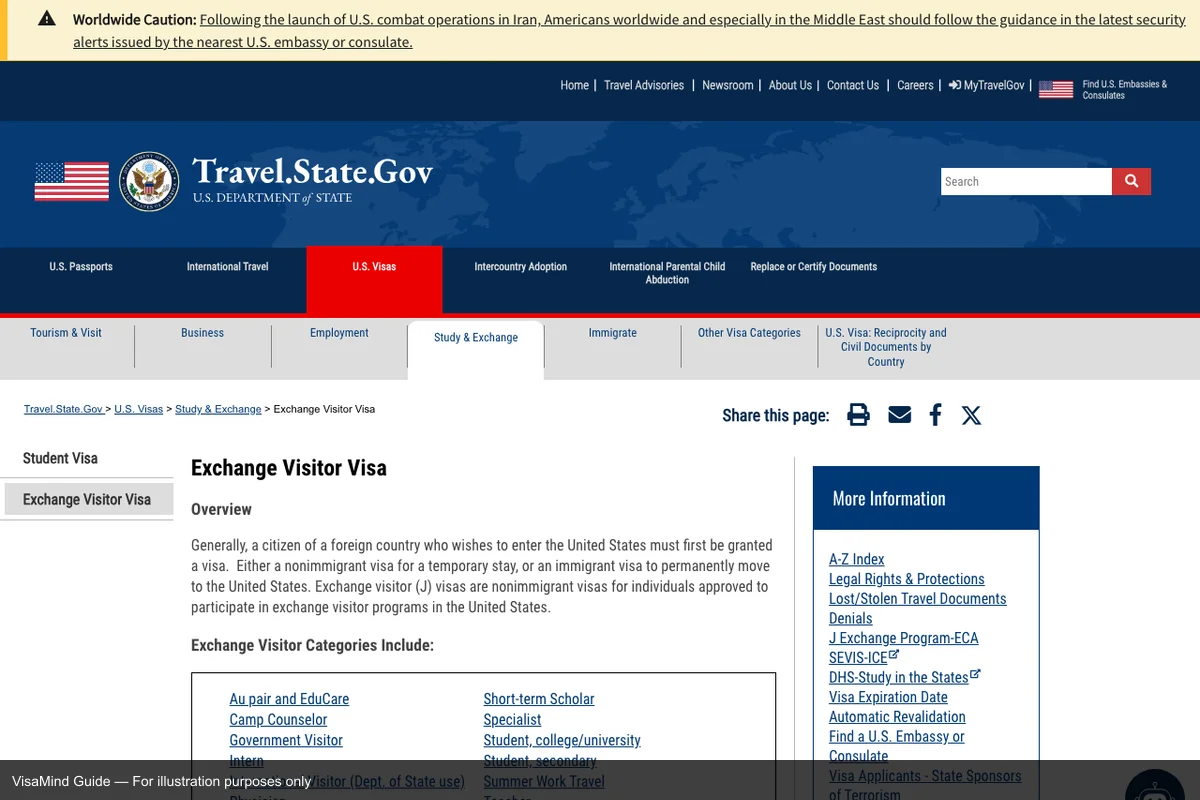
Official portal interface for DS-2019
Source: DS-2019 online portal
Context and workflow
#DS-2019 is best understood as a sponsor-issued program document, not a petition the applicant files. The major decisions usually happen around sponsor selection, program eligibility, SEVIS issuance, consular timing, and whether the exchange program may later trigger a DS-3035 waiver issue or a later I-539 status question.
Why this matters
- This form helps confirm that the application matches the program’s requirements and checklist.
- This form acts as a cross-check point: details here must match other forms and supporting documents.
Where it fits in the workflow
- Filed while in current status to maintain lawful presence
- Timing relative to current status expiration is often important
- May affect other pending applications
- DS-2019 is commonly filed alongside Form DS-160.
Who uses it
A Department of State-designated sponsor issues DS-2019 to a person accepted into an approved J-1 exchange visitor program and to eligible J-2 dependents. The exchange visitor then uses that document to apply for the J visa, prepare for the interview, and seek admission in the correct exchange category.
When it is used
- J-1: J-1 Exchange Visitor Visa
- J-2: J-2 Dependent Visa
- When petitioning for J-1 — approval of DS-2019 is a step toward this visa category
- When filing DS-2019 alongside DS-160 (DS-160 nonimmigrant visa application required alongside DS-2019)
- After filing DS-2019 — DS-3035 may be the next step (J-1 waiver if subject to two-year home residence requirement)
- After filing DS-2019 — I-539 may be the next step (Change of status or extension for J-1 exchange visitors)
Requirements snapshot
#- After submitting DS-2019, you generally schedule a visa interview and bring the confirmation page with barcode.
Failure prevention (What causes Form DS-2019 rejections?)
#Substantive weaknesses
- Insufficient supporting evidence
- Inconsistencies between forms and documents
- Failure to address all eligibility criteria
- To avoid expired or invalid ds-2019: Use the current DS-2019 from your program; verify start/end dates.
- To avoid missing proof of funding or program acceptance: Include financial evidence and program acceptance letter as required.
What it asks for (What does Form DS-2019 ask for?)
#- Complete the Online Visa Application, Form DS-160.
- Upload a photo in the format explained in the Photograph Requirements.
- Your eligibility for the exchange visitor program
- Details of your exchange program and sponsor
- Your current immigration status and arrival history
- Your full legal name as it appears on official documents
- Your date and place of birth
- Documentation related to: Passport valid for travel to the United States - Your passport must be valid for at least six months after your period o
- Documentation related to: Complete all required sections, sign, and submit with required evidence
Sources for this section
What you need (What do you need for Form DS-2019?)
#- The current edition of DS-2019
- Proof of current immigration status
- Government-issued photo identification
- Passport-style photographs meeting specifications
- Upload a photo in the format explained in the Photograph Requirements.
- Passport valid for travel to the United States - Your passport must be valid for at least six months after your period of stay in the United States.
- Complete all required sections, sign, and submit with required evidence.
- Failure to upload a photo that meets the visa photo requirements.
- Copy of your filed or approved DS-160 (DS-160 nonimmigrant visa application required alongside DS-2019)
Sources for this section
Checklist (What is the Form DS-2019 checklist?)
#- To obtain the most recent version of Form DS-2019 and its accompanying instructions, visit the official Department of State website.
- Review the official DS-2019 instructions before filing
- Gather required supporting documents per the instructions
- Complete all required sections of DS-2019
- Confirm photos are unmounted and unretouched per Department of State specifications
- Sign, date, and submit DS-2019 with all required supporting evidence
Sources for this section
Fees
#| Component | Amount |
|---|---|
| DS-2019 issuanceDS-2019 is typically issued by a designated exchange sponsor after program acceptance rather than filed like a normal USCIS petition. | See official schedule |
| SEVIS and visa-stage costsJ-1 applicants often face a SEVIS fee and a visa application fee, though some government-sponsored exchange visitors may be exempt from some visa-processing charges. | See official schedule |
Does DS-2019 itself have a normal filing fee like a USCIS form?
Usually no. DS-2019 is generally issued by the program sponsor after acceptance. Applicants should instead focus on sponsor fees, the SEVIS fee, and any visa application fee rules that apply to the J-visa process.
What happens if I submit the wrong fee?
Because the exchange process involves sponsor-issued documents and later visa-stage fees, the right question is which fee belongs to which step. Check your sponsor instructions, the J-visa fee rules, and SEVIS guidance before paying anything.
Fee waiver: The practical question is usually not a DS-2019 filing fee, but the sponsor's program costs and the separate J-visa and SEVIS charges tied to the exchange process.
Department of State fee schedule
Verify sponsor charges, SEVIS fees, and visa fees separately. DS-2019 is not a standard self-filed benefit request with one simple filing fee.
Processing times
#| Category | Processing time |
|---|---|
| Student/Exchange (F, M, J) | 0.5 to 7.5 monthsas of February 2026 |
- processing times to learn more.
- Processing time for DS-2019 under "Student/Exchange (F, M, J)": 0.5 to 7.5 months (as of February 2026).
- Processing times for DS-2019 vary by category and processing location. Verify current processing times with the issuing authority.
- Processing times differ significantly by eligibility category. Initial applications, renewals, and replacements each go through different adjudication queues, and some categories consistently take longer than others.
- Renewal filings are often processed differently than initial applications. If you are renewing, file well before your current authorization expires — some categories allow you to continue working while the renewal is pending if filed on time.
- The service center assigned to your case affects how long it takes. Department of State distributes filings across multiple centers, and each has different workloads. You cannot choose which center processes your case.
Where to file
#Applicants do not usually file DS-2019 directly with USCIS or DOS the way they file a petition. A designated exchange sponsor issues DS-2019 through SEVIS after accepting the participant into the exchange program.
Submit application
Work with the designated exchange sponsor to obtain the DS-2019. The sponsor, not the applicant, controls issuance of the form and the underlying SEVIS record.
Submit application
After receiving DS-2019, the applicant typically uses it to complete DS-160, pay the required J-visa fees, and schedule the J-visa interview.
Treat DS-2019 as a sponsor-issued eligibility record. The filing-style steps happen later in the J-visa process, not at the moment the form is created.
Form sections (What sections does Form DS-2019 have?)
#Program Information
Exchange program details.
- Program number and sponsor name
- Category (e.g., Research Scholar, Student)
- Program start and end dates
- Field of study or research
Exchange Visitor Details
Applicant identification.
- Full name and date of birth
- Country of citizenship
- SEVIS ID
- Funding source and amount
Training or Study Plan
Activities during the program.
- Site of activity (host institution)
- Supervisor or advisor name
- Brief description of activities
- Academic credentials required
Key terms
#- SEVIS
- Student and Exchange Visitor Information System, a database for tracking exchange visitors.In this form: Applicants must be registered in SEVIS to receive Form DS-2019.
Strategy tips
#Mistake severity
#| Mistake type | Severity | How to avoid |
|---|---|---|
| Expired or invalid DS-2019 | Rejection | Use the current DS-2019 from your program; verify start/end dates. |
| Missing proof of funding or program acceptance | RFE | Include financial evidence and program acceptance letter as required. |
| Unsigned or altered DS-2019 | Rejection | Ensure program sponsor signs the form; do not make changes after issuance. |
| Applying with expired program dates | Rejection | Verify start/end dates; apply for visa within 30 days of program start. |
Examples (What are examples for Form DS-2019?)
#- Strong application: A research scholar submits the DS-2019 form with a detailed letter of invitation from a U.S. university and a passport valid for the entire duration of their stay, ensuring a seamless application process.
- Strong application: An au pair applicant includes a perfectly formatted digital photo and a comprehensive host family agreement, resulting in a smooth visa interview.
- Strong application: A trainee provides a complete DS-160 confirmation page and a training plan approved by their U.S. sponsor, facilitating a straightforward visa issuance.
- An applicant overseas completes DS-2019 as part of the consular visa interview process
- A beneficiary of an approved petition uses DS-2019 to apply for their immigration visa at the embassy
- An applicant in the J-1 category files DS-2019 as part of their immigration process
Common misconceptions (What misconceptions surround Form DS-2019?)
#- Some applicants assume that having a DS-2019 automatically allows entry into the United States, but a visa is still required.
- Meeting the document requirements guarantees visa approval — The consular officer retains discretion to approve or deny the visa based on the totality of circumstances, even when all documents are submitted.
- DS-2019 has more than one fee component (e.g. DS-2019 issuance and SEVIS and visa-stage costs); paying only one or paying the wrong amount can result in rejection of the entire filing.
- A fee waiver for DS-2019 is not automatic — only specific qualifying categories are eligible, and a waiver request can be denied while the underlying form is still expected to be filed.
- DS-2019 cannot always be filed in any way — the correct filing method depends on the applicant's category, and using the wrong channel can result in rejection.
- A complete DS-2019 can still be denied on the merits — issues like “Insufficient supporting evidence” are evaluated by the reviewer even when paperwork is clean.
Edge cases and variations
#- If you are asked to submit or update DS-2019, treat it as a package update: check every place the same details appear and keep them consistent.
Scenarios
#A Chinese researcher receives a signed DS-2019 from a US university for a J-1 research scholar program. She completes DS-160 and schedules a visa interview.
J-1 visa issued at the consulate. She enters the US and begins her research program on the designated start date.
The DS-2019 must be signed by your program sponsor. Verify program dates and SEVIS status before your interview.
An exchange visitor's DS-2019 shows a program end date that has already passed when they arrive at the consulate.
Visa denied. The sponsor must issue a new DS-2019 with valid dates before a new application can be submitted.
Apply for your J-1 visa well before the program start date. Expired or invalid program dates cause automatic denial.
A J-1 academic trainee is subject to the two-year home residence requirement. She applies for a DS-3035 waiver before changing status.
Waiver approved. She can then pursue H-1B or adjustment of status without the two-year bar.
If subject to the two-year rule, obtain a waiver before changing status or applying for certain immigrant visas.
Key differentiators
#- Unlike Form DS-160: Form DS-2019 is specifically for exchange visitor programs, while Form DS-160 is the general nonimmigrant visa application.
- Unlike Form DS-160: Online Nonimmigrant Visa Application: Filed together: DS-160 nonimmigrant visa application required alongside DS-2019 (J-1 Exchange Visitor pathway)
- Unlike Form DS-3035: J-1 Waiver Recommendation Application: Next step after approval: J-1 waiver if subject to two-year home residence requirement (J-1 Exchange Visitor pathway)
Why it matters
#What happens after you submit
#- Await receipt confirmation from the agency
- Respond promptly to any requests for additional information
- Keep copies of all submitted materials
Verification
#This guide is based on official Department of State instructions for DS-2019 and is updated with changes in form editions or filing rules. Always confirm current requirements on the official Department of State website.
Resources
#Free United States planning tools
#Itemize the government fees that go alongside Form DS-2019.
United States eligibility checker
See which United States visas your profile fits before you finalize Form DS-2019.
United States processing times
Get the typical wait time for the visa associated with Form DS-2019.
United States interview practice
Practice United States interview questions if your filing route includes one.