
Quick summary
#Eligible nonimmigrants inside the United States seeking an extension of stay, change of status, reinstatement, or another qualifying I-539 benefit category.
Before the current authorized stay expires, or on the special timing rules that apply to the specific category or late-filing exception claimed.
After filing, USCIS reviews the request, may require biometrics or more evidence, and then decides whether the current stay is extended or a new nonimmigrant status is granted.
Current I-94 and present nonimmigrant status details The requested category and the evidence supporting eligibility for that category Dependent relationship evidence and any principal-status documents when the filing depends on another person’s classification
Overview (What is Form I-539?)
#Form I-539 is the USCIS form for certain nonimmigrants who need to extend their stay or request a change to another eligible nonimmigrant classification while remaining in the United States. It is heavily timing-sensitive: USCIS expects the filing before the current authorized stay expires, and some categories have special restrictions or are not eligible to use this form at all. Strong I-539 filings are clear on the current status, the requested new status, the bridge-period problem if one exists, and why the applicant remains eligible the whole time.
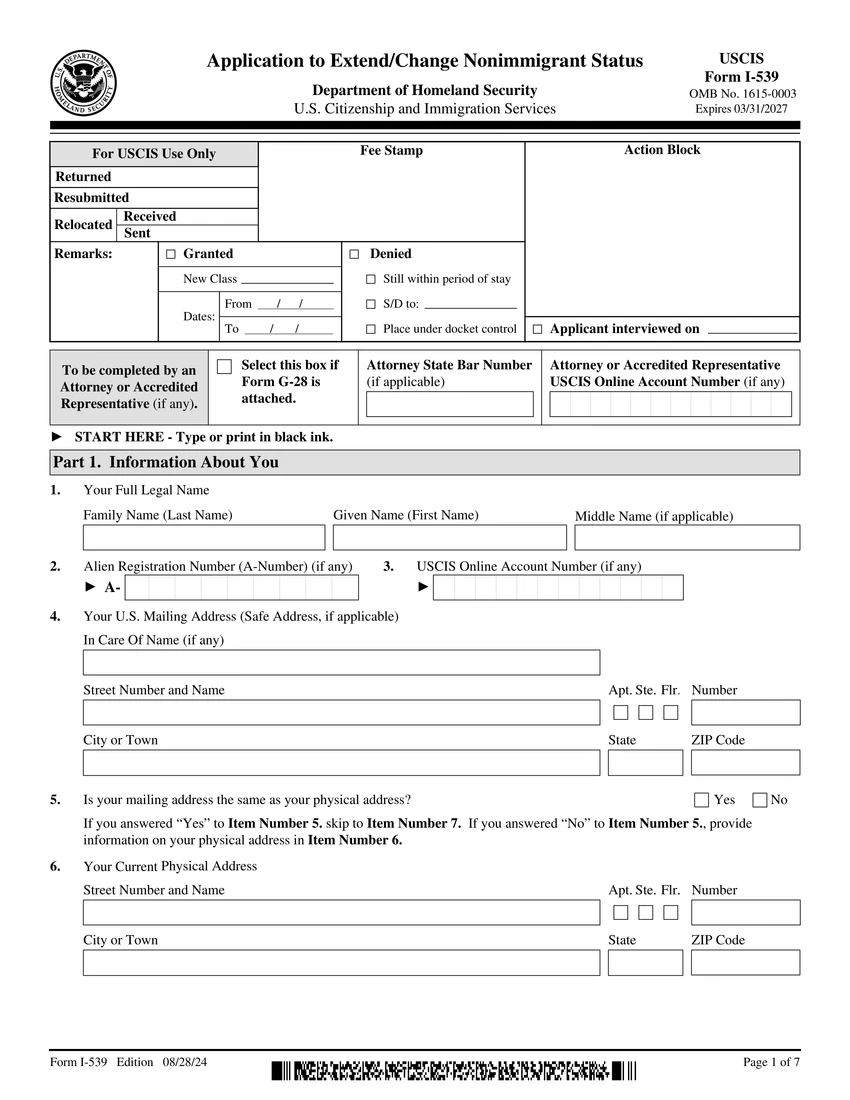
First page of I-539 form
Source: I-539 PDF
Context and workflow
#USCIS says many applicants should file I-539 before the I-94 expires and often recommends filing at least 45 days before the end of the current stay. It also warns that some categories cannot use I-539 at all and must instead use another form such as I-129. That makes form choice and timing two of the biggest decision points on this page.
Why this matters
- This form helps confirm that the application matches the program’s requirements and checklist.
- Small mismatches inside I-539 (or between I-539 and supporting evidence) can force rework later in processing.
Where it fits in the workflow
- Initiating the process for extending or changing nonimmigrant status.
- Receipt Notice (Form I-797) is typically issued after submission.
- May involve a biometrics appointment depending on the case.
- Potentially leads to approval or denial notice.
Who uses it
Common I-539 users include certain visitors seeking an extension, eligible dependents such as H-4 or L-2 dependents, people changing to a qualifying student or dependent category, F or M students seeking reinstatement, certain CNMI residents, and some V-status or parole-related situations described in the USCIS instructions. It is not the right form for many principal employment-based status changes such as H-1B, L-1, O-1, or TN.
When it is used
- When you need to extend your current nonimmigrant status before it expires
- When you want to change from one nonimmigrant classification to another eligible status
- If your current status allows extension or change under the official instructions
- B-1/B-2 — Extend visitor status
- F1 — Extend or change student status
- When filing I-539 alongside I-94-RECORD (Current I-94 status required to extend)
- As an alternative to I-485 — if you are eligible to adjust status, you may file I-485 instead of extending
Requirements snapshot
#- B-1/B-2 Extension: Visitor extending stay beyond I-94 date
- F-1 Reinstatement: Student seeking reinstatement after status violation
- J-2 Extension: Dependent of J-1 exchange visitor
Eligibility Category Codes
#Eligibility information for this form. Confirm your category in the official instructions before filing.
This is a shortlist of common categories. The official instructions include many more.
| Code | Who applies |
|---|---|
| General | NOTE: Dependents of L-1 intracompany transferees may need to apply for an extension or change of status to L-2 on this application. An employer may need to file Form I-129 on behalf of the L-1 intracompany transferee. |
| Eligibility | Nonimmigrants in the United States may apply for an extension of stay or a change of status on this application, except as noted in the Who May Not File Form I-539 section. |
Failure prevention (What causes Form I-539 rejections?)
#Technical rejections
- Ensure form edition is current
Substantive weaknesses
- Lack of evidence for the claimed relationship of dependents.
- To avoid filing extension after i-94 has expired: File I-539 before your current status expires; late filings may be denied.
- To avoid wrong form version or fee: Use the current edition date and check the fee schedule before submitting.
- To avoid using wrong supplement for status type: Use the correct supplement (e.g., H-4, L-2, F-1) for your dependent or status type.
- To avoid traveling outside u.s. while extension pending: Do not travel until approved or you have valid visa for reentry; travel may abandon the application.
What it asks for (What does Form I-539 ask for?)
#- Details about your reason for requesting an extension or change of status.
- Sign and date your application.
- Biographical information including family name, mailing address, and date of birth.
- Applicant identification information
- Supporting documentation inventory
- Eligibility or purpose details
- Declarations and signatures
What you need (What do you need for Form I-539?)
#- The current edition of I-539
- Current I-94 or proof of present nonimmigrant status
- Evidence of eligibility for the requested classification or extension
- Current I-94
- Financial evidence
- Explanation of why extension is needed
- Proof of ties to home country
- Principal's I-129 receipt or approval
- Marriage or birth certificate
Checklist (What is the Form I-539 checklist?)
#- Download the current I-539 and instructions from the official USCIS website
- Review the official I-539 instructions before filing
- Gather required supporting documents per the instructions
- Complete all required sections of I-539
- Confirm the form is signed and dated in all required fields
- Sign and date your Form I-539, ensuring that you include all necessary supporting documents before submission.
Fees
#| Component | Amount |
|---|---|
| Filing FeeThe standard filing fee for form i-539. Check the current fee on the official USCIS fee schedule. | See official schedule |
| Biometrics Services FeeA biometrics fee may be required depending on your category. Some applicants are scheduled for a biometric services appointment — check the official fee schedule and form instructions. | See official schedule |
| Premium Processing (limited availability)Premium processing is not available for most I-539 filings. USCIS offers it only for certain change-of-status requests (to F, M, or J categories); confirm current eligibility and the applicable fee on the official USCIS page before relying on it. | See official schedule |
Can the Form I-539 fee be waived?
Fee waivers may be available for qualifying applicants. See official instructions for eligibility.
What happens if I submit the wrong fee?
USCIS will reject your application if the incorrect fee is submitted. Verify the current fee on the official schedule before filing.
Fee waiver: Fee waivers may be available for qualifying applicants. See official instructions for eligibility. For related guidance, see Arrival/Departure Record.
Fees change; always verify on USCIS.
Processing times
#| Category | Processing time |
|---|---|
| All other change of status applications | 1 to 10.5 weeksas of January 2026 |
| All other extension of stay applications | 1 to 10 weeksas of January 2026 |
| Change of status to B nonimmigrant | 4 to 5 monthsas of January 2026 |
| Change of status to F or M student or J exchange visitor category | 4.5 to 6.5 monthsas of January 2026 |
| Change of status to H4 dependents | 5.5 to 9 monthsas of January 2026 |
| Change of status to L dependent | 8.5 to 12 monthsas of January 2026 |
| Change of status to H4 dependent with I-765 | 5 to 7 monthsas of January 2026 |
| Extension of stay for B nonimmigrant | 4 to 5 monthsas of January 2026 |
| Extension of stay for F or M students and J exchange visitor category | 3 to 4.5 monthsas of January 2026 |
| Extension of stay for H4 dependents | 6.5 to 9.5 monthsas of January 2026 |
| Extension of stay for L dependents | 6 to 8.5 monthsas of January 2026 |
| Extension of stay for T nonimmigrant | 21 to 23.5 monthsas of January 2026 |
| Extension of stay for U nonimmigrant | 20 to 23 monthsas of January 2026 |
| Extension of stay for H4 dependents with I-765 | 4.5 to 7 monthsas of January 2026 |
| Reinstatement to student status | 10 to 12.5 monthsas of January 2026 |
- Processing times for I-539 vary by eligibility category and service center. Data sourced from the official USCIS processing times tool.
- Processing times differ significantly by eligibility category. Initial applications, renewals, and replacements each go through different adjudication queues, and some categories consistently take longer than others.
- Renewal filings are often processed differently than initial applications. If you are renewing, file well before your current authorization expires — some categories allow you to continue working while the renewal is pending if filed on time.
- The service center assigned to your case affects how long it takes. USCIS distributes filings across multiple centers, and each has different workloads. You cannot choose which center processes your case.
- To check your estimated timeline: visit the official USCIS processing times tool, select your form and eligibility category, and note that the tool shows the filing date of cases currently being worked on — not a countdown from when you filed.
- While pending: track your case status online with your receipt number, respond promptly to any requests for additional evidence, and update your address through your USCIS account if you move.
Where to file
#Online filing is available for some categories — verify on the official form page. Otherwise, file by mail to the address in the instructions.
File online
Submit Form I-539 application for an extension or change of status by mail or online before the expiration date on your Form I-94.
Submit application
Submit Form I-539 application for an extension or change of status by mail or online before the expiration date on your Form I-94.
Filing locations and procedures may change. Always verify on the official USCIS website before submitting. For related guidance, see Report of Medical Examination and Vaccination.
Form sections (What sections does Form I-539 have?)
#Personal Information
Applicant identification.
- Full name and A-Number if applicable
- Date of birth and nationality
- Current address and contact
Eligibility
Basis for the application.
- Category or classification claimed
- Supporting evidence type
- Dates establishing eligibility
Supporting Documents
Required attachments.
- Identity and status documents
- Category-specific evidence
- Fee payment or waiver request
Choose your path
#Choose your path based on your eligibility category. Each block summarizes who qualifies, what to file, common mistakes, and typical processing time.
B-1/B-2 Visitor Extension
Visitors seeking to extend their authorized stay beyond the I-94 expiration date.
File with:
- Current I-94
- Financial evidence
- Explanation of why extension is needed
- Proof of ties to home country
Common mistakes:
- Filing after I-94 has already expired
- Not providing compelling reason for extension
Typical processing: Varies by category — see USCIS processing times
H-4/L-2 Dependent Extension
Dependents of H or L workers extending status concurrent with principal's petition.
File with:
- Principal's I-129 receipt or approval
- Marriage or birth certificate
- Current I-94
Common mistakes:
- Not filing concurrently with principal's I-129
- Status gap if principal's petition is denied
Typical processing: Varies by category — see USCIS processing times
Change to F-1 Student Status
Nonimmigrants in valid status seeking to change to F-1 student status.
File with:
- Financial evidence for tuition and living
- Current status documentation
Common mistakes:
- Starting school before change of status is approved
Typical processing: Varies by category — see USCIS processing times
F-1 Reinstatement
F-1 students who have fallen out of status and are seeking reinstatement.
File with:
- Letter from DSO supporting reinstatement
- Explanation of status violation
Common mistakes:
- Filing outside the reinstatement window after falling out of status — confirm the current timeframe on the USCIS reinstatement page
- Not demonstrating violation was beyond student's control
Typical processing: Varies by category — see USCIS processing times
Category comparison
#| Category code | Eligibility | Typical filing companion | Auto-extension? | Premium processing? |
|---|---|---|---|---|
| B-1/B-2 Extension | Visitor extending stay beyond I-94 date | Proof of financial support and return intent | No | No |
| F-1 Reinstatement | Student seeking reinstatement after status violation | Letter from DSO and academic records | No | No |
| H-4/L-2 Extension | Dependent of H or L worker extending stay | Principal's I-129 receipt or approval | No | No |
| J-2 Extension | Dependent of J-1 exchange visitor | J-1 principal's DS-2019 and program extension | No | No |
| Change to F-1 | Changing to student status | No | Limited — see USCIS |
Strategy tips
#Mistake severity
#| Mistake type | Severity | How to avoid |
|---|---|---|
| Filing extension after I-94 has expired | Rejection | File I-539 before your current status expires; late filings may be denied. |
| Wrong form version or fee | Delay | Use the current edition date and check the fee schedule before submitting. |
| Using wrong supplement for status type | Rejection | Use the correct supplement (e.g., H-4, L-2, F-1) for your dependent or status type. |
| Traveling outside U.S. while extension pending | Rejection | Do not travel until approved or you have valid visa for reentry; travel may abandon the application. |
Examples (What are examples for Form I-539?)
#- Strong application: An applicant submits the form with all required documents and receives a timely decision on their extension or change of status.
- Strong application: A visitor seeking to extend their authorized stay beyond the I-94 expiration date files with the required evidence and receives a decision on the extension, with processing times that vary by category — check the USCIS processing-times tool. (I-539 does not itself grant work authorization; an Employment Authorization Document requires a separate Form I-765 where the category allows it.)
- Strong application: Dependents of H or L workers file to extend their status concurrently with the principal's petition and receive a decision on the request, with timelines that vary by category — check the USCIS processing-times tool.
- Strong application: A nonimmigrant in valid status seeking to change to F-1 student status files with the required evidence and receives a decision on the change of status, with timelines that vary by category — check the USCIS processing-times tool.
- Strong application: An F-1 student who has fallen out of status files for reinstatement with the required evidence and receives a decision, with timelines that vary by category — check the USCIS processing-times tool.
Common misconceptions (What misconceptions surround Form I-539?)
#- Filing does not automatically extend your status while the application is pending
- You may need to meet the eligibility requirements for the requested classification
- I-539 has more than one fee component (e.g. Filing Fee and Biometrics Services Fee); paying only one or paying the wrong amount can result in rejection of the entire filing.
- A fee waiver for I-539 is not automatic — only specific qualifying categories are eligible, and a waiver request can be denied while the underlying form is still expected to be filed.
- Processing time for I-539 is not one-size-fits-all — different categories see very different timelines (for example, All other change of status applications runs about 1 to 10.5 weeks, while All other extension of stay applications runs about 1 to 10 weeks).
- I-539 cannot always be filed in any way — the correct filing method depends on the applicant's category, and using the wrong channel can result in rejection.
Edge cases and variations
#- If you are asked to submit or update I-539, treat it as a package update: check every place the same details appear and keep them consistent.
In-depth guidance
#How to file Form I-539 with USCIS
Form I-539 is the USCIS application you use to ask for an extension of stay in the nonimmigrant status you already hold, or to apply for a change of status to a different eligible nonimmigrant classification, without leaving the United States. Start by confirming that your category may use this application at all. The official USCIS instructions list who may file Form I-539 and who may not, and several classifications are excluded — principal employment-based workers are sponsored by an employer on Form I-129 instead.
Once you know the form fits, download the current edition of Form I-539 and its instructions from USCIS, complete the application for the classification you are requesting, and assemble the evidence the instructions list for that category. That usually means proof of your present status from your Form I-94, evidence you still qualify for the classification, and relationship documents for any dependents. Family members extending or changing status alongside you are added on Form I-539A rather than on separate applications.
You then file Form I-539 with USCIS by mail, or online where your category supports it, before the authorized stay on your I-94 expires.
Extension of stay vs. change of status
Form I-539 covers two different requests, and the evidence differs. An extension of stay asks USCIS for more time in the nonimmigrant status you already hold: you remain in the same classification, and the application has to show you still meet its conditions and that your reason for staying is consistent with it. A change of status asks USCIS to move you into a different nonimmigrant classification while you remain in the United States, so the application has to prove eligibility for the new category, not only the old one.
Some categories may only extend, some may only change, and a few may do neither on this application — the USCIS instructions are the controlling list. Timing matters for both requests: file before your current authorized stay expires, because a late application is excused only when USCIS accepts an extraordinary-circumstances explanation, and filing does not by itself extend your status while the request is pending. If you are eligible for permanent residence, Form I-485 may be the better path than another extension.
When to file Form I-539 — and what filing does not do
Timing is where most Form I-539 applications go wrong. USCIS expects the application to reach it while you are still holding the nonimmigrant status you were admitted in, which in practice means before the authorized stay printed on your Form I-94 ends.
An application that arrives after that date is not refused automatically, but it moves into a much narrower lane: the official USCIS instructions for Form I-539 allow a late filing to be excused only where you can show the delay was caused by extraordinary circumstances beyond your control, that you have not otherwise violated the conditions of your status, and that you remain a bona fide nonimmigrant.
The practical consequence is that the date on your I-94, not the date your current visa stamp expires, is the deadline you are working against. Those two dates are frequently different, and reading the visa instead of the I-94 record is a common way to file late without realising it. Build the filing schedule backwards from the I-94 date, leaving room to gather the evidence your category requires, because an application that is complete but late is in worse shape than one filed early with a request for evidence still to come.
A pending application also does not unlock anything on its own. Do not begin an activity that only the requested classification permits until USCIS approves the change of status, and treat work authorization as a separate question: Form I-539 never grants permission to work, and where your category allows employment you request it on Form I-765. International travel deserves the same caution, because leaving the country while the request is pending can be treated as abandoning it.
Confirm the timing rules for your own classification in the official USCIS instructions for Form I-539, linked in full from the official sources listed on this page, before you file.
Building the Form I-539 evidence package for your category
USCIS adjudicates Form I-539 on the evidence attached to it, and the instructions organize that evidence by nonimmigrant status rather than as one universal list. Start from your own classification. A B-1 visitor for business or B-2 visitor for pleasure is asked for the original Form I-94 plus a detailed written statement explaining why more time is needed. A dependent in a category such as H-4, L-2, or J-2 is asked for evidence of the principal's status and of the qualifying relationship.
An F or M student seeking reinstatement is asked for a designated school official's supporting statement and an explanation of the violation. Every application carries a copy of Form I-94 for each person named on it, and each family member added on Form I-539A signs their own supplement.
Two failure modes account for most requests for evidence on this application. The first is a package that proves the wrong thing — evidence that you qualified for the status you already hold, when the question USCIS is deciding is whether you qualify for the classification you are asking to change to. The second is inconsistency: names, dates of birth, and passport details that do not match across the application, the I-94 record, and the supporting documents.
Assemble the package against the evidence list for your exact category in the official USCIS instructions for Form I-539, and include a complete English translation for any document not written in English.
Scenarios
#An applicant files the application with all required supporting documents and the correct fee.
Application accepted. Biometrics may be scheduled. Case proceeds to adjudication.
Follow the evidence checklist for your category. Missing documents trigger RFEs or denial.
An applicant who needs a principal employment classification (e.g., H-1B) files I-539 instead of having the employer file I-129.
Application rejected or denied. The wrong form cannot grant the requested classification, and the applicant must refile on the correct form.
Confirm I-539 is the right form for your category before filing. Principal employment-based classifications use I-129, not I-539.
An applicant forgets to sign the form.
Application rejected. Must resubmit with signature. Unsigned forms are not accepted.
Sign and date the form. Review the signature block before mailing.
Key differentiators
#- Unlike Form I-94: Arrival/Departure Record: Required for: Current I-94 status required to extend (Status Change pathway)
- Unlike Form I-485: Application to Register Permanent Residence or Adjust Status: Alternative option: If eligible, may adjust status instead of extending (Status Change pathway)
Why it matters
#What happens after you submit
#- Receive a Receipt Notice (Form I-797) confirming the application has been received.
- Attend a biometrics appointment if required, where fingerprints, photo, and signature are collected.
- Wait for USCIS to process the application and issue a decision.
- Receive an approval or denial notice based on the application review.
Verification
#This guide is derived from official USCIS instructions for I-539 and is updated when form editions or filing rules change. Always verify current requirements at the official USCIS website.
Resources
#Free United States planning tools
#Itemize the government fees that go alongside Form I-539.
United States eligibility checker
See which United States visas your profile fits before you finalize Form I-539.
United States processing times
Get the typical wait time for the visa associated with Form I-539.
United States interview practice
Practice United States interview questions if your filing route includes one.