
Quick summary
#A U.S. citizen, lawful permanent resident, or qualifying U.S. national petitioner filing for an eligible family member.
At the start of a family-based green card case, before the beneficiary moves to adjustment of status or consular processing.
After approval, the case usually moves either to I-485 or to Department of State immigrant-visa processing, depending on location and eligibility.
Petitioner status evidence and the claimed relationship documents Biographic details across I-130, I-130A, passports, and civil records The selected post-approval path: adjustment of status or consular processing
Overview (What is Form I-130?)
#I-130 is not the green card application itself. It is the petition that asks USCIS to recognize the qualifying family relationship so the beneficiary can move to the next immigration stage. That next stage is not automatic, and it depends heavily on who filed, who the beneficiary is, where the beneficiary lives, and whether an immigrant visa is immediately available. Spouse cases often require I-130A in the initial packet.
After approval, the case may continue through I-485 if the beneficiary can adjust status in the United States, or through Department of State consular processing with later financial sponsorship through I-864. A strong I-130 filing is really about getting the relationship evidence, petitioner-status evidence, and post-approval pathway right from the start so you do not create delays later.
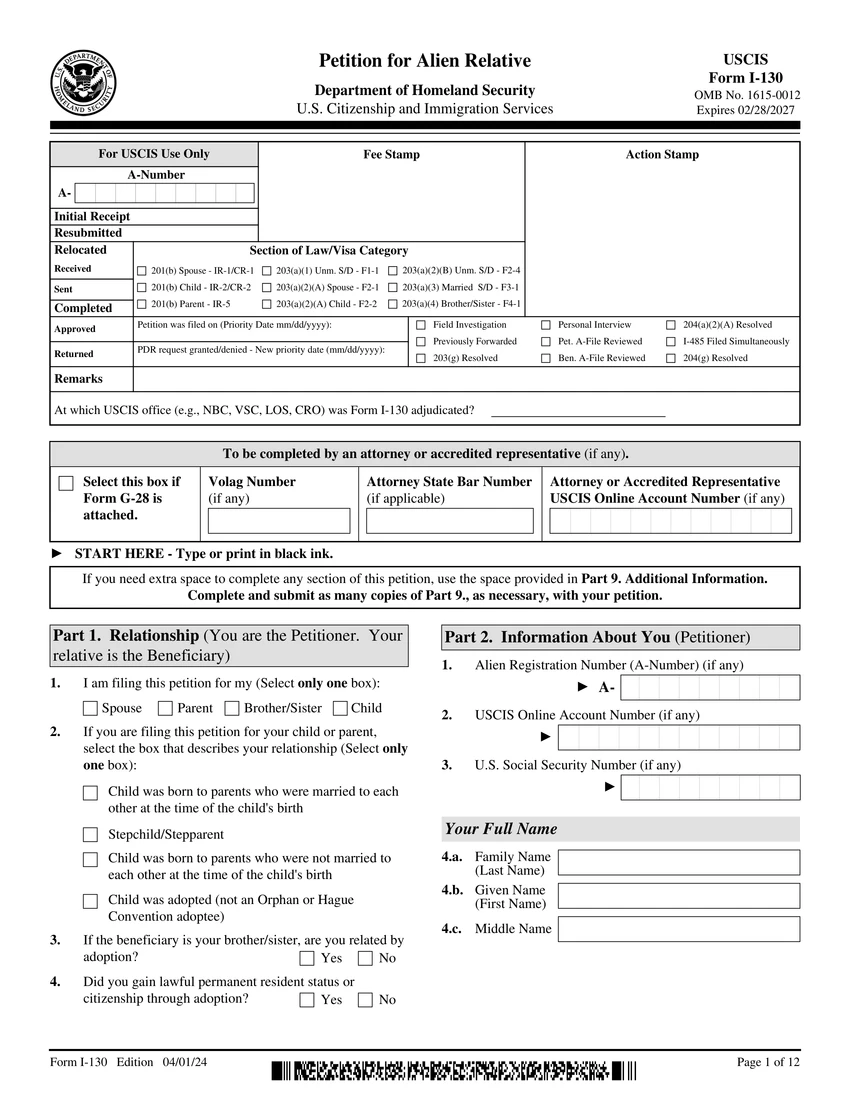
First page of I-130 form
Source: I-130 PDF
Context and workflow
#I-130 is the front door to many family-based green card cases, but one of the most important choices happens inside the petition itself: whether the beneficiary will pursue adjustment of status in the United States or consular processing abroad. USCIS says you must choose only one of those options in Part 4 and should not leave the section blank.
While you wait, it helps to understand the likely downstream route, including I-485, IR-1, CR-1, IR-2, and the broader U.S. adjustment of status vs consular processing guide.
Where it fits in the workflow
- Starts the family-based immigration process by asking USCIS to recognize the qualifying relationship.
- Leads to either adjustment of status or consular processing after approval, depending on the beneficiary's location and eligibility.
- Requires careful planning because the petition itself asks you to indicate the intended downstream path.
- Is commonly filed with I-130A in spouse cases and often leads later to I-485 or I-864.
Who uses it
The petitioner uses I-130 for a qualifying relative, such as a spouse, parent, child, or sibling where the law allows that relationship. U.S. citizens can petition for more family categories than lawful permanent residents, and immediate-relative cases follow different timing rules from preference-category cases. In spouse cases, the initial packet often includes I-130A. The beneficiary does not use I-130 by itself to ask for a green card; the later step is usually I-485 if adjustment is available or immigrant-visa processing followed by I-864.
When it is used
- IR-1: spouse of a U.S. citizen in an immediate-relative pathway
- CR-1: spouse pathway where conditional residence applies
- IR-2: child of a U.S. citizen in a family-based immigrant route
- As the petition stage before later forms such as I-485 or I-864
Failure prevention (What causes Form I-130 rejections?)
#Technical rejections
- Submitting the form without a valid signature.
- Failing to include Form I-130A when required for a spouse.
- Ensure form edition is current
Substantive weaknesses
- Submitting original documents unnecessarily, which may be destroyed.
What it asks for (What does Form I-130 ask for?)
#- Biographical information about the petitioner and beneficiary
- Evidence of the petitioner's U.S. citizenship, lawful permanent residence, or qualifying U.S. national status
- The claimed qualifying relationship and the civil documents used to prove it
- Whether the beneficiary will pursue adjustment of status inside the United States or consular processing abroad
- Prior marriages, name changes, and family-history facts that affect eligibility
- Spouse-specific supplemental information through I-130A when required
- Declarations, signatures, and other details that must align with the later green-card path
What you need (What do you need for Form I-130?)
#- The current edition of I-130
- Proof of your own immigration status, such as citizenship evidence, passport, or green card
- Evidence of the qualifying relationship, such as marriage, birth, or adoption records depending on the case
- Beneficiary identification documents and photographs where required
- If filing for a spouse, the supplemental spouse information required by I-130A
- A plan for the next stage, such as I-485 inside the U.S., later financial sponsorship through I-864, and the wider U.S. documents checklist
Checklist (What is the Form I-130 checklist?)
#- Download the current I-130 and instructions from the official USCIS website
- Review the official I-130 instructions before filing
- Gather required supporting documents per the instructions
- Complete all required sections of I-130
- Confirm the form is signed and dated in all required fields
- Confirm all pages are from the same current I-130 edition
- Sign, date, and submit I-130 with all required supporting evidence
Fees
#| Component | Amount |
|---|---|
| I-130 filing feeCheck the current filing fee on the USCIS fee schedule because the amount can change and payment rules differ by filing method. | See official schedule |
| Possible later correction costIf the approved petition needs to be rerouted to consular processing after approval, USCIS says you may need I-824, which adds cost and time. | See official schedule |
Do online and paper I-130 filings use the same fee rules?
The filing fee is controlled by USCIS, but the payment method depends on how you file. Online filings use the USCIS online payment flow, while paper lockbox filings must follow the current USCIS payment instructions.
Why does choosing the wrong post-approval path matter financially?
Because if you need to switch to consular processing after approval, USCIS says you may need to file I-824, which adds another filing fee and more waiting time.
Always verify both the amount and the accepted payment method on the USCIS site before filing.
Processing times
#- I-130 processing times vary by relationship category, petitioner's status, and USCIS workload.
- Immediate-relative and preference-category petitions do not move on the same timeline, so compare only against your exact filing category in the USCIS processing-times tool.
- Approval of I-130 does not by itself mean the beneficiary can move immediately to a green-card filing. Some relatives must still wait for visa availability after approval.
- If the case later needs a path correction between adjustment of status and consular processing, that can add significant extra delay.
Where to file
#USCIS says you have two main filing options for I-130: online filing through a USCIS account or paper filing to the correct lockbox address for your location and filing situation.
File online
USCIS allows I-130 online filing, including cases where the beneficiary is in the United States and will later file I-485 by mail. In that situation, the I-130 receipt notice should be included in the I-485 packet.
Submit application
Paper filing addresses vary based on where you live and whether you are filing only I-130 or filing in connection with I-485. Use the USCIS direct filing address page instead of assuming one lockbox works for every case.
If you live outside the United States, USCIS notes that some U.S. citizen immediate-relative petitioners may request filing at a U.S. embassy or consulate in limited circumstances.
Form sections (What sections does Form I-130 have?)
#Part 3. Biographic Information
Petitioner and beneficiary identity details should line up cleanly with passports, birth records, and prior USCIS filings.
- Use legal names, dates of birth, and biographic details exactly as they appear on the civil records and passports.
- Fix inconsistencies between current and prior filings before submission rather than hoping USCIS ignores them.
- In spouse cases, make sure the related I-130A information supports the same identity and address history.
Part 4. Information About Beneficiary
This is where the case path becomes practical: relationship type, beneficiary facts, and whether the case will head toward adjustment or consular processing.
- Choose only the correct downstream path for the beneficiary instead of mixing adjustment and consular assumptions.
- Make sure the beneficiary's address, marital history, and identity details match the civil records and the real case strategy.
- If the beneficiary is a spouse, this section should work together with I-130A and later plans for I-485 or consular processing.
Part 9. Additional Information
Use this section to cure complexity, not create it. If the relationship timeline or processing path needs explanation, it should be handled clearly here.
- Clarify unusual family-history or filing details in a way that matches the main evidence packet.
- Do not use this section as a substitute for missing civil documents or missing relationship evidence.
- If the case may later require [I-824] or a correction between adjustment and consular processing, this is exactly why the earlier sections need to be accurate now.
Mistake severity
#| Mistake type | Severity | How to avoid |
|---|---|---|
| Weak or incomplete relationship evidence | RFE | Build the packet around the exact civil records and supporting evidence that prove the claimed family relationship. |
| Missing I-130A in a spouse case | Rejection | Include I-130A whenever the petition is for a spouse and follow the current USCIS instructions. |
| Selecting both adjustment of status and consular processing, or leaving Part 4 blank | Delay | Choose only one downstream path on the form and make sure it matches the beneficiary's real plan and location. |
| Using the wrong edition or filing address | Rejection | Check the USCIS edition date and the current direct filing addresses right before you submit. |
| Trying to fix a post-approval path problem too late | Delay | Review the adjustment-vs-consular choice carefully before filing and correct it while the petition is still pending if plans change. |
Examples (What are examples for Form I-130?)
#- Strong application: An applicant submits the form with all required documents and receives a timely decision.
- Weak application: An applicant submits the form without evidence of the family relationship, leading to a request for additional information and a delay in processing.
Common misconceptions (What misconceptions surround Form I-130?)
#- I-130 has more than one fee component (e.g. I-130 filing fee and Possible later correction cost); paying only one or paying the wrong amount can result in rejection of the entire filing.
- I-130 cannot always be filed in any way — the correct filing method depends on the applicant's category, and using the wrong channel can result in rejection.
- I-130 can be rejected before substantive review for technical errors such as “Submitting the form without a valid signature.”
- A complete I-130 can still be denied on the merits — issues like “Submitting original documents unnecessarily, which may be destroyed” are evaluated by the reviewer even when paperwork is clean.
- Submitting I-130 is the start of the process — applicants should expect follow-up steps such as “Receive Receipt Notice (a related form) confirming the form submission.”
- Approval of I-130 only establishes the qualifying family relationship — the beneficiary still has to apply for a visa or adjustment of status separately.
Scenarios
#A software engineer submitted their petition with all supporting documents
The case was approved within the standard timeline
Prepare all evidence before filing to avoid delays
Why it matters
#Derivative beneficiaries do not require separate petitions.
Why it matters: This can simplify the process for families with multiple eligible members.
Married children of lawful permanent residents are not eligible.
Why it matters: Filing for a married child can lead to denial or revocation of the petition.
Non-citizen U.S. nationals have similar petition rights as lawful permanent residents.
Why it matters: This expands eligibility for petitioners born in American Samoa or Swains Island.
If you have been married less than two years, your spouse will receive conditional permanent resident status.
Why it matters: Failure to remove conditions can lead to termination of status and removal proceedings.
What happens after you submit
#- Receive Receipt Notice (a related form) confirming the form submission.
- USCIS reviews the petition and supporting documents.
- Receive a notice of action regarding the petition's status.
- If approved, proceed with next stage forms for the beneficiary's immigration process.
Verification
#This guide is derived from official USCIS instructions for I-130 and is updated when form editions or filing rules change. Always verify current requirements at the official USCIS website.
Resources
#Free United States planning tools
#Itemize the government fees that go alongside Form I-130.
United States eligibility checker
See which United States visas your profile fits before you finalize Form I-130.
United States processing times
Get the typical wait time for the visa associated with Form I-130.
United States interview practice
Practice United States interview questions if your filing route includes one.