
Overview (What is Form I-140?)
#I-140 is the employment-based immigrant petition USCIS uses to decide whether a foreign national qualifies under a specific permanent-worker category such as EB-1, EB-2, or EB-3. The real strategy questions are category choice, whether PERM is required, whether the employer can prove ability to pay the offered wage, and whether premium processing or concurrent filing with I-485 is available. Approval can be pivotal, but it does not itself grant work authorization or permanent residence.
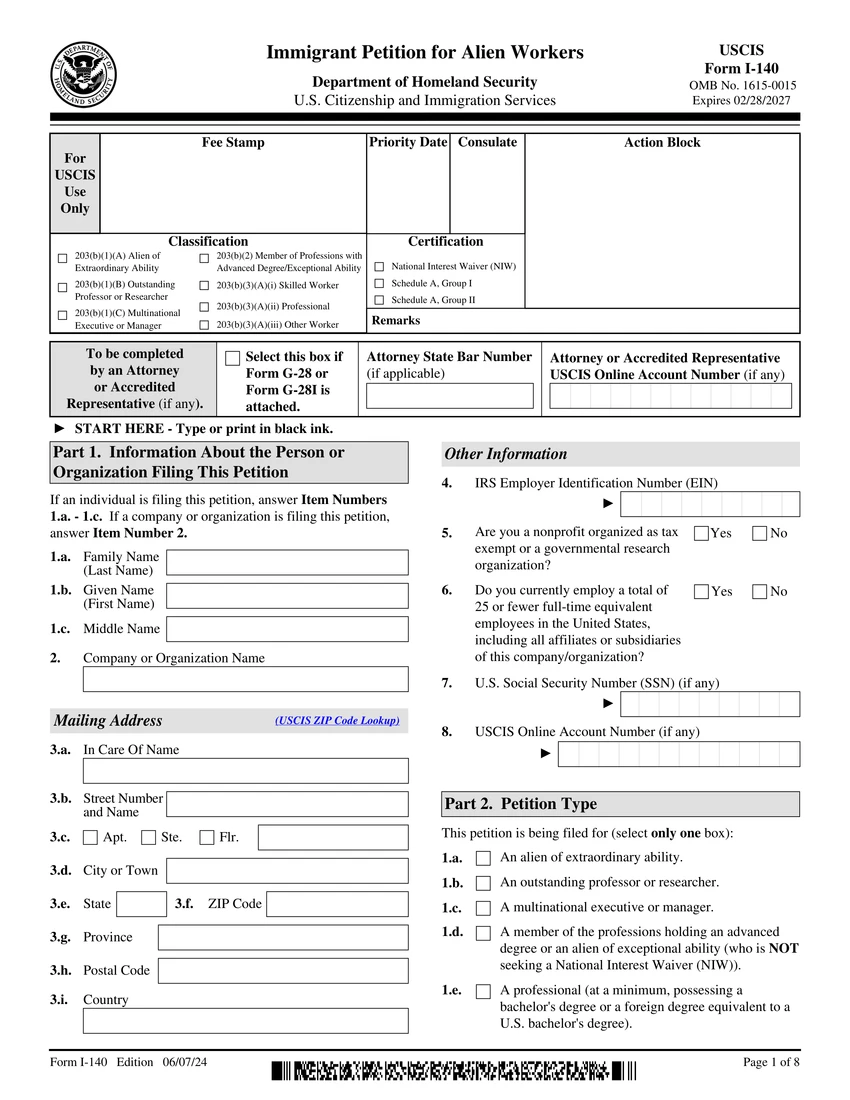
First page of I-140 form
Source: I-140 PDF
Context and workflow
#I-140 sits in the middle of the employment-based green-card process, usually after labor certification or category-specific evidence is ready and before the final green-card step. USCIS now allows some I-140 filings online, but only in limited standalone situations. If another form such as I-907 or I-485 is being filed with it, the filing path changes.
Where it fits in the workflow
- Initiates the employment-based immigration process.
- Receipt Notice (a related form) is issued upon submission.
- May lead to next stage forms for adjustment of status or consular processing.
- I-140 is commonly filed alongside Form I-907.
Who uses it
A U.S. employer usually files I-140 for the worker, but some categories allow self-petitioning, such as extraordinary ability or certain national-interest-waiver cases. This form is for employment-based permanent residence, not for a temporary work-visa petition and not for a family-based immigrant case.
When it is used
- EB-1: EB-1 Employment-Based First Preference
Requirements snapshot
#- EB-1: Extraordinary ability, outstanding professor/researcher, or multinational executive
- EB-2: Advanced degree or exceptional ability; may require labor certification
- EB-2 NIW: National Interest Waiver; no job offer or PERM required
- EB-3: Skilled workers, professionals, or other workers; requires labor certification
Failure prevention (What causes Form I-140 rejections?)
#Technical rejections
- Submitting the form without a valid signature.
- Ensure form edition is current
Substantive weaknesses
- Failing to provide evidence of the worker's qualifications.
What it asks for (What does Form I-140 ask for?)
#- Details about the U.S. employer and the job offer.
- Contact information, certification, and signature of the petitioner or authorized signatory
- Details about the alien worker, including biographical information and immigration history.
- Applicant identification information
- Supporting documentation inventory
- Eligibility or purpose details
- Declarations and signatures
What you need (What do you need for Form I-140?)
#- The current edition of I-140
- Proof of your own immigration status (citizenship certificate, passport, or green card (Permanent Resident Card))
- Beneficiary identification documents and photographs
Checklist (What is the Form I-140 checklist?)
#- Download the current I-140 and instructions from the official USCIS website
- Review the official I-140 instructions before filing
- Gather required supporting documents per the instructions
- Complete all required sections of I-140
- Confirm the form is signed and dated in all required fields
- Confirm all pages are from the same current I-140 edition
- Sign, date, and submit I-140 with all required supporting evidence
Fees
#| Component | Amount |
|---|---|
| I-140 filing feeCheck the current USCIS fee schedule for the petition itself. | See official schedule |
| Premium processingIf the case uses I-907, premium-processing fees are separate and USCIS has recently updated some premium-processing amounts. | See official schedule |
Always verify both the base I-140 fee and any current premium-processing amount before filing.
Form sections (What sections does Form I-140 have?)
#Part 4. Processing Information
Complete this section as described in the official instructions.
- Common mistake: Missing employer attestation for EB-1B/C
- USCIS verifies this section.
Part 6. Basic Information About the Proposed Employment
Complete this section as described in the official instructions.
- Common mistake: Wrong fee or outdated form version
- Avoid: Check current fee schedule and form edition date before submitting.
- Common mistake: Forgetting to sign the petition
- Avoid: Sign and date all required sections before submitting.
- Common mistake: Incorrect priority date or labor certification number
- Avoid: Double-check PERM case number and priority date; errors affect I-485 timing.
- USCIS verifies signature and photo specs.
Part 11. Additional Information
Complete this section as described in the official instructions.
- Submitting a petition without a valid signature.
- Failing to provide all required evidence and supporting documents.
- Not providing a labor certification when required.
- USCIS verifies this section.
Strategy tips
#Common mistakes (What mistakes are common with Form I-140?)
#- Submitting a petition without a valid signature.
- Failing to provide all required evidence and supporting documents.
- Not providing a labor certification when required.
- Submitting original documents when not required, which may be destroyed.
- Not attending a required biometric services appointment.
- Using an incorrect edition of the form.
- Missing pages from the form.
Examples (What are examples for Form I-140?)
#- Common weakness: Employer fails to provide proof of ability to pay the offered wage, leading to a request for additional evidence.
- Scenario: A software engineer submitted their petition with all supporting documents The case was approved within the standard timeline Prepare all evidence before filing to avoid delays
Common misconceptions (What misconceptions surround Form I-140?)
#- Some applicants assume that once the I-140 is filed, they can immediately start working in the U.S.; however, approval of the I-140 does not grant work authorization.
- I-140 has more than one fee component (e.g. I-140 filing fee and Premium processing); paying only one or paying the wrong amount can result in rejection of the entire filing.
- I-140 can be rejected before substantive review for technical errors such as “Submitting the form without a valid signature.”
- A complete I-140 can still be denied on the merits — issues like “Failing to provide evidence of the worker's qualifications” are evaluated by the reviewer even when paperwork is clean.
- Submitting I-140 is the start of the process — applicants should expect follow-up steps such as “Receive Receipt Notice (a related form) confirming submission.”
- I-140 confirms the employer/role is approvable — it does not by itself grant the worker status to enter or work.
Scenarios
#A software engineer submitted their petition with all supporting documents
The case was approved within the standard timeline
Prepare all evidence before filing to avoid delays
Why it matters
#Premium processing availability varies by category
Why it matters: Choosing the wrong option can delay adjudication.
Concurrent filing changes evidence requirements
Why it matters: Filing alongside another application may waive some documents.
Labor certifications expire 180 days from the date of certification
Why it matters: USCIS must receive Form I-140 before the expiration to avoid rejection.
Professional athletes' labor certifications do not contain minimum job requirements.
Why it matters: USCIS may request additional evidence if not provided.
What happens after you submit
#- Receive Receipt Notice (a related form) confirming submission.
- USCIS reviews the petition and supporting documents.
- Receive a notice of action, which could be a request for additional evidence or a decision.
- If approved, proceed with next stage forms for adjustment of status or consular processing.
Verification
#This guide is derived from official USCIS instructions for I-140 and is updated when form editions or filing rules change. Always verify current requirements at the official USCIS website.
Resources
#Free United States planning tools
#Itemize the government fees that go alongside Form I-140.
United States eligibility checker
See which United States visas your profile fits before you finalize Form I-140.
United States processing times
Get the typical wait time for the visa associated with Form I-140.
United States interview practice
Practice United States interview questions if your filing route includes one.