Latest reported interview data
#Applicant-reported research
Interview research snapshot
- Visa group:
- Naturalization (N-400)
- Release:
- 2026.07.18-us-v1
- Release date:
- July 18, 2026
- Source period:
- 2024-03–2026-07
935+
qualifying naturalization (n-400) interview reports
| Question theme | Reports | Prevalence |
|---|---|---|
| Civics test question | 510+ | 55% |
| Background questions | 175+ | 19% |
| Identity verification | 145+ | 16% |
Applicant-reported findings are observational and are not official government data or a prediction of what any officer will ask.
How the Civics Test Works
#USCIS asks up to 10 questions from the official 100-question bank and stops once the applicant answers 6 correctly or can no longer reach 6.
2025 Civics Test
USCIS asks up to 20 questions from the official 128-question bank and stops once the applicant answers 12 correctly or answers 9 incorrectly.
The filing date controls which version applies. Do not choose a study list based only on the interview date.
The Most Frequently Asked Civics Questions
#USCIS does not publish a frequency ranking of civics questions. Study the complete official question bank for the version that applies to the N-400 filing date.
Useful study groupings include principles of American government, the system of government, rights and responsibilities, American history, geography, symbols, and holidays. These categories organize study; they do not predict which questions an officer will select.
American Government Questions
#Government questions make up the largest category — roughly half of the 100 questions. They cover three sub-topics.
Principles of American Democracy
These test your understanding of foundational concepts:
- What is the supreme law of the land? — The Constitution
- What does the Constitution do? — Sets up the government, defines the government, protects basic rights of Americans
- The idea of self-government is in the first three words of the Constitution. What are these words? — We the People
- What is an amendment? — A change or addition to the Constitution
- What do we call the first ten amendments to the Constitution? — The Bill of Rights
- What is the "rule of law"? — Everyone must follow the law, leaders must obey the law, government must obey the law, no one is above the law
System of Government
These test knowledge of how the federal government operates:
- Name one branch or part of the government. — Congress (legislative), President (executive), the courts (judicial)
- Who makes federal laws? — Congress (Senate and House of Representatives)
- Who is the current president? — Answer changes with elections
- Who vetoes bills? — The President
- What does the judicial branch do? — Reviews laws, explains laws, resolves disputes, decides if a law goes against the Constitution
- How many justices are on the Supreme Court? — Nine (9)
- Who is the Chief Justice of the United States now? — Answer changes with appointments
- How many US senators are there? — 100
- We elect a US senator for how many years? — Six (6)
- The House of Representatives has how many voting members? — 435
- We elect a US representative for how many years? — Two (2)
Rights and Responsibilities
These cover what citizens can and must do:
- What is one right or freedom from the First Amendment? — Speech, religion, assembly, press, petition the government
- How old do citizens have to be to vote for president? — Eighteen (18) and older
- What are two rights only for US citizens? — Vote in a federal election, run for federal office
- What is one responsibility that is only for US citizens? — Serve on a jury, vote in a federal election
- What are two ways Americans can participate in their democracy? — Vote, join a political party, help with a campaign, join a civic group, run for office, write to a newspaper, call elected officials
American History Questions
#History questions span from the colonial era to the present. Officers ask these slightly less often than government questions, but they still appear in most interviews.
Colonial Period and Independence
- What is one reason colonists came to America? — Freedom, political liberty, religious freedom, economic opportunity, to practice their religion, to escape persecution
- Who lived in America before the Europeans arrived? — American Indians / Native Americans
- What did the Declaration of Independence do? — Announced our independence from Great Britain, declared our independence, said the United States is free from British control
- When was the Declaration of Independence adopted? — July 4, 1776
- Who was the first president? — George Washington
- Who is the "Father of Our Country"? — George Washington
- Name one of the writers of the Federalist Papers. — James Madison, Alexander Hamilton, John Jay, Publius
- What territory did the United States buy from France in 1803? — The Louisiana Territory / Louisiana
- Benjamin Franklin is famous for many things. Name one. — US diplomat, oldest member of the Constitutional Convention, first Postmaster General, writer of "Poor Richard's Almanac", started the first free libraries
1800s
- Name one war fought by the United States in the 1800s. — War of 1812, Mexican-American War, Civil War, Spanish-American War
- Name the US war between the North and the South. — The Civil War
- Name one problem that led to the Civil War. — Slavery, economic reasons, states' rights
- What was one important thing that Abraham Lincoln did? — Freed the slaves (Emancipation Proclamation), saved/preserved the Union, led the US during the Civil War
Recent American History
- Name one war fought by the United States in the 1900s. — World War I, World War II, Korean War, Vietnam War, Gulf War
- Who was president during World War I? — Woodrow Wilson
- Who was president during the Great Depression and World War II? — Franklin Roosevelt
- Before he was president, Eisenhower was a general. What war was he in? — World War II
- During the Cold War, what was the main concern of the United States? — Communism
- What movement tried to end racial discrimination? — The civil rights movement
- What did Martin Luther King Jr. do? — Fought for civil rights, worked for equality for all Americans
- What major event happened on September 11, 2001, in the United States? — Terrorists attacked the United States / Al Qaeda attacked the United States
Geography, Symbols & Holidays
#Integrated civics questions are among the most commonly asked — and the easiest to memorize.
Geography
- What is the capital of the United States? — Washington, D.C.
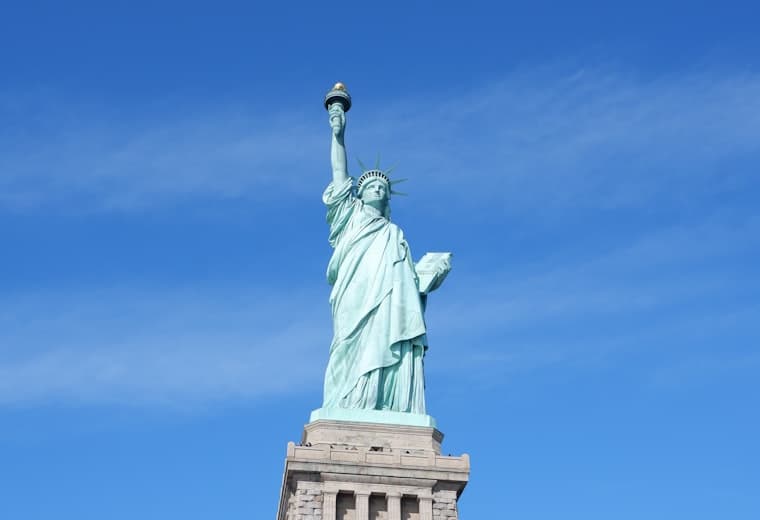
- Where is the Statue of Liberty? — New York Harbor / Liberty Island (also acceptable: New Jersey, near New York City, on the Hudson River)
- Name one of the two longest rivers in the United States. — Missouri River, Mississippi River
- What ocean is on the West Coast of the United States? — Pacific Ocean
- What ocean is on the East Coast? — Atlantic Ocean
- Name one US territory. — Puerto Rico, US Virgin Islands, American Samoa, Northern Mariana Islands, Guam
- Name one state that borders Canada. — Maine, New Hampshire, Vermont, New York, Pennsylvania, Ohio, Michigan, Minnesota, North Dakota, Montana, Idaho, Washington, Alaska
- Name one state that borders Mexico. — California, Arizona, New Mexico, Texas
Symbols
- Why does the flag have 13 stripes? — Because there were 13 original colonies
- Why does the flag have 50 stars? — Because there are 50 states / because each star represents a state
- What is the name of the national anthem? — "The Star-Spangled Banner"
- What is the Statue of Liberty? — A symbol of freedom, a gift from France
Holidays
- When do we celebrate Independence Day? — July 4
- Name two national US holidays. — New Year's Day, Martin Luther King Jr. Day, Presidents' Day, Memorial Day, Independence Day, Labor Day, Columbus Day, Veterans Day, Thanksgiving, Christmas
These questions have simple, factual answers that do not require interpretation. They reward straightforward memorization.
Study Strategies
#-
Confirm whether the 2008 or 2025 test applies using the N-400 filing date.
-
Download the matching official USCIS question-and-answer list.
-
Check the USCIS updates page for answers affected by elections or appointments.
-
Practise answering aloud because the civics test is oral.
-
Study the full bank rather than relying on an unofficial frequency list.
-
Review the English reading and writing requirements and any exception or accommodation that may apply.
Study time varies by applicant. No fixed number of weeks guarantees a passing result.
Special Accommodations: The 65/20 Exception
#Applicants may qualify for English-language exceptions, disability accommodations, or special civics consideration depending on age, time as a lawful permanent resident, and medical eligibility.
Applicants who qualify for the age-65/20-year special consideration study a designated bank of 20 questions. The officer asks 10, and 6 correct answers are required. Confirm eligibility and the applicable test version on USCIS before relying on an exception.
What Happens If You Fail
#If an applicant fails part of the naturalization test at the first interview, USCIS generally schedules a second examination on the failed portion within 60 to 90 days. The notice explains what will be retested.
Failing the second examination can result in denial of the N-400. Read the USCIS notice carefully and use the official materials for the correct test version. A denial does not automatically end lawful permanent resident status, but other issues identified in the case may require legal advice.
Practice the Civics Test
#Practise the official civics topics for the test version tied to your N-400 filing date.
VisaMind practice is a study aid, not an official USCIS test or a prediction of the questions an officer will select.