On this page
- Who Can You Sponsor?
- Relationship or Family Evidence
- Financial Requirements
- The Application Process
- Processing Times and Waiting
- Rights While Waiting
- Conditions After Approval
- Path to Permanent Residence
- Common Refusal Reasons
- Real Scenarios
- Visa options for this goal
- Guides for United States
- Other goals for United States
Who Can You Sponsor?
#With over 800,000 family-based visas issued annually, family immigration is a significant pathway for loved ones to join their relatives in the United States. If you're a U.S. citizen, a Green Card holder, or a refugee/asylee, you have the opportunity to sponsor various family members to immigrate to the U.S. Here's how your status can influence whom you can sponsor:
Who Can You Sponsor?
| Your Status | Eligible Family Members |
|---|---|
| U.S. Citizen | Spouse, unmarried children under 21, unmarried sons and daughters over 21, married children, siblings (if you are over 21) |
| Green Card Holder | Spouse, unmarried children under 21, unmarried sons and daughters over 21 |
| Refugee/Asylee | Spouse, unmarried children under 21 |
What You Need to Know
Eligibility Criteria
To sponsor a family member, your status is the key determinant in the process. As a U.S. citizen, you have the broadest range of eligible family members you can sponsor, including siblings and married children. In contrast, Green Card holders face more restrictions, limited to spouses and unmarried children. Refugees and asylees can also sponsor spouses and unmarried children, provided they were admitted to the U.S. within the past two years.
Required Documentation
Before you start the petition process, gather the necessary proof of your status:
- Proof of Citizenship: Birth certificate, passport, or naturalization certificate.
- Proof of Permanent Residency: Green Card or visa.
- Refugee/Asylee Status: Documentation of refugee or asylee admission.
It is essential to download and complete the current family immigration forms and instructions from the official USCIS website. Make sure to review the instructions specific to your eligibility category to avoid common pitfalls, such as failing to provide adequate proof of your status.
How to Proceed
- Gather Documentation: Start by collecting all required documents to prove your status as a U.S. citizen, Green Card holder, or refugee/asylee.
- Download Forms: Obtain the necessary forms from the USCIS website.
- Complete and Submit: Fill out all sections of the form, sign it, and submit it with the required evidence.
For a detailed understanding of the family immigration process, consider exploring related resources such as the K1 Fiancé Visa Overview and the US Marriage Immigrant Visa.
By understanding the eligibility criteria and preparing the required documentation, you can effectively navigate the U.S. family immigration process and bring your loved ones closer.
Relationship or Family Evidence
#What Counts as Proof of Relationship?
When petitioning for a family member to immigrate to the United States, providing evidence of your relationship is crucial. This evidence demonstrates the legitimacy of your relationship to the U.S. Citizenship and Immigration Services (USCIS). Here are the main types of evidence you can use:
Marriage and Cohabitation
- Marriage Certificates: A certified marriage certificate is essential for proving a marital relationship. This document should be issued by an official government body.
- Joint Lease or Mortgage: Documents showing joint ownership or rental of a property can serve as proof of cohabitation.
- Utility Bills: Utility bills in both names can further substantiate that you live together.
Financial Interdependence
- Joint Bank Accounts: Statements from joint bank accounts can display financial interdependence.
- Shared Insurance Policies: Health, auto, or life insurance policies listing each other as beneficiaries or dependents.
- Tax Returns: Jointly filed tax returns can also support your claim of financial interdependence.
Photos and Communications
- Photographs: Photos from various occasions, such as family gatherings, holidays, or significant events, can help illustrate the authenticity of your relationship.
- Correspondence: Emails, text messages, or letters exchanged over time can demonstrate ongoing communication.
- Social Media Interaction: Screenshots or printouts of social media interactions may also be useful.
Additional Considerations
Why Is This Evidence Important?
By submitting comprehensive evidence, you are helping to establish the legitimacy of your relationship to the USCIS. This is a critical part of the process for family-based immigration petitions, such as the K1 Fiancé Visa or the CR1/IR1 Marriage Visa.
How to Submit Your Evidence
- Gather All Necessary Documents: Collect the evidence listed above that pertains to your situation.
- Review the Requirements: Before submission, ensure you have met all evidence requirements as outlined in the USCIS instructions for your specific visa type.
- Organize and Label Documents: Clearly label each piece of evidence to make it easy for USCIS officers to understand its relevance.
- Submit with Application: Include all evidence when submitting your petition to avoid delays.
Providing thorough and organized evidence can significantly impact the outcome of your family immigration petition. Be sure to follow all USCIS guidelines and requirements carefully to enhance the success of your application.
Financial Requirements
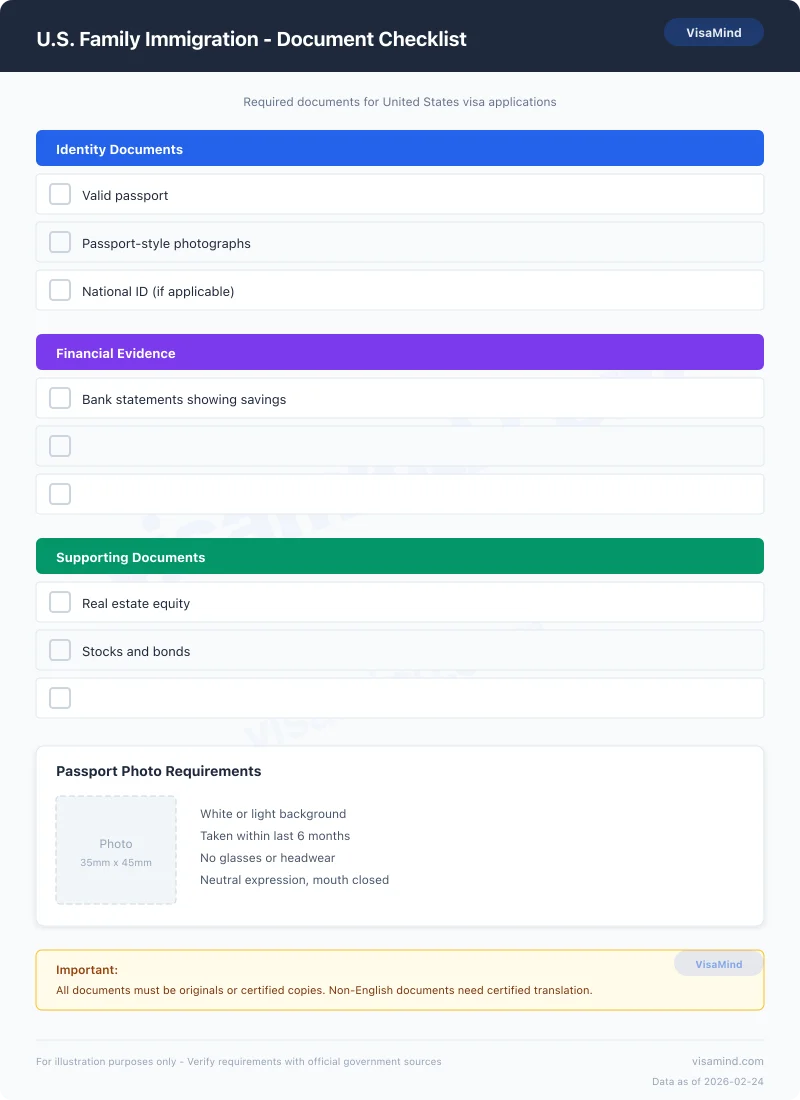
#
Financial Requirements for Sponsoring Family Members
When sponsoring a family member to immigrate to the United States, one of the critical aspects you need to address is meeting the financial requirements set by the U.S. Citizenship and Immigration Services (USCIS). These requirements ensure that the immigrant will not become a public charge and can be financially supported by the sponsor. Let's dive into the specifics of these financial obligations.
Income Thresholds
As a sponsor, you must demonstrate that your household income is at least 125% of the U.S. Federal Poverty Guidelines. This is to ensure that you have the financial capability to support the intending immigrant. The exact income requirement depends on the size of your household, including the number of people you are already supporting.
| Household Size | 125% of Federal Poverty Guidelines (2023) |
|---|---|
| 2 | $24,650 |
| 3 | $31,075 |
| 4 | $37,500 |
| 5 | $43,925 |
For example, if you are sponsoring a spouse and you have no children, your household size would be 2, and your income should be at least $24,650. If you are active duty in the U.S. Armed Forces and sponsoring your spouse, the requirement drops to 100% of the guidelines.
Savings Requirements
If your income is below the threshold, you might still qualify by demonstrating sufficient savings or assets. The value of these assets must equal five times the difference between your income and the required income level. This means if your income falls short by $5,000, you would need $25,000 in assets to make up the difference.
Examples of assets include:
- Bank statements showing savings
- Real estate equity
- Stocks and bonds
Maintenance Funds
In certain cases, especially when dealing with visas like the K1 Fiancé Visa, you may need to show maintenance funds to prove that you can support your fiancé(e) during the visa process. This is often included as part of the overall financial evaluation.
Common Pitfalls
Failing to provide adequate proof of financial capability is a common reason for delays or denials in family immigration petitions. Ensure you collect all necessary documentation, such as tax returns, pay stubs, and bank statements, to support your financial claims. For more detailed guidance, you can refer to the US Marriage Immigrant Visa process, which outlines additional financial requirements for spousal visas.
By meeting these financial requirements, you can confidently proceed with the immigration process for your family member, knowing that you've provided a stable foundation for their new life in the United States.
The Application Process
#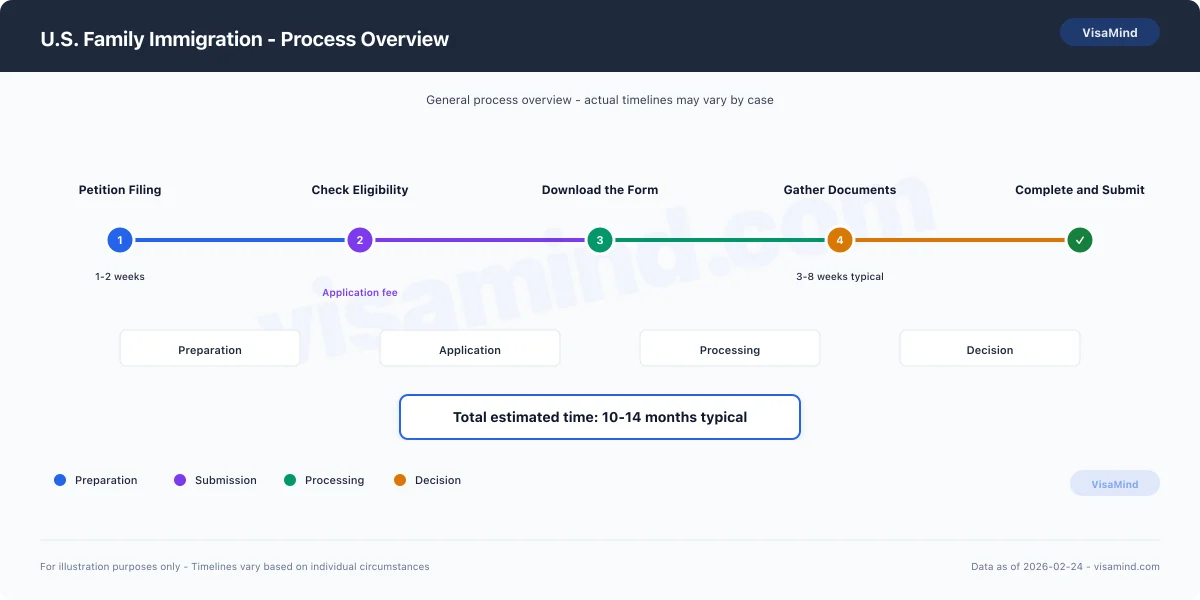
Step-by-Step Guide to the U.S. Family Immigration Application Process
Navigating the U.S. family immigration process involves a series of steps that include filing petitions, providing documentation, and attending interviews. Below is a detailed guide to help you through the application process.
1. Petition Filing
To initiate the family immigration process, you must file a petition with the United States Citizenship and Immigration Services (USCIS).
-
Determine Eligibility: Ensure that you meet the eligibility criteria. You must be a U.S. citizen, Green Card holder, or a refugee/asylee admitted within the past 2 years to petition for your family member.
-
Download the Form: Obtain the appropriate petition form for your situation from the official USCIS website. Carefully review the instructions specific to your eligibility category.
-
Gather Required Documents: Collect proof of your status as a U.S. citizen, Green Card holder, or refugee/asylee. This is vital to support your petition.
-
Complete and Submit the Form: Fill out all required sections of the form, ensuring accuracy and completeness. Sign the form and submit it along with the required documents to the USCIS.
2. Document Submission
After filing your petition, you need to submit supporting documents to facilitate the processing of your application.
-
Proof of Relationship: Submit evidence that demonstrates your relationship with the family member you are petitioning for. This could include birth certificates, marriage certificates, or adoption papers.
-
Financial Documents: You may need to provide financial evidence to demonstrate your ability to support your relative once they move to the U.S.
For more detailed guidance on document requirements, you can refer to the US Visa Interview Checklist.
3. Biometrics Appointment
Once your petition is reviewed, USCIS will notify you of a biometrics appointment.
- Attend the Biometrics Appointment: At this appointment, your fingerprints, photograph, and signature will be taken. This process is critical for background checks.
4. Interview Process
The interview phase is a crucial component of the family immigration process.
-
Receive Interview Notification: After your biometrics are processed, you will receive a notification of your interview date and location.
-
Prepare for the Interview: It is important to prepare thoroughly for your interview. You can refer to the US Visa Interview Prep guide for tips on how to prepare effectively.
-
Attend the Interview: During the interview, you will be asked questions to verify the information provided in your application. Ensure you bring all required documents, as failing to do so can delay the process.
By following these steps diligently and preparing thoroughly for each phase, you can navigate the family immigration process more smoothly. For more information on related visas, you might also explore the options like the CR1/IR1 Visa and the K1 Visa depending on your specific situation.
Processing Times and Waiting
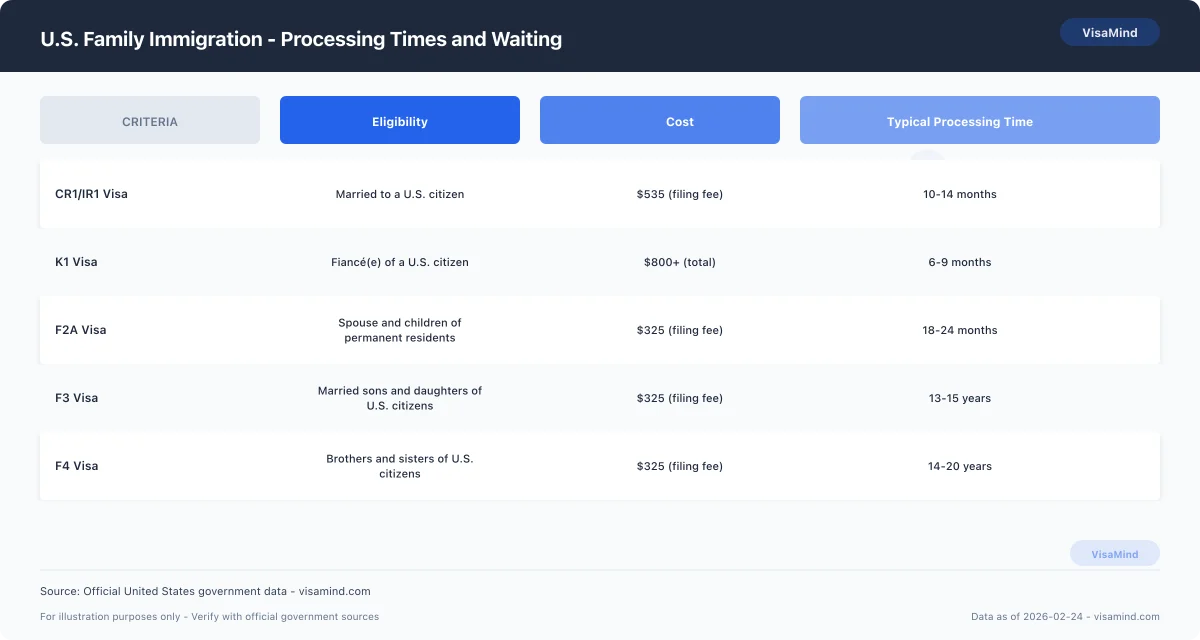
#
Processing Times and Waiting
When navigating the U.S. family immigration process, understanding the processing times and factors affecting these timelines is critical. The processing time for family immigration visas can vary significantly depending on several factors, including the type of visa and the priority category. This section will provide a side-by-side comparison of the processing times for various family-related visas and discuss what can affect these timelines.
Family Visa Processing Comparison
Here's a detailed comparison of processing times and other relevant factors for some common U.S. family immigration visas:
| Visa Type | Eligibility | Cost | Typical Processing Time |
|---|---|---|---|
| CR1/IR1 Visa | Married to a U.S. citizen | $535 (filing fee) | 10-14 months |
| K1 Visa | Fiancé(e) of a U.S. citizen | $800+ (total) | 6-9 months |
| F2A Visa | Spouse and children of permanent residents | $325 (filing fee) | 18-24 months |
| F3 Visa | Married sons and daughters of U.S. citizens | $325 (filing fee) | 13-15 years |
| F4 Visa | Brothers and sisters of U.S. citizens | $325 (filing fee) | 14-20 years |
What Affects Processing Speed?
Several factors can influence the processing time for family immigration visas:
-
Priority Category: The U.S. immigration system prioritizes certain family members over others. For instance, immediate relatives of U.S. citizens, such as spouses and children under 21, typically have shorter waiting times compared to other family categories.
-
Country of Origin: The demand for visas from specific countries can impact processing times. Countries with high numbers of applicants may experience longer wait times due to annual visa quotas.
-
Completeness of Application: Ensuring that your application is complete and includes all required documentation can prevent delays. Missing documents or information can result in requests for evidence, which prolong the process.
-
USCIS Backlog: The volume of applications received by U.S. Citizenship and Immigration Services (USCIS) can affect processing times. High volumes can lead to backlogs, slowing down individual case processing.
For a deeper understanding of visa processing times and potential delays, you might find the Visa Processing Times Explained guide helpful.
If you're interested in learning more about specific visas, such as the K1 Fiancé Visa, you can explore the K1 Fiance Visa Overview. Additionally, for those considering employment-based paths, the US Employment Immigration Overview can provide further insights.
By understanding these factors and preparing your application thoroughly, you can better navigate the U.S. family immigration process.
Rights While Waiting
#What Are Your Rights While Waiting for Family Immigration?
When applying for U.S. family immigration, it's important to understand the rights and restrictions you may face while your application is pending. This period can be both exciting and challenging, as you navigate the rules regarding work, travel, and maintaining your status.
Work Rights: Can You Work While Waiting?
Your ability to work while waiting for family immigration approval largely depends on your current visa status and whether you have applied for an Employment Authorization Document (EAD). Generally, you will need an EAD to work legally in the U.S. if you do not already hold a visa that permits employment. Here are some key points to consider:
- EAD Application: If you're eligible, applying for an EAD is crucial to gain work authorization. Approval timelines can vary, so plan accordingly.
- Current Visa Status: If you hold a work-authorized visa such as the H-1B or L-1 visa, you may continue to work under its terms.
- Spouses and Dependents: Certain visas, like the L-2 or H-4, may allow dependents to apply for work authorization. Check specific eligibility requirements for these visas.
For more information on employment options, you might find the U.S. Employment Immigration Overview helpful.
Travel Restrictions: Can You Leave the U.S.?
Traveling outside the U.S. while your family immigration application is pending can be risky and might impact your application. Here’s what you should know:
- Advance Parole: To travel without abandoning your application, consider applying for Advance Parole, which allows you to re-enter the U.S. without a visa.
- Current Visa: If you hold a travel-authorized visa, ensure it remains valid throughout your trip to avoid complications upon re-entry.
- Pending Applications: Leaving the U.S. without Advance Parole or a valid visa can result in your application being considered abandoned.
For further guidance, explore the U.S. Port of Entry Guide on navigating re-entry requirements.
Implied Status: How Do You Maintain Your Status?
Maintaining your immigration status while waiting for family immigration approval is crucial. Here's how you can ensure you remain compliant:
- Bridging Visas: The U.S. does not offer bridging visas; you must maintain your current visa status until your new status is granted.
- Status Expiration: If your current visa is nearing expiration, consider options for extension or change of status, as outlined in Change Status Vs Extend Stay.
- Implied Status: While there is no formal "implied status," continuing to fulfill the conditions of your current visa is essential to avoid lapses.
Understanding these aspects can help you navigate the waiting period more effectively and ensure compliance with U.S. immigration laws.
Conditions After Approval
#Conditional vs. Permanent Status
Once your family member's immigration petition is approved, they may receive either conditional or permanent resident status, depending on the nature of the relationship and the duration of the marriage, if applicable. If your family member enters the U.S. on a CR1 or K1 visa, they may initially receive conditional status, particularly if the marriage is less than two years old. Conditional residents are required to apply to remove these conditions within 90 days before the two-year anniversary of receiving their status.
In contrast, if the marriage has lasted more than two years when the visa is approved, the immigrant spouse may receive permanent resident status immediately upon entry to the United States. This status does not require the removal of conditions and offers more stability and security.
Residence Requirements
To maintain a Green Card, your family member must adhere to certain residence requirements:
- Physical Presence: They must be physically present in the U.S. for at least 183 days each year.
- Continuous Residence: They should not leave the U.S. for extended periods, typically considered six months or more, without filing for a re-entry permit.
Failure to comply with these requirements may jeopardize their permanent resident status. For more details, you can refer to the U.S. Green Card guide.
Restrictions on Conditional Residents
While holding conditional status, certain restrictions apply:
- Travel: Conditional residents can travel, but they must carry their Green Card and passport. Extended stays outside the U.S. might lead to issues upon re-entry.
- Employment: They can work in the U.S. but must ensure their employment does not violate any terms of their visa status.
- Change of Address: Any change in address must be reported to the U.S. Citizenship and Immigration Services (USCIS) within 10 days.
For further guidance on navigating these conditions, exploring resources like the US Visa Interview Checklist can be beneficial. Understanding these requirements and restrictions helps ensure that your family member maintains their status and progresses smoothly towards full permanent residency.
Path to Permanent Residence
#Timeline from Family Visa to Permanent Residence
When considering a path to permanent residence in the United States through family immigration, understanding the timeline is crucial. The journey begins with filing a petition to bring a relative to the U.S. This process is primarily managed by the U.S. Citizenship and Immigration Services (USCIS).
Step-by-Step Process
-
File a Petition: As a U.S. citizen or Green Card holder, you must file Form I-130, Petition for Alien Relative, to start the process. This step requires you to provide proof of your status as a U.S. citizen, Green Card holder, or refugee/asylee.
-
Approval of Petition: Once the petition is approved, your relative might have to wait for a visa number to become available. The waiting period depends on the visa category and the applicant's country of origin. For immediate relatives (spouses, children, and parents of U.S. citizens), visas are typically available immediately.
-
Application for a Visa or Adjustment of Status: If your relative is outside the U.S., they will apply for an immigrant visa through consular processing. If they are in the U.S., they may apply for adjustment of status to become a permanent resident.
-
Receive a Green Card: After the visa is granted or the adjustment of status is approved, your relative will receive a Green Card, signifying their status as a lawful permanent resident.
For more details on the differences between consular processing and adjustment of status, you can explore the US Adjustment of Status vs Consular Processing guide.
Path to U.S. Citizenship
Once your family member becomes a lawful permanent resident, they may be eligible to apply for U.S. citizenship after a certain period.
-
Residency Requirement: Typically, a Green Card holder must reside in the U.S. for at least five years before applying for citizenship. However, spouses of U.S. citizens may be eligible after three years.
-
Naturalization Process:
- File Form N-400, Application for Naturalization.
- Attend a biometrics appointment.
- Complete an interview and pass English and civics tests.
-
Naturalization Ceremony: If approved, your family member will attend a naturalization ceremony to take the Oath of Allegiance, officially becoming a U.S. citizen.
For a comprehensive understanding of the steps involved in visa application, refer to the US Visa Application Steps.
Considerations and Pitfalls
-
Documentation: Failure to provide adequate documentation, such as proof of your status, can delay the process.
-
Visa Availability: Understanding visa availability is key, especially for categories subjected to annual limits. For a detailed explanation, consult the Visa Processing Times Explained.
The path from a family visa to permanent residence and eventually to U.S. citizenship involves several steps and a commitment to meeting various requirements. By following the proper procedures and providing the necessary documentation, you can help your family members achieve their immigration goals.
Common Refusal Reasons
#Insufficient Evidence
- Proof of Relationship: Failure to provide adequate documentation proving the legitimacy of your relationship can result in a denial. This includes not submitting marriage certificates, birth certificates, or other vital records.
- Financial Support: You must demonstrate the ability to financially support the intending immigrant. If you fail to provide sufficient evidence of income or assets, such as tax returns or pay stubs, your petition could be denied.
Sham Marriage Concerns
- Inconsistent Information: Discrepancies in personal information, such as differing addresses or marital histories, may raise red flags.
- Lack of Joint Assets: Not having shared bank accounts, property, or other joint financial responsibilities may lead to suspicions of a sham marriage.
Financial Shortfalls
- Sponsorship Requirements: The petitioner must meet certain income thresholds specified by the U.S. government. If your income does not meet the required level, your petition can be denied. You might need a co-sponsor to meet this requirement.
- Affidavit of Support: Incomplete or inaccurate affidavits can cause delays or denials. This document is crucial for showing your financial commitment to support the immigrant.
Medical and Character Issues
- Health Concerns: Certain medical conditions can be grounds for denial. The intending immigrant must undergo a medical examination by a designated physician.
- Criminal Background: A criminal record or past immigration violations can negatively impact the petition. Proper documentation and, in some cases, legal assistance will be necessary to address these issues.
For more information on family immigration, you can explore the CR1 and IR1 Visa types or learn more about the K1 Visa process. Understanding why visas get denied can help in preparing a more robust application.
Real Scenarios
#Real-Life Scenario: Petitioning for a Spouse
Imagine you're a U.S. citizen who recently married your partner from abroad. You want to bring them to the United States to live permanently. As a U.S. citizen, you're eligible to file a petition for your spouse using the CR1/IR1 visa. The first step is to gather evidence of your status as a U.S. citizen, such as a birth certificate or passport, and proof of your marriage, like a marriage certificate. You'll need to download the appropriate forms and instructions from the official USCIS website and carefully review them before starting the process. This involves completing all required sections, signing, and submitting your petition with the necessary evidence.
Common Pitfalls and How to Avoid Them
One of the most common pitfalls in the family immigration process is failing to provide adequate proof of your status as a U.S. citizen or a Green Card holder. Without this crucial documentation, your petition could be delayed or even denied. To avoid this, ensure you have original or certified copies of all necessary documents before submission. You might find it helpful to refer to guides on USCIS Petition Vs Visa for understanding the differences between filing a petition and applying for a visa.
What If You're a Permanent Resident?
If you're a Green Card holder looking to petition for a relative, such as a spouse or child, the process is slightly different. While you still need to prove your status, the wait times and eligibility categories differ from those of a U.S. citizen. Permanent residents can petition for their spouse or unmarried children. For more insights on processing times, you might want to explore the Visa Processing Times Explained guide. Remember, careful preparation and adherence to the guidelines can significantly streamline your family member's immigration journey.
FAQs
Can I switch from a K1 visa to a Green Card in the United States?
How much does a United States family visa cost?
What documents do I need to prove family relationship for immigration?
Can I switch from a CR1 visa to an IR1 visa in the United States?
What happens if I fail to provide proof of my status as a U.S. citizen?
Do I need to be a U.S. citizen to sponsor a family member for immigration?
Can family members work in the U.S. while waiting for their visa processing?
Sources
Last reviewed: February 24, 2026
VisaMind provides informational guidance only and is not a government agency. This is not legal advice. Requirements can change and eligibility depends on your specific facts. If your case is complex or high-stakes, consult a licensed immigration attorney.
Next steps
Requirements vary by nationality, purpose, timeline, and case details. VisaMind turns uncertainty into a sequenced checklist with official source citations.
Find my visa