What the C1/D Combined Transit and Crew Visa Covers
#
The C1/D visa allows you to travel through the United States and serve as a working crewmember on a vessel or aircraft. It combines transit and crew authorization in one nonimmigrant visa for short, job-related stays.
Purpose
The C1/D visa covers two connected activities: transit through the United States (C1) and service as a crewmember (D). You use it when you must enter the country briefly to join, depart with, or work aboard a sea vessel or aircraft.
You do not use this visa for tourism, permanent residence, or general employment in the United States. It applies only to work performed as part of your duties on a vessel or airline.
The transit portion allows immediate and continuous travel through the United States when necessary for your assignment. The crew portion authorizes entry tied directly to your role aboard the ship or aircraft.
You apply through the U.S. Department of State by submitting Form DS-160 and attending a visa interview at a U.S. embassy or consulate. For current procedures and requirements, refer to the Department of State and USCIS.
Who Uses It
You qualify for a C1/D visa if you work as a crewmember on:
- A sea vessel
- An international airline
Your position must involve active service on board. This includes roles directly connected to vessel or aircraft operations.
You generally need this visa if:
- You are a citizen of a foreign country.
- You intend to enter the United States temporarily.
- You will join or depart with your vessel or aircraft from a U.S. location.
- You are not entering for permanent residence.
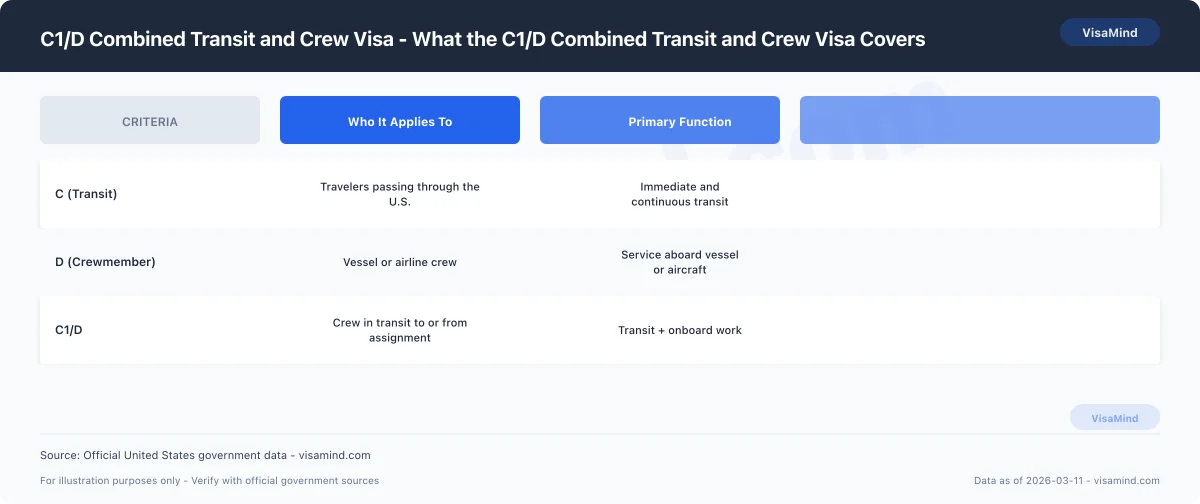
The table below shows how the visa categories combine:
| Visa Type | Who It Applies To | Primary Function |
|---|---|---|
| C (Transit) | Travelers passing through the U.S. | Immediate and continuous transit |
| D (Crewmember) | Vessel or airline crew | Service aboard vessel or aircraft |
| C1/D | Crew in transit to or from assignment | Transit + onboard work |
If you already hold a valid Visitor (B) visa or qualify under the visa waiver program, different rules may apply for transit. Confirm eligibility with the U.S. Department of State before you apply.
Scope of Entry
The C1/D visa allows you to enter the United States only for the time necessary to carry out your crew-related duties and transit. It does not grant open-ended stay or unrestricted employment.
Your authorized activities are limited to:
- Joining your assigned vessel or aircraft.
- Departing the United States as part of your crew duties.
- Remaining in the country briefly as required for your work schedule.
You cannot accept separate employment in the United States outside your crew role. Any other type of work requires a different nonimmigrant visa classification and, in many cases, approval from USCIS.
U.S. Customs and Border Protection (CBP) determines your admission at the port of entry. Even with a valid C1/D visa, you must demonstrate that your purpose matches the visa classification.
Renewal and Extension
#C1/D visas do not function like long-term work visas. Your ability to remain in the United States depends on the specific classification issued and the period granted at entry.
D-3 and Lightering Stays
If you perform lightering activities, you may qualify for a D-3 visa. This classification allows a stay of up to 180 days while you temporarily land in the United States to complete those duties.
You must show that:
- You are a crewmember.
- You will perform lightering activities.
- Your stay will not exceed 180 days.
- You intend to depart after completing your assignment.
You apply for the visa through the U.S. Department of State using Form DS-160. Approval is not automatic, even if you request a C1/D classification.
| Visa Type | Purpose | Maximum Stay |
|---|---|---|
| D-3 | Lightering activities | Up to 180 days |
Customs and Border Protection (CBP) determines your admission period at the port of entry.
Extension Limits
There is no extension process for C1/D status, and crewmembers generally cannot change to another nonimmigrant status or adjust status from inside the United States. Under 8 CFR 245.1(b)(2), C and D crew classifications are barred from most in-country change-of-status and adjustment relief. Do not assume you can extend your stay beyond what CBP grants at entry or switch to another status without departing.
Your authorized stay depends on:
- The visa classification issued.
- The duration granted upon admission.
- The specific activity you will perform.
If your plans change, the normal path is to depart the United States and apply for the appropriate visa abroad through the U.S. Department of State, rather than filing to extend or change status inside the country. Filing for a C1/D visa does not guarantee approval.
You must limit your work to the duties permitted under your crew classification.
Filing Outcomes
You apply for a C1/D or D-3 visa through consular processing by submitting Form DS-160 and attending an interview with the U.S. Department of State.
Possible outcomes include:
-
Visa approval in the requested classification.
-
Refusal of the application.
-
Issuance in a different classification, if appropriate.
Even with visa issuance, CBP makes the final decision on admission and length of stay.
C1/D crew generally cannot change or extend status from inside the United States under 8 CFR 245.1(b)(2). If your circumstances change, plan to apply for the appropriate visa abroad rather than filing for a change or extension with USCIS.
Official sources: https://www.ecfr.gov/current/title-8/chapter-I/subchapter-B/part-245/section-245.1
When to Get Professional Help
#Certain C1/D crew transit cases involve petition approvals, prior refusals, or inconsistencies that increase the risk of delay or denial. In these situations, legal guidance helps you correct errors before they affect your ability to work or travel.
Complex Situations
You should seek professional help if your case involves petition-based work authorization or detailed security disclosures.
If you are applying in connection with an approved Form I-129 petition (such as for H-1b visa or L-1 classification), you must have that approval in place before you submit the DS-160. The consulate will verify petition status through U.S. Citizenship and Immigration Services (USCIS). Filing out of sequence can delay or derail your visa issuance through the U.S. Department of State.
You also need assistance if:
- Your Form DS-160 answers require detailed security or background explanations
- Your personal information does not exactly match your passport or supporting documents
- You have prior immigration filings with USCIS that must align with your current application
Even small discrepancies can trigger additional review.
| Issue | Why It Matters |
|---|---|
| Mismatch in name or passport data | Can lead to delays or refusal |
| Incomplete security answers | May result in denial |
| No approved I-129 (if required) | Consulate cannot issue visa |
Accurate, consistent documentation is critical in crew visa processing.
When Denials Occur
If your C1/D visa was denied, consult a professional before reapplying.
You must identify whether the denial resulted from incomplete DS-160 responses, inconsistent information, or missing petition verification. Simply submitting a new application without correcting the underlying issue often leads to another refusal.
Focus on these steps:
-
Review every DS-160 answer for accuracy and completeness.
-
Confirm all biographical details match your passport exactly.
-
Verify petition approval status with USCIS, if applicable.
You should also retrieve your prior application using your saved application ID if it is still available. DS-160 data remains accessible for a limited period, so acting quickly matters.
A careful review reduces repeat errors and improves your chances at the next interview.
When Petitions Involve USCIS
You need legal guidance when your crew travel connects to a petition filed with USCIS.
For H-1B or L-1 classifications, the approved Form I-129 is the foundation of your visa application. The U.S. Department of State will confirm that USCIS approved the petition before issuing the visa.
Do not complete the DS-160 until:
- USCIS has approved the petition
- You have accurate petition details
- All identifying information matches supporting records
If USCIS records conflict with your DS-160 responses, the consulate may delay or refuse the visa.
Professional review ensures your petition approval, DS-160 responses, and passport information align exactly. That alignment protects your ability to work and transit under the C1/D classification.
What Your Employer Must Do
#Your employer plays a direct role in documenting your crew employment and confirming the purpose of your transit. There is no USCIS "C1/D form" — the C1/D is a consular visa you apply for yourself using Form DS-160. Your employer's job is to give you accurate employment documentation that supports your application, not to complete sections of a USCIS form.
Employment Details to Provide
Your employer must clearly describe your position, duties, and purpose of travel as a crew member in transit.
At a minimum, you should receive:
- Your official job title
- A description of your work duties
- The name of the vessel or aircraft (if applicable)
- The reason you must transit the United States
- Confirmation that you will perform crew-related work
These details must match the information you enter on your DS-160. Any inconsistency between your employer’s information and your application can delay processing.
Use the table below to confirm consistency:
| Item | Must Match On |
|---|---|
| Job title | Employer documents and Form DS-160 |
| Purpose of transit | Employer statement and DS-160 |
| Nature of work | Employer description and application |
Your employer should provide this information in clear, specific terms. Avoid vague descriptions of your work.
Employment Documentation to Supply
There is no C1/D form to download from USCIS. The C1/D is issued by the U.S. Department of State through consular processing, and the only application form is the Form DS-160, which you complete yourself.
Instead of completing a USCIS form, your employer should provide the supporting documentation a consular officer expects, such as:
-
A signed employment or engagement letter on company letterhead.
-
A crew contract or letter confirming your role aboard the named vessel or aircraft.
-
Assignment details that match what you enter on your DS-160.
For current procedures and requirements, rely on U.S. Department of State guidance rather than third-party sources.
Reviewing Employer Documents
Because there is no employer section on a USCIS form for this visa, your employer's responsibility is to make sure the employment documents they give you are complete and accurate.
They should:
- Confirm your job title and crew role
- Provide complete employment and assignment information
- Avoid vague or inconsistent descriptions
- Sign any employment or engagement letter where appropriate
Incomplete or inconsistent employment documents can cause delays or refusal at the interview.
Before your interview, review every document for accuracy and confirm that the information matches your DS-160 and your passport. You remain responsible for the consistency of your application.
From Work Visa to PR
#You cannot file for permanent residence while you remain in C1/D crew transit status. You must first move into a qualifying work-authorized category and then submit the correct filings to U.S. Citizenship and Immigration Services (USCIS), supported by clear evidence and complete forms.
USCIS Filings
A C1/D visa allows transit and crew-related duties, not long-term work in the United States. To pursue permanent residence (PR), you must first obtain a separate work-authorized status and then file the appropriate application or petition with U.S. Citizenship and Immigration Services (USCIS).
Your filing will depend on the immigration path available to you. USCIS requires that you:
- Submit the required form for your immigration benefit
- Include all supporting evidence
- Pay the correct filing fees (see current USCIS fee schedule)
If you are applying from outside the United States, you will complete Form DS-160 as part of the visa process handled by the U.S. Department of State. USCIS handles petitions and immigration benefits, while the Department of State manages visa interviews and issuance.
You must follow the official form instructions carefully and send your package to the address listed on the current USCIS form instructions page.
Filing Evidence
USCIS decides your case based on the documents you submit. Incomplete filings lead to delays or denials.
Include:
- A properly completed and signed application form
- Proof of your current immigration status
- Evidence supporting your eligibility for the requested benefit
- Filing fees or an approved fee waiver, if eligible
Organize your evidence in a clear order. Label each exhibit and reference it in your application where relevant.
| Evidence Type | Purpose |
|---|---|
| Identity documents | Confirm your legal identity |
| Status documents | Show your current lawful presence |
| Eligibility documents | Prove you qualify for the benefit requested |
| Filing fee receipt | Confirm payment to USCIS |
If you apply through a U.S. consulate, you will submit civil documents and complete the DS-160 online before your visa interview. The U.S. Department of State reviews these materials for visa issuance.
Next Steps After Filing
After USCIS receives your application, you'll get a receipt notice confirming acceptance. Hold onto that notice—it has your case number.
USCIS may:
-
Approve your petition or application
-
Issue a Request for Evidence (RFE)
-
Schedule you for an interview
-
Deny the case if eligibility isn't established
If you get an RFE, respond by the deadline. Submit exactly what USCIS asks for.
If your case requires consular processing, the U.S. Department of State schedules your visa interview after petition approval. If approved, Customs and Border Protection (CBP) decides admission at the port of entry.
Dependents
#C1/D is not a petition-based or family-based visa, and there is no derivative or dependent C1/D visa for spouses or children. A family member cannot get a "C1/D dependent" visa, because no such category exists. They must qualify for a visa in their own right.
No Derivative C1/D Status
Under the U.S. Department of State's Foreign Affairs Manual, the D (crew) classification has no accompanying dependent or derivative visa. A spouse or child who wants to accompany or visit a crewmember must independently qualify for a different visa — most commonly a B-1/B-2 visitor visa — or travel under the Visa Waiver Program / ESTA if they are eligible.
What this means in practice:
- Your family members cannot be added to your C1/D application.
- They cannot apply for a C1/D visa as your dependents.
- Each family member must qualify on their own under B-1/B-2 or another appropriate category.
How Family Members Travel Separately
If your spouse or child intends to travel to or visit the United States, they apply in their own right under the category they actually qualify for. For most visitors that means completing Form DS-160, Online Nonimmigrant Visa Application for a B-1/B-2 visitor visa and attending their own visa interview with the U.S. Department of State.
Each applicant needs:
- A valid passport (generally valid for at least six months beyond the intended stay)
- Their own DS-160 confirmation page
- Their own visa fee payment receipt (see the Department of State fee schedule for current amounts)
- Evidence supporting the category they are applying under
Approval is decided individually for each person, and U.S. Customs and Border Protection (CBP) determines admission at the port of entry.
Work and Status Limits
A C1/D visa does not grant work authorization to anyone, and a family member admitted as a B-1/B-2 visitor cannot work in the United States. Each person must stay within the limits of the category they were actually admitted under.
How to Apply
#To apply for a C1/D visa, complete the required online form, schedule a consular interview, and follow the U.S. Department of State’s instructions. Accuracy and organization matter at every step.
Complete the DS-160
You must fill out Form DS-160, Online Nonimmigrant Visa Application for a C1/D crew transit visa. This is required for all nonimmigrant visa categories.
Fill out the DS-160 carefully, answering every question truthfully. The information you enter must match your passport and crew-related travel details.
After submitting the form online:
- Print the DS-160 confirmation page with the barcode
- Keep the confirmation page for your records
- Bring the printed barcode page to your visa interview
The barcode page proves your application was submitted.
| Step | What You Must Do | Why It Matters |
|---|---|---|
| 1 | Complete DS-160 online | Required for all nonimmigrant visas |
| 2 | Submit the form electronically | Activates your application |
| 3 | Print barcode confirmation page | Required for interview entry |
If you make mistakes, you may need to correct them before your interview. Follow the instructions during the DS-160 process and check Department of State guidance for technical issues.
Schedule Your Interview
After submitting the DS-160, schedule a visa interview at a U.S. Embassy or Consulate. The U.S. Department of State manages visa interviews and issuance.
You can't complete your C1/D visa application without an interview appointment unless a specific exception applies. Confirm current interview requirements with the embassy or consulate where you’ll apply.
When scheduling, you'll need:
- Your DS-160 confirmation barcode number
- Passport information
- Any required fee payment confirmation (see Department of State for current amounts)
Book your appointment early if your work schedule requires travel by a specific date. Interview availability varies by location.
| Item Needed to Schedule | Source |
|---|---|
| DS-160 barcode number | From your confirmation page |
| Passport details | Your valid passport |
| Fee information | U.S. Department of State |
If you need current fee amounts or appointment procedures, review the guidance from the U.S. Department of State before scheduling.
Application Submission Steps
You complete your C1/D visa application through consular processing, not through USCIS. USCIS handles immigration benefits inside the United States, but the Department of State issues visas abroad.
Follow these steps:
-
Complete and submit the DS-160 online.
-
Print the DS-160 barcode confirmation page.
-
Schedule your interview at a U.S. Embassy or Consulate.
-
Attend your interview with the required documents.
Bring your printed DS-160 confirmation page to the interview. The consular officer reviews your application and supporting information before making a decision.
If the visa is issued, you may travel to a U.S. port of entry. CBP determines admission when you arrive.
Fees and Processing Times
#You pay a set application fee and wait for both interview scheduling and visa issuance. processing times depend on visa category and consular location, and they can vary widely throughout the year.
Application Fees
The Machine Readable Visa (MRV) fee of $185 applies when applying for a C1/D visa. This fee applies as of March 2026.
The fee covers:
- Review of your Form DS-160 application
- Scheduling of your consular interview
- Visa processing by the U.S. Department of State
You pay the MRV fee before scheduling your interview. The fee is separate from any employer expenses tied to your maritime or airline work.
USCIS doesn't collect this fee for a C1/D visa since visa issuance happens through a U.S. embassy or consulate under the Department of State. Confirm the current fee on the Department of State’s official fee schedule before payment.
Standard Processing Times
Processing involves DS-160 handling and post-interview visa issuance.
As of February 2026, reported processing ranges for Crew and Transit (C, D, C1/D) categories are:
| Visa Category | Reported Processing Range |
|---|---|
| Crew and Transit (C, D, C1/D) | 0.5 to 14 months |
These ranges reflect appointment availability and application volume at specific consular posts.
After your interview, most applicants receive a decision within 2 to 8 weeks, depending on the embassy or consulate. Check the local consulate’s processing page for when your passport will be ready for pickup or delivery.
Timelines change often—verify current estimates with the U.S. Department of State.
Category & Location Variations
The processing times differ by visa classification and interview location.
For comparison, as of February 2026:
| Visa Category | Reported Processing Range |
|---|---|
| Visitor (B1/B2) | 0.5 to 23 months |
| Student/Exchange (F, M, J) | 0.5 to 7.5 months |
| Petition-based (H, L, O, P, Q) | 0.5 to 4.5 months |
| Crew and Transit (C, D, C1/D) | 0.5 to 14 months |
C1/D timelines depend on local demand in port cities and countries with large maritime or airline crews.
If your employer files a petition with USCIS for a different work classification, that timeline doesn't control C1/D processing. The Department of State determines interview scheduling and visa issuance abroad. Review the specific embassy or consulate’s published wait times before planning travel.
Eligibility Requirements
#You must qualify as a transit passenger (C1) or as a crewmember (D), and select the correct category on your DS-160. Eligibility depends on your travel purpose, employment role, and the activities you’ll perform in the United States.
Transit vs Crewmember Rules
You qualify for C1 transit classification if you pass through the United States to reach another country. You must show proof of onward travel and confirm the United States isn't your final destination.
A D crewmember visa is for those serving as crew on a vessel or aircraft who will depart with that vessel or aircraft.
Here's a comparison:
| Requirement | C1 Transit | D Crewmember |
|---|---|---|
| Purpose | Travel through the U.S. | Work as crew on vessel/aircraft |
| Proof Needed | Evidence of onward transit | Proof of crew employment |
| Employment Role | Not required | Required |
Pick the right visa type on your Form DS-160. The wrong category can lead to refusal.
At your interview with the Department of State, bring:
- A valid passport
- DS-160 confirmation page
- Evidence supporting your transit or crew role
- A compliant visa photo
CBP decides admission at the port of entry.
Employment-Related Criteria
For a D visa, eligibility depends on active crew employment. You need to show your work is directly tied to the vessel or aircraft entering the United States.
Provide documentation like:
- Employer verification letter
- Crew contract
- Identification linking you to the vessel or airline
Your documents must match your passport and DS-160. Inconsistent dates, job titles, or travel details can result in denial.
Answer all background and security questions fully. Don’t leave blanks. If something doesn’t apply, use “None” or “N/A.”
If you later file for a different immigration benefit with USCIS, your visa classification must match your actual activities.
Special Activity Eligibility
Limit your activities to those allowed under your classification. A C1 visa doesn’t authorize employment in the U.S. A D visa allows only crew-related duties.
You do not qualify if you:
- Intend to remain in the United States beyond your authorized stay
- Plan to perform non-crew employment
- Select a visa category that doesn’t match your purpose
Submit a photo that meets Department of State standards. Noncompliant photos can delay or prevent issuance.
Review your DS-160 before submission. Make sure your passport details, travel dates, and employment information are accurate and consistent.
Conditions and Portability
#Strict limits apply to the type of work you perform, the activities you conduct in the United States, and the documents you carry. USCIS, the Department of State, and CBP each play specific roles in enforcing these requirements.
Onboard Work Rules
A C1/D visa lets you travel to the United States to join or depart a vessel or aircraft as a crew member. You can perform work only in your crew capacity.
This visa doesn’t allow unrelated employment in the U.S. Any work outside your assigned crew duties isn’t covered.
If your employment changes, review guidance from USCIS before acting. Don’t assume a new role, employer, or assignment is covered under the same visa.
| Activity Type | Permitted Under C1/D | Notes |
|---|---|---|
| Crew duties onboard | Yes | Must match your role as issued |
| Unrelated U.S. employment | No | Not authorized under C1/D |
| Change in work assignment | Review required | Confirm with USCIS guidance |
Make sure your visa classification matches the work you actually do.
Activity Restrictions
Your stay in the United States must relate directly to your transit or crew duties. You can’t remain in the country for purposes unrelated to joining, serving on, or departing from a vessel or aircraft.
You also can’t use this visa as a substitute for another employment-based or visitor classification. If your plans change, consult Department of State guidance before traveling.
CBP officers decide admission at the port of entry. They review your visa and supporting documents to assess whether your stated purpose matches your classification.
Carry documentation that clearly supports your transit or crew assignment. Inconsistent or incomplete records can delay admission.
Document Compliance
Complete Form DS-160, Online Nonimmigrant Visa Application before your visa interview with the U.S. Department of State.
Every entry should match your employment details.
Prepare passport-style photographs before starting the process. Photos that don't meet official standards often hold up processing.
Keep these documents together:
- Valid passport
- DS-160 confirmation page
- Visa appointment confirmation
- Crew assignment documentation
For filing procedures and requirements, refer to the U.S. Department of State for visa processing and USCIS for immigration benefit guidance.
Requirements do change. You're responsible for meeting the standards in effect when you apply.
Common Petition Challenges
#Most C1/D visa delays happen because of document errors. Double-check your Form DS-160, format uploads carefully, and organize proof of your work assignment before the interview with the U.S. Department of State.
Photo & Format Problems
Follow the photo and file formatting rules exactly as the DS-160 system requires.
The online form won't always flag subtle errors, but a consular officer can refuse or delay processing if your photo doesn't meet specifications.
Common issues:
- Uploading a photo that doesn't match the printed confirmation
- Submitting a file that doesn't load properly in the CEAC system
- Bringing a printed photo that's different from the digital version
Quick checklist before submission:
| Item to Verify | What You Should Confirm |
|---|---|
| Digital photo upload | The image displays clearly in the DS-160 preview |
| Printed copy | Matches the uploaded version |
| File format | Accepted by the DS-160 system without error message |
If the system flags a problem, fix it before you schedule or attend your interview.
Missing Confirmation Pages
Not uploading or printing the DS-160 confirmation page is a common error. You need to save and print the confirmation page before you exit the CEAC system.
Bring the confirmation page to your visa interview with the U.S. Department of State. Without it, the officer may not process your application.
Steps to avoid issues:
-
Complete and submit the DS-160 online.
-
Download and save the confirmation page right away.
-
Print a clear copy for your records and the interview.
| Document | Why It Matters |
|---|---|
| DS-160 confirmation page | Confirms submission of your online visa application |
| Printed copy | Required at your interview |
If you lose the page, log back into the CEAC system to retrieve your confirmation details.
How to Avoid Delays
Prepare your documents before scheduling your interview. Waiting until the last minute rarely ends well.
Focus on:
- Accuracy – DS-160 details must match your work assignment.
- Completeness – Submit the form and save the confirmation page.
- Consistency – Use the same personal details everywhere.
If your employer files a related petition with USCIS, make sure your visa application matches that information.
Before your interview, review the instructions from the U.S. Department of State and confirm you have every required page printed. Small document errors often cause delays, but careful review prevents most issues.
Fees
#Total estimated cost: $185
| Component | Amount |
|---|---|
| Application fee (MRV)MRV fee (non-petition) | $185 |
Verify current fees — official United States fee schedule
Fees shown are as of 2026-03. Verify on the official United States government website before applying.
Required forms
#Plan your C1/D Combined Transit and Crew Visa with free United States tools
#Itemized government fees for C1/D Combined Transit and Crew Visa and other United States categories.
Check United States eligibility
See how your profile scores against C1/D Combined Transit and Crew Visa and other United States visas.
United States processing times
Typical wait times and stage breakdowns for C1/D Combined Transit and Crew Visa and related United States visas.
Practice United States interview
Common interview questions and feedback for United States visa applicants.
Verified United States directory
#Browse source-backed, publication-certified records related to this visa route.
Browse source-backed, publication-certified records related to this visa route.
Browse source-backed, publication-certified records related to this visa route.