What the J-1 Exchange Visitor Visa Covers
#The J-1 Exchange Visitor Visa allows you to enter the United States to join approved exchange programs in education, training, research, teaching, and cultural activities.
It supports structured programs that foster the exchange of knowledge and skills between you and U.S. participants.
Purpose and program types
The J-1 Exchange Visitor Visa applies to individuals who plan to participate in a recognized exchange program in the United States.
You must enter for a specific educational, research, training, teaching, or cultural purpose.
Common program categories include:
- Teaching assignments
- Research programs
- Professional training placements
- Cultural exchange activities
Each J-1 Exchange Visitor participates through a designated exchange program.
You do not apply casually or independently; your participation must align with an approved activity.
You generally must:
- Be a citizen of a foreign country
- Intend to enter the United States temporarily
- Participate in a qualifying exchange program
You apply for the visa through the U.S. Department of State using Form Form DS-160.
USCIS oversees related immigration benefits, while the Department of State handles visa issuance.
U.S. Customs and Border Protection (CBP) determines your admission at entry.
| Authority | Role in J-1 Process |
|---|---|
| U.S. Department of State | Visa application and issuance |
| USCIS | Immigration benefits within the U.S. |
| CBP | Admission at port of entry |
Goals of the exchange
The J-1 program is designed to promote the exchange of persons, knowledge, and skills in fields such as education, research, and professional development.
You enter the United States to gain experience and contribute your background and expertise.
The visa supports structured cultural and professional interaction.
Your program must focus on learning, teaching, or training within a defined framework.
Key goals include:
- Promoting mutual understanding between you and U.S. participants
- Facilitating skill and knowledge exchange
- Supporting organized cultural activities
The emphasis is on temporary exchange.
The program does not serve as a general work visa or a permanent immigration path.
You must comply with the terms of your exchange category.
USCIS enforces immigration compliance, while the Department of State oversees program integrity through its visa process.
Who typically uses it
The J-1 Exchange Visitor Visa is used if you plan to join a formal exchange program in the United States.
It is common among:
- Teachers participating in classroom exchange
- Researchers conducting collaborative projects
- Trainees completing structured professional programs
- Individuals involved in cultural exchange activities
You must qualify under a specific exchange category.
Eligibility depends on the nature of your program, not on personal preference.
The process typically includes:
-
Securing placement in a qualifying exchange program
-
Completing Form DS-160
-
Attending a visa interview with the U.S. Department of State
You remain an exchange visitor, not a standard employee or immigrant.
Your stay centers on the approved program, and you must follow its stated purpose and duration.
Eligibility Requirements
#You must qualify under the specific rules that apply to your student type and education level.
The requirements focus on your approved program category and your academic or professional background.
Program and category criteria
To receive J-1 Exchange Visitor classification, you must fit within an approved program and category.
Each category carries its own rules, and you must meet the standards that apply to your exact student type.
Nonimmigrant students must follow a defined set of requirements based on their classification and level of study.
USCIS governs immigration benefits, while the U.S. Department of State manages visa issuance and consular processing.
Key factors include:
- Your designated J-1 Exchange Visitor category
- The specific rules tied to your student type
- Compliance with regulations linked to your education level
- Proper completion of Form Form DS-160 for visa processing
| Factor | What You Must Show |
|---|---|
| Program category | You meet the criteria for your assigned exchange category |
| Student type | You follow the rules that apply to your classification |
| Education level | You satisfy requirements tied to your academic stage |
You must review the official program requirements carefully before applying.
Education and experience guidance
Your academic background and prior experience must align with your student category.
The rules differ depending on whether you enter at an early academic stage or at an advanced level.
You must demonstrate that your education level matches the expectations of your J-1 Exchange Visitor program.
Requirements may vary based on whether you pursue secondary, undergraduate, graduate, or other approved study.
Pay close attention to:
- Your highest completed level of education
- Any required academic credentials
- Experience relevant to your field of study
- Compliance with rules tied to your nonimmigrant student classification
If you aren't certain whether your education or experience qualifies, consult official guidance from USCIS and the U.S. Department of State before submitting Form DS-160 or proceeding with visa processing.
What Documents Do I Need?
#
You must present identity documents, proof of your approved J-1 Exchange Visitor program, and evidence that you can pay for your stay.
The U.S. Department of State reviews these materials during visa processing, and CBP reviews key records when you arrive.
Identity and travel documents
You need a valid passport for travel to the United States.
Your passport must remain valid for at least six months beyond your intended stay.
You must also complete and submit the Online Nonimmigrant Visa Application (Form DS-160).
Upload a photo that meets the required format while completing the DS-160.
Prepare to present:
- Passport valid for at least six months beyond your stay
- DS-160 confirmation page
- Properly formatted photo uploaded with the DS-160
After admission, CBP will issue either an admission stamp in your passport or a paper Form I-94, Arrival/Departure Record.
Keep this record with your documents because it confirms your lawful entry as a J-1 Exchange Visitor.
| Document | Issued By | Purpose |
|---|---|---|
| Passport | Your home country | Confirms identity and nationality |
| DS-160 | U.S. Department of State | Visa application record |
| Form I-94 | CBP | Proof of lawful admission |
Program and supporting evidence
You must show documents that explain the purpose of your travel as a J-1 Exchange Visitor.
These records confirm that you plan to participate in an approved exchange program.
Bring documentation that clearly states:
- The nature of your exchange program
- The activities you will perform
- The dates of participation
The consular officer evaluates whether your planned activities match the J-1 category listed in your application.
Your documents must align with the purpose you entered on the DS-160.
If USCIS approved any related benefit tied to your exchange category, carry copies of that approval.
Present organized copies so the officer can quickly confirm your eligibility and intent to participate in the program described.
Proofs of intent and finances
You must prove that you can pay for all travel and living expenses during your stay.
Provide clear financial records that show accessible funds.
Acceptable evidence may include:
- Personal bank statements
- Financial support documentation
- Sponsorship-related financial records
Your documentation must demonstrate that you won't rely on unauthorized employment to support yourself.
You should also carry documents that show your intent to follow the terms of your exchange program and depart the United States at the end of your authorized stay.
The U.S. Department of State evaluates this during visa processing, and CBP may review your records again at entry.
If you have questions about required evidence, review the official instructions from the U.S. Department of State and USCIS before your interview.
Application Process
#You must secure acceptance from an approved exchange program, complete the Form DS-160, and attend a visa interview at a U.S. Embassy or Consulate.
Each step requires accurate forms, proper documentation, and careful preparation.
Join an approved exchange program
You cannot apply for a J-1 Exchange Visitor visa until a U.S. government‑approved exchange visitor program accepts you.
Start by researching programs that match your academic, research, or training goals.
Confirm that the program is authorized to sponsor J-1 Exchange Visitors.
To qualify, you must:
- Apply directly to the exchange program
- Meet the program’s selection criteria
- Receive formal acceptance
Program sponsors issue the documentation you need to move forward with the visa process.
Without acceptance from an approved sponsor, you cannot proceed to the visa interview stage.
If you have questions about program eligibility requirements, review the sponsor’s instructions carefully.
For official regulatory guidance, consult the U.S. Department of State.
Complete the DS-160 and prepare for interview
All J-1 Exchange Visitor applicants must complete Form DS-160, Online Nonimmigrant Visa Application.
Follow these steps:
-
Complete the DS-160 online.
-
Save your application ID.
-
Submit the form electronically.
-
Print the DS-160 confirmation page with the barcode.
Save your application ID so you can retrieve your form for up to 30 days if needed.
Complete the form in one sitting when possible to reduce errors.
After submitting the DS-160, schedule a visa interview at a U.S. Embassy or Consulate.
The U.S. Department of State conducts visa interviews and determines visa issuance.
Prepare passport-style photos before starting the application.
Photos that do not meet requirements can delay processing.
Assemble evidence and submit
Bring complete and organized documentation to your visa interview.
Missing documents can result in delays or refusal.
At minimum, you should have:
- DS-160 confirmation page (barcode page printed)
- Valid passport
- Program acceptance documentation
- Any required supporting evidence requested by the Embassy or Consulate
Use this checklist to stay organized:
| Document | Required for Interview | Notes |
|---|---|---|
| DS-160 Confirmation Page | Yes | Print before leaving the application system |
| Passport | Yes | Must be valid |
| Program Acceptance | Yes | Issued by approved sponsor |
| Supporting Evidence | As requested | Follow Embassy instructions |
Sign and submit all required forms accurately.
Provide truthful and complete information.
For procedural updates, review guidance from the U.S. Department of State and, where applicable, U.S. Citizenship and Immigration Services (USCIS).
Dependents
#Your spouse and unmarried children may apply to join you while you participate in a J-1 Exchange Visitor program.
Each dependent must qualify independently and submit separate forms and supporting documents through the U.S. Department of State.
Who qualifies as a dependent
Only certain family members qualify for dependent status under a J-1 Exchange Visitor.
You may bring:
- Your spouse
- Your unmarried children
Each dependent must have proof of their relationship to you and must apply for their own visa.
At the visa interview, your dependents must present documentation tied directly to your J-1 visa and program participation.
U.S. Customs and Border Protection (CBP) determines admission at the port of entry.
| Family Member | Eligible as J-1 Dependent | Key Requirement |
|---|---|---|
| Spouse | Yes | Proof of legal marriage |
| Unmarried children | Yes | Proof of parent-child relationship |
| Other relatives | No | Not eligible under J-1 rules |
If your child plans to attend Kindergarten through Grade 12, you must prepare for school enrollment requirements after arrival.
If a dependent will study in the United States, confirm that the school is properly certified before entry.
Required dependent documents
Each dependent must apply separately and submit required forms and evidence.
Your dependents must provide:
- A valid Form DS-160, Online Nonimmigrant Visa Application
- A Form DS-2019, Certificate of Eligibility for Exchange Visitor Status, issued for each dependent
- A copy of your J-1 visa
- Proof of relationship (such as a marriage or birth record)
The U.S. Department of State processes visa applications and conducts interviews.
If you have been accepted to a school certified by the Student and Exchange Visitor Program (SEVP), complete all required pre-entry steps before traveling.
USCIS handles immigration benefits inside the United States, but visa issuance occurs through the Department of State.
Employer Obligations
#Your J-1 visa process depends on an approved program sponsor, not directly on USCIS.
The sponsor controls key documents, confirms your eligibility, and provides official program guidance.
Sponsor role and documents
A designated sponsor issues Form DS-2019, Certificate of Eligibility for Exchange Visitor Status. Without this document, you cannot apply for a J-1 visa.
The sponsor checks whether you meet the required skills for your exchange category. They use standards published by the U.S. Department of State when screening applicants.
You'll need the information on Form DS-2019 when completing Form DS-160, the Online Nonimmigrant Visa Application. The U.S. Department of State reviews your DS-160 and supporting documents during the visa process.
Your sponsor’s responsibilities include:
- Issuing Form DS-2019
- Verifying that you meet required skills and qualifications
- Providing program-specific guidance
- Maintaining oversight of your Exchange Visitor program
| Document | Issued By | Purpose |
|---|---|---|
| Form DS-2019 | Program Sponsor | Confirms eligibility for J-1 Exchange Visitor status |
| Form DS-160 | Applicant | Visa application submitted to the U.S. Department of State |
Where to find sponsor guidance
Your designated sponsor is your main source for program instructions. Sponsors explain eligibility standards, required skills, and document preparation.
The U.S. Department of State lists qualification requirements and outlines Exchange Visitor categories. Review those standards before applying.
For questions about visa issuance or interviews, contact the U.S. Department of State. If you seek immigration benefits inside the United States, review guidance from U.S. Citizenship and Immigration Services (USCIS).
Written instructions from your sponsor are binding. Your Form DS-2019 and program category dictate what you are permitted to do as a J-1 Exchange Visitor.
Path to Permanent Residence
#A J-1 Exchange Visitor must address nonimmigrant intent. Any filings with U.S. Citizenship and Immigration Services (USCIS) can impact future immigration options.
Your intent and the forms you submit matter for any possible transition beyond exchange visitor status.
Nonimmigrant intent considerations
The J-1 Exchange Visitor category requires you to maintain nonimmigrant intent. You must show plans to leave the United States after completing your program.
When you apply for a J-1 visa using Form DS-160, you confirm this temporary intent to the U.S. Department of State. During the visa process, you must demonstrate your stay is limited to the approved exchange activities.
If you later pursue permanent residence, prior statements about your intent may be scrutinized. Officers may review whether:
- You represented that you would leave the United States after your program.
- Your actions matched the temporary purpose of the J-1 category.
- Your filings with USCIS are consistent with your earlier representations.
Inconsistent intent can affect credibility in future applications.
| Stage | Authority Involved | Focus on Intent |
|---|---|---|
| DS-160 visa application | U.S. Department of State | Temporary stay |
| USCIS benefit filing | USCIS | Consistency with prior intent |
| Admission to U.S. | U.S. Customs and Border Protection (CBP) | Compliance with visa terms |
USCIS filings and implications
If you seek an immigration benefit while in the United States, file the appropriate form with USCIS. Each form you submit states your purpose in the country.
USCIS reviews:
- The type of benefit you request.
- Your current immigration classification.
- Your previously expressed intent to depart the United States.
When you file with USCIS, you attest that the information is accurate. This includes confirming your immigration history and prior representations made during the visa process.
You should review the official form instructions on the USCIS website before filing. The instructions explain eligibility requirements, required evidence, and where to submit your application.
| Filing Action | What It Signals |
|---|---|
| Maintaining J-1 status | Continued temporary intent |
| Filing for an immigration benefit | Possible change in long-term plans |
| Providing supporting documentation | Evidence of eligibility and consistency |
Fees and Processing Times
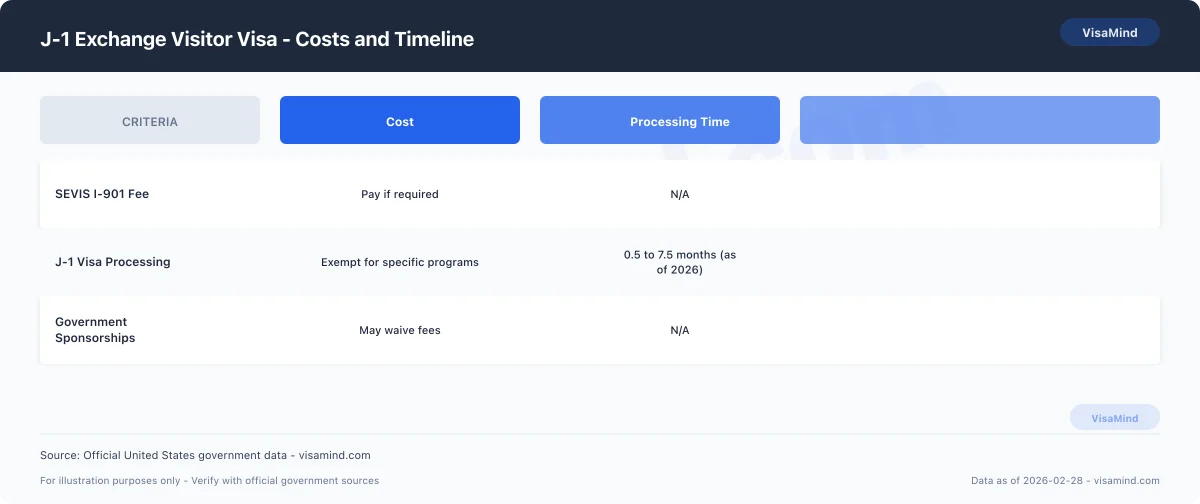
#You must pay specific government fees and plan for variable processing times when applying for a J-1 Exchange Visitor visa. Costs depend on the stage of your case.
Timelines vary by visa category and U.S. embassy or consulate.
Visa and government fees
You will pay fees at different points in the J-1 process. Most applicants pay both a visa application fee and a SEVIS fee.
| Fee Type | Amount (USD) | Paid To | When You Pay |
|---|---|---|---|
| Machine Readable Visa (MRV) application fee | $185 | U.S. Department of State | Before your visa interview |
| SEVIS I-901 fee | Check official source | SEVIS (DHS system) | Before your visa interview |
The $185 MRV fee applies to J-1 Exchange Visitor visa applicants as of February 2026. You pay this fee after submitting Form Form DS-160, Online Nonimmigrant Visa Application.
Most J-1 applicants must also pay the SEVIS I-901 fee. If you fail to pay it when required, the consular officer may delay or refuse visa issuance.
Confirm the current SEVIS fee amount and payment rules through the U.S. Department of Homeland Security’s SEVIS system. For visa-related fees, rely on the U.S. Department of State.
USCIS does not issue J-1 visas. The Department of State handles visa interviews and issuance.
Typical processing windows
The processing times vary based on the visa category you select in Form DS-160 and the U.S. embassy or consulate where you apply.
As of February 2026, reported DS-160 processing ranges include:
| Visa Category | Reported Time Range |
|---|---|
| Visitor (B1/B2) | 0.5 to 23 months |
| Student/Exchange (F, M, J) | 0.5 to 7.5 months |
| Petition-based (H, L, O, P, Q) | 0.5 to 4.5 months |
| Crew and Transit (C, D, C1/D) | 0.5 to 14 months |
J-1 Exchange Visitor applicants fall under the Student/Exchange (F, M, J) category. Current reports show a range of 0.5 to 7.5 months, depending on location.
In many cases, overall processing estimates are 2 to 8 weeks, but this depends on interview availability and post-specific workload. Administrative processing can extend timelines beyond standard estimates.
Your timeline starts after you submit the DS-160 and schedule your interview.
How to verify current timelines
Always confirm timelines before making travel plans. Processing times change frequently.
Follow these steps:
-
Check the U.S. Department of State’s visa appointment wait time tool for your specific embassy or consulate.
-
Review the processing category for Student/Exchange (F, M, J).
-
Confirm any post-specific instructions on the embassy or consulate website.
If your J-1 program requires a petition-based step handled by U.S. Citizenship and Immigration Services (USCIS), verify USCIS processing times directly on the USCIS website. Most J-1 applicants, though, complete their process through a designated sponsor and the Department of State rather than USCIS.
Do not rely on third-party estimates. Use official government sources for both fee amounts and current processing windows before you apply.
Renewal and Extension
#You must rely on official government instructions when you renew or extend your J-1 Exchange Visitor status. Always confirm that you meet the eligibility rules for your specific category before you file anything.
Where to find current renewal instructions
Start with the official U.S. Citizenship and Immigration Services (USCIS) website. Download the most current J-1–related forms and read the accompanying instructions carefully.
USCIS updates forms and filing instructions without notice. Using an outdated edition can delay or reject your filing.
For visa issuance or a new visa stamp, review guidance from the U.S. Department of State. You may need to complete Form DS-160, depending on your situation.
The Department of State controls visa applications and interviews. USCIS manages immigration benefits inside the United States.
| Purpose | Government Authority | What to Check |
|---|---|---|
| Immigration benefit or status matter | USCIS | Current forms and filing instructions |
| Visa application or interview | U.S. Department of State | Form DS-160 and consular guidance |
Always read the full instruction page before you prepare your documents.
Review eligibility before refiling
Confirm that you still qualify as a J-1 Exchange Visitor under your specific category. Each category has its own requirements, and eligibility can change based on your program details.
Before you proceed, review:
- Your exact J-1 category
- The current eligibility criteria listed in the form instructions
- Any category-specific conditions described by USCIS
Do not assume that prior approval guarantees continued eligibility. USCIS evaluates each filing under the current rules and instructions.
Download the latest version of the form and re-read the instructions even if you filed before. Small changes in wording can affect how you prepare your application.
If you cannot confirm eligibility based on the posted instructions, review the detailed guidance on the USCIS website before you refile.
When Self-Preparation Isn't Enough
#Small technical mistakes and timing errors can disrupt your J-1 Exchange Visitor application. You must complete each step in the correct order and meet strict formatting rules to avoid preventable problems.
Common paperwork and technical pitfalls
You complete the Form DS-160 online. Small errors can create immediate obstacles.
One common issue involves uploading a photo that does not meet the required specifications. If your photo fails to meet the technical standards, the system may reject it or flag your application.
That forces you to correct and resubmit before moving forward.
Pay close attention to:
- Photo format and file quality
- Proper upload confirmation before submitting
- Accurate personal details with no missing fields
Even minor inconsistencies in your DS-160 can slow processing. The U.S. Department of State reviews this form during consular processing, so accuracy matters at the start.
If you previously filed a petition with U.S. Citizenship and Immigration Services (USCIS) for a different visa category, confirm its approval before completing the DS-160. Consular officers verify petition status during the visa interview process.
| Issue | What Happens |
|---|---|
| Photo does not meet requirements | Application delays or system rejection |
| Petition not approved before DS-160 (if required) | Consular verification problems |
When errors can cause delays or denials
Timing mistakes can affect how your case moves forward. If a required petition has not been approved by USCIS, the consulate will confirm that status before issuing a visa.
Submitting the DS-160 before confirming approval can lead to complications. You may need to correct records or wait for confirmation before the interview proceeds.
As a J-1 Exchange Visitor, you must ensure:
- All required petitions are approved before relying on them
- Your DS-160 reflects accurate and complete information
- Your uploaded photo satisfies technical requirements
Consular officers rely on verified petition data and accurate DS-160 submissions. When those records do not align, your case can stall or face refusal until corrected.
Common Petition Challenges
#Small errors in your J-1 Exchange Visitor application can cause delays, Requests for Evidence (RFEs), or denials. Most problems involve inconsistent information, incorrect selections on the Form DS-160, or incomplete background disclosures.
You reduce risk by reviewing every entry against your passport and supporting records before submission.
Inconsistent or mismatched information
Every detail on your DS-160 must match your passport and supporting documents exactly. Even minor differences in spelling, dates, or travel history can delay processing or result in denial.
Common mismatch areas include:
- Full legal name (including middle names)
- Passport number
- Date and place of birth
- Travel dates
- Prior U.S. travel information
If you start multiple DS-160 sessions, confirm that each saved version contains identical information. Inconsistent answers across sessions create red flags during review by the U.S. Department of State.
Use this checklist before submitting:
| Item to Verify | Must Match Exactly |
|---|---|
| Passport biographic page | Name, number, date of birth |
| Supporting documents | Travel dates, prior visa history |
| All DS-160 entries | No conflicting responses |
Review your application line by line. Don’t rely on memory if your passport or prior records show something different.
Photo, category selection, and background questions
Technical errors often trigger avoidable delays. A non-compliant visa photo or selecting the wrong visa category can lead to rejection.
Pay attention to:
- Photo quality and format requirements
- Correct selection of the J-1 visa category
- Complete answers to all security and background questions
Choosing the wrong visa type, such as a tourist or student category instead of the J-1 Exchange Visitor classification, can result in immediate refusal. You must select the visa that matches your program purpose.
Security and background sections require full disclosure. Leave no blanks. If a question does not apply, use “None” or “N/A” where appropriate. Incomplete sections often result in RFEs or denial.
How errors lead to RFEs or denials
Errors affect your case at different stages. Consular officers review the DS-160 during visa processing, and incomplete or inconsistent information can halt progress.
Common outcomes include:
-
Request for Evidence (RFE) – Triggered by missing or unclear information.
-
Administrative delay – Caused by discrepancies that require clarification.
-
visa denial – Issued when key information is incorrect or inconsistent.
The most preventable issues involve skipped background questions and mismatched identity details. You control these risks by reviewing every answer before submission.
If you are unsure about technical requirements, confirm current standards through the U.S. Department of State. Careful preparation protects your J-1 Exchange Visitor application from avoidable setbacks.
Conditions and Portability
#Your J-1 Exchange Visitor status hinges on the specific exchange program that sponsors you. You’re required to follow the limits set by your sponsor and the U.S. Department of State to keep your status valid.
Program-specific restrictions
Eligibility and restrictions come down to your exchange program type. Some programs impose extra conditions that can affect your ability to stay in or return to the United States.
You may run into restrictions if you:
- Participate in a government-funded exchange program
- Take part in a program involving graduate medical education
- Possess a specialized skill listed on the Exchange Visitor Skills List
These factors might limit future immigration options or require you to meet additional conditions before changing status.
Confirm any program-specific limits with your sponsoring organization before making employment or travel plans.
| Factor | Why It Matters |
|---|---|
| Government funding | May trigger additional eligibility conditions |
| Graduate medical education | Subject to specific program rules |
| Skills List occupation | May affect future immigration benefits |
Your sponsor controls your program authorization. Filing a Form DS-160 or applying for benefits through USCIS doesn’t override sponsor-imposed limits.
Your spouse and unmarried children under 21 can apply for J-2 visa classification. Approval isn’t guaranteed.
Departure and status conditions
You need to maintain active participation in your approved exchange program. If your program ends, your J-1 status ends with it.
Certain exchange visitors must return to their home country for a required period if they:
- Received government funding
- Participated in graduate medical education
- Have a listed specialized skill
Check whether this requirement applies to you before seeking another U.S. visa or immigration benefit.
Visa issuance is handled by the U.S. Department of State. Admission at the port of entry is determined by U.S. Customs and Border Protection.
Status benefits inside the United States fall under USCIS.
If you plan to change status, extend your stay, or depart and reenter, review your program conditions closely and confirm compliance with your sponsor.
Fees
#Total estimated cost: $405
| Component | Amount |
|---|---|
| Application fee (MRV)MRV fee (non-petition), paid at the consulate. | $185 |
| SEVIS I-901 feeJ-1 SEVIS fee, paid at fmjfee.com before the visa interview. | $220 |
Verify current fees — official United States fee schedule
Fees shown are as of 2026-05-14. Verify on the official United States government website before applying.
Required forms
#Plan your J-1 Exchange Visitor Visa with free United States tools
#Itemized government fees for J-1 Exchange Visitor Visa and other United States categories.
Check United States eligibility
See how your profile scores against J-1 Exchange Visitor Visa and other United States visas.
United States processing times
Typical wait times and stage breakdowns for J-1 Exchange Visitor Visa and related United States visas.
Practice United States interview
Common interview questions and feedback for United States visa applicants.
Verified United States directory
#Browse source-backed, publication-certified records related to this visa route.
Browse source-backed, publication-certified records related to this visa route.
Browse source-backed, publication-certified records related to this visa route.