What the M-1 Vocational Student Visa Covers
#The M-1 visa allows you to enter the United States for full-time vocational or non-academic study.
It applies only to approved programs and schools that meet federal certification standards.
Who it covers
The M-1 visa covers international students planning to pursue full-time vocational or technical training in the United States.
You must intend to enroll in a qualifying non-academic program, not a traditional academic degree program.
You typically apply for the visa through the U.S. Department of State by submitting Form DS-160 and attending a visa interview.
After visa issuance, U.S. Customs and Border Protection (CBP) decides whether to admit you at a U.S. Port of entry.
If you're already in the United States and want to change or extend your status, U.S. Citizenship and Immigration Services (USCIS) handles that request.
The M-1 category does not cover:
- Academic degree programs
- Exchange visitor programs under the “J” classification
- Casual or part-time study
You must pursue study on a full-time basis in an approved vocational field.
| Requirement | M-1 Student |
|---|---|
| Type of study | Full-time vocational or non-academic |
| Visa application form | DS-160 (Department of State) |
| Status changes in U.S. | USCIS |
Types of eligible programs
The M-1 visa applies to vocational and non-academic programs.
These programs focus on practical skills and occupational training, not academic degrees.
Eligible programs must provide structured, full-time instruction.
Examples include technical or trade-based training, as long as the school and program meet federal certification requirements.
Your program must be classified as vocational.
If your goal is an academic course of study, you'll need to review the separate student visa category for academic students.
Before applying, confirm that:
- The program is vocational or non-academic
- The course load qualifies as full-time
- The school is authorized to enroll M-1 students
If you're unsure whether your program qualifies, review guidance from the U.S. Department of State and USCIS.
School certification requirements
You can only attend a school certified by the Student and Exchange Visitor Program (SEVP), which operates under U.S. Immigration and Customs Enforcement.
SEVP certification allows a school to enroll international students in M-1 status.
If a school isn't SEVP-certified, you can't receive an M-1 visa to attend that institution.
Before you complete the DS-160 or schedule a visa interview, confirm that your chosen school:
- Is approved by SEVP
- Is authorized to issue documentation for M-1 students
- Offers a qualifying vocational program
| School Requirement | Why It Matters |
|---|---|
| SEVP certification | Required to enroll M-1 students |
| Authorized vocational program | Must match M-1 classification |
| Full-time course structure | Required for status compliance |
If the school’s status is unclear, consult the U.S. Department of Homeland Security or USCIS guidance before you apply.
Post-Study Options
#Your admission at the airport determines how long you may stay and what status you must follow.
You must present the correct documents, confirm your I-94 record, and respond quickly to any notice issued at entry.
Arrival and entry
When you arrive at a U.S. port of entry, Customs and Border Protection (CBP) decides whether to admit you in M-1 status.
Your visa alone doesn't guarantee entry.
You must present:
- Valid passport
- Valid M-1 visa
- Form I-20 issued to you
CBP reviews these documents and confirms your purpose of travel.
If the officer admits you, the officer creates an electronic Form I-94 record.
Your I-94 controls your stay.
It shows:
| Item | What It Means for You |
|---|---|
| Class of Admission | Must state M-1 |
| Date of Admission | The day you entered |
| Admit Until Date | How long you may remain |
Check your I-94 record immediately after entry to confirm the information is correct.
If the class of admission doesn't show M-1, you need to address the issue promptly.
The U.S. Department of State handles visa issuance, but CBP controls admission at the border.
Maintaining status at arrival
Your responsibility starts the moment CBP admits you.
The I-94 record governs how long you may stay and what status you must maintain.
You must:
- Confirm your I-94 shows M-1
- Follow the terms of your Form I-20
- Keep copies of your admission documents
If your I-94 lists the wrong status or incorrect information, that error can affect your lawful stay.
Review it carefully and act quickly if you spot a mistake.
Your Student status depends on maintaining the classification shown on your I-94.
USCIS relies on that record if you later file any application or request.
The visa lets you request entry; the I-94 controls your authorized period in the United States.
Responding to entry notices
CBP may issue Form I-515A if something is missing or incomplete in your documentation at entry.
This notice gives you limited time to correct the issue.
If you receive Form I-515A:
-
Contact your Designated School Official (DSO) immediately.
-
Follow the instructions listed on the notice.
-
Submit the required documents within 30 days.
Failure to respond within 30 days can affect your status.
Work closely with your DSO to prepare the required response.
Keep copies of everything you submit.
If you need additional guidance about compliance or future filings, review instructions from U.S. Citizenship and Immigration Services (USCIS) or seek legal advice.
Fees and Processing Times
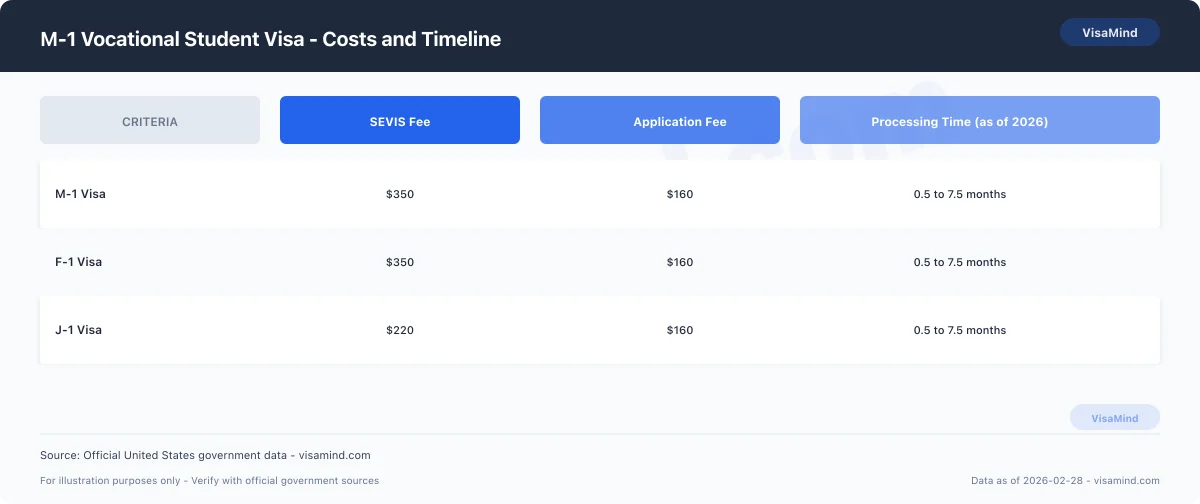
#You must pay specific government fees before the U.S. Department of State will issue your M-1 visa.
processing times vary by visa category and consular location, so you should plan several months ahead.
Visa and application fees
You must complete and submit Form DS-160, Online Nonimmigrant Visa Application and pay the required Machine Readable Visa (MRV) fee before scheduling your interview.
As of February 2026, the M-1 visa application fee is:
| Fee Type | Amount (USD) | Paid To |
|---|---|---|
| Nonimmigrant visa application (MRV) fee | $185 | U.S. Department of State |
You pay this fee through the U.S. Department of State’s designated payment system for the U.S. embassy or consulate where you apply.
The fee is required for each applicant and is non‑refundable, even if the visa is refused.
If you need updated amounts or payment instructions, review U.S. Department of State resources before submitting payment.
USCIS does not collect the DS-160 fee for consular visa processing.
SEVIS fee
Before you attend your visa interview, you must pay the I-901 SEVIS fee as an M-1 student.
This fee supports the Student and Exchange Visitor Information System (SEVIS), which tracks your Form I-20 and your status while you study in the United States.
You must pay the SEVIS fee before the consular officer can issue your visa.
Keep proof of payment.
Bring your SEVIS payment confirmation to your visa interview with the U.S. Department of State.
If you are unsure of the current I-901 SEVIS fee amount or payment steps, check the official government instructions before submitting payment.
Do not confuse this fee with the DS-160 visa application fee; you must pay both separately.
Processing time ranges
Visa processing times depend on:
- The visa category selected on your DS-160
- The U.S. embassy or consulate handling your case
- Local interview availability
Interview appointment wait times vary by visa category and by U.S. embassy or consulate. These are appointment estimates, not processing times for Form DS-160. Check the State Department’s Global Visa Wait Times tool for current, location-specific data.
Many cases move from application to decision within 2 to 8 weeks, but this depends on interview scheduling and post-specific workload.
Always verify current processing times directly with the U.S. Department of State before making travel plans.
How to Apply
#You apply for an M-1 vocational visa by securing admission to an approved school, completing the required government forms accurately, and submitting them with consistent supporting documents.
Accuracy and document matching matter at every step.
Before you apply
Start by researching and applying to a Student and Exchange Visitor Program (SEVP)-certified vocational school.
Only an approved school can support your M-1 application.
S. Citizenship and Immigration Services (USCIS)** website.
Read the instructions for your eligibility category before you begin.
Prepare key items in advance:
- Valid passport (information must match all forms exactly)
- Passport-style photos that meet government specifications
- School-issued documents
- Any required supporting evidence listed in the form instructions
Make sure all biographical details match your passport and other records word for word.
Even small inconsistencies can delay processing or lead to denial.
If you are applying through a petition-based category such as H-1b visa or L-1, obtain an approved Form I-129 before completing the visa application.
A U.S. consulate will verify petition approval before issuing a visa, as confirmed by the U.S. Department of State.
Use this checklist to confirm readiness:
| Item | Why It Matters |
|---|---|
| SEVP-certified school | Required for M-1 eligibility |
| Current USCIS forms | Outdated editions may be rejected |
| Matching passport data | Prevents delays or denial |
| Compliant photos | Avoids processing delays |
Completing forms
Complete the Form DS-160 Online Nonimmigrant Visa Application accurately and in one sitting if possible.
You can retrieve saved data for up to 30 days, but multiple sessions increase the risk of inconsistent answers.
Save your application ID immediately.
Print the DS-160 confirmation page before leaving the Consular Electronic Application Center (CEAC) system.
Answer every security and background question fully.
Leaving sections incomplete often results in a request for evidence or refusal.
Follow these steps:
-
Enter your name, date of birth, and passport details exactly as shown in your passport.
-
Review all entries before submitting.
-
Save and print the confirmation page.
-
Keep copies of all submissions for your records.
A common mistake involves entering slightly different travel dates or name spellings across sessions.
Review every field carefully before final submission.
If you file any required forms with USCIS, sign where indicated and include all listed evidence.
Missing signatures or documents can result in rejection.
Submission tips
Upload the DS-160 confirmation page as required for your visa application.
Bring the printed confirmation page to your visa interview with the U.S. Department of State.
Check the USCIS website for current filing instructions if you must submit forms to USCIS.
Use the official instructions to confirm the correct mailing location and required evidence.
Keep these best practices in mind:
- Use identical information across all forms and documents.
- Double-check passport numbers and expiration dates.
- Confirm photo compliance before submission.
- Retain copies of everything you submit.
If any information changes after submission, follow guidance from USCIS or the U.S. Department of State before taking further action.
Accurate, complete submissions move faster and reduce the risk of delays tied to avoidable errors.
When to Get Help
#You face higher risk if you have a prior denial or feel unsure about the information you submit.
Protect your personal data when completing forms and sharing documents.
Prior denials and uncertain cases
If a consular officer or U.S. Citizenship and Immigration Services (USCIS) previously denied your application, don’t reapply until you understand why. Filing again—even with a new Form DS-160 or updated documents as an M-1 student—won’t guarantee approval.
Seek professional guidance if your case involves:
- A prior visa denial at a U.S. Department of State interview
- Conflicting details between your DS-160 and supporting documents
- Concerns about how your personal history appears in your file
- Uncertainty about answering specific questions on government forms
Review the denial notice or refusal explanation closely. Compare it to what you plan to include in your new application.
| Issue | Why Help Matters |
|---|---|
| Prior denial | You must address the exact reason for refusal before reapplying |
| Inconsistent answers | Even small discrepancies can raise concerns |
| Incomplete information | Missing details can delay or undermine your case |
Don’t guess or leave important details unclear. Consistent, accurate answers are essential.
Protecting personal information
You’ll provide sensitive personal data when you complete the DS-160 or respond to USCIS or the U.S. Department of State. Guard that information throughout the process.
Limit where and how you share:
- Passport details
- Contact information
- Education and training history
- Any identification numbers requested on forms
Use only official government forms and instructions. Never send personal documents to unknown third parties.
| Action | Risk if Ignored |
|---|---|
| Sharing documents casually | Identity misuse or fraud |
| Using unofficial form versions | Rejection or processing delays |
| Providing inaccurate data | Possible denial |
You’re responsible for everything filed under your name as an M-1 student. Double-check each form before submitting and keep copies of everything.
Extending Your Student Visa
#You’ll need to take specific steps to keep your M-1 status valid. Transferring schools, staying enrolled full time, and protecting your Form I-20 all factor into your ability to remain in the United States.
Transferring schools
If you want to transfer to a different school, you must file Form I-539, Application to Extend/Change Nonimmigrant Status, with USCIS. Status doesn’t transfer automatically.
File Form I-539 before you start at the new school. USCIS will review your request and decide if you can continue in M-1 status at the new institution.
Use this checklist for transfers:
- Complete and sign Form I-539
- Submit it to USCIS
- Wait for a decision before relying on the transfer
The Form DS-160 is for visa issuance, not for extending or transferring status inside the United States. USCIS handles extensions and changes of status.
| Action | Responsible Agency |
|---|---|
| Visa issuance abroad | U.S. Department of State |
| Extension or transfer of status in the U.S. | USCIS |
Maintaining full course of study
You have to maintain a full course of study to keep your M-1 status. Dropping below full-time enrollment puts your status at risk.
Your student status depends on active participation in your vocational program. If you don’t keep full enrollment, you may violate your status.
Core requirements include:
- Stay enrolled in a full course load
- Continue attending classes
- Don’t reduce coursework without authorization
USCIS may decide you failed to comply if you stop maintaining a full course of study. That can affect future applications, including requests to extend status.
Check your enrollment status with your school before changing your schedule.
Keeping important forms safe
Always protect your Form I-20. You’ll need it for future immigration steps.
Don’t throw away old Forms I-130. Keep every original in a safe place. You may need them for USCIS filings or when applying for a new visa abroad through the DS-160 process.
Use this checklist:
- Store originals securely
- Keep copies elsewhere
- Bring the correct version to any USCIS filing or visa interview
If you can’t produce your Form I-20 when needed, you may face delays or complications in future applications. Treat this form as a permanent record.
Required Documents
#You’ll need to gather school-issued records, government forms, and identity documents before applying for an M-1 vocational visa. Accuracy and document condition matter, especially for anything submitted to USCIS or presented during consular processing.
School documents (I-20, enrollment proof)
Your main school document is Form I-20, issued by your designated school official (DSO). Get this form directly from your vocational school and keep the original for your records and visa process.
Form I-20 confirms your acceptance into a vocational program. Look over every detail for accuracy before using it.
Check that:
- Your legal name matches your passport
- Program name and dates are correct
- The school official has signed where required
If something’s wrong, contact your DSO right away. Don’t submit a form with errors.
You’ll also complete Form DS-160, the Online Nonimmigrant Visa Application, through the U.S. Department of State. Make sure the information matches your Form I-20 exactly.
| Document | Who Issues It | Why It Matters |
|---|---|---|
| Form I-20 | Designated School Official | Confirms acceptance into a vocational program |
| DS-160 | U.S. Department of State (online form) | Required nonimmigrant visa application record |
Keep copies of all school correspondence for your records.
Identification and passport photos
You’ll need a valid passport as proof of identity. Make sure your passport info matches your Form I-20 and DS-160.
You’ll also submit passport-style photos as required. Photos submitted to USCIS must meet strict standards.
Follow these rules:
- Photos must be unmounted
- Photos must be unretouched
- Don’t digitally edit or enhance the image
No filters, no background changes, no adjustments. If you alter the photo, USCIS may reject it.
Check the official photo specifications before you get your photos.
Other evidence to submit
Depending on your case and instructions from the U.S. Department of State or USCIS, you may need additional documents. Requirements can change, so check directly with the relevant agency.
Prepare documents that:
- Match your Form I-20
- Match your DS-160 responses
- Clearly identify you by your legal name
Keep documents consistent. Even small errors in spelling, dates, or program details can slow things down.
Before your interview or submission, review:
-
Your completed DS-160 confirmation
-
Your signed Form I-20
-
Your passport and required photos
If you’re not sure whether a document is needed, consult the official guidance from USCIS or the U.S. Department of State.
Eligibility Requirements
#You must qualify based on your program, your school’s status, and your ability to pay for your studies and living costs. Both USCIS and the U.S. Department of State review these factors closely during the M-1 vocational visa process.
Enrollment criteria
Enrollment must be in a vocational or other nonacademic program in the United States. The M-1 visa doesn’t cover language training programs.
Your program should be practical or technical, not academic. If you’re mainly interested in academic study, you’ll need another visa classification.
To meet the enrollment requirement, you must:
- Be accepted into a vocational or nonacademic program
- Attend a school certified by the Student and Exchange Visitor Program (SEVP)
- Intend to engage in full-time study as defined by your school
The focus is hands-on or career-oriented training. USCIS checks if your program fits the vocational category, and the U.S. Department of State reviews eligibility during visa processing after you submit Form DS-160.
Proof of enrollment and school status
You must prove your school is authorized to enroll M-1 students. Only SEVP-certified schools can issue the necessary documentation.
Your school issues a valid Form I-20, Certificate of Eligibility for Nonimmigrant Student Status. This document confirms:
- Your acceptance into an approved vocational program
- The school’s SEVP certification
- The program start and end dates
You’ll need the information from Form I-20 to complete the DS-160, Online Nonimmigrant Visa Application, for visa issuance.
Present a properly issued and signed Form I-20 at your visa interview. An incomplete or outdated form can delay or prevent approval.
Financial documentation
You must show you can pay for your education and support yourself while in the United States. The government won’t issue an M-1 visa if you can’t prove you have enough funds.
Your financial evidence should cover:
- Tuition and school fees
- Living expenses
- Other required educational costs
Form I-20 lists the estimated cost of attendance. Use that figure as your baseline when preparing documentation.
Acceptable proof usually includes official financial records showing available funds. If you rely on a sponsor, you’ll need documents showing the sponsor’s ability to provide support.
For specific documentation standards or current procedures, review guidance from the U.S. Department of State for visa processing and from USCIS for student benefits.
Common Rejection Reasons
#
Most M-1 visa refusals come from filing errors, unpaid fees, or incorrect selections on the DS-160. You can lower your risk by checking photo standards, confirming SEVIS payment, and answering all background questions completely and accurately.
Photo and document compliance
The U.S. Department of State rejects many applications over non-compliant visa photos. You must follow the official specifications. Don’t submit mounted, altered, or digitally retouched images.
Bad lighting, wrong size, or outdated photos can delay or derail your case at the interview. Use a professional service or a validated photo tool that meets Department of State standards.
Common photo mistakes
- Retouched or filtered images
- Photos attached to cardboard or backing
- Incorrect dimensions or background
- Low-resolution or blurry images
Supporting documents must match your Form DS-160 information. Inconsistent names, dates, or school details create credibility concerns during consular review.
If you’re unsure about current technical standards, review the photo guidance before submitting your DS-160.
SEVIS and fee issues
You must pay the I-901 SEVIS Fee before your visa interview. If you don’t, your application will be refused until you correct the problem.
The SEVIS record must be active and linked to an SEVP-certified school. If you apply using a school that isn’t certified, the consular officer cannot issue your M-1 visa.
| Issue | Result | What You Must Do |
|---|---|---|
| I-901 SEVIS Fee unpaid | Visa refusal | Pay the fee before interview |
| SEVIS record not active | Processing delay or refusal | Confirm status with your school |
| School not SEVP-certified | Ineligibility | Enroll in a certified institution |
Always verify payment status through the official SEVIS system. For current fee amounts, consult U.S. Department of Homeland Security resources.
Application category and background questions
Choosing the wrong visa category on the DS-160 can get your application denied. The M-1 visa is specific to vocational or nonacademic programs. If you choose B-1/B-2 or another nonimmigrant category, the officer may refuse your case.
Review your purpose of travel carefully before submitting the form. Corrections after submission often require a new DS-160.
Security and background questions also trigger refusals or delays if left blank or answered inconsistently. Every question needs an answer.
Avoid these DS-160 errors:
- Leaving fields blank instead of “None” or “N/A”
- Skipping prior travel or background disclosures
- Providing incomplete employment or education history
Inconsistent answers may result in extra administrative processing or further review. Complete the DS-160 carefully and confirm all responses before scheduling your interview.
Fees
#Total estimated cost: $185
| Component | Amount |
|---|---|
| Application fee (MRV)MRV fee (non-petition). SEVIS I-901 fee ($200) paid separately. | $185 |
Verify current fees — official United States fee schedule
Fees shown are as of 2026-02. Verify on the official United States government website before applying.
Required forms
#Plan your M-1 Vocational Student Visa with free United States tools
#Itemized government fees for M-1 Vocational Student Visa and other United States categories.
Check United States eligibility
See how your profile scores against M-1 Vocational Student Visa and other United States visas.
United States processing times
Typical wait times and stage breakdowns for M-1 Vocational Student Visa and related United States visas.
Practice United States interview
Common interview questions and feedback for United States visa applicants.
Verified United States directory
#Browse source-backed, publication-certified records related to this visa route.
Browse source-backed, publication-certified records related to this visa route.
Browse source-backed, publication-certified records related to this visa route.