On this page
What This Visa Covers
#
The B-1/B-2 visa is for those who want to enter the United States temporarily for business, tourism, or both. It’s nonimmigrant, meaning you’re expected to leave when your visit ends.
Permitted activities
Your activities must match what you list on your visa application, including the Form DS-160 submitted to the U.S. Department of State.
You may qualify if you plan to:
- Travel to the United States for temporary business purposes (B-1)
- Visit for tourism or personal travel (B-2)
- Combine both business and tourism during the same trip (B-1/B-2)
This visa doesn’t offer permanent residence or immigrant benefits. It’s strictly for temporary visits.
U.S. Citizenship and Immigration Services (USCIS) manages immigration benefits inside the U.S., but the U.S. Department of State issues visas. CBP makes the final call at the port of entry.
You’ll need to state your purpose as a visitor or tourist clearly on your DS-160 and at your visa interview.
Visa categories
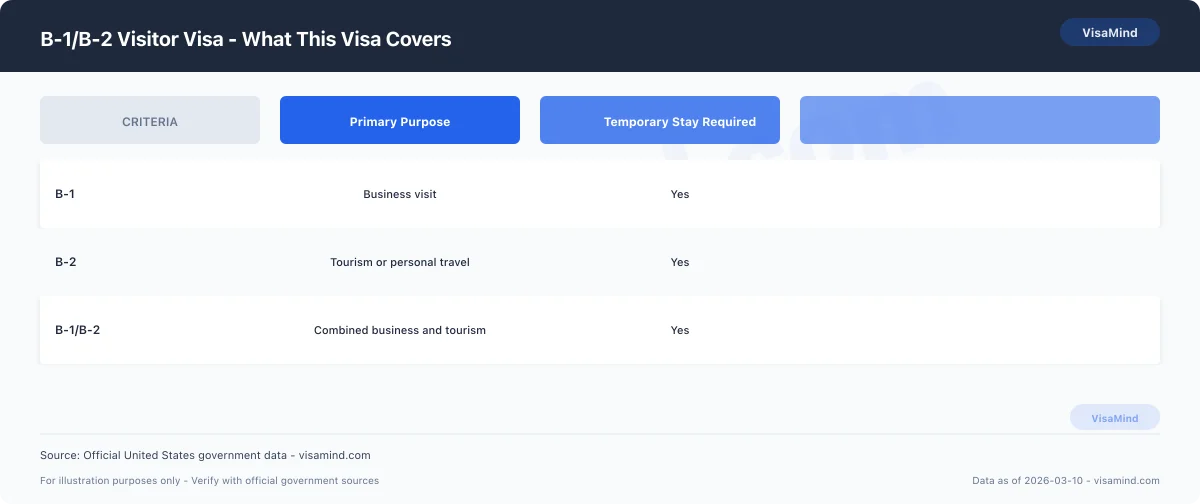
The visitor visa includes three related classifications, each tied to your trip’s purpose.
| Visa Type | Primary Purpose | Temporary Stay Required |
|---|---|---|
| B-1 | Business visit | Yes |
| B-2 | Tourism or personal travel | Yes |
| B-1/B-2 | Combined business and tourism | Yes |
All three fall under the nonimmigrant visitor visa category.
You select the classification when filling out Form DS-160. The consular officer from the U.S. Department of State decides which visa category you’ll get based on your purpose and eligibility.
No matter the category, you need to show your visit is temporary and limited to approved visitor activities.
Application Process
#To get a B1/B2 visitor visa, you’ll have to complete the online application, attend an in-person interview, and provide supporting documents. The U.S. Department of State runs the visa interviews and issuance, while USCIS provides the official forms and instructions.
Complete DS-160
You need to complete Form DS-160, Online Nonimmigrant Visa Application, for a B1/B2 visitor/tourist visa. This form is required for all nonimmigrant visa categories.
Here’s what you’ll do:
-
Fill out the DS-160 online.
-
Enter accurate personal and travel information.
-
Submit the form electronically.
-
Print the DS-160 confirmation barcode page.
Bring the printed barcode confirmation page to your visa interview. Without it, the consular officer can’t access your application.
Use the official instructions from USCIS and the U.S. Department of State. Answer every question, and sign the form electronically before submitting.
| Requirement | What You Must Do |
|---|---|
| Form | Complete DS-160 online |
| Information | Provide personal and travel details |
| Signature | Submit electronically |
| Interview Document | Print DS-160 barcode confirmation page |
Review your answers before you submit. Mistakes can slow things down.
Schedule & attend interview
After submitting the DS-160, schedule a visa interview at a U.S. Embassy or Consulate. The U.S. Department of State manages this step.
Bring the required documents to your appointment:
- Printed DS-160 barcode confirmation page
- Any appointment confirmation documents
- Supporting evidence for your visit
At the interview, a consular officer will review your application and ask about your planned activities. Provide clear, direct answers.
The officer decides whether to issue the B1/B2 visa. The U.S. Department of State, not USCIS, handles visa issuance.
Submit evidence & finalize
You’ll need to provide supporting evidence as part of your application. Bring documents that match what you entered in your DS-160.
Typical steps include:
-
Gather all required supporting documents.
-
Present them at your interview as instructed.
-
Make sure all forms are complete and signed.
Download the current B1/B2 visitor visa instructions from government sources before final submission.
Incomplete forms, missing signatures, or missing evidence can delay or prevent visa issuance. Double-check the instructions to confirm you’ve met all requirements before the interview.
Fees and Processing Times
#You’ll pay government fees and deal with wait times that vary by location and visa category. The U.S. Department of State sets visa fees, interview scheduling, and issuance timelines for B1/B2 visitor visas.
Application fees
A nonimmigrant visa application fee (MRV) is required when you submit Form DS-160 for a B1/B2 visitor/tourist visa.
| Fee Type | Amount (USD) | Paid To | Notes |
|---|---|---|---|
| Nonimmigrant Visa Application Fee (MRV) | $185 | U.S. Department of State | Required to schedule your visa interview |
| Visa Issuance Fee | Varies by nationality | U.S. Department of State | Only if applicable to your country |
The $185 fee applies to B1/B2 applicants as of February 2026. You must pay this fee before scheduling your interview.
Some applicants also pay a visa issuance (reciprocity) fee after approval, depending on nationality. Not every country has this fee.
If you apply for an immigration benefit with USCIS inside the U.S. later, USCIS charges different fees. Those don’t replace the MRV payment.
Always confirm current amounts with the U.S. Department of State before paying.
Processing time ranges
Processing time includes DS-160 submission, interview scheduling, and post-interview visa issuance. Wait times vary by embassy or consulate.
As of February 2026, reported DS-160 processing time ranges by category:
| Visa Category | Reported Time Range |
|---|---|
| Visitor (B1/B2) | 0.5 to 23 months |
| Student/Exchange (F, M, J) | 0.5 to 7.5 months |
| Petition-based (H, L, O, P, Q) | 0.5 to 4.5 months |
| Crew and Transit (C, D, C1/D) | 0.5 to 14 months |
For B1/B2 applicants, processing often takes 2 to 8 weeks, but some locations report much longer waits. The wide range reflects local demand, staffing, and security checks.
Your timeline depends on:
- The U.S. embassy or consulate where you apply
- Appointment availability
- Whether additional administrative processing is required
The U.S. Department of State manages these timelines.
Verify current timelines
Check current wait times directly with the U.S. Department of State before making travel plans. processing times change often and differ by city and country.
Steps to follow:
-
Complete and submit Form DS-160.
-
Check interview wait times at your chosen U.S. embassy or consulate.
-
Confirm if a visa issuance fee applies to your nationality.
Don’t use general estimates. Your specific location controls your timeline.
If you’re already in the U.S. and file a request with USCIS, review case processing times there. USCIS timelines don’t apply to consular B1/B2 visa issuance abroad.
Document Checklist
#You’ll need to bring specific documents to your B1/B2 visitor visa interview and complete the required online form accurately. Missing items can slow things down or force you to reschedule with the U.S. Department of State.
Passport & ID
Your passport is the main identity document for a B1/B2 visitor visa.
Bring:
- A valid passport
- Any prior passports if they contain relevant U.S. visas or travel history
- Government-issued photo ID, if required by the U.S. embassy or consulate
Your passport should be in good condition. Damaged or altered passports can cause delays or prevent you from boarding.
If you previously applied for an immigration benefit with USCIS, keep copies of related approval notices or receipts. While USCIS doesn’t issue B1/B2 visas, prior filings may appear in your immigration history.
| Document | Required | Notes |
|---|---|---|
| Valid passport | Yes | Must be presented at interview |
| Previous passports | If available | Helpful for prior U.S. travel history |
| USCIS notices | If applicable | Bring copies, not originals unless instructed |
Check passport validity rules with the U.S. Department of State before your interview.
Photos & DS-160 confirmation
You must complete Form DS-160 before scheduling your interview.
During the DS-160 process, upload a digital photo that meets the official requirements. If the image is rejected, you may need to bring a printed photo to your appointment.
Bring:
- The DS-160 confirmation page with barcode
- A compliant visa photo (if instructed)
The DS-160 confirmation page proves you submitted your application. Without it, the consular officer can’t retrieve your file.
| Item | When Required | Purpose |
|---|---|---|
| DS-160 confirmation page | Always | Identifies and retrieves your application |
| Digital photo upload | During DS-160 | Required to submit application |
| Printed photo | If requested | Backup if digital photo fails |
Complete every field on the DS-160 accurately. Inconsistent answers can cause credibility issues during your interview.
Supporting forms and records
Gather documents that support your DS-160 information.
At minimum, prepare:
- Confirmation of your DS-160 submission
- Any forms related to prior USCIS filings, if relevant
- Records that match your application statements
Your documents need to be consistent. If your DS-160 mentions prior travel, employment, or USCIS filings, bring evidence for those entries.
Organize your documents logically. Keep originals and copies separate if possible.
| Category | Examples |
|---|---|
| Application proof | DS-160 confirmation page |
| Prior U.S. filings | USCIS receipt or approval notices (if any) |
| Identity support | Passport and related ID documents |
The consular officer will review your documents during the interview. CBP makes the final decision at the port of entry.
Tips and Common Mistakes
#Strong B1/B2 visitor visa applications are accurate, complete, and consistent from start to finish. Most delays and denials stem from avoidable errors in the Form DS-160, photo submission, or interview preparation.
Expert tips
Complete the DS-160 in one sitting if you can. Save your application ID so you can retrieve the form within 30 days if needed.
Enter your name, passport number, and travel details exactly as they appear on your passport and supporting documents. Even small discrepancies can cause trouble at your interview.
If you’ve filed a petition with USCIS, such as Form I-129 for H-1b visa or L-1 status, wait until it’s approved before submitting the DS-160. The consulate will check petition status.
Prepare compliant passport-style photos before starting. Print and keep the DS-160 confirmation page after submission and bring it to your interview.
Answer every security and background question. If a question doesn’t apply, use “None” or “N/A” instead of leaving it blank.
Common application mistakes
Most B1/B2 denials involve inconsistency, missing steps, or the wrong visa classification. Your answers, documents, and selected category must align.
| Mistake | Result | How to Avoid It |
|---|---|---|
| Selecting the wrong visa type | Refusal | Choose B-1, B-2, or B-1/B-2 based on your actual purpose as a visitor/tourist |
| Inconsistent DS-160 answers | Refusal | Review every page before submission; match passport details exactly |
| Skipped security questions | Request for evidence or denial | Answer all background questions completely |
| Not scheduling an interview | Processing delay | Book your interview after submitting the DS-160 |
| Missing documents at interview | Delay or refusal | Bring all required confirmations and supporting records |
Don’t expect the consular officer to overlook small errors. Fix them before you submit.
Photo & DS-160 best practices
Photo issues and DS-160 errors often slow down visitor visa processing. The technical requirements are strict.
Photo best practices:
- Use a recent passport-style photo that meets U.S. Department of State standards
- Avoid low-resolution or improperly sized images
- Use a professional service or validated tool if unsure
Poor-quality or non-compliant photos can require resubmission and delay scheduling.
DS-160 best practices:
-
Complete every section.
-
Review all answers before final submission.
-
Print the confirmation page immediately.
Don’t exit the CEAC system without saving your application ID. Once you submit, schedule your visa interview and bring the confirmation page with you.
Conditions of Stay
#A B1/B2 visitor visa lets you request entry to the United States for business (B1) or tourism (B2). The actual period of stay depends on what happens at the port of entry and what’s listed on your admission record.
Entry records & arrival
A B1/B2 visa doesn’t guarantee admission. U.S. Customs and Border Protection (CBP) decides whether to admit you when you arrive.
If CBP admits you, the officer issues proof of admission in one of these forms:
- An admission stamp in your passport
- A paper Form I‑94, Arrival/Departure Record
Your Form I‑94 is the official evidence of:
- Your immigration classification (B1, B2, or B1/B2)
- The date you were admitted
- The date your authorized stay ends
Review your admission record immediately after entry. If the classification or dates are wrong, address the issue promptly through the appropriate government agency, such as U.S. Citizenship and Immigration Services (USCIS), if needed.
Your Form DS-160 confirmation and visa issuance by the U.S. Department of State only allow you to travel to a U.S. port of entry. CBP determines how long you can remain.
| Document | Issued By | Purpose |
|---|---|---|
| B1/B2 Visa | U.S. Department of State | Allows you to travel to a U.S. port of entry |
| Admission Stamp | CBP | Confirms entry classification and date |
| Form I‑94 | CBP | Shows authorized period of stay |
Passport validity
You must hold a passport valid for at least six months beyond your intended period of stay in the United States.
Some countries have agreements with the United States that provide exceptions to the six‑month validity rule. If your country qualifies, your passport may be considered valid for a longer period than the expiration date printed in it.
Before traveling, check:
- Your passport expiration date
- Whether your country has a six‑month validity exemption
- That your passport will not expire during your authorized stay
If your passport expires too soon, CBP may limit your admission period to match your passport’s validity. Renew your passport before travel if it doesn’t meet the required period.
Duration and limits
Your authorized stay as a Visitor/tourist does not automatically match your visa’s expiration date. The visa is for travel; your Form I‑94 controls how long you may remain.
You must:
-
Enter the United States in B1 or B2 status.
-
Remain only until the date listed on your admission record.
-
Depart the United States on or before that date.
Staying beyond the authorized period on your admission record violates your status. USCIS handles certain immigration benefits if you seek to change or extend status, but your Form I‑94 is always the controlling document.
Keep copies of your admission stamp and any paper Form I‑94 with your travel records. These documents are your proof that you maintained lawful visitor status during your stay.
Know When to Get Help
#A B1/B2 visitor visa application requires accuracy and preparation. Filing the application doesn’t guarantee approval.
When to seek expert help
Consider professional help if you feel unsure about any part of the Form DS-160 or your supporting documents. Even small inconsistencies can affect how a consular officer sees your application.
Seek help if:
- You struggle to complete the DS-160 accurately
- Your travel purpose isn’t clearly business (B1) or tourism (B2)
- You’re uncertain about how to present your visitor/tourist plans
- You previously applied and didn’t receive approval
- You worry that your application may raise questions
Submitting Form DS-160 and attending an interview through the U.S. Department of State process doesn’t guarantee you’ll receive a visa.
| Situation | Why Guidance Matters |
|---|---|
| Confusing travel purpose | You must clearly fit within B1 or B2 visitor categories |
| Prior application issues | You need to address concerns directly and consistently |
| Unclear documentation | Incomplete or inconsistent information can delay or harm your case |
If you’re unsure, don’t guess. Errors can create avoidable problems.
What a professional can help with
A qualified immigration attorney or accredited representative can review your DS-160 before you submit it. They’ll check for inconsistencies, missing details, and unclear answers.
They can also:
-
Clarify whether your trip fits the B1 (business) or B2 (tourist) category
-
Help you describe your travel purpose in clear, specific terms
-
Prepare you for the visa interview conducted by the U.S. Department of State
-
Identify weak points in your application and address them directly
Professionals do not control visa decisions. The U.S. Department of State issues visas, and U.S. Customs and Border Protection (CBP) determines admission at the port of entry.
| Area of Help | How It Protects You |
|---|---|
| Application review | Reduces mistakes on the DS-160 |
| Interview preparation | Helps you answer questions clearly and consistently |
| Case assessment | Identifies risks before you apply |
You remain responsible for your application, but informed guidance helps you submit it with more confidence and accuracy.
Eligibility Requirements
#You must confirm that your purpose for travel matches the B1 or B2 visitor classification and follow the correct application steps. Careful review of instructions reduces delays and prevents avoidable denials.
Who can apply
You may apply for a B1/B2 visitor visa if you plan to travel to the United States temporarily as a Visitor/tourist and you follow the required process.
You must:
- Select the correct visa classification (B1, B2, or combined B1/B2).
- Complete the Form DS-160, Online Nonimmigrant Visa Application.
- Follow the application procedures issued by the U.S. Department of State.
- Provide information that matches the purpose of your trip.
The U.S. Department of State manages visa applications and interviews at U.S. embassies and consulates. U.S. Citizenship and Immigration Services (USCIS) handles immigration benefits inside the United States, not visa issuance abroad.
| Step | Responsible Agency | Your Action |
|---|---|---|
| Complete DS-160 | U.S. Department of State | Submit accurate online application |
| Attend interview (if required) | U.S. Department of State | Follow consulate instructions |
| Admission at entry | U.S. Customs and Border Protection (CBP) | Request entry as visitor |
Apply under the category that fits your travel purpose.
Review category instructions
Before starting your application, review the instructions for your specific visitor category.
Each visa classification has its own requirements and procedural steps. Read the guidance provided by the U.S. Department of State for consular processing and confirm that you’re using the correct form and classification.
Focus on:
- Category definitions (B1 vs. B2).
- Required application steps.
- Interview procedures.
- Supporting documentation instructions.
Don’t rely on general summaries. Use agency instructions to confirm current procedures before submitting your DS-160 or scheduling an appointment.
What Consular Officers Evaluate
#A consular officer from the U.S. Department of State decides whether you qualify for a B1/B2 Visitor/Tourist visa. The central issue is whether you intend to return to your home country after your temporary stay.
Your application and interview must show clear, credible intent to depart the United States when your visit ends.
Evidence of ties to home country
You must prove that you plan to return home after your trip. If you can’t demonstrate this, the officer will refuse your visa.
Strong ties connect you to your country of residence in ways that make overstaying unlikely. Weak or unclear ties raise concern about immigrant intent.
Use documentation that supports the information listed in your Form DS-160 form.
| Type of Tie | What It Should Show |
|---|---|
| Employment | Ongoing job or business activity you will resume |
| Family | Immediate family members who remain in your home country |
| Property or Assets | Ownership or long-term financial commitments |
| Education | Current enrollment with a set return date |
Each document should match your stated purpose of travel. Inconsistencies between your DS-160 and supporting evidence can undermine your credibility.
If your situation doesn’t clearly require you to return home, the officer may conclude that you failed to demonstrate nonimmigrant intent.
Interview consistency & red flags
The interview tests whether your answers align with your DS-160 and supporting documents. Officers look for clear, direct responses about your travel purpose and return plans.
Inconsistent or vague answers create doubt. Changing details about your employment, trip duration, or who will pay for your visit raises concern.
Common red flags include:
- Unclear explanation of why you must return home
- Contradictions between your DS-160 and oral answers
- Hesitation when discussing your job or residence abroad
You must answer truthfully and consistently. If the officer believes you may not return to your home country, they will refuse the B1/B2 visa.
Fees
#| Component | Amount |
|---|---|
| Application fee (MRV)MRV fee (non-petition) | $185 |
Fees change; always verify on USCIS.
Required forms
#Next steps
#Use Find My Visa to build a sequenced plan with official sources and deadlines.
FAQs
How long can you stay on a B1/B2 visa?
CBP sets your authorized stay when you arrive in the United States. You need to follow the period they grant at entry.
For details about your status or extending your stay while in the United States, consult information provided by USCIS.
What does the B-1/B-2 visitor visa allow me to do?
The form is for persons visiting the United States temporarily for business, tourism, or a combination of both. It is a nonimmigrant visa covering business (B-1), tourism (B-2), or a combination (B-1/B-2).
Do I need to complete the DS-160 to apply?
Yes. Applicants must submit a completed Form DS-160, the Online Nonimmigrant Visa Application. After completing the DS-160 you must print and keep the DS-160 barcode/confirmation page to bring to your interview.
What documents should I bring to my visa interview?
Gather required documents including your passport, the Form DS-160 confirmation page, and a photo that meets the Photograph Requirements.
What are the photo requirements and how do I submit a photo?
Your photo must meet the Photograph Requirements and you must upload a photo meeting those requirements while completing Form DS-160.
How much does the visitor visa application cost?
The application fee (MRV) is $185 (as of 2026-02). Note: some nationals may also need to pay a visa issuance fee if applicable.
How long does processing usually take?
processing times vary by category and location. Published ranges include, for example, 0.5 to 23 months for Visitor (B1/B2) Form DS-160 processing (as of February 2026); another published range is 2–8 weeks. Verify current processing times with the issuing authority.
If I file for a B-1/B-2 visa, is approval guaranteed?
No. Filing a B-1/B-2 does not guarantee approval.
What are common reasons visa applications are refused or delayed?
Common issues include failing to upload a compliant photo, not scheduling the visa interview after completing the Form DS-160, submitting incomplete documentation at the interview, inconsistent information across DS-160 and passport, selecting the wrong visa category, and leaving security/background questions incomplete. Also, failure to demonstrate intent to return to your home country is a common refusal reason.
What should I do immediately after completing the DS-160?
Print and keep the Form DS-160 barcode/confirmation page and upload or include it with your visa application; then schedule and attend your visa interview at the U.S. Embassy or Consulate.
Official sources referenced
Last reviewed: 2026-03-10
VisaMind provides informational guidance only and is not a government agency. This is not legal advice. Requirements can change and eligibility depends on your specific facts. If your case is complex or high-stakes, consult a licensed immigration attorney.
Next steps
Every United States visa case depends on your nationality, purpose, and timeline. Get a personalized plan with official sources and deadlines.
Get my B-1/B-2 Visitor Visa plan