On this page
What the G-1 International Organization Visa Covers
#The G visa classification allows entry to the United States for official duties with a designated international organization. It covers government representatives, mission staff, organization employees, certain personal employees, and qualifying immediate family members.
Who the G visas serve
G visas are issued to individuals traveling to the U.S. for official functions tied to a designated international organization. You need to be entering to attend meetings, represent your government, or take up an approved position.
You may qualify if you are:
- A permanent mission member of a recognized government assigned to a designated international organization
- A government representative traveling temporarily to attend meetings
- A representative of a non-recognized or non-member government
- An employee appointed to work at a designated international organization, including the United Nations
- An immediate family member of a principal G visa holder
- A personal employee or domestic worker of a G-1 through G-4 visa holder
You must apply for the correct G classification under U.S. visa law if your purpose fits these roles.
Applications are processed by the U.S. Department of State. You’ll need to complete the Form DS-160 Online Nonimmigrant Visa Application and follow consular instructions.
Different G visa categories
Each G visa category matches a specific role or relationship to the international organization.
| Visa Category | Who It Covers |
|---|---|
| G-1 | Permanent mission members of a recognized government to a designated international organization and their immediate family |
| G-2 | Representatives of a recognized government traveling temporarily to attend meetings and their immediate family |
| G-3 | Representatives of non-recognized or non-member governments and their immediate family |
| G-4 | Individuals appointed to work at a designated international organization, including the United Nations, and their immediate family |
| G-5 | Personal employees or domestic workers of G-1 through G-4 visa holders |
You need to select the category that fits your official role. A mismatch can cause delays or require correction during consular processing.
The U.S. Department of State decides visa eligibility and issues the visa. U.S. Customs and Border Protection (CBP) determines admission at the port of entry.
Scope of official travel
A G visa is valid for travel to:
- Attend meetings at a designated international organization
- Visit an organization for official discussions
- Begin or continue an approved appointment
- Perform assigned duties tied directly to the organization
Your activities in the U.S. must match your official purpose. You can’t use a G visa for unrelated employment or personal business outside your authorized role.
You’ll need to demonstrate that your trip is directly connected to your government or organizational assignment. Consular officers review your DS-160 and supporting documents to confirm this.
If you later seek an immigration benefit inside the U.S., USCIS will handle that request. The G visa itself only covers your official entry and stay for qualifying duties.
Eligibility Requirements
#You must travel to the United States for an official assignment with a qualifying international organization and provide clear documentation of that role. Your eligibility depends on your duties, the organization, and any family members accompanying you.
Official purpose and duties
You need to show that your trip has a specific official purpose tied to your work with an international organization. The G‑1 visa isn’t for personal travel or private employment.
Your application should include:
- The specific duties you’ll perform
- The official title of your position
- The expected location of service in the U.S.
- The anticipated duration of your assignment
You’ll provide this information when completing Form DS‑160 with the U.S. Department of State. Make sure your description of duties matches what the organization provides.
Before applying, review the requirements for your eligibility category to confirm your assignment qualifies for G‑1 classification. If you later apply for a related immigration benefit with USCIS, the agency will check that your activities remain consistent with your official purpose.
| Requirement Area | What You Must Show |
|---|---|
| Purpose of travel | Official assignment only |
| Nature of work | Duties tied directly to the organization |
| Duration | Defined period of service |
| Consistency | Information aligns across all documents |
Information about the international organization
You must identify the international organization or office where you’ll serve. Your eligibility depends on your formal connection to that organization.
Provide details such as:
- Full name of the organization
- U.S. office location where you’ll work
- Your department or division
- Contact information for the organization
Your DS‑160 must accurately reflect this information. Inconsistent or incomplete information can slow down visa processing with the U.S. Department of State.
The organization must sponsor or assign you for official duties in the U.S. Your role must be directly connected to that organization, not to an outside employer.
| Organization Detail | Why It Matters |
|---|---|
| Official name | Confirms qualifying entity |
| U.S. office location | Establishes place of service |
| Department/unit | Clarifies scope of duties |
| Assignment confirmation | Links you to the organization |
Verify the organizational information before submitting your DS‑160.
Dependents and relationships
If your family will accompany you, provide complete information about each dependent. Eligibility depends on your relationship and their intent to join you during your assignment.
Prepare:
- Full legal name of each dependent
- Date and place of birth
- Relationship to you
- Confirmation that they will accompany or follow you
Each dependent submits a separate DS‑160. The U.S. Department of State reviews each application individually.
Your relationship must be documented and consistent across all forms and records. If you later seek a benefit with USCIS for a dependent while in the U.S., the agency will check that the family relationship and your G‑1 status remain valid.
Accuracy in family information prevents delays.
How to Apply Step by Step
#
You must complete the Online Nonimmigrant Visa Application (Form DS-160), print the required confirmation pages, and submit supporting documents. Each step requires accuracy and full completion before moving forward.
Complete the DS-160 online
Begin by completing Form DS-160, Online Nonimmigrant Visa Application. This form applies to all nonimmigrant visa categories, including the G-1.
Fill out every required section. Provide accurate biographical details, travel information, and everything else requested. Incomplete forms can cause delays.
Steps:
-
Access the DS-160 through the U.S. Department of State system.
-
Complete all required fields.
-
Review your answers carefully.
-
Electronically sign and submit the application.
After submission, you’ll get a barcode confirmation page. Save this page immediately.
For technical issues or form instructions, refer to U.S. Department of State guidance. USCIS doesn’t process visa applications at consulates.
Print and keep confirmation pages
After submitting your DS-160, print the barcode confirmation page. This proves you completed and submitted the application.
Print the overall application confirmation page for your records. Keep both pages somewhere safe.
Checklist:
- ✅ DS-160 barcode confirmation page
- ✅ DS-160 application confirmation page
You’ll need the barcode confirmation page for your visa interview and document submission. Without it, the consular post can’t match your file to your application.
Keep digital copies as backup, but bring the printed versions to any appointment. The U.S. Department of State requires this documentation to proceed.
Gather and submit supporting evidence
Gather all required documents before your visa appointment or submission. Submit complete evidence as requested.
Prepare at a minimum:
- Printed DS-160 barcode confirmation page
- Printed DS-160 confirmation page
- Any required supporting evidence requested by the consular post
Organize your documents. Place confirmation pages at the front.
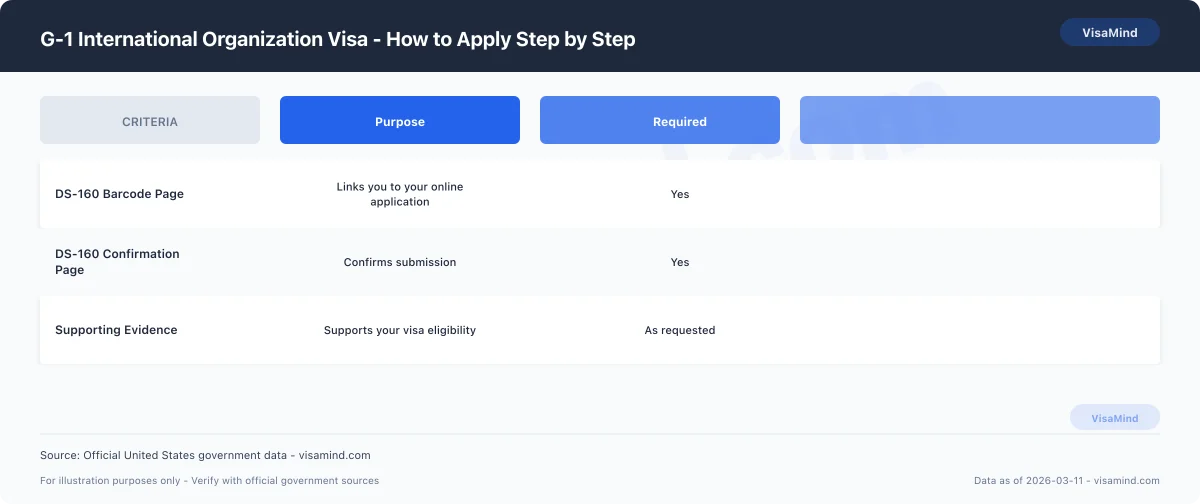
| Document | Purpose | Required |
|---|---|---|
| DS-160 Barcode Page | Links you to your online application | Yes |
| DS-160 Confirmation Page | Confirms submission | Yes |
| Supporting Evidence | Supports your visa eligibility | As requested |
Complete all required sections, sign where needed, and submit according to the U.S. Department of State’s instructions. Consular officers review your documents before issuing a visa.
Required Documents
#You must present a valid passport, a completed Form DS-160 confirmation page, and official documentation from your government or international organization. Consular officers use these to confirm identity and official purpose.
Passport and travel validity
Your passport must be valid for travel to the U.S. at the time of your visa application and entry.
Check before your interview:
- Passport validity: Valid for U.S. travel
- Condition: Undamaged and machine-readable
- Identity details: Name and biographic data match your DS-160
Any discrepancy between your passport and Form DS-160 can delay processing.
If you’ve filed any immigration-related request with USCIS, ensure your passport information is consistent across records. Use the same spelling and biographic details.
If your passport will expire soon, renew it before your interview. The U.S. Department of State won’t issue a visa in an invalid passport.
| Document Element | What Must Match |
|---|---|
| Full legal name | DS-160 entry |
| Date of birth | DS-160 entry |
| Passport number | DS-160 entry |
Diplomatic note / travel orders
Submit a diplomatic note and/or official travel orders confirming your status and assignment.
This document must include:
- Your full name
- Your title or position
- The name of the international organization
- The purpose of travel
- The expected duration of your assignment
The diplomatic note serves as formal confirmation that you qualify for G classification based on official duties. Without it, the consular officer can’t verify eligibility.
Your government or international organization issues this document. Make sure it’s signed and formatted according to official standards. Bring the original to your interview unless told otherwise by the U.S. Department of State.
For any related USCIS application, follow the official form instructions and include the required supporting evidence listed by USCIS.
DS-160 confirmation and official instructions
Complete the Online Nonimmigrant Visa Application, Form DS-160 and print the confirmation page.
Bring the DS-160 confirmation page with the barcode to your visa interview. The consular officer uses this barcode to access your application.
Steps:
-
Complete Form DS-160 accurately and in full.
-
Review all entries for consistency with your passport and diplomatic note.
-
Print the confirmation page after submission.
If you later submit any form to USCIS related to G status, use the current edition and instructions provided by USCIS. Always use the latest version of any form.
| Required Item | Issuing Authority |
|---|---|
| DS-160 confirmation page | U.S. Department of State |
| Immigration benefit forms (if applicable) | U.S. Citizenship and Immigration Services (USCIS) |
Incomplete forms or missing confirmation pages can prevent visa issuance. Make sure every document aligns with your official assignment and passport details.
Fees and Processing Times
#There’s no Machine Readable Visa (MRV) application fee for a G-1 visa. processing times vary by visa category and consulate location. Review current timelines before making travel plans.
Application fee details
The G-1 visa has no MRV application fee.
| Fee Type | Amount (USD) | Notes |
|---|---|---|
| MRV application fee | $0 | No payment required to submit Form DS-160 for G-1 |
You still need to complete Form DS-160, Online Nonimmigrant Visa Application through the U.S. Department of State.
Even though the fee is $0, the form must be filled out accurately and you may need to schedule a visa interview.
The U.S. Department of State manages visa interviews and issues G-1 visas.
U.S. Citizenship and Immigration Services (USCIS) does not issue G-1 visas abroad.
Admission at the port of entry is determined by U.S. Customs and Border Protection (CBP).
Fee policies can change.
Category-specific processing windows
Processing times depend on the visa classification you select in the DS-160 and the U.S. embassy or consulate handling your case.
As of February 2026, general DS-160 processing times are:
| Visa Category (DS-160 grouping) | Reported Processing Range |
|---|---|
| Visitor (B1/B2) | 0.5 to 23 months |
| Student/Exchange (F, M, J) | 0.5 to 7.5 months |
| Petition-based (H, L, O, P, Q) | 0.5 to 4.5 months |
| Crew and Transit (C, D, C1/D) | 0.5 to 14 months |
G-1 visas are in international organization categories, but wait times often follow embassy workload patterns.
In many locations, applicants report total visa processing of approximately 2 to 8 weeks.
This range varies by post and individual circumstances.
Processing time includes:
- DS-160 submission
- Interview scheduling wait time
- Administrative processing, if required
- Visa printing and return
The U.S. Department of State determines interview availability and final visa issuance.
Verify current timelines
You need to verify current visa appointment wait times directly with the U.S. Department of State through the specific embassy or consulate where you plan to apply.
Processing times change based on:
- Embassy or consulate workload
- Local staffing
- Security or administrative processing
- Seasonal application volume
Estimates from other visa categories or countries don’t apply.
Even small differences in location can change your processing window.
If your international organization assignment has a fixed start date, submit your DS-160 early.
Check appointment availability before making travel plans.
Conditions of Stay
#Your G-1 status is tied directly to your role with a qualifying international organization.
Strict rules apply to visa validity, reapplication, and compliance.
You cannot assume future approval.
Reapplication and residency rules
The G-1 visa does not grant open-ended permission to remain in the United States.
You may stay only while you continue to qualify under your assignment with the international organization.
If you need a new visa stamp, you must apply outside the United States through the U.S. Department of State.
You will:
-
Complete Form DS-160, Online Nonimmigrant Visa Application.
-
Attend a visa interview at a U.S. embassy or consulate, if required.
-
Obtain a new visa before seeking admission again.
Some related classifications, like G-5 and NATO-7 visa holders, must also apply for new visas abroad rather than inside the United States.
For immigration benefits inside the United States, you must follow instructions from U.S. Citizenship and Immigration Services (USCIS) and file the correct form as directed.
| Action | Government Authority |
|---|---|
| Visa issuance or renewal abroad | U.S. Department of State |
| Immigration benefits inside the U.S. | USCIS |
| Admission at port of entry | U.S. Customs and Border Protection (CBP) |
Approval is not guaranteed
Submitting an application does not guarantee approval.
Each application receives an independent review.
When you apply using Form DS-160, a consular officer with the U.S. Department of State decides if you qualify at that time.
Prior approvals do not bind the officer to issue another visa.
If you seek a benefit from USCIS, that agency reviews your filing under current eligibility rules.
You must provide accurate and complete information.
Approval depends on whether you:
- Continue to qualify under the G-1 classification
- Properly complete required forms
- Meet all eligibility requirements at the time of filing
Travel plans should wait until you have formal approval.
Consequences and special rules
You must maintain the conditions of your G-1 classification at all times.
If your qualifying role ends, your basis for remaining in the United States may also end.
Failure to comply with application or reapplication procedures can result in:
- Visa refusal by the U.S. Department of State
- Denial of a filing by USCIS
- Refusal of admission by CBP at a port of entry
Special rules apply to some related visa categories.
For example, G-5 and NATO-7 visa holders must seek a new visa outside the United States.
You are responsible for monitoring your status and following official filing instructions.
Check procedural requirements from USCIS and the U.S. Department of State.
Tips and Common Mistakes
#Accurate forms, compliant photos, and complete supporting documents prevent most G-1 visa delays.
You control these details.
Small errors can stop your application from moving forward.
Form completion best practices
Complete the Form DS-160 Online Nonimmigrant Visa Application carefully.
Try to finish it in one sitting.
Save your application ID so you can return if needed; the system allows retrieval for a limited time.
Print and keep the DS-160 confirmation page before exiting the Consular Electronic Application Center (CEAC).
You must submit this confirmation page with your visa application and bring it to your interview.
Follow these steps to reduce errors:
-
Enter your name exactly as it appears in your passport.
-
Use consistent dates and employment details throughout the form.
-
Review every answer before submitting.
Common document issues that cause delays include:
- Not providing a valid passport
- Missing or incomplete diplomatic note
- Missing travel orders
- Not including the DS-160 confirmation page
If another petition-based status applies, make sure the underlying petition is approved before completing the DS-160.
The consulate checks petition status through official systems.
For procedural details, rely on the U.S. Department of State for visa processing and USCIS for petition matters.
Photo and document quality
Your visa photo must meet U.S. Department of State technical standards.
Poor lighting, incorrect size, or improper background often leads to rejection.
Prepare your passport-style photos before you start the DS-160.
This avoids last-minute uploads that fail quality checks.
- Clear, sharp image with no shadows
- Plain background
- Proper dimensions and head positioning
- No visual distortions or digital alterations
Use a professional service or a validated photo tool that follows Department of State specifications.
Low-resolution images from mobile devices often fail review.
Check that your passport is valid and undamaged.
Submitting an expired or invalid passport will delay processing.
Security/background question guidance
Answer all security and background questions on the DS-160 truthfully and completely.
Don’t guess, leave blanks, or provide inconsistent answers.
The form requires a direct response to each question.
If something doesn’t apply, follow the form’s instructions.
Review your answers for consistency with:
- Your passport details
- Your diplomatic note
- Your travel orders
- Any approved petition, if applicable
Inconsistent information can trigger additional review or delays.
The U.S. Department of State conducts its own screening during visa processing.
Discrepancies often require clarification before a decision is made.
Review the entire DS-160 before final submission.
If you need to correct errors after submission, you may have to complete a new form and bring an updated confirmation page to your interview.
What Consular Officers Evaluate
#Consular officers review your application for accuracy, completeness, and proper visa classification.
They compare your Form DS-160, passport, and supporting records line by line.
Every background and security question must be answered fully and truthfully.
Consistency across documents
Officers compare the information in your DS-160 with your passport and all supporting documents.
Every detail must match exactly: full legal name, date of birth, passport number, travel dates.
Even small discrepancies can delay your case or lead to refusal.
Differences between separate DS-160 sessions raise concerns.
Checklist before your interview:
- Name spelling matches your passport
- Passport number and expiration date are correct
- Travel dates are consistent
- Employment and address history align with your documents
- No conflicting answers between saved or re-submitted DS-160 forms
| Item Reviewed | What Officers Check | Common Problem |
|---|---|---|
| Biographic data | Exact match with passport | Typographical errors |
| Travel history | Same dates across forms | Inconsistent entries |
| Employment history | Matches supporting letters | Missing or altered dates |
Review your DS-160 carefully before submission.
You’re responsible for ensuring every entry matches your official records.
Background and security answers
Officers expect every security and background question to be answered completely.
Blank fields, partial answers, or skipped sections can result in delays or refusal.
If a question does not apply, enter “None” or “N/A” where permitted.
Incomplete responses often trigger additional review.
That review can extend processing time or require you to provide clarification.
Focus on these areas:
- Prior visa applications and outcomes
- Criminal or legal history disclosures
- Immigration violations, if any
- Security-related questions
Accuracy matters more than speed.
Review each answer before you submit the DS-160.
If you’re unsure how to respond to a security question, consult the official instructions from the U.S. Department of State.
Do not guess or omit information.
Correct visa category and supporting evidence
Officers confirm you selected the correct visa category for your travel.
Choosing the wrong classification can lead to refusal, even if the rest of your application is complete.
For a G-1 visa, your purpose must align with service to a recognized international organization.
Supporting documents must reflect that role.
Verify before submission:
- Correct nonimmigrant visa category selected on the DS-160
- Supporting letter matches the visa classification requested
- Documents clearly state your official position and purpose
| Review Area | What Must Match | Risk if Incorrect |
|---|---|---|
| Visa category | Purpose of travel | Refusal |
| Supporting letter | Official assignment | Request for clarification |
| DS-160 purpose | Organizational role | Processing delay |
Selecting the correct visa type is your responsibility.
If you’re uncertain, review the official guidance from the U.S. Department of State before submitting your application.
Know When to Get Help
#Some G-1 cases move smoothly, but others raise legal or procedural issues that call for professional guidance.
It’s important to recognize early signs of complexity and act before delays or denials occur.
When cases may be complex
Seek help if your eligibility depends on nuanced facts rather than clear documentation.
Common complexity triggers:
- Questions about your relationship to a qualifying international organization
- Prior visa refusals or immigration violations
- Inconsistent information on your Form DS-160
- Derivative status for a spouse in a same-sex marriage where documentation is limited
- Changes in assignment, title, or funding source
U.S. immigration authorities evaluate spousal relationships without regard to gender.
Still, you must provide standard proof of a valid marriage.
Use this table to assess risk level:
| Situation | Risk Level | Why Help May Be Needed |
|---|---|---|
| First-time G-1 applicant with clear documentation | Low | Straightforward eligibility |
| Prior visa denial | Moderate | Prior record affects credibility |
| Marriage-based derivative status with limited records | Moderate to High | Requires strong supporting evidence |
| Inconsistent employment or assignment history | High | May trigger additional review |
If your case fits the moderate or high categories, consult qualified counsel before submitting your DS-160.
Working with USCIS and consulates
Different agencies handle different stages of your case.
- U.S. Citizenship and Immigration Services (USCIS) handles immigration benefits and certain status matters inside the United States.
- The U.S. Department of State oversees visa interviews and visa issuance at U.S. embassies and consulates.
- U.S. Customs and Border Protection (CBP) decides admission at the port of entry.
You must ensure that information provided to USCIS matches what you submit on your DS-160 and present at your consular interview.
Seek help if:
-
USCIS issues a request for evidence.
-
A consular officer refuses your visa under a legal ground you do not understand.
-
Your case requires coordination between a status change in the United States and visa issuance abroad.
Professional guidance helps you respond accurately and avoid conflicting records across agencies.
Referral points for tricky matters
Some situations require specialized review rather than general advice.
You should request a referral to an experienced immigration attorney if your case involves:
- Security-related questions during the DS-160 process
- Prior removal proceedings or overstays
- Derivative status based on a marriage that occurred in a jurisdiction with unique documentation rules
- A same-sex marriage where foreign civil documents are difficult to obtain
In these cases, timing and documentation strategy are important.
For procedural details, confirm requirements directly with the U.S. Department of State for visa processing and with USCIS for immigration benefits.
Use professional help when the issue involves legal interpretation rather than simple document gathering.
Fees
#| Component | Amount |
|---|---|
| Application fee (MRV)No fee for G-1 visas for qualified officials | $0 |
Fees change; always verify on USCIS.
Required forms
#Next steps
#Use Find My Visa to build a sequenced plan with official sources and deadlines.
FAQs
What is the G-1 visa and who uses Form G-1?
Form G-1 (G visa) is used by diplomats and government officials who will work for international organizations in the United States. The G-1 category covers permanent mission members of a recognized government to a designated international organization and their immediate family members.
What other G visa categories exist?
Other G categories include G-2 for representatives of a recognized government traveling temporarily to attend meetings and their immediate family members; G-3 for representatives of non-recognized or non-member governments and their immediate family members; G-4 for individuals coming to take up an appointment at a designated international organization (including the UN) and their immediate family members; and G-5 for personal employees or domestic workers of G-1 through G-4 visa holders.
What activities qualify someone for a G-1 (or other G) visa?
To receive a G-1, G-2, G-3, or G-4 visa, you must be traveling to attend meetings at, visit, or work at a designated international organization. The visa ensures the traveler is going for official duties and meets specific visa requirements.
Do G-5 and NATO-7 visa holders have any special reapplication rules?
Yes. G-5 and NATO-7 visa holders must reapply for their visas outside the United States.
Which online form do I need to complete to apply?
Visa applicants must submit a completed Form DS-160, the Online Nonimmigrant Visa Application. After completing the DS-160 you must print and keep the DS-160 barcode/confirmation page.
What core documents should I prepare before applying?
Core documents include a passport valid for travel to the United States, a diplomatic note and/or travel orders, the Form DS-160 confirmation page, and any other required documentation that applicants for G and NATO visas are asked to gather and deliver.
Is there an application fee for the G-1 visa?
The application fee (MRV) is $0 (as of 2026-03).
How long does processing typically take?
processing times vary by category and location; verify current processing times with the issuing authority. A commonly noted processing window is 2–8 weeks but category and location-specific ranges may be longer.
What common mistakes can lead to delays or rejections?
Common problems include failing to submit a valid passport, not using the Form DS-160 confirmation page, inconsistent information across DS-160 sessions or with your passport, poor-quality or non-compliant visa photos, and selecting the wrong visa category.
Does filing a G-1 (or related) application guarantee approval?
No. Filing for a G-1 does not guarantee approval.
Official sources referenced
Last reviewed: 2026-03-11
VisaMind provides informational guidance only and is not a government agency. This is not legal advice. Requirements can change and eligibility depends on your specific facts. If your case is complex or high-stakes, consult a licensed immigration attorney.
Next steps
Every United States visa case depends on your nationality, purpose, and timeline. Get a personalized plan with official sources and deadlines.
Find my visa