
On this page
- What the O-2 Essential Support Personnel Visa Covers
- When to Consult a Professional
- Application Process
- Fees and Processing Times
- Conditions and Rights
- What to Submit
- Path to Permanent Residence
- Renewal and Extension
- Eligibility Requirements
- Relationship Scrutiny Red Flags
- Check Before You File
- Fees
- Required forms
- Related visa types
- Related guides
- Related goals
- Next steps
What the O-2 Essential Support Personnel Visa Covers
#The O-2 visa lets essential support personnel accompany and work with an O-1 visa holder in the United States. It covers only support roles that are directly tied to the O-1’s specific event or performance and require skills not commonly found in the U.S.
Purpose and scope
The O-2 visa authorizes you to enter the United States to provide essential support to an O-1 principal. Your role must be integral to the O-1’s performance at a specific event or series of events.
You must provide skills critical to the O-1’s work that aren’t available from U.S. workers. The visa doesn’t cover general labor or unrelated services.
Your authorized work is limited to:
- Supporting the named O-1 beneficiary
- Participating in the specific event or performance listed in the petition
- Performing duties directly related to the O-1’s activities
You can’t use the O-2 visa to take independent employment or accept work outside the approved support role.
| Key Element | What It Means for You |
|---|---|
| Principal requirement | You support an approved O-1 visa holder |
| Nature of role | Essential and integral to the performance |
| Skill level | Critical skills not readily available in the U.S. |
| Work limits | Only as described in the approved petition |
USCIS reviews whether your role meets these standards before approving the petition.
Who files the petition
You can’t file for an O-2 visa on your own. A U.S. employer or agent must submit Form I-129, Petition for a Nonimmigrant Worker, with USCIS on your behalf.
The petitioner must:
- Identify you as essential support personnel
- Connect your role directly to the O-1’s approved activities
- Describe the specific event or performance
USCIS adjudicates the Form I-129 petition. If USCIS approves it, you apply for the O-2 visa through the U.S. Department of State if you’re outside the United States.
The Department of State manages visa interviews and issuance. U.S. Customs and Border Protection (CBP) determines admission at the port of entry.
How O-2 relates to O-1
The O-2 visa depends entirely on the O-1 petition. You can’t qualify for O-2 classification unless there’s a principal O-1 beneficiary tied to the same event or performance.
Your status remains linked to the O-1’s authorized activities. If the O-1’s engagement ends, your authorized support role also ends.
| O-1 Principal | O-2 Support Personnel |
|---|---|
| Performs at event | Provides essential support |
| Must qualify individually | Must prove integral role |
| Files through employer/agent | Filed by same employer/agent |
| Primary beneficiary | Dependent support classification |
USCIS evaluates both roles together to confirm your work is necessary for the O-1’s performance. You don’t receive independent authorization beyond that support function.
When to Consult a Professional
#
O-2 classification depends on precise alignment with the O-1 visa principal and accurate Form I-129 filing. Errors can lead to rejection or a Request for Evidence (RFE) from USCIS.
Complex or high-risk cases
Consult a professional when your role doesn’t clearly match the O-1 principal’s approved work. USCIS scrutinizes whether your services directly support the O-1’s specific event or activity, and inconsistencies can raise concerns.
High-risk situations include:
- Unclear job duties tied to the O-1 beneficiary
- Multiple employers or changing work locations
- Prior filings under a different visa classification
- Time-sensitive projects where delays impact production or contracts
If your case involves overlapping responsibilities or previous immigration filings, even minor drafting errors in Form I-129 can cause delays. A professional aligns the job description, supporting letter, and classification so USCIS sees a consistent narrative.
A rejected petition can disrupt authorized work and require refiling.
Common mistakes that need help
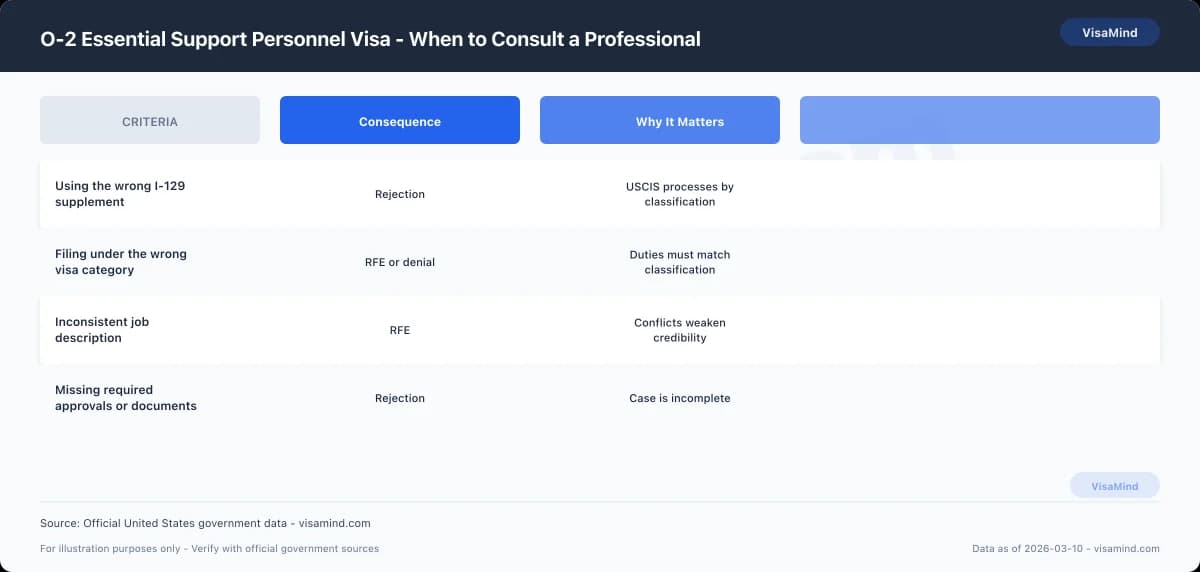
Many O-2 petitions fail because of avoidable filing errors. USCIS may reject a case before review if required documentation is missing.
Common issues include:
| Mistake | Consequence | Why It Matters |
|---|---|---|
| Using the wrong I-129 supplement | Rejection | USCIS processes by classification |
| Filing under the wrong visa category | RFE or denial | Duties must match classification |
| Inconsistent job description | RFE | Conflicts weaken credibility |
| Missing required approvals or documents | Rejection | Case is incomplete |
You must use the correct Form I-129 supplement for the O classification. Selecting the wrong category, such as an H or L supplement, leads to rejection.
Your job description should remain consistent across all documents. If your support role differs from the petition letter or contract, USCIS may question whether the O-2 classification fits your work.
Professional review helps catch these inconsistencies before filing.
Expert filing tips
Strong filings focus on clarity and internal consistency. Each document should support the same description of your role and the O-1’s activity.
Follow this approach:
-
Confirm the correct O classification supplement on Form I-129.
-
Draft a detailed support letter explaining your essential role.
-
Align contracts, itineraries, and work descriptions.
-
Review all documents for matching dates, duties, and employer information.
If your work description shifts even slightly between documents, USCIS may issue an RFE. Professionals review filings line by line to confirm duties, classification, and event details match.
You’re responsible for the accuracy of your petition. Careful preparation reduces rejections and prevents delays that could affect your ability to work.
Application Process
#You file the O-2 petition through USCIS using Form I-129, Petition for a Nonimmigrant Worker. Accuracy, timing, and complete documentation all factor into whether USCIS issues an approval, Request for Evidence (RFE), or denial.
Filing Form I-129
Submit Form I-129 to request O-2 classification as essential support personnel for an O-1 visa principal. Only certain Form I-129 classifications qualify for online filing—confirm availability before you file.
Complete all O-2 sections fully and sign where required. Missing fields or signatures often lead to rejection or delay.
Include documentation showing:
- Your role as essential support personnel
- Your specific duties in support of the O-1’s work
- The working relationship between you and the O-1 beneficiary
- That your services are necessary to the O-1’s performance
If you file for status in the Commonwealth of the Northern Mariana Islands (CNMI) and the form requests a physical address, list your CNMI P.O. Box as instructed.
| Filing Component | What You Must Do |
|---|---|
| Form | Submit Form I-129 |
| Classification | Request O-2 essential support personnel |
| Evidence | Prove eligibility and support role |
| Signature | Ensure all required signatures are included |
Download the correct edition of the form and verify the requested validity dates match your intended period of employment.
Timing and adjudication
You may file Form I-129 no more than one year before the O-2 employment start date. Filing too early results in rejection.
USCIS will conduct an adjudicative review after receiving your petition. The agency may:
- Approve the petition
- Issue a Request for Evidence (RFE)
- Issue a Notice of Intent to Deny (NOID)
- Deny the petition
- Refer the case for investigation
If USCIS finds inconsistencies—such as mismatched validity dates—it may issue an RFE. Delays are less likely when the requested employment period aligns with your supporting documentation.
USCIS posts general processing updates on its website. For current timeframes, use the USCIS processing times tool.
Related filings and premium processing
You may file related applications together with Form I-129 in certain situations.
If your spouse or unmarried child seeks O-3 visa classification, you can file Form I-539, Application to Extend/Change Nonimmigrant Status, at the same time and in the same location as Form I-
- When properly packaged together, USCIS may adjudicate them at the same time. Otherwise, USCIS reviews them separately.
When timing is important, you may request premium processing by filing Form I-907 with Form I-
- This service provides a 15-day adjudicative action for eligible classifications.
| Related Filing | Purpose | Key Point |
|---|---|---|
| Form I-539 | O-3 dependent status | File with I-129 for concurrent review |
| Form I-907 | Premium processing request | 15-day adjudicative action for eligible cases |
Double-check all forms for signatures, correct fees, and consistent supporting evidence before submission.
Fees and Processing Times
#You must file Form I-129 with USCIS to request O-2 classification in support of an O-1 visa worker. Total cost and timeline depend on the filing type, service center workload, and whether you request premium processing.
Required fees
You pay filing fees to USCIS when you submit Form I-129 for O-2 classification.
| Fee Type | Amount (USD) | Notes |
|---|---|---|
| Form I-129 filing fee | $780 | Required for O-2 petition (as of Feb. 2026) |
| Biometrics services fee | $85 | If USCIS requires biometrics |
USCIS rejects petitions filed with the wrong fee or outdated form edition. This is a frequent cause of delay.
You must:
- Use the current edition of Form I-129.
- Include the correct filing fee.
- Submit a separate payment if you request premium processing.
USCIS processing time estimates
USCIS processing times for Form I-129 vary by visa classification and service center. O-2 petitions are grouped under “O – Extraordinary ability.”
As of January 2026, reported processing times for that category range from:
| Classification | Estimated Processing Time |
|---|---|
| O – Extraordinary ability | 9.5 to 14 months |
Other Form I-129 categories range from about 3.5 months to over 30 months, depending on classification.
Processing times reflect USCIS workload and change frequently. Use the USCIS processing times tool with the service center listed on your receipt notice.
If you need the O-2 beneficiary to begin work by a specific date, file as early as regulations allow.
Premium processing and fee changes
Premium processing lets USCIS take adjudicative action on your Form I-129 within an expedited timeframe. You must file a separate premium processing request and pay a separate premium fee.
If USCIS receives your premium processing request postmarked on or after March 1, 2026, you must include the new fee that applies to the specific benefit requested.
Incorrect premium fees lead to rejection or delay.
In limited situations tied to filings associated with certain dates in 2025, USCIS requires an additional $100,000 payment as a condition of eligibility. Verify whether that requirement applies to your case before filing.
Premium processing does not guarantee approval. It only shortens the USCIS decision timeframe.
Conditions and Rights
#Your O-2 status is tied directly to the approved O-1 visa principal and the specific event or activity listed in the petition. You may only work as authorized by USCIS, and your role must remain supportive rather than independent.
Employment and study rights
You may work in the United States only in the position described in the approved Form I-129, Petition for a Nonimmigrant Worker. Your employment must support the O-1 principal’s event or performance.
You cannot accept other employment or begin new work unless a new petition is properly filed and approved. If the O-1 changes employers, the new employer must file a new Form I-129 with USCIS according to the form instructions.
Family members in O-3 visa status have different rights:
| Status | Work Authorization | Study |
|---|---|---|
| O-2 | Authorized only as approved on Form I-129 | Not restricted by status |
| O-3 | Not permitted to work | May study full-time or part-time |
Adjudication outcomes
USCIS reviews the Form I-129 to determine whether your services are essential to the O-1 principal’s activity. Officers assess whether your duties match the support role described in the petition.
USCIS may:
-
Approve the petition as filed.
-
Deny the petition if requirements are not met.
If USCIS approves the petition and you apply for a visa abroad, the U.S. Department of State handles visa issuance. Admission to the United States is decided by U.S. Customs and Border Protection (CBP) at the port of entry.
Each stage involves a separate authority. Approval at one step does not guarantee the next.
Role and contract requirements
Your role must directly support the O-1 principal’s performance or event. You cannot perform services that fall outside the scope of the approved petition.
The petition filed on your behalf should clearly define:
- The specific duties you will perform
- The event or activity you will support
- The employer responsible for your work
USCIS expects consistency between the petition, your actual duties, and any contractual arrangements.
If your responsibilities materially change, the employer should file a new Form I-129 before you begin the new work.
You must remain within the terms approved by USCIS to maintain lawful status.
What to Submit
#You must file Form I-129 with U.S. Citizenship and Immigration Services (USCIS) and include detailed proof that you provide essential support to the O-1 visa beneficiary.
Your petition must document your skills, your working relationship with the O-1, and the specific employment terms.
Core evidence of essential services
You must prove that your services are critical to the O-1 beneficiary’s work and cannot be easily performed by another worker.
Submit evidence such as:
- Documentation of specialized or critical skills directly tied to the O-1’s performance or project
- Proof of a longstanding working relationship with the O-1 beneficiary
- Records of prior performances, productions, or collaborations together
- A detailed explanation of your current role and why it is essential
USCIS looks for clear proof that your skills are not general support services. Describe the exact tasks you will perform and how they connect to the O-1’s area of extraordinary ability.
Use specific examples. Identify events, productions, or projects where you previously worked together and explain how your experience with the O-1 makes you uniquely qualified to continue in that role.
Contracts and advisory opinions
Your Form I-129 must include written proof of the employment arrangement.
Provide:
- A copy of the written contract between you and the petitioner
- If no written contract exists, a summary of the oral agreement outlining key terms
- A valid job offer or employment agreement
- A written advisory opinion from an appropriate labor organization or peer group
The advisory opinion must come from a relevant labor union, peer group, or management organization with expertise in the O-1 beneficiary’s field. This letter should address your role and confirm that your services are appropriate for O-2 classification.
If your work involves specific events or activities, include a copy of the itinerary. Contracts and itineraries must match the role described in the petition.
Employer and role information
The petitioner must provide complete employer details in the I-129 filing.
Include:
- The legal name, address, and contact information of the employer or event organizer
- A clear description of the O-1 beneficiary’s activities
- A detailed explanation of your supporting role
- The original version of required supporting documents
Your role description should outline your day-to-day duties and explain how they support the O-1’s work. Avoid vague job titles.
Focus on the actual services you will perform. USCIS reviews whether the employment terms, role description, and supporting evidence consistently show that you will work only in support of the O-1 beneficiary.
Any inconsistencies between the contract, advisory opinion, and petition can delay or undermine approval.
Path to Permanent Residence
#An O-2 visa does not directly lead to a green card. Your long-term plans often depend on your principal O-1 visa beneficiary’s strategy.
Employment-based pathways may require separate petitions, certified labor filings, and careful timing with USCIS.
When immigrant pathways may apply
You work in the United States only to support the O-1 principal’s approved activities under the Form I-129 petition filed with U.S. Citizenship and Immigration Services (USCIS).
If the O-1 beneficiary pursues permanent residence through employment, your future options depend on that process and your own eligibility under immigration law.
In employment-based cases that require employer sponsorship, the process may include:
- A labor certification process (if required for the category)
- An approved immigrant petition, such as Form I-140
- Ongoing qualifying employment
For certain employment-based categories such as EB-2 visa or EB-3 visa, the employer must complete the PERM labor certification process before filing Form I-140.
The employer cannot skip this step where it applies.
If the O-1 principal changes status to H-1b visa, the employer must ensure the Labor Condition Application (LCA) is certified before filing the H-1B petition with USCIS.
| Step | Who Files | Agency Involved |
|---|---|---|
| Labor certification (if required) | Employer | U.S. Department of Labor |
| Form I-140 | Employer | USCIS |
| Nonimmigrant change (e.g., H-1B) | Employer | USCIS |
Key steps to watch for
You must monitor petition timing and approval status closely. Your ability to remain and work depends on valid underlying status and approved filings.
Focus on these practical steps:
-
Confirm that any required labor certification is approved before Form I-140 is filed.
-
Ensure the employer files the correct form with USCIS, including Form I-129 for nonimmigrant classification changes.
-
Track expiration dates for your O-2 status and authorized stay.
-
Keep copies of all receipt and approval notices from USCIS.
If you pursue a change to another nonimmigrant category, such as H-1B, confirm that the LCA is certified before the petition is submitted.
Filing out of sequence can delay or disrupt your work authorization.
Renewal and Extension
#You may extend your O-2 status to continue supporting the O-1 visa principal, but you must file properly and on time.
USCIS requires a new petition and clear documentation that explains why your continued stay is necessary for the approved work.
Extending stay
You cannot extend your stay automatically. Your employer or petitioner must file Form I-129, Petition for a Nonimmigrant Worker, with U.S. Citizenship and Immigration Services (USCIS) to request an extension of your O-2 classification.
You may only request an extension to continue the same event, activity, or work that supports the O-1 principal.
If the O-1’s authorized period changes, your extension request must reflect that timeline.
Your eligibility depends on:
- A valid O-1 principal maintaining status
- A continued need for your specific support services
- A properly filed Form I-129 requesting the extension
- Compliance with the terms of your current admission
USCIS will review whether your continued presence remains essential to the O-1’s approved work.
| Requirement | Who Provides It | Purpose |
|---|---|---|
| Form I-129 | Petitioner | Requests extension of O-2 classification |
| Proof of continued work | Petitioner | Confirms ongoing qualifying activity |
| Status documentation | You | Shows lawful admission and stay |
What to submit for extensions
Your extension filing must include documentation that supports your continued eligibility.
USCIS expects clear evidence tied directly to your authorized stay.
Include:
- A copy of your Form I-94, Arrival/Departure Record
- A written statement explaining why you need the extension
- Supporting documents that show the work continues
- The completed Form I-129 filed by your petitioner
Your written explanation should describe the ongoing event or activity and why your role remains necessary. Keep the statement factual and specific.
Supporting documents should connect your duties to the O-1 principal’s approved work. Avoid general descriptions.
Focus on dates, responsibilities, and continuity.
Timing and supporting statements
File the extension request before your authorized stay expires, as shown on your Form I-94. USCIS will use that date to determine whether you maintained status.
Your supporting statement should:
-
Identify the event or activity.
-
Explain why it has not concluded.
-
Describe your continuing role.
Keep the explanation direct.
If USCIS needs clarification, it may request additional evidence. Strong initial documentation reduces delays and helps demonstrate that your continued stay directly supports authorized work.
Eligibility Requirements
#You qualify for O-2 classification only if you directly support a specific O-1 visa holder.
USCIS focuses on whether your skills are essential to that person’s performance and whether you meet industry-specific standards.
Essentiality and critical skills
USCIS requires you to prove that your services are an integral part of the O-1 beneficiary’s work. Your role cannot be general support or easily replaced by a U.S. worker.
You must show:
- Your skills are critical and specialized, not common in the industry
- The O-1’s performance depends on your specific experience
- You have experience that is directly tied to the O-1’s work
- Your assistance relates to the exact event or activity listed in the petition
USCIS reviews whether your knowledge of the O-1’s methods, style, or production needs makes you uniquely qualified.
If your duties could be performed by another qualified worker without affecting the O-1’s performance, you will not meet the standard.
You must submit evidence with Form I-129 showing that your work is essential to the O-1’s approved activity.
Industry-specific (motion picture/TV) rules
If you support an O-1B in the motion picture or television industry, you must meet stricter criteria.
USCIS requires proof that:
- You have a longstanding working relationship with the O-1, or
- You are essential to a production taking place both inside and outside the United States
- Your skills are critical due to significant production occurring in multiple locations
The standard focuses on continuity and production needs across borders.
| Requirement Area | General O-2 | Motion Picture/TV O-2 |
|---|---|---|
| Integral to O-1’s performance | Yes | Yes |
| Critical, non-general skills | Yes | Yes |
| Longstanding relationship required | Not specifically | Often required |
| Production inside and outside U.S. | Not required | Required if relying on production-based eligibility |
If you work in film or television, you must clearly document how your role connects to the international scope of the production.
Filing prerequisites
You cannot self-petition for O-2 classification. An employer or agent must file Form I-129, Petition for a Nonimmigrant Worker, with USCIS on your behalf.
Eligibility to file depends on:
- A qualifying O-1 petition filed for the principal beneficiary
- Your role as essential support personnel
- Evidence demonstrating your critical assistance
USCIS evaluates your eligibility together with the O-1’s approved work.
If the O-1 does not have a valid petition covering the event or activity, your O-2 classification cannot stand alone.
You may only work in the capacity described in the approved petition.
Any material change to your role or the O-1’s activity may require an amended filing with USCIS.
Relationship Scrutiny Red Flags
#USCIS closely reviews whether the O-2 beneficiary has a legitimate working relationship with the O-1 visa principal.
Officers focus on document authenticity, proof of an actual working arrangement, and strict compliance with Form I-129 requirements.
Document authenticity issues
USCIS expects original documents or properly issued copies that include required watermarks or other distinctive security features.
If you submit a consultation or supporting record that lacks these marks, the officer may question whether the document is valid.
This often leads to delays while USCIS verifies the document or issues a request for evidence.
In some cases, the petition may be denied if authenticity remains unresolved.
Pay close attention to:
- Advisory consultations that must include official watermarks or distinctive markings
- Correct versions of documents issued by the appropriate organization
- Complete, unaltered copies of required evidence
| Risk Factor | Why It Matters to USCIS | Likely Outcome |
|---|---|---|
| Missing watermark | Raises authenticity concerns | Processing delay or RFE |
| Altered document appearance | Suggests possible tampering | Heightened scrutiny |
| Incorrect document version | Indicates noncompliance | Possible denial |
You reduce risk by confirming that every consultation and supporting document contains the required identifying features before filing Form I-129.
Missing contractual or advisory evidence
USCIS expects clear proof that you'll work with the O-1 beneficiary in a qualifying role. In motion picture or television productions, you need to document a pre-existing relationship with the O-1 principal.
Simply stating that relationship isn't enough. USCIS looks for objective evidence, not just informal claims.
Your petition should include:
- A copy of the written contract between you and the petitioner, or
- A detailed summary of the oral agreement
- Required advisory consultations, including those for O-1 extraordinary achievement in motion pictures or television
| Missing Evidence | Why USCIS Flags It |
|---|---|
| No contract or oral summary | No proof of agreed work terms |
| No proof of prior working relationship (film/TV) | Relationship not established |
| Missing required consultation | Statutory requirement not met |
If any of these items are missing, USCIS may decide the O-2 role isn't supported by enough evidence.
Timing and form errors that cause denials
Even strong evidence can't fix basic filing mistakes. USCIS rejects or denies petitions that don't meet technical requirements.
Form I-129 must be filed within the permitted timeframe before the employment start date. Filing too late can disrupt the requested start date and risk denial.
Common procedural errors include:
-
Submitting Form I-129 without a valid signature
-
Using the wrong edition of Form I-129
-
Filing after the required timeframe
| Error Type | Consequence |
|---|---|
| Missing signature | Rejection or denial |
| Wrong form edition | Rejection |
| Late filing | Start date problems or denial |
Use the current edition of Form I-129, and make sure every required signature is in place. Small technical mistakes often lead to avoidable denials.
Check Before You File
#Make sure your petition is complete, consistent, and ready for review by U.S. Citizenship and Immigration Services (USCIS). Errors on Form I-129 can delay adjudication or trigger rejection.
Privacy and feedback
Review every page of Form I-129 and all supporting documents before submission. You're responsible for the accuracy of everything in the petition.
Avoid including unnecessary personal data in cover letters or supporting materials. Stick to what's needed for USCIS to determine O-2 eligibility in support of the O-1 visa beneficiary’s work.
When seeking professional review, share documents securely and remove unrelated personal identifiers. Only provide passport numbers, birth dates, and contact details if the form specifically asks for them.
Keep copies of everything you submit. Maintain a file that includes:
- The signed Form I-129
- All supporting evidence
- Filing fee payment confirmation
- Any correspondence prepared for USCIS
USCIS may issue a request for evidence if something's missing or unclear. Clear documentation lowers that risk.
Final checklist
Before you mail your petition, check that each required component is present and properly organized.
Core filing components
| Item | What to Verify |
|---|---|
| Form I-129 | Correct edition, fully completed, signed |
| Filing fee | Correct amount per USCIS fee guidance |
| Supporting evidence | Documents clearly labeled and relevant to the O-2 role |
| Signatures | Original signatures where required |
| Copies | Complete copy retained for your records |
Check that names, dates, and passport details match across all documents. Inconsistent information can cause delays.
Use this review process:
-
Confirm the O-1 principal petition status.
-
Match the O-2 duties to the principal’s approved work.
-
Review all forms for unanswered fields.
-
Verify payment using the USCIS fee calculator.
-
Confirm the correct filing address in the Form I-129 instructions.
Mail the petition as instructed by USCIS. Guessing the address risks rejection.
Special filing instructions (CNMI)
If employment will be in the Commonwealth of the Northern Mariana Islands (CNMI), follow the instructions in the Form I-129 guidance for that jurisdiction.
USCIS may set distinct filing directions or documentation requirements for CNMI-based employment. Review the current Form I-129 instructions before filing.
Check:
- The proper filing location
- Any CNMI-specific classification guidance
- Required evidence tied to the location of work
Don't use outdated mailing addresses or rely on prior filings. USCIS updates instructions periodically, and you must follow the current version.
Fees
#| Component | Amount |
|---|---|
| Filing fee (I-129)Filing fee (I-129): $780 (as of 2026-02). Verify the current fee on the official schedule before filing. | $780 |
| BiometricsBiometrics: $85 (as of 2026-02). Verify the current fee on the official schedule before filing. | $85 |
Fees change; always verify on USCIS.
Required forms
#Next steps
#Use Find My Visa to build a sequenced plan with official sources and deadlines.
FAQs
Where do you find current filing instructions?
Always review the official Form I-129 instructions published by USCIS.
USCIS updates forms, fees, and filing locations from time to time. Avoid using old mailing addresses or fee amounts.
Who can file the petition to bring O-2 essential support personnel to the United States?
A U.S. employer or agent must file the petition to bring essential support staff of O-1 visa artists or athletes into the United States for specific events or performances.
What basic purpose does the O-2 classification serve?
The O-2 visa covers essential support personnel who are integral to the performance of an O-1 visa holder and who provide critical skills not readily available in the United States.
What is required to qualify as an O-2 support person?
You must be an integral part of the O-1A visa holder’s performance and have critical, non-general skills and experience; for motion picture/television industry work, longstanding relationship or essentiality for production inside and outside the U.S. may be required.
What form is filed to petition for an O-2 worker?
USCIS petitions for O-2 workers using Form I-129; the O-2 form and supporting documentation are filed with USCIS as part of that petition process.
What types of evidence should an O-2 applicant submit?
Applicants should provide evidence of critical support skills, evidence demonstrating current essentiality and specialized skills, proof of longstanding working relationship or prior collaborations, contracts or summaries of oral agreements, and written advisory opinions or consultations where required.
Are there signature, edition, or watermark requirements I should watch for?
Yes. Submitting forms without required signatures, using the wrong form edition date, or providing consultation documents that lack required watermarks or distinctive marks can cause delays or denials.
What are the main fees currently associated with filing I-129 and biometrics?
The Form I-129 filing fee is $780 (as of 2026-02) and the biometrics services fee is $85 (as of 2026-02).
Do processing times vary for Form I-129?
Yes. processing times for Form I-129 vary by eligibility category and service center; USCIS posts category-specific ranges and general processing time data on its tool.
Does filing an O-2 petition guarantee approval?
No. Filing an O-2 petition does not guarantee approval; USCIS may issue approvals, denials, requests for evidence, notices of intent to deny, or refer cases for investigation.
Official sources referenced
Last reviewed: 2026-03-10
VisaMind provides informational guidance only and is not a government agency. This is not legal advice. Requirements can change and eligibility depends on your specific facts. If your case is complex or high-stakes, consult a licensed immigration attorney.
Next steps
Every United States visa case depends on your nationality, purpose, and timeline. Get a personalized plan with official sources and deadlines.
Find my visa