
What the Courtesy Visa (VICOR) Covers — Brazil courtesy visa
#
The Courtesy Visa (VICOR) is meant for specific public figures visiting Brazil in a non-official capacity. It also extends to their spouse or partner.
The Federal Police (Polícia Federal – PF) processes the visa inside Brazil, while consulates handle issuance abroad.
Who the visa is for
You qualify for the Courtesy Visa (VICOR) if you’re a foreign personality or authority visiting Brazil on an unofficial visit. This visa doesn’t cover formal state missions or accredited diplomatic assignments.
Your spouse or partner may receive a VICOR linked to your status. The focus is on your personal standing as a recognized authority, not on employment, tourism, or business.
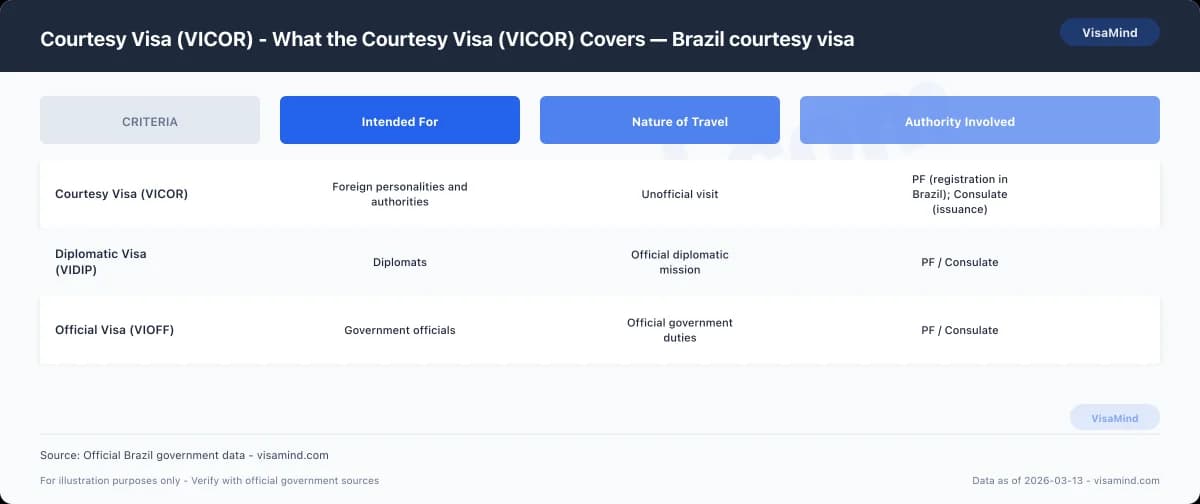
Here’s a table showing how VICOR compares to related visa types:
| Visa Type | Intended For | Nature of Travel | Authority Involved |
|---|---|---|---|
| Courtesy Visa (VICOR) | Foreign personalities and authorities | Unofficial visit | PF (registration in Brazil); Consulate (issuance) |
| Diplomatic Visa (VIDIP) | Diplomats | Official diplomatic mission | PF / Consulate |
| Official Visa (VIOFF) | Government officials | Official government duties | PF / Consulate |
If your visit is for formal government representation, review the Diplomatic Visa (VIDIP) or Official Visa (VIOFF) instead.
The Federal Police (PF) oversees immigration records inside Brazil.
Official form and authority
The Courtesy Visa is documented with the Polícia Federal form titled “Courtesy Visa (VICOR)”. This is an official immigration classification in Brazil’s visa system.
You’ll deal with two authorities:
-
Brazilian consulates abroad – issue the visa in your passport.
-
Federal Police (PF) – manage immigration control and registration after you enter Brazil.
Here’s a quick breakdown:
| Stage | Responsible Authority | What They Handle |
|---|---|---|
| Visa issuance abroad | Brazilian consulate | Visa approval and placement in passport |
| Immigration control in Brazil | Federal Police (PF) | Registration and status administration |
VICOR is its own classification, separate from Diplomatic Visa (VIDIP), Official Visa (VIOFF), or Form RER-Visa. Make sure the visa type matches your visit’s purpose before applying.
The Application Channel
#Use the correct channel based on where you’re applying and your visa category. Inside Brazil, applications go through the Federal Police (Polícia Federal – PF). Brazilian consulates issue visas abroad.
Accuracy is important, especially if your status relates to a Diplomatic Visa (VIDIP), Official Visa (VIOFF), or an Form RER-Visa.
Where to get the form
Always use the latest version.
Don’t use third-party websites or old forms. The PF updates forms and instructions without warning.
Your filing location determines which authority processes your case:
| Situation | Authority Responsible | Where to Obtain Form |
|---|---|---|
| Filing inside Brazil | Federal Police (PF) | Official PF website |
| Applying from abroad | Brazilian Consulate | Consulate handling your jurisdiction |
If your status involves VIDIP (Diplomatic Visa) or VIOFF (Official Visa), confirm whether processing is through a consulate or requires PF registration after arrival. RER-Visa holders must follow PF’s instructions for their category.
Review the eligibility instructions for your exact visa type before downloading the form.
Preparing the application
Complete every required section before submitting. Incomplete applications can delay processing or get rejected.
Follow these steps:
-
Read the eligibility instructions for your visa category.
-
Fill in all mandatory fields.
-
Double-check your information.
-
Sign the form as required.
-
Gather all supporting evidence listed in the instructions.
Your eligibility category decides which documents you need. This is especially important for:
- Diplomatic Visa (VIDIP)
- Official Visa (VIOFF)
- RER-Visa classifications
Don’t assume document requirements are the same across visa types. The PF provides category-specific instructions, and you have to follow them.
If extra documentation is requested, include it when filing. Submitting only part of the evidence can slow things down.
For any fees in BRL (R$), check the official PF source for the current amount and payment method.
How to submit
Submit your signed application as instructed by your filing authority.
If you’re filing inside Brazil, you go through the Federal Police (PF). The PF manages immigration registration, including cases linked to existing visa statuses.
If you’re applying abroad, submit your application to the relevant Brazilian consulate, which issues the visa.
Before you submit, check that:
- The form version is current
- All sections are filled out
- The form is signed
- All required evidence is attached
Follow the submission steps in the order given in the official instructions. If your case is linked to VIDIP, VIOFF, or RER-Visa, check if extra steps apply.
Check with the Federal Police or Brazilian consulate for their current submission procedures, appointment requirements, and any updates.
Conditions and Restrictions
#A Brazil courtesy visa is discretionary. You must meet your category’s criteria, and authorities can refuse your application even if you submit everything required.
Approval is not guaranteed
Submitting a VICOR (courtesy visa) application doesn’t guarantee approval. Brazilian consulates look at each case individually before issuing the visa.
The decision sits with the authority handling your case. Visa issuance is done through a Brazilian consulate abroad, while immigration control in Brazil is handled by the Federal Police (Polícia Federal – PF).
Approval depends on whether your situation fits the specific courtesy category. Filing documents alone doesn’t create a right to the visa.
| Visa Type | Is Approval Automatic? | Issuing Authority |
|---|---|---|
| Courtesy Visa (VICOR) | No | Brazilian consulate abroad |
| Diplomatic Visa (VIDIP) | No | Brazilian consulate abroad |
| Official Visa (VIOFF) | No | Brazilian consulate abroad |
| Form RER-Visa | No | Brazilian consulate abroad |
Wait for a formal decision before making travel plans. Prior travel to Brazil or past visa history doesn’t guarantee approval.
Other limitations
A courtesy visa doesn’t put you in the same legal category as a Diplomatic Visa (VIDIP) or an Official Visa (VIOFF) holder. Each visa type has its own scope and purpose.
You’re only allowed to do activities consistent with your visa. If you do something outside what’s permitted, you risk refusal, cancellation, or future immigration issues.
Inside Brazil, the Federal Police (PF) oversees immigration registration and compliance. You must follow PF requirements during your stay.
If your circumstances change, don’t expect the courtesy visa to convert automatically into another status, like an RER-Visa. You need proper authorization through the correct legal process before changing your immigration category.
Eligibility and Protocol
#Brazil grants a courtesy visa to certain relatives and individuals who don’t qualify for dependent status under diplomatic or official visas. You’ll need to confirm both your relationship and the principal visa holder’s status before applying.
Eligible categories
You may qualify for a courtesy visa if you’re a direct family member of someone holding a Diplomatic Visa (VIDIP) or an Official Visa (VIOFF) and you don’t meet the criteria for a dependent visa under those categories.
Eligible applicants often include:
- Direct relatives not covered by VIDIP or VIOFF dependent rules
- Individuals linked to diplomatic or official missions in special circumstances
Brazilian consulates issue the courtesy visa abroad. After arrival, you must register with the Federal Police (Polícia Federal – PF) if registration is required for your stay.
The courtesy visa doesn’t convert into a Diplomatic Visa (VIDIP) or Official Visa (VIOFF). It’s used only when dependent status isn’t available under those visa types.
| Principal Status | Dependent Eligible Under VIDIP/VIOFF? | Courtesy Visa Option |
|---|---|---|
| VIDIP holder | Yes | No |
| VIDIP holder | No | Yes |
| VIOFF holder | Yes | No |
| VIOFF holder | No | Yes |
If you fall outside standard diplomatic or official dependent rules, the courtesy visa might be the right legal basis for your stay.
Family and special circumstances
You’ll need to show a clear family link to the main VIDIP or VIOFF holder. Direct family relationships carry the most weight.
Typical documents include:
- Proof of the principal’s valid VIDIP or VIOFF
- Civil documents showing your relationship
- Evidence explaining why you don’t qualify as a dependent under VIDIP or VIOFF
In some cases, Brazil may look at special circumstances tied to diplomatic or official assignments. Authorities review these individually.
The consulate checks your eligibility before issuing the visa. Once in Brazil, you must comply with PF registration rules that fit your visa category.
If your circumstances change later, like becoming eligible for a different status (for example, through a residence-based pathway such as an Form RER-Visa), you’ll need to follow the proper process with the Brazilian authorities.
What are the fees and processing times?
#There’s no government application fee for a Brazil Courtesy Visa as of March 2026. Processing is usually completed within 10 business days, but the exact timing depends on where you apply.
Fee details
As of March 2026, the application fee is R$ 0 for a Brazil Courtesy Visa.
Brazilian consulates issue the visa abroad and don’t charge a government filing fee for this category right now. If you need registration after arrival, the Federal Police (Polícia Federal – PF) handles it inside Brazil.
Key points:
- The R$ 0 amount applies to the Courtesy Visa category.
- Other categories, like Diplomatic Visa (VIDIP) or Official Visa (VIOFF), have their own rules.
- If you later change status in Brazil (for example, through an Form RER-Visa process), separate rules might apply.
Check with the Brazilian consulate where you file, as consular practices can shift.
Typical processing time
Processing usually takes up to 10 business days.
This timeline applies to standard applications submitted through a Brazilian consulate. Business days don’t include weekends or official holidays.
You should:
-
Submit a complete application to avoid delays.
-
Watch for communication from the consulate for extra document requests.
-
Allow extra time if you have urgent travel plans.
If you’re already in Brazil and dealing with post‑entry requirements, the PF manages immigration registration. The visa itself is issued abroad by a consulate.
For Diplomatic Visa (VIDIP) and Official Visa (VIOFF) applicants, internal government coordination can affect timelines. Confirm expectations with the issuing authority.
Fee table headings
Here’s a quick table for cost and timing:
| Item | Amount (BRL) | Processing Time | Authority Responsible |
|---|---|---|---|
| Courtesy Visa – Application | R$ 0 | Up to 10 business days | Brazilian Consulate |
| Immigration Registration (if required) | Check with PF | Varies by appointment availability | Federal Police (PF) |
If you apply under a different category—like VIDIP, VIOFF, or a residence-based process such as RER-Visa—confirm the fees and timelines with the right Brazilian authority before submitting your documents.
Fees
#| Component | Amount |
|---|---|
| Application feeNo charge for courtesy visas for all countries on the consular fee schedule | $0 |
Fees change; always verify on PF.