
Overview — Brazil official visa
#Brazil issues an official visa for individuals traveling on government-related duties. You’ll need to use the correct visa category and complete the required Federal Police documentation to regularize your status in Brazil.
Purpose
The Brazil official visa applies to travelers entering the country for official government functions. Use this category if your trip is directly tied to public service or institutional representation—not tourism or private business.
This visa category sits alongside other official classifications:
- Diplomatic Visa (VIDIP)
- Courtesy Visa (VICOR)
- Form RER-Visa
- Official Visa (VIOFF)
Each reflects a distinct legal status. Your role and purpose must match the specific visa classification assigned by the Brazilian consulate.
Brazilian consulates issue the visa abroad. Once in Brazil, the Federal Police (Polícia Federal – PF) manages your immigration registration and compliance.
Form identity
The official visa process involves a Federal Police form known as Official Visa (VIOFF).
The VIOFF form is an official PF document used for this visa category. Complete it accurately to support your immigration record inside Brazil.
| Item | Description |
|---|---|
| Visa name | Official Visa |
| Form title | Official Visa (VIOFF) |
| Responsible authority (in Brazil) | Federal Police (Polícia Federal – PF) |
| Visa issuance authority (abroad) | Brazilian consulates |
Procedural instructions may change. Confirm current requirements directly with the Federal Police or the Brazilian consulate handling your case.
Quick context
You’ll encounter the Official Visa (VIOFF) within Brazil’s structured visa system for government-related travel. It’s distinct from diplomatic and courtesy classifications, though all fall under official-state travel categories.
In practical terms:
-
A Brazilian consulate issues your official visa before travel.
-
You enter Brazil under that visa classification.
-
The Federal Police handles your immigration registration and documentation inside Brazil.
You’re expected to follow PF procedures after arrival if registration or documentation updates are required. The Federal Police and the issuing Brazilian consulate provide current procedural guidance.
The Application Channel
#Applying for an Official Visa (VIOFF) involves an electronic form, a formal diplomatic note, and sometimes filing with the Federal Police (Polícia Federal – PF). Every step requires specific documents and coordination with your mission or organization.
How to start the application
Begin by completing the electronic visa application form for the Official Visa (VIOFF). You’ll need to upload:
- A recent photo of the visa holder
- The holder’s signature
Always use the latest version.
Before starting, review the instructions for your eligibility category. Official Visa (VIOFF), Diplomatic Visa (VIDIP), and Courtesy Visa (VICOR) each have different channels. Confirm that VIOFF is correct for you.
After completing all required fields, submit the form and print the Recibo de Entrega de Requerimento (Form RER-Visa). Sign this receipt. Missing forms, signatures, or uploads will delay processing.
Keep copies of everything you submit. Your passport must remain valid for the application.
| Required at Initial Filing | Format |
|---|---|
| Electronic visa form | Online submission |
| Applicant photo | Digital upload |
| Applicant signature | Digital upload |
| RER-Visa receipt | Printed and signed |
| Valid passport | Physical document |
Nota Verbal and embassy/chancellery role
You can’t apply for an Official Visa (VIOFF) without a Nota Verbal.
The Nota Verbal must come from one of the following:
- The local Chancellery
- A foreign Diplomatic Mission
- An International Organization
This document formally supports your request and confirms your official status. A copy of the Nota Verbal submitted to the appropriate diplomatic authority must go with your application.
Your embassy or organization coordinates the diplomatic communication. You don’t issue the Nota Verbal yourself. Details in your electronic application must match those in the Nota Verbal, including your name and official function.
If you qualify for a Diplomatic Visa (VIDIP) or Courtesy Visa (VICOR) instead, your mission will indicate the correct category in its diplomatic communication. The visa category must align with the purpose of your stay.
Filing with Polícia Federal
The Polícia Federal (PF) handles immigration procedures inside Brazil.
When filing with PF, present:
- Your valid passport
- The signed RER-Visa receipt
- A copy of the Nota Verbal
- Any completed electronic application confirmation
Use the official PF instructions for the current VIOFF process. Requirements may vary depending on your status and location.
PF reviews your submission to confirm the diplomatic endorsement and your documentation meet the Official Visa criteria. If documents are missing or inconsistent, PF will not complete the process.
Procedures can change. Verify updates directly with the Polícia Federal.
Accreditation and Arrival
#After entering Brazil with a Diplomatic Visa (VIDIP), Courtesy Visa (VICOR), or another official category, you must complete local registration and accreditation. The Federal Police (Polícia Federal – PF) handles immigration registration, while your host authority manages recognition of your official status.
Arrival registration
Register with the Federal Police (PF) if your visa category requires immigration control after entry. The PF is responsible for immigration registration inside Brazil.
Registration generally involves:
- Presenting your passport with the VIDIP, VICOR, or other official visa
- Providing your entry record
- Submitting any immigration forms required by the PF
- Paying applicable fees in BRL (R$), if required
If you don’t qualify for a diplomatic, official, or courtesy visa, you must obtain the appropriate residency authorization through the PF.
| Situation | Responsible Authority | Action Required |
|---|---|---|
| Diplomatic, official, or courtesy visa holder | Federal Police (PF) | Immigration registration, if applicable |
| Not eligible for VIDIP/VICOR | Federal Police (PF) | Apply for proper residency authorization |
Check PF’s official guidance for current procedures, required documents, and fees in R$.
Accreditation with the host ministry
Visa issuance alone doesn’t confirm your official standing in Brazil. You also need accreditation with the relevant Brazilian host ministry or government body connected to your mission.
Accreditation formally recognizes:
- Your role and function
- The duration of your assignment
- Your eligibility for privileges linked to your status
Holders of a Diplomatic Visa (VIDIP) or Courtesy Visa (VICOR) usually require this step to activate their official capacity in Brazil.
Your sponsoring institution or foreign government typically coordinates this process. Follow their instructions and submit documents as requested to avoid delays.
If your role changes, notify the appropriate authority to update your accredited status.
ID and residence procedures
After registration and accreditation, you may need to obtain Brazilian identification reflecting your immigration category. The Federal Police (PF) manages immigration records for your legal stay.
Your obligations depend on your visa type:
- VIDIP or VICOR holders: Follow the identification process linked to your accredited status.
- Other foreign nationals not eligible for diplomatic or courtesy status: Apply for the appropriate residency authorization through the PF.
Failure to secure the correct status can affect your lawful stay.
Confirm documentation standards and fees (in R$) directly with the Federal Police.
Conditions and Restrictions
#Your Brazil official visa depends on government approval, defined scope of activity, and compliance with immigration rules. Know who decides your case, what your visa allows, and what obligations apply during your stay.
Approval and outcomes
Submitting a visa application doesn’t guarantee approval. Brazilian consulates assess applications abroad, and the Federal Police (Polícia Federal – PF) oversees immigration control and registration inside Brazil.
The decision depends on whether your request fits the specific category, such as:
- Diplomatic Visa (VIDIP)
- Courtesy Visa (VICOR)
- Form RER-Visa (when applicable to official functions)
Each serves a defined official purpose. Authorities may approve, deny, or limit the visa based on your stated role and supporting documentation.
If approved, your visa reflects the exact classification granted. You can’t assume that applying under one category will result in issuance under another.
If denied, follow the instructions provided by the issuing consulate. For procedural details, consult the relevant Brazilian consulate or the Ministry of Foreign Affairs.
| Authority | Role in the Process |
|---|---|
| Brazilian Consulate | Issues official visas abroad |
| Federal Police (PF) | Handles immigration control and registration inside Brazil |
Scope and limits
Your official visa limits you to the purpose stated in your application. You may only carry out activities directly connected to your diplomatic, courtesy, or authorized official function.
For example:
- VIDIP applies to individuals recognized for diplomatic functions.
- VICOR applies to specific courtesy-based official roles.
- RER-Visa applies only within the scope defined for that status.
You can’t use an official visa for unrelated employment, private business, or activities outside your authorized mission.
The visa’s validity, permitted stay, and conditions appear in your visa documentation. If you need details on duration or permitted activities, confirm them with the issuing Brazilian consulate before travel.
Any activity beyond your approved role can result in immigration consequences handled by the PF.
Responsibilities
You must comply with all Brazilian immigration rules during your stay. The Federal Police manages immigration registration and oversight once you enter Brazil.
Your core responsibilities include:
- Entering Brazil under the correct visa classification
- Respecting the exact purpose of your visa
- Following any registration or reporting requirements imposed by the PF
If your official role changes, you cannot automatically continue under the same visa. Seek guidance from the appropriate Brazilian authority before altering your activities.
Failure to comply with visa conditions may affect your current status and any future applications. Always verify procedural requirements directly with the Federal Police or the issuing Brazilian consulate before taking action.
Eligibility and Protocol — VIOFF visa
#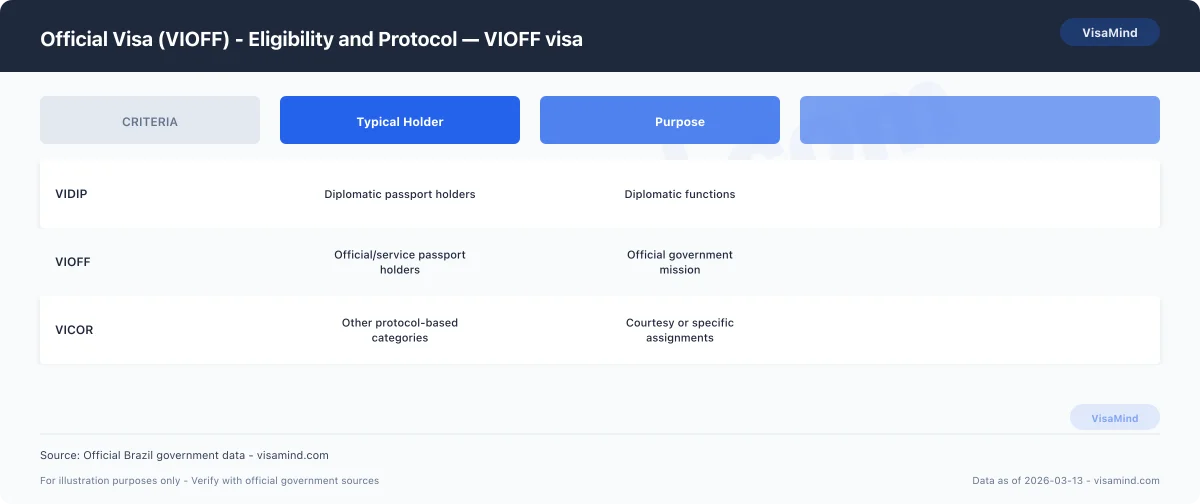
The Official Visa (VIOFF) applies to foreign government authorities and staff traveling to Brazil on an official mission. It also covers eligible dependents and follows specific protocol rules distinct from diplomatic and courtesy categories.
Who qualifies
You qualify for a VIOFF (Official Visa) if you travel to Brazil on an official mission representing:
- A foreign government
- An international organization recognized by the Brazilian government
Your travel may be temporary or permanent, as long as it relates directly to your official duties.
This visa generally applies to holders of official or service passports traveling on government business. It doesn’t replace the Diplomatic Visa (VIDIP), which applies to diplomats, or the Courtesy Visa (VICOR), which covers other specific categories defined by protocol.
The Brazilian consulate abroad issues the visa. After arrival, if registration is required for your length of stay, you must complete immigration registration with the Federal Police (Polícia Federal – PF) inside Brazil.
| Visa Type | Typical Holder | Purpose |
|---|---|---|
| VIDIP | Diplomatic passport holders | Diplomatic functions |
| VIOFF | Official/service passport holders | Official government mission |
| VICOR | Other protocol-based categories | Courtesy or specific assignments |
If your activity doesn’t fall under official state representation, you may need a different category, such as an Form RER-Visa, depending on your role.
Dependents
Your dependents may receive a VIOFF when they accompany you during your official mission.
Eligible dependents generally include:
- Your spouse
- Your dependent children
Their status depends on your official assignment. If your mission ends, their status typically ends as well.
Dependents receive the visa through the Brazilian consulate abroad, linked to your official status. If local registration applies due to the duration of stay, they must also register with the Federal Police (PF) after arrival.
Dependents cannot independently convert this status into another visa category unless Brazilian authorities authorize a change. Any modification requires formal assessment under Brazilian immigration rules.
Passport context
Your passport type determines whether VIOFF is appropriate.
VIOFF is generally issued to holders of:
- Official passports
- Service passports
If you hold a diplomatic passport, authorities may instead direct you to apply for a Diplomatic Visa (VIDIP), depending on your function.
If you do not hold an official or diplomatic passport, you typically do not qualify for VIOFF.
Brazilian consulates assess the nature of your mission before issuing the visa. The classification reflects your formal role, not personal preference.
Once in Brazil, your immigration record and, where required, your registration with the Federal Police (PF) must match the visa category issued.
Any discrepancy between your passport type and your declared mission can delay processing or require reclassification.
When to Get Help
#You face fewer problems when you act early during status changes, dependent applications, or mission completion.
Delays with the Federal Police (PF) or incorrect visa classification can disrupt your stay and official functions.
Status transitions and alternatives
Seek help when your activities no longer match your current visa, such as a Diplomatic Visa (VIDIP) or Courtesy Visa (VICOR).
You cannot continue using a diplomatic or courtesy classification if you no longer qualify under that status.
If you are not eligible for a diplomatic, official, or courtesy visa, you must pursue the appropriate residency authorization with the Federal Police (PF) in Brazil.
Brazilian consulates issue visas abroad, but PF manages immigration registration and status matters inside Brazil.
You should request guidance when:
- Your official role changes during your assignment
- Your accreditation ends before your planned departure
- You intend to remain in Brazil under a different legal basis
- You must transition to an Form RER-Visa framework
| Situation | Authority Involved | Action Needed |
|---|---|---|
| Visa issued abroad | Brazilian consulate | Apply for correct visa classification |
| Status change inside Brazil | Federal Police (PF) | Request proper residency authorization |
| Loss of diplomatic eligibility | Federal Police (PF) | Regularize stay under appropriate category |
Do not assume your existing visa automatically converts to another category.
You must regularize your status before continuing your stay.
Family dependents and end-of-mission steps
You should obtain help when your dependents’ status depends on your diplomatic or courtesy classification.
A spouse or child under a VIDIP or VICOR typically holds status tied to your assignment.
If your mission ends, your dependents’ authorization may also end.
You must coordinate departure or request appropriate residency authorization with PF if any family member intends to remain.
Act promptly when:
- Your assignment concludes earlier than expected
- A dependent plans to study or work independently
- Your family’s travel dates differ from yours
| Event | Impact on Dependents | Required Step |
|---|---|---|
| End of official mission | Status may expire | Arrange departure or apply with PF |
| Change in principal’s visa | Dependent status affected | Review eligibility immediately |
| Dependent stays longer | Separate authorization required | Seek PF guidance |
Do not wait until your diplomatic function formally closes.
Begin reviewing your family’s options as soon as your end date becomes clear.
Complex diplomatic cases
You need professional assistance when your situation does not fit clearly within VIDIP, VICOR, or official visa categories.
Classification errors can affect registration and future eligibility.
Complex cases include:
- Mixed roles combining official and non-official duties
- Overlapping accreditations
- Disputes about eligibility for diplomatic or courtesy status
- Questions about whether an RER-Visa applies
| Issue | Risk | Where to Address |
|---|---|---|
| Incorrect visa category | Irregular stay | Brazilian consulate or PF |
| Failure to regularize status | Administrative penalties | Federal Police (PF) |
| Unclear diplomatic eligibility | Visa refusal | Brazilian consulate |
Resolve classification doubts before entering Brazil or before your role changes inside the country.
Early legal review prevents gaps in lawful status and avoids unnecessary complications with PF.
What does it cost?
#Brazil currently charges no government application fee for official visas.
You still need to confirm procedures with the correct authority, depending on where you apply and whether you must register with the Federal Police (Polícia Federal – PF) after arrival.
Application fees
As of March 2026, the government fee for a Brazil official visa is R$ 0.
This applies to categories such as:
- Diplomatic Visa (VIDIP)
- Courtesy Visa (VICOR)
- Form RER-Visa
- Other official mission visas issued for government purposes
| Visa Category | Government Application Fee (BRL) | Where Issued |
|---|---|---|
| Diplomatic Visa (VIDIP) | R$ 0 | Brazilian consulate abroad |
| Courtesy Visa (VICOR) | R$ 0 | Brazilian consulate abroad |
| RER-Visa | R$ 0 | Brazilian consulate abroad |
Brazilian consulates issue the visa sticker or authorization abroad.
If you must complete post‑arrival registration, the Federal Police (PF) handles that process inside Brazil.
Fee notes and dates
The R$ 0 amount reflects the current official government charge as of March 2026.
Fee policies can change without notice.
Before you apply, you should:
-
Confirm the current fee with the Brazilian consulate where you will file.
-
Verify whether PF registration is required after entry.
-
Check if your sponsoring government entity must submit any supporting documentation.
Although the visa itself carries no government fee, your consulate may provide guidance on administrative steps, appointment procedures, or documentation handling.
For the most accurate and current fee information, consult the Brazilian consulate responsible for your jurisdiction and, if applicable, the Federal Police for in‑country registration requirements.
How long does it take?
#Most Brazil official visas process in up to 10 business days, but the authority handling your case and your location affect the timeline.
You must also account for registration steps with the Federal Police (Polícia Federal – PF) after arrival.
Typical processing time
Brazilian consulates generally issue an official visa within up to 10 business days from the date they accept your complete application.
This timeframe applies to official categories such as:
- Diplomatic Visa (VIDIP)
- Courtesy Visa (VICOR)
- Form RER-Visa (Residence permit for official assignments)
The clock starts only after you submit all required documents and the consulate confirms your file is complete.
Missing documents or corrections will pause processing.
| Stage | Authority | Standard Timeframe |
|---|---|---|
| Visa issuance abroad | Brazilian consulate | Up to 10 business days |
| Registration after entry | Federal Police (PF) | Separate in-country step |
If you are already in Brazil and applying for a status-related procedure, the PF manages that stage.
The 10‑business‑day timeframe refers to visa issuance abroad, not post-entry registration.
Processing time context
The processing time depends on where you apply and whether your documents meet official requirements at submission.
Consulates issue visas abroad.
The Federal Police (PF) handles immigration registration inside Brazil after you enter with your official visa.
These are separate processes with separate timelines.
You should also consider:
- Local consular workload
- Public holidays in Brazil or your country of application
- Completeness and accuracy of your diplomatic or official documentation
For example, a Diplomatic Visa (VIDIP) or Courtesy Visa (VICOR) supported by formal government communication typically moves within the standard timeframe.
However, incomplete diplomatic notes or missing appointment confirmations will delay issuance.
If timing is critical, confirm current processing estimates directly with the Brazilian consulate where you will apply.
Fees
#| Component | Amount |
|---|---|
| Application feeNo charge for official visas for all countries on the consular fee schedule | $0 |
Fees change; always verify on PF.