
Student Visa Options at a Glance
#The table below summarizes the main visa options for this goal, including who qualifies, the key filing requirement, and reported processing times.
| Visa Option | Who It’s For | Key Filing | Processing Time |
|---|---|---|---|
| Study Permit | Study Permit is a study-related pathway administered by IRCC for eligible international students or graduates. It can support later transitions to longer-term work or residence options. | Form IMM-1294 | 2-4 months (verify current estimate in IRCC processing times). |
Use the linked visa pages for full eligibility details, required documents, and step-by-step instructions.
Getting Accepted First
#Before applying for a Study Permit, you have to secure admission to a Designated Learning Institution (DLI). IRCC will refuse your application if you can’t prove you’re enrolled at a DLI.
Check that your school is on the official DLI list. Complete the school’s admission process and get a formal acceptance letter.
Once you’re admitted, gather documents for both your admission and immigration application:
- Letter of acceptance from a DLI
- Provincial Attestation Letter (PAL) or Territorial Attestation Letter (TAL), if required
- Valid passport and travel documents
- Government-issued identification
- Medical exam confirmation, if requested
- Details about your family members
- Updated contact information
Your acceptance letter doesn’t guarantee approval. IRCC reviews your background carefully.
You must disclose:
- Previous residential addresses
- Any criminal history
- Any past security or admissibility issues
If you don’t declare accurate information, you risk refusal. Border admissibility is enforced by the Canada Border Services Agency (CBSA), but IRCC assesses your application before you travel.
Follow this sequence to protect your application:
1. Secure Admission from a DLI.
Get a formal acceptance letter confirming your enrollment.
2. Obtain a PAL or TAL if required.
Some applicants need this provincial or territorial confirmation with their Study Permit application.
3. Prepare Identity and Travel Documents.
Make sure your passport is valid and matches your application details.
4. Complete Medical Requirements.
If instructed, do the required medical exam and keep proof of completion.
5. Disclose Background Information Fully.
Provide accurate residence history and declare any criminal or security concerns.
6. Update Personal Details.
Confirm your current address, phone number, and family information before submitting to IRCC.
Incomplete documentation is a common reason for delays. Missing proof of DLI enrollment can result in refusal.
Treat your school acceptance as the foundation of your immigration case. If your documentation is clear, complete, and truthful, IRCC can assess your Study Permit application without unnecessary complications.
Costs and Fees
#Official government fees for the main visa options associated with this goal are listed below. Fees may change — verify the current schedule through the linked visa pages.
| Visa / Route | Fee | Amount |
|---|---|---|
| Study Permit | Application fee | C$150 |
| Study Permit | Biometrics | C$85 |
How to Apply for a Student Visa
#You must apply for a Study Permit through IRCC before you travel to Canada. In most cases, you’ll submit your application online.
IRCC processes your application once it receives a complete file. Processing time starts the day IRCC receives your complete application and ends when a decision is made on your permanent residence application.
Follow these steps carefully:
1. Create or sign in to your online account.
Use your IRCC online account to start a new Study Permit application or continue a previous one. Your account stores your application history and messages from IRCC.
2. Complete the application form.
Enter accurate information about your studies and personal details. Don’t leave required fields blank.
3. Upload required documents.
Include your letter of acceptance from a Canadian institution. Failing to submit the letter of acceptance can delay or prevent processing.
4. Pay the application fees.
Use a valid credit or debit card through your online account. Check the IRCC website for current fees in CAD (CA$) before you submit.
5. Submit your application.
Apply online whether you are inside or outside Canada. You may submit a paper application only if you have a disability or cannot apply online due to technical issues.
Keep your documents organized before you start the online process. This reduces errors and prevents delays.
Common documents to prepare:
- Letter of acceptance from a Canadian institution
- Valid credit or debit card for fee payment
- Access to your IRCC online account
IRCC won’t begin processing until your application is complete. Missing documents can result in delays.
If you’re new to Canada, you must also apply separately for the GST/HST credit, even if you haven’t filed a Canadian tax return. If you have children, use Form RC66 to apply for the Canada Child Benefit, which also helps determine your eligibility for the GST/HST credit.
Always review instructions in your IRCC account before you submit. Small mistakes can slow down a decision.
Can You Work on a Student Visa?
#You must be enrolled at a Designated Learning Institution (DLI) to study in Canada. Whether you can work depends on the conditions attached to your Study Permit and whether you need a separate work permit from IRCC.
IRCC handles work permit applications and extensions. You must meet eligibility requirements, and IRCC may refuse your application if you or a family member doesn’t qualify.
Work Permit Fees
If IRCC requires you to apply for a work permit, you must pay the applicable fee.
| Application Type | Fee (CAD) |
|---|---|
| Work permit (including extensions) – per person | CA$155 |
If your family members apply at the same time and place, and your children qualify as dependants, your family may be eligible to pay a maximum total fee of CA$500.
All required exams for each person must be valid at the same time. If one person’s documents expire, IRCC may delay processing.
Processing Times and Delays
IRCC publishes estimated processing times. These estimates reflect how long IRCC expects it will take to process an application received today or during the month and year you applied.
IRCC aims to process most complete applications within its posted timeframes. Non‑routine applications may take longer.
The processing times can change if application volumes increase. In some situations, IRCC cannot provide accurate timelines.
You should:
- Keep your contact information up to date
- Submit a complete application
- Ensure all required exams and documents remain valid
Outdated contact details can delay your application. Missing documents can also slow a decision.
Before you apply to work, review the conditions listed on your Study Permit and confirm whether IRCC requires a separate work permit for your situation.
Post-Study Options
#After you finish your program, check your status under your Study Permit and confirm what you’re authorized to do next. IRCC manages permit applications and extensions.
You can’t assume you may remain in Canada without valid authorization. You must apply for the appropriate permit and submit a complete application with all required documents.
Applying for a Work Permit
If you plan to work after graduation, you’ll need to apply to IRCC for a work permit and meet all eligibility requirements. You must:
- Obey Canadian law
- Have no criminal record
- Provide a police certificate if required
- Submit personal and biographical information to confirm your identity and background
- Include all required supporting documents
Incomplete applications lead to delays or refusal.
If you apply as part of a qualifying group, special fee rules may apply. For example, a maximum group fee may apply to a group of three or more performing artists and their staff. Check IRCC guidance to confirm whether this applies to you.
At the Port of Entry
When you arrive in Canada, state your purpose clearly. If you intend to study or change your status, inform the officer at the port of entry.
Failing to disclose your intention to study or your plans can create serious immigration issues. Border admissibility decisions are handled by the Canada Border Services Agency, not IRCC.
Tax and Benefit Responsibilities
Once you begin working or earning income, you must understand your tax obligations. The Canada Revenue Agency (CRA) collects taxes and administers government payments.
As a newcomer, you may qualify for certain benefits, credits, or programs. You must file income tax returns if required and provide accurate information.
The CRA defines who qualifies as a newcomer for tax purposes. Review official CRA guidance so you understand:
- Whether you must file a tax return
- How to report income
- Whether you qualify for benefit or credit payments
Maintaining Compliance
You must continue to follow Canadian laws and maintain valid status at all times. Keep copies of all applications and approvals from IRCC.
If you plan to extend your stay or change your status, gather your documents early and submit a complete application. Missing documents or incorrect information can delay your ability to work or remain in Canada legally.
From Student to PR
#Moving from a Study Permit to permanent residence requires careful planning and strict compliance with IRCC requirements. Your transition starts with maintaining valid status and submitting complete, accurate applications at every stage.
IRCC reviews your history in Canada closely. Incomplete records or missing documents can delay or undermine a future permanent residence application.
You must keep copies of all documents you submitted with your study permit, including:
- Letter of acceptance from your designated learning institution (DLI)
- Proof of identity and residence documents, if requested
- Any criminal record certificate, where required
- Your completed study permit application and supporting forms
Accurate documentation matters. If IRCC requests additional residence or background documents, you must provide them exactly as instructed.
When preparing for the next step in your status, follow a structured approach:
1. Confirm your eligibility to apply from within Canada.
You cannot submit an in‑Canada application if you do not meet the eligibility rules. Filing from inside Canada when you are not eligible can lead to refusal.
2. Review your prior submissions.
Ensure the information in your new application matches what you previously provided to IRCC. Inconsistencies can trigger further review.
3. Gather required background documents early.
If a criminal record certificate applies to your situation, obtain it before you apply to avoid delays.
4. Submit a complete application package.
IRCC expects all required forms and supporting evidence at the time of filing.
IRCC handles permit and permanent residence applications. You’re responsible for ensuring every document is accurate, complete, and consistent with your immigration history.
Do not assume you can change your status at any time from inside Canada. Eligibility rules control where and how you apply. If you’re unsure about your filing location or documentation, review official guidance from IRCC before you submit anything.
Your path from student to permanent resident depends on compliance, documentation, and timing. Keep organized records and follow IRCC instructions exactly.
Student Visa Pitfalls
#You must present a clear and consistent story to IRCC. If your current immigration status doesn’t match your stated educational plans, IRCC may question your credibility.
Your application should explain why you want to study and how that plan fits your background. Vague or conflicting statements about your educational intent create avoidable risk.
Inconsistent Immigration Status
Your current status in Canada must align with your request for a Study Permit. If you previously held another status, explain any change in plans directly and clearly.
You can’t expect IRCC to fill in gaps. You must connect the facts yourself.
If your record shows expired status, a departure from Canada, or other changes, address them in your application. Silence often leads to refusal.
Weak or Missing Supporting Documents
IRCC reviews the documents uploaded in the Client Information field carefully. Incomplete files are a common problem.
Use this checklist before you submit:
- Copies of original documents
- Clear, legible scans
- An acceptable translation for any document not in English or French
- Consistent personal details across all records
If you submit a document in another language without a proper translation, IRCC may refuse your Study Permit. Poor-quality scans can create the same result.
Every document should support your stated educational intent. If your paperwork tells a different story than your written explanation, IRCC will rely on the evidence.
Failing to Update Government Records
Your obligations don’t end after you receive a Study Permit.
If you leave Canada or your permit expires, you must update the Canada Revenue Agency (CRA) when your personal circumstances change. Failing to report these changes can create complications in future immigration applications.
Keep your records consistent across agencies. If CRA information conflicts with your immigration history, IRCC may scrutinize your file more closely.
Document Control Table
| Risk Area | What You Must Do |
|---|---|
| Immigration status | Ensure it matches your study plans |
| Educational intent | Provide a direct and consistent explanation |
| Foreign-language documents | Include acceptable translations |
| Personal changes | Update CRA if you leave Canada or your permit expires |
Accuracy, consistency, and complete documentation protect your application. Small inconsistencies can lead to major delays or refusal.
Cost of Studying
#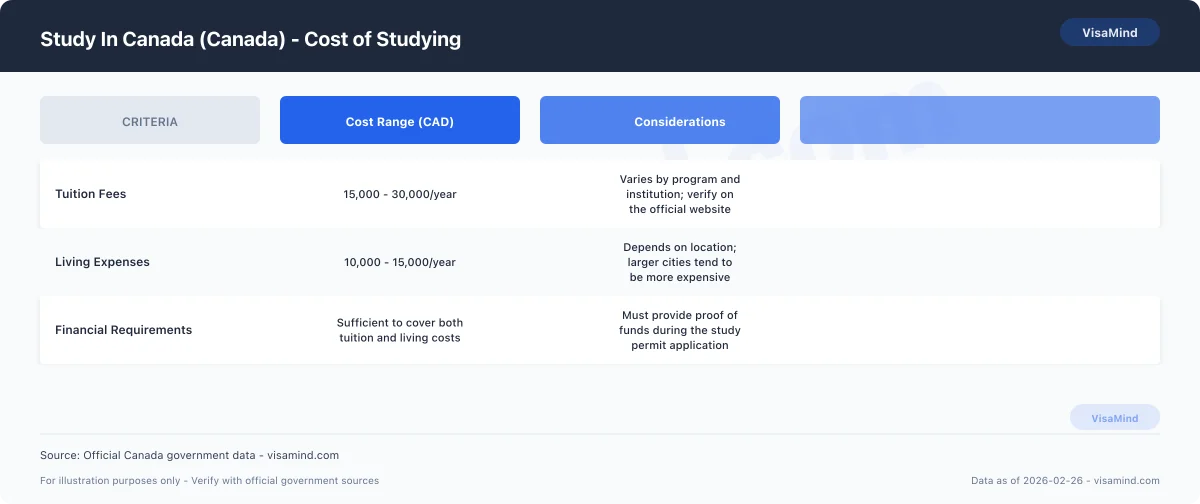
Before applying for a Study Permit, you’ll need to budget for both tuition and living expenses. Immigration, Refugees and Citizenship Canada (IRCC) expects proof that you can support yourself during your stay.
IRCC might ask for financial documents showing you can pay tuition and daily costs. If you can’t demonstrate enough funds, your Study Permit application could be refused.
Your total costs usually include:
- Tuition fees charged by your school
- Housing and food expenses
- Health-related requirements, including a medical certificate if IRCC requires one
- Application-related costs, such as biometrics if you are between 14 and 79 years old
- Document preparation and submission expenses
IRCC doesn’t publish all costs together. Confirm current fees and payment instructions directly with IRCC.
When you apply for a Study Permit, complete every section accurately and submit it online or by mail. Incomplete forms can cause processing delays and increase your expenses.
You’ll also need to gather supporting documents, which may involve extra costs. These might include:
- Proof of acceptance from your Canadian institution
- Evidence of financial support
- Confirmation that you meet eligibility requirements
- A valid medical certificate, if required
If you’re a new resident with children under 19, you may need to submit Form RC151 with proof of birth for each child. Mailing documents and getting official records can add to your expenses.
Biometrics is another possible cost. If you’re in the required age range, you must complete biometrics as part of your application.
Plan your budget before applying. Review IRCC’s official guidance for current government fees in CAD (CA$) and required documents for the Study Permit process.
Student Life and Practical Matters
#You must keep your Study Permit valid during your stay in Canada. IRCC starts processing when it receives your completed application and ends when a decision is made.
If you’re applying from outside Canada or the United States, add 3 to 4 months for mailing time.
Documents You Should Keep Ready
Keep clear records of your identity and family information. These may be needed for permits, benefits, or other applications.
- Valid passport and travel documents to confirm your identity
- Medical examination results, if IRCC requires them
- Proof of birth for your children, especially for credits or benefits
- Evidence you can pay for return transportation for yourself and any family members
Apply for your family members at the same time and place when possible. This helps reduce delays and keeps your status in sync.
Processing and Planning Timelines
The processing times depend on your location. IRCC counts time from the date it receives a complete application.
If you’re outside Canada and the United States, plan for extra mailing time before processing even starts.
Benefits and Financial Support
As a newcomer, you may apply for certain benefit and credit payments, including provincial or territorial payments. You can apply even before filing your first Canadian tax return.
These payments may help while you settle. Don’t wait to apply just because you haven’t earned income in Canada.
If you’ve lived in Canada for part of the year or for several years without income, you might still qualify. Review eligibility rules before you apply.
Real Scenarios
#You plan to apply for a Study Permit and think recent bank statements are enough. IRCC reviews your application and expects details about your contact information and income sources for up to two years before you arrive.
You realize you only included partial records. Your file doesn’t show all income sources during that period.
To fix this, you:
-
Gather complete income records covering up to two years before your planned arrival, including every source of earnings.
-
Verify your contact information so IRCC can reach you easily.
-
Submit the updated documents promptly through the proper IRCC channel linked to your application.
IRCC assesses your application based on the full record you provide. When your financial history is complete and consistent, the review moves forward without extra document requests.
Scenario: Delayed Biometrics Submission
You submit your Study Permit application to IRCC but delay your biometrics appointment. You assume a short delay won’t matter.
IRCC can’t continue processing certain parts of your file until you complete biometrics. The delay directly slows your application.
You address the issue by:
2. Attending the appointment without further delay.
- Monitoring your IRCC account to confirm the update appears on your file.
Processing resumes only after IRCC receives confirmation that your biometrics requirement is satisfied. Delays at this stage affect your overall timeline.
Scenario: Mismatched Contact Information
You change your phone number after applying for a Study Permit and forget to update your details. IRCC tries to contact you about your application.
Because your contact information is outdated, you risk missing important communication. That can slow the process.
You correct this by:
- Updating your contact details directly in your IRCC application account.
- Reviewing your profile to ensure all fields are accurate and current.
- Checking messages regularly for any additional requests.
Accurate contact information lets IRCC communicate efficiently with you. Clear records and timely responses keep your Study Permit application on track.
Finding the Right Institution
#You must choose a Canadian institution that can formally admit you and issue a letter of acceptance. Without this document, Immigration, Refugees and Citizenship Canada (IRCC) won’t process your Study Permit application.
Focus first on whether the school can provide the documentation needed for a Study Permit. You need proof the institution has accepted you into a specific academic program.
When comparing institutions, review:
- Admission requirements
- Program details and structure
- Length of study
- Official acceptance documentation
- Your ability to meet entry criteria
Your Study Permit application must clearly identify the institution and the program you intend to attend. IRCC will assess your application based on the details you provide about your chosen school and course of study.
Make sure the institution issues a formal letter of acceptance. This letter proves you’ve secured a place in a Canadian academic program.
Prepare to submit documents confirming your admission. These must match the information in your Study Permit application.
IRCC also requires personal information, including:
- Biographical details
- Identity information
- Program and institution information
Keep all information consistent across your acceptance letter and Study Permit application. Inconsistencies can delay processing or lead to refusal.
Meeting the institution’s admission criteria does not guarantee Study Permit approval. IRCC reviews your full application, including your personal details and supporting documents.
Choose an institution whose program fits your academic background. You must show that your planned studies are genuine and supported by official documentation.
Before you apply for a Study Permit, confirm that:
4. Your supporting documents match the institution’s records.
Select your institution carefully. Your acceptance letter forms the foundation of your entire immigration process.
Rules You Must Follow
#You must satisfy Immigration, Refugees and Citizenship Canada (IRCC) that you’ll leave Canada when your Study Permit expires. This condition applies even if you hope to stay longer.
If you want to keep studying after your permit expires, you must restore your status as a student and apply for a new Study Permit. If restoration isn’t available, follow the instructions in your application portal.
You must upload required documents correctly.
- If requested, upload your PAL/TAL in the Client Information field.
- If you qualify for an exception, upload proof of that exception in the same field.
Incomplete uploads can delay or affect your application.
Application and Biometrics Requirements
When you submit your Study Permit application, pay the biometrics fee at the same time. IRCC won’t process biometrics without payment.
Follow all document instructions exactly as listed in your application checklist. Provide clear copies and complete information.
If you have children and need to submit Form RC151, mail the completed form with proof of birth to your designated tax centre. Missing documents can delay processing.
Tax and Residency Obligations
Your tax obligations depend on your residency status in Canada. The Canada Revenue Agency (CRA) considers you a newcomer during your first year as a resident for income tax purposes.
You may need to file taxes as an international student. Your residency status determines:
- Whether you must file a return
- When you may receive benefit and credit payments
- Whether provincial or territorial payments apply
Keep the CRA updated on changes to your:
- Marital status
- Immigration status
- Residency status
Accurate records help you receive the correct benefit and credit payments.
If you’re unsure about your residency classification, review the CRA guidance on determining residency status before filing. Incorrect reporting can affect both your tax obligations and your eligibility for payments.
You must comply with both immigration rules set by IRCC and tax rules set by the CRA. Not following either can affect your legal status in Canada.
Scholarships and Funding
#You must prove you can pay for your tuition and living costs before IRCC approves your Study Permit. Scholarships can help, but they don’t remove the requirement to show enough funds.
IRCC checks whether you can support yourself and any accompanying family members during your stay. You include financial details as part of your application, along with your biographical information, educational background, and study plans.
Proving Financial Capacity
You must show that you can cover:
- Tuition fees
- Living expenses for yourself
- Living expenses for any family members who come with you
Your processing time starts when IRCC receives your complete application and ends when a decision is made. Incomplete financial documentation can delay that timeline.
If you pay required fees with a prepaid credit card, keep the card active long enough to receive any possible refund. Closing or discarding the card too early can make repayment difficult.
Using Scholarships as Proof
Scholarships count toward your available funds. You should clearly document the amount awarded and the period it covers.
Provide evidence showing the funding is genuine and accessible. IRCC reviews this information to confirm your financial plan is realistic and sustainable for your studies.
You’re responsible for covering any gap between your scholarship and your total expenses.
1. Calculate your total costs.
Add tuition and estimated living expenses for yourself and any accompanying family members.
2. Confirm your funding sources.
Identify scholarships, personal savings, or other financial support you’ll rely on.
3. Prepare clear documentation.
Ensure all financial and personal details in your application are accurate and complete.
4. Submit a complete Study Permit application.
Processing begins only after IRCC receives all required information.
Taxes and Residency Status
Once you begin studying in Canada, you’ll need to understand your residency and immigration status for tax purposes. Your status affects your tax obligations and eligibility for certain benefits or credits.
Review guidance from the Canada Revenue Agency to understand your responsibilities as an international student. Planning ahead helps you avoid compliance issues later.
Global Overview
#See how this topic works across all countries in our Student Visa Guide.
Study in Other Countries
#Free Canada planning tools
#Estimate Canada government fees for the visa categories tied to this goal.
See which Canada visas may match your profile for study in canada.
Typical Canada processing wait times for the visas relevant to this goal.
Rehearse common Canada interview questions before your appointment.