
Canada Global Talent Stream: Overview
#The Global Talent Stream (GTS) lets Canadian employers hire highly skilled foreign workers quickly under the Global Skills Strategy. This pathway is used when specialized talent isn’t readily available in Canada and the role meets strict IRCC criteria.
What it is and who uses it
The Global Talent Stream is employer-driven. It’s part of Canada’s Temporary Foreign Worker Program and requires employer participation from the outset.
You use the GTS when:
- A Canadian employer offers you a highly skilled position.
- The employer qualifies under Category A or Category B.
- The employer complies with the Immigration and Refugee Protection Act and Regulations.
Employers initiate the process. They must show that the role meets criteria tied to innovation or in-demand occupations.
Once the employer’s approval is secured, you apply to IRCC for a Work Permit (Employer-Specific). Usually, this is an LMIA-Based Work Permit, tied to a positive Labour Market Impact Assessment under the Global Talent Stream.
You submit your work permit application to IRCC using the required forms, including Form IMM 1295 if applying from outside Canada.
Category overview
The Global Talent Stream has two categories. Your eligibility depends on which category your employer qualifies under.
| Category | Who qualifies | Key requirement |
|---|---|---|
| Category A | Innovative Canadian companies | Referral by a designated referral partner and hiring unique, specialized talent |
| Category B | Employers filling in-demand roles | Hiring for occupations listed on the Global Talent Occupations List |
Under Category A, the employer must be referred by a designated partner, and the position must require talent that is unique and specialized.
Under Category B, the employer must hire for a role listed on the Global Talent Occupations List. These are high-demand, highly skilled occupations identified as important to Canada’s economy.
You don’t choose the category yourself. The employer determines eligibility based on business needs and referral or occupation criteria.
How it fits into Canada’s temporary worker programs
The Global Talent Stream is part of Canada’s temporary worker framework. It’s not a permanent residence program.
You receive an employer-specific work permit. That means:
- You can work only for the approved employer.
- You must work in the approved position.
- You must follow the conditions listed on your permit.
IRCC processes your work permit application after the employer completes the LMIA process under the GTS. CBSA determines admissibility when you enter Canada.
The GTS is different from permanent programs such as Express Entry (Federal Skilled Worker). Express Entry can lead to permanent residence, while the Global Talent Stream provides temporary work authorization.
Employer Obligations
#
Employers must meet strict legal and program requirements when hiring through the Global Talent Stream (GTS). IRCC and Employment and Social Development Canada expect compliance with immigration rules, Labour Market Benefits Plan commitments, and proof that both the business and job offer are genuine.
Failure to meet these duties can affect an employer’s ability to hire foreign workers in the future.
Compliance and legal duties
Employers must follow all conditions tied to the LMIA-Based Work Permit or any LMIA-exempt employer-specific work permit issued under the program.
Obligations include:
- Hiring the worker under the approved occupation and stream
- Ensuring the position matches the National Occupational Classification (NOC) requirements
- Respecting any limits tied to research roles or short-term work periods
Faster processing may apply to LMIA-exempt, highly skilled workers in TEER 0 or 1 occupations, but only for employer-specific work permits. The worker still applies to IRCC for a Work Permit (Employer-Specific), often using Form IMM 1295.
If the worker later applies for permanent residence through Express Entry (Federal Skilled Worker), the job offer must remain consistent with what was submitted under the GTS.
IRCC assesses work permit applications. The Canada Border Services Agency (CBSA) determines admissibility at the port of entry.
Labour Market Benefits Plan (LMBP) duties
Under Category B, employers must commit to measurable benefits for Canadians and permanent residents.
The Labour Market Benefits Plan must focus on:
- Job creation, or
- Skills and training investments
These commitments must be carried out during the period covered by GTS approval.
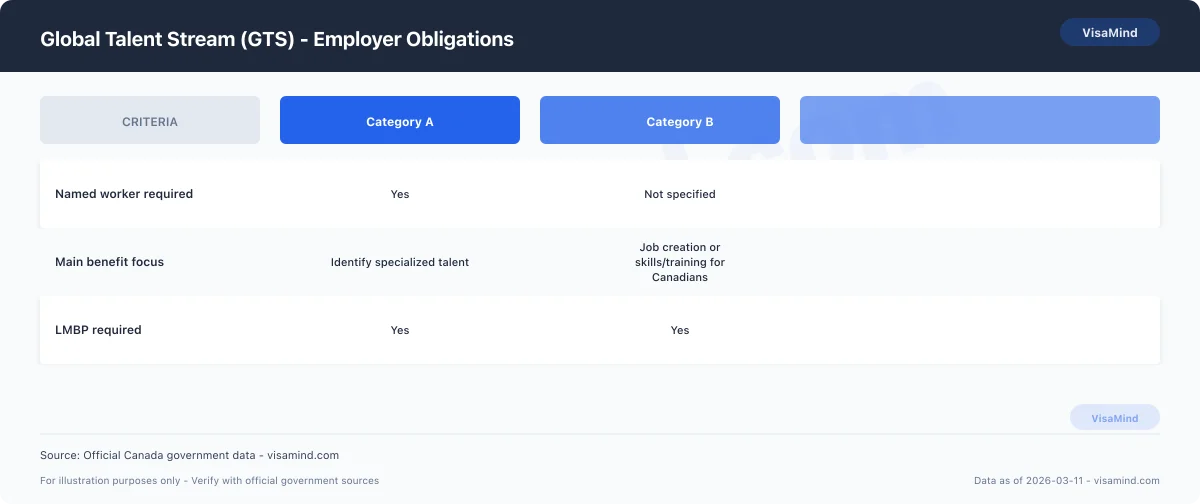
Under Category A, the employer must identify the specific foreign worker and include their information in the application. Without a named worker, the employer doesn’t qualify under this category.
| Requirement | Category A | Category B |
|---|---|---|
| Named worker required | Yes | Not specified |
| Main benefit focus | Identify specialized talent | Job creation or skills/training for Canadians |
| LMBP required | Yes | Yes |
The LMBP is an enforceable commitment.
Business and job legitimacy
Employers must prove their business operates legitimately in Canada and that the job offer is genuine.
For LMIA-required positions under the Global Talent Stream, the occupation must fall within designated highly skilled roles, such as engineers, analysts, or computer programmers.
For certain research-related roles, the worker must:
- Conduct research at a Canadian, publicly funded, degree-granting institution or its affiliated research institution
- Work in Canada for one period of up to 120 days within a 12-month period
Job duties must match the description in the application. Any mismatch can lead to refusal of the LMIA-based work permit or the employer-specific work permit by IRCC.
The Dual-Track Application
#You and your employer file separate but coordinated applications. The employer secures the required authorization first, and you then apply to Immigration, Refugees and Citizenship Canada (IRCC) for your work permit with supporting documents that match the employer’s approval.
Employer (LMIA / LMIA-exempt) steps
The employer must determine whether the position requires a Labour Market Impact Assessment (LMIA) or qualifies as LMIA‑exempt under the Global Talent Stream.
If the role appears on the Global Talent Occupations List, the employer must meet Category B requirements. In LMIA-based cases, the employer submits an application that reflects reasonable employment needs and the expected duration of work.
A key requirement is the Labour Market Benefits Plan (LMBP). This plan outlines the employer’s concrete commitments to create lasting, positive impacts on the Canadian labour market.
Employers must ensure:
- The job duties and duration align with genuine business needs.
- The occupation matches the selected Global Talent Stream category.
- The LMBP commitments are clear and measurable.
Some foreign nationals may work in Canada for one 120‑day period within a 12‑month period, if eligible. Employers must track this carefully to avoid non-compliance.
If you later apply through Express Entry (Federal Skilled Worker), your job details must remain consistent with the employer’s original submission.
Worker application steps
After the employer completes the required process, you apply to IRCC for a Work Permit (Employer-Specific).
If the position required an LMIA, you apply for an LMIA-Based Work Permit. Your application must match the employer’s approved job offer, including occupation and employment duration.
You typically submit:
-
Form Form IMM 1295 (Application for Work Permit Made Outside Canada, if applicable).
-
Supporting documents that reflect the employer’s authorization.
-
Payment of the required fees.
Key work permit fees:
| Item | Fee (CAD) |
|---|---|
| Work permit (including extensions) – per person | CA$155 |
Family members may apply at the same time and place. To qualify for a maximum family fee of CA$500, all family members must apply together and children must meet the definition of dependants.
Medical exams, if required, must be valid at the time of application.
IRCC assesses eligibility. The Canada Border Services Agency (CBSA) determines admissibility when you enter Canada.
Quebec and third-party representative notes
If the job is located in Quebec, additional provincial considerations may apply. Confirm whether Quebec-specific steps are required before filing with IRCC.
If you use a third-party representative, make sure:
- The representative accurately reflects the employer’s LMIA or LMIA‑exempt details.
- All forms, including IMM 1295, match the employer’s submission.
- You review the LMBP-related job information for consistency.
Inconsistent information between the employer’s submission and your work permit application can delay processing or result in refusal.
You remain responsible for the accuracy of your application, even if a representative prepares it.
Fees and Processing Times
#You pay government fees to IRCC for your work permit application and biometrics. Your employer completes separate steps under the Global Talent Stream. Processing times depend on how and when you submit a complete application, including Form Form IMM 1295 and supporting documents.
Fees and biometrics
You pay fees directly to Immigration, Refugees and Citizenship Canada (IRCC) when you apply for a Work Permit (Employer-Specific) under the Global Talent Stream.
You should expect fees for:
- Work permit processing
- Biometrics (if required)
- Any additional services requested by IRCC
IRCC may require you to provide biometrics as part of your application. If required, you must:
-
Pay the biometrics fee.
-
Receive a biometric instruction letter from IRCC.
-
Attend a biometric collection appointment.
You submit your work permit application using Form IMM 1295 and include proof of payment. If you later apply for permanent residence through Express Entry (Federal Skilled Worker), that process involves separate fees.
Your employer also has obligations under the Global Talent Stream, including submitting a Labour Market Benefits Plan and documents proving business legitimacy, but those steps are separate from your personal IRCC work permit fees.
Typical processing timelines
The processing times for a Global Talent Stream case involve two separate stages:
| Stage | Who Handles It | What Is Processed |
|---|---|---|
| Global Talent Stream assessment | Government authority responsible for the stream | Employer eligibility and Labour Market Benefits Plan |
| Work Permit (Employer-Specific) | IRCC | Your LMIA-Based Work Permit application |
The background information provided does not specify exact processing timeframes.
Your processing time depends on:
- Whether your employer qualifies under Category A or Category B
- How quickly your employer submits required documents
- Whether you submit a complete IMM 1295 application
- Whether IRCC requests additional documents or biometrics
If you later apply through Express Entry (Federal Skilled Worker), that is a separate process with its own timelines.
How processing time is measured
IRCC measures processing time from the date it receives your complete application.
Your file is not considered complete until you:
- Submit Form IMM 1295
- Pay the required fees
- Provide all required supporting documents
- Complete biometrics, if instructed
If IRCC requests additional documents, the clock may pause until you respond. Delays often occur when applicants omit required documents or submit unclear copies.
For a LMIA-Based Work Permit linked to the Global Talent Stream, your processing time reflects only the work permit stage handled by IRCC. It does not include:
- Your employer’s preparation of the Labour Market Benefits Plan
- The business legitimacy assessment
- Any internal employer recruitment steps
Track your application through your IRCC account and respond immediately to any requests to avoid unnecessary delays.
Changing Employers
#You cannot simply switch companies under the Global Talent Stream. Your authorization is tied to a specific employer, job title, and National Occupation Classification (NOC) code under an employer-specific LMIA-Based Work Permit.
Job details and NOC requirements
Your current Work Permit (Employer-Specific) lists your employer’s name, job title, and conditions. If you change employers, you’ll need a new Labour Market Impact Assessment (LMIA) under the Global Talent Stream and a fresh work permit from Immigration, Refugees and Citizenship Canada (IRCC).
The new employer has to provide all the right job details, including:
- Legal business name and CRA business number
- Business contact info, alternate contacts if any
- Job title and matching NOC code
- Detailed job duties
- Compensation and benefits
- Any language requirements beyond English or French, with justification
- Third-party representative details, if used
Your NOC code must fit the actual duties you’ll perform. If it doesn’t match, expect a refusal.
You have to submit a new application (such as Form IMM 1295) that shows the updated employer and position. If you later apply under Express Entry (Federal Skilled Worker), your work history needs to line up with the NOC used in your permit.
| Item on Work Permit | Must Change When Switching Employers |
|---|---|
| Employer name | Yes |
| Job title | Yes, if different role |
| NOC code | Yes, if duties differ |
| Work location | Yes, if new location |
Proofs needed at the border
If you apply for your new permit at a port of entry where eligible, you’ll need documents matching the approved LMIA and job offer. CBSA officers assess admissibility at the border, not IRCC.
Bring:
- LMIA confirmation for the new employer
- Written job offer with title, NOC, duties, and compensation
- Proof of your identity and citizenship
- Evidence of your current immigration status
- Employer contact details
Job details on your documents must match exactly. Officers compare the NOC, duties, and compensation against the LMIA approval.
If you previously worked for another employer, bring proof that you followed your prior permit conditions. Inconsistent information can cause delays or even prevent entry.
Occupation lists and category routing
The Global Talent Stream routes applications based on occupation and employer circumstances. The employer must select the correct category when seeking the LMIA.
Your job offer should clearly state:
- The specific occupation and NOC code
- Core job duties
- Compensation structure
- Any specialized language requirements with justification
If your occupation changes, the LMIA category may change as well. A software engineer and a technical sales specialist, for example, use different NOC codes and require different justifications.
| Factor | Why It Matters |
|---|---|
| NOC code accuracy | Determines eligibility and assessment |
| Language requirements | Must be justified if beyond English/French |
| Compensation details | Must align with the LMIA approval |
| Employer business details | Confirms legitimacy and compliance |
The LMIA category, NOC code, and job description all have to align. IRCC reviews your LMIA-Based Work Permit using those details.
When to Get Professional Help
#Many Global Talent Stream applications can be handled without a lawyer, especially if the employer is organized and experienced. But mistakes in job details, employer information, or forms can cause delays or problems with IRCC or at the border with the Canada Border Services Agency (CBSA).
When an employer handles it
Plenty of Global Talent Stream cases go smoothly when the employer manages the LMIA-Based Work Permit process and prepares the documentation correctly.
You should check that your employer provides:
- The correct legal business name
- A valid Canada Revenue Agency business number
- A detailed job offer or contract
- The right NOC code and job title
- The exact start and end dates of employment
Make sure these details are consistent on your Form IMM 1295 and any supporting documents to IRCC.
| Document Element | Must Match Across |
|---|---|
| Legal business name | Job offer, LMIA documents, IMM 1295 |
| NOC code | Job offer, work permit application |
| Job title | Contract, IMM 1295 |
| Employment period | Job offer, work permit form |
If the employer has a good HR or immigration team, extra legal help isn’t always needed. Still, you’re responsible for reviewing everything before it’s submitted.
Situations that benefit from a lawyer
Some cases are more complicated than a basic Work Permit (Employer-Specific) application.
Consider legal help if:
- You want to transition to Express Entry (Federal Skilled Worker) and need consistent occupational classification.
- Your job duties don’t fit neatly into one NOC code.
- Your contract terms differ from what the employer filed.
- You expect detailed questions from a CBSA officer about your eligibility.
A lawyer can review whether your job description, NOC, and employment period support both your work permit and future plans.
Legal review is also useful if multiple entities are involved in your employment or if business documentation is unclear. Small inconsistencies can cause unnecessary delays.
Common application pitfalls to avoid
Most refusals come from inconsistencies or missing employer details—not the program itself.
Watch out for:
-
Incorrect or incomplete CRA business number
-
Mismatched job offer and IMM 1295
-
Missing employment start or end dates
-
Wrong NOC code selection
-
Vague job duties that don’t match the occupation
CBSA officers may ask for proof of your job offer and eligibility at the port of entry. Bring clear documentation showing your employer’s legal name, business number, job title, NOC code, and employment period.
Check every field against your contract before submitting to IRCC. Accuracy is more important than speed.
From Work Visa to PR
#A Global Talent Stream work permit can support a long-term plan for permanent residence. Keep your employer-specific status, documents, and future application strategy aligned from the start.
Typical permanent residence pathways
Many Global Talent Stream workers later apply for permanent residence through Express Entry (Federal Skilled Worker).
You submit your PR application to Immigration, Refugees and Citizenship Canada (IRCC). IRCC reviews your eligibility and supporting documents.
Your work history under a valid LMIA-Based Work Permit becomes part of your immigration record. This includes employment tied to a specific employer under a Work Permit (Employer-Specific).
Documents that often carry forward from your work permit stage include:
- A valid job offer or employment contract
- Employer business records, such as a business license
- Canada Revenue Agency (CRA) tax documentation from the employer
- Biometrics (fingerprints and photo) already provided to IRCC
If you applied under Category A of the Global Talent Stream, your employer would have submitted a referral form from a designated partner. Keep copies of all filings and approvals for your records.
For eligibility criteria and selection factors, refer to the Express Entry (Federal Skilled Worker) program guidance from IRCC.
How this work permit fits into PR planning
Your Global Talent Stream approval starts with Form IMM 1295 and supporting employer documents.
That application establishes:
| Stage | What It Demonstrates |
|---|---|
| LMIA-Based Work Permit | A genuine job offer from a Canadian employer |
| Employer-Specific Approval | Authorized work tied to one employer |
| Biometrics Submission | Identity verification on file with IRCC |
You must maintain valid status while preparing your PR application.
Keep copies of your job offer, referral documentation (if applicable), employer compliance records, and proof that you worked under the approved conditions.
IRCC evaluates permanent residence separately from your work permit. Your work authorization doesn’t turn into PR automatically.
You have to file a complete PR application and meet the program requirements in effect at the time you apply.
Dependents
#Your spouse and children can apply to join you while you work in Canada under the Global Talent Stream. Each family member must submit a separate application to IRCC and meet admissibility requirements.
Spouse and children: eligibility and fees
Your spouse or common-law partner and dependent children may apply to accompany you when you receive a Work Permit (Employer-Specific) supported by a Global Talent Stream LMIA.
Each family member must:
- Submit their own application to IRCC
- Complete the required forms (such as Form IMM 1295, if applying for a work permit)
- Pay the applicable IRCC processing fees
- Meet admissibility requirements
IRCC sets processing fees by application type. Review the IRCC fee schedule for current amounts in CAD (CA$) before applying.
If your spouse applies for a work permit, they file a separate application. Children applying to study or visit must use the appropriate study permit or visitor application.
| Family Member | Possible Application Type | Separate Fee Required |
|---|---|---|
| Spouse/Common-law partner | Work Permit | Yes |
| Dependent child | Study permit or visitor record | Yes |
Your employer’s CA$1,000 LMIA processing fee is for your position, not your dependents.
Health insurance and exams
You need to show proof of private health insurance for temporary foreign workers not yet covered by provincial or territorial health insurance.
If your spouse or children aren’t immediately eligible for public health coverage, arrange private insurance for them too. IRCC may ask for proof of coverage during processing.
Each family member must meet medical admissibility requirements. If IRCC requires a medical exam, use an approved panel physician before IRCC finalizes the application.
CBSA assesses admissibility at the port of entry. Even with approved documents, your family members must satisfy border officers that they meet entry requirements.
Group application notes
You can submit your family’s applications together with your LMIA-Based Work Permit application, but IRCC processes each person’s file separately.
To keep the process organized:
-
Make sure your employer submitted a complete LMIA application under the Global Talent Stream.
-
Gather all required forms and supporting documents for each family member.
-
Pay the correct fee for each application.
-
Submit all applications to IRCC at the same time, if possible.
Your employer must provide documentation showing the job offer is legitimate and that Global Talent Stream requirements are met. These employer documents support your work permit application but don’t replace the forms required from your spouse or children.
If you later apply for permanent residence through Express Entry (Federal Skilled Worker), you’ll include your spouse and dependent children in that separate process.
How to Renew
#You must apply to extend your Work Permit (Employer-Specific) before it expires. Renewal depends on whether your job stays LMIA-based or becomes LMIA-exempt under the Global Talent Stream.
When to re-file
You can’t keep working under the Global Talent Stream if your permit expires. Submit a new application to IRCC before the expiry date on your current permit.
Renewal requires you to confirm whether your job still needs a Labour Market Impact Assessment (LMIA).
- If your role is LMIA-based, your employer must hold a valid positive LMIA issued through the Global Talent Stream of the Temporary Foreign Worker Program.
- If your role is LMIA-exempt, your employer must maintain compliance and provide the required exemption details.
If you change employers, you must apply for a new LMIA-Based Work Permit or LMIA-exempt employer-specific permit. A Global Talent Stream work permit doesn’t transfer automatically to a new company.
If you plan to apply for Express Entry (Federal Skilled Worker) for permanent residence, you must still keep valid temporary status until IRCC approves your permanent application.
Documentation for extensions
Submit a complete application to IRCC, typically using Form IMM 1295 for a work permit made from outside Canada. Follow the form instructions from IRCC for your situation.
Include documents based on your job category:
| Situation | Required Documents |
|---|---|
| LMIA-Based Job | Positive LMIA decision letter under Global Talent Stream |
| LMIA-Exempt Job | Employment contract, offer of employment number, LMIA exemption code, proof employer compliance fee was paid |
Your employment contract or job offer should clearly state:
- Job title
- National Occupation Classification (NOC) code
- Description of duties
- Terms of employment
You’ll need to pay the required processing fees in CAD (CA$). Check the IRCC fee schedule for current amounts.
Biometrics and fee repeats
IRCC may ask you to provide biometrics again, depending on your prior submissions and validity period. If biometrics are required, you must pay the fee and complete the appointment as instructed.
You must also pay applicable work permit processing fees with each new application. Fees don’t carry over from your previous permit.
At the port of entry, the Canada Border Services Agency (CBSA) may ask for proof of eligibility. Bring:
- Your valid job offer or contract
- The LMIA decision letter (if applicable)
- LMIA exemption details (if applicable)
CBSA determines admissibility at the border. IRCC processes and approves your permit application.
Eligibility Requirements
#To qualify under the Global Talent Stream, your employer must meet specific program conditions and submit a complete application through the proper government channels. You must also fit within an approved category, occupation framework, or exemption.
Category A vs Category B criteria
The Global Talent Stream has two main pathways. Employers must decide which category fits before applying.
| Feature | Category A | Category B |
|---|---|---|
| Focus | Unique, specialized talent | In-demand occupations |
| Employer requirement | Must complete LMIA process through LMIA Online | Must complete LMIA process through LMIA Online |
| Additional documents | Labour Market Benefits Plan | Labour Market Benefits Plan |
For both categories, employers need to:
- Submit the application through LMIA Online
- Prepare and file a Labour Market Benefits Plan
- Pay the required processing fee as set by the Government of Canada
- Include the Global Talent Stream form with the LMIA application, if necessary
- Ensure third-party representatives sign Section 11b
- Send supporting documents to the Government of Quebec for Quebec positions
Approval under either category lets you apply for an LMIA-Based Work Permit.
Occupation and qualification rules
You must apply for a Work Permit (Employer-Specific) that matches the approved LMIA. Working for another employer is not allowed unless you get new authorization.
To get your work permit, you need to:
-
Complete the application form, including Form IMM 1295.
-
Submit biometrics when required.
-
Pay the government processing fees in Canadian dollars.
-
Check current processing times through the Government of Canada.
Eligibility depends on the position described in your LMIA approval. You must meet the qualifications listed by your employer.
If you want permanent residence later, such as through Express Entry (Federal Skilled Worker), you’ll need to meet that program’s criteria. The Global Talent Stream work permit doesn’t grant permanent residence on its own.
Research and short-term work exemptions
Some short-term work situations don’t need a full Global Talent Stream LMIA process. These exemptions depend on the work’s nature and length.
Even with an exemption, you still need to:
- Confirm if a work permit is necessary
- Follow IRCC application steps
- Give biometrics if told to
- Meet admissibility rules at the border, assessed by the Canada Border Services Agency
If you’re not sure about an exemption, your employer should check requirements with the Government of Canada before you apply.
Common Petition Challenges
#Most refusals or delays come from missing documents, errors in the Labour Market Benefits Plan (LMBP), or mistakes with fees or biometrics. Align your LMIA, work permit, and supporting records from the start to avoid setbacks with Immigration, Refugees and Citizenship Canada (IRCC).
Documentation gaps
Incomplete documentation is a frequent reason for delay or refusal under the Global Talent Stream. Every section of the LMIA application and the LMIA-Based Work Permit package must be filled out fully.
For first-time Global Talent Stream applicants, Section 9 (Labour Market Benefits Plan) must be complete. The main or alternate employer contact needs to review and sign the LMBP before submitting. Missing signatures can cause refusals.
You also need:
- Employer registration certificate copy, if your province asks for it
- Proof of exemption, if claiming one
- Simultaneous submission to MIFI for Quebec positions
- Written notice to Service Canada if a temporary foreign worker is using an IRCC temporary public policy
If you apply for a Work Permit (Employer-Specific), make sure Form Form IMM 1295 matches the approved LMIA. Differences between the LMIA and work permit application often trigger extra review.
| Document Issue | Likely Result |
|---|---|
| Unsigned LMBP | Processing delay or refusal |
| Missing provincial registration proof | Application returned or refused |
| Quebec LMIA not filed with MIFI | Processing delay |
| No written notice for public policy request | Non-compliance concern |
LMBP and wage compliance issues
The Labour Market Benefits Plan is a binding commitment. Service Canada checks whether you follow through on what you promised in your LMBP.
Not meeting those commitments affects your ability to get future LMIAs or support more foreign workers.
Wage and recruitment rules matter, too. If you charge recruitment fees to a temporary foreign worker, Service Canada can issue a negative LMIA decision. That stops the worker from getting an employer-specific work permit through IRCC.
Keep clear internal records showing:
- Your LMBP commitments were implemented
- No recruitment fees were charged
- The approved LMIA terms were followed
Non-compliance can impact future filings, including when a worker later applies for permanent residence through Express Entry (Federal Skilled Worker).
Payment and biometrics errors
IRCC rejects work permit applications if you don’t pay the processing fee. Confirm the correct fee amount using the IRCC fee tool before you submit.
If you don’t provide biometrics when required, processing stops. IRCC won’t finalize the application until biometrics are done.
Common mistakes include:
-
Sending IMM 1295 without proof of payment
-
Leaving out biometrics when required
-
Assuming payment will be requested later
If IRCC rejects your application for non-payment, you’ll have to reapply. That can delay entry to Canada even if your LMIA is still valid.
Can I get a GTS work permit?
#You can get a Global Talent Stream (GTS) work permit if a Canadian employer hires you and completes the process. Eligibility depends on whether the job needs a Labour Market Impact Assessment (LMIA) and whether IRCC approves your employer-specific work permit application.
Quick eligibility check
You’re eligible for a Work Permit (Employer-Specific) under GTS if:
- A Canadian employer submits a Global Talent Stream application
- The employer gets a positive LMIA (if required)
- You apply to IRCC for a work permit
- You fill out Form Form IMM 1295 accurately and send all required documents
GTS is employer-driven. You can’t apply on your own without a job offer tied to a specific employer.
IRCC processes most complete applications within its service standard. Processing times vary by location. If you apply from outside Canada or the United States, expect 3–4 months for mailing time.
Check processing timelines through IRCC’s tool before applying. Filing under GTS doesn’t guarantee approval.
| Requirement | Who is responsible |
|---|---|
| Submit GTS/LMIA application | Employer |
| Pay required government fees (CA$) | Employer/Applicant (varies) |
| Submit IMM 1295 and work permit application | You |
| Assess work permit eligibility | IRCC |
LMIA-exempt vs LMIA-required
Most GTS positions require an LMIA-Based Work Permit. Your employer must get a positive LMIA before you apply to IRCC.
If the LMIA is required:
-
Employer applies under the Global Talent Stream.
-
Government checks wages and working conditions.
-
After approval, you submit your work permit application.
Employers must pay at least the prevailing wage. Not updating wages can lead to compliance penalties and affect future applications.
Some positions may be LMIA-exempt under other immigration pathways. In those cases, you’d still apply for an employer-specific work permit through IRCC, but without an LMIA number.
GTS is not the same as permanent residence programs like Express Entry (Federal Skilled Worker). GTS leads to a temporary work permit, not permanent status. You can apply for permanent residence separately if you qualify.
How to prepare a Labour Market Benefits Plan?
#You need to create a detailed Labour Market Benefits Plan (LMBP) before IRCC will approve your Global Talent Stream application. The plan sets measurable commitments that IRCC will monitor during and after your worker receives an LMIA‑Based Work Permit.
What to include in the LMBP
Your LMBP should have specific, time‑bound commitments that benefit Canada’s labour market. Vague goals or general hiring statements aren’t accepted.
Include:
- Clear job creation targets (how many Canadian citizens or permanent residents you’ll hire and when)
- Skills and training commitments (training programs, mentorship, knowledge transfer from the foreign worker)
- Investment details tied to workforce development
- Timelines and measurable outcomes
Lay out commitments in a structured way. Use numeric targets, not rough estimates.
| Commitment Area | What You Must Specify |
|---|---|
| Hiring | Number of Canadians/permanent residents, positions, timelines |
| Training | Type of training, who receives it, frequency, duration |
| Knowledge transfer | How the foreign worker will train or mentor staff |
| Monitoring | How you will track and document results |
Your plan should fit your business operations. If the foreign national later applies for permanent residence through Express Entry (Federal Skilled Worker), your documented compliance can support the job offer’s credibility.
Keep commitments realistic. IRCC will check performance against what you promise.
Signatures, submission and compliance
An authorized company representative must sign the LMBP. Signing means you agree to meet each commitment within the stated timeframe.
Submit the LMBP as part of your Global Talent Stream process, linked to the LMIA supporting the Work Permit (Employer-Specific). IRCC and related authorities may review your compliance while the work permit is valid.
If the foreign worker applies from outside Canada, they’ll file Form Form IMM 1295 and pay:
| Fee Type | Amount (CAD) |
|---|---|
| Work permit processing fee (IMM 1295) | CA$155 |
| Biometrics fee | CA$85 |
IRCC aims to process Global Skills Strategy applications within 2 weeks after receiving a complete application. Processing time starts when IRCC gets the full application and ends with a decision.
Keep detailed records—payroll data, training logs, and hiring documentation—in case there’s a review.
Consequences of failing commitments
IRCC treats the LMBP as a binding agreement. If you don’t meet your commitments without a valid reason, you face compliance action.
Consequences include:
- Negative compliance findings
- Restrictions on future LMIA applications
- Refusal of future Global Talent Stream requests
- Increased scrutiny of future Work Permit (Employer-Specific) filings
Non‑compliance can also affect related immigration steps. If your employee later applies for permanent residence, inconsistencies between your LMBP and actual employment conditions may create credibility issues.
Set achievable targets, track progress monthly, and document every fulfilled commitment to reduce risk.
Fees
#| Component | Amount |
|---|---|
| Filing fee (IMM-1295)Work permit (outside Canada). | CA$155 (approx $113 USD) |
| BiometricsBiometrics: CA$85 (approx $62 USD) (as of 2026-02). Verify the current fee on the official schedule before filing. | CA$85 (approx $62 USD) |
Fees change; always verify on IRCC.
Required forms
#Plan your Global Talent Stream (GTS) with free Canada tools
#Itemized government fees for Global Talent Stream (GTS) and other Canada categories.
See how your profile scores against Global Talent Stream (GTS) and other Canada visas.
Typical wait times and stage breakdowns for Global Talent Stream (GTS) and related Canada visas.
Common interview questions and feedback for Canada visa applicants.