
On this page
- What the Refugee Claim (Asylum) Covers — Canada asylum
- Application Process
- Your Rights During Processing
- When to Consult a Professional — refugee claim Canada
- Processing Times and Costs
- What Happens Next
- Eligibility Criteria
- Credibility and Procedural Risks
- Fees
- Required forms
- Related visa types
- Related goals
- Next steps
What the Refugee Claim (Asylum) Covers — Canada asylum
#A refugee claim lets you ask Canada for protection if returning to your home country would put you at risk.
You apply from inside Canada through Immigration, Refugees and Citizenship Canada (IRCC) using the official asylum forms and instructions.
Who this covers
This process covers people physically in Canada who fear persecution or danger if they return to their home country.
You may qualify to make a refugee claim if:
- You are in Canada.
- You believe you face persecution in your home country.
- You believe you would be in danger if forced to return.
You file your claim with Immigration, Refugees and Citizenship Canada (IRCC) using the official refugee claim (asylum) forms.
Download the current forms and instructions directly from IRCC to avoid using outdated versions.
This process is different from resettlement programs handled outside Canada.
For example, a Government-Assisted Refugee (GAR) or someone under the Private Sponsorship of Refugees program does not apply through the in-Canada refugee claim form.
If you do not qualify for a refugee claim, you may explore other options such as Humanitarian and Compassionate Considerations, depending on your circumstances.
| Situation | Correct Process |
|---|---|
| You are inside Canada and fear persecution | In-Canada refugee claim with IRCC |
| You are outside Canada seeking resettlement | GAR or Private Sponsorship of Refugees |
| You do not meet refugee criteria but have compelling circumstances | Humanitarian and Compassionate Considerations |
Where to start
Start with the official refugee claim (asylum) application package from IRCC.
You must:
-
Download the current asylum forms and guide from IRCC.
-
Complete the required forms fully and accurately.
-
Follow the official submission instructions provided by IRCC.
Use only the most recent version of each form.
IRCC updates forms and instructions, and outdated versions can delay your claim.
The refugee claim form is specific to people applying from within Canada.
It is not interchangeable with forms used for resettlement or sponsorship programs.
If you include family members in your claim, review the instructions carefully to confirm which supporting documents are required.
Always rely on the IRCC guide for the correct document checklist and any updates.
Key pathways
Canada offers different protection pathways, and you must choose the one that matches your situation.
1. In-Canada Refugee Claim (Asylum)
You apply from inside Canada using the official refugee claim forms managed by IRCC.
This pathway focuses on your fear of persecution or danger in your home country.
1. Government-Assisted Refugee (GAR)
This program applies to refugees resettled to Canada with government support.
It is not filed through the in-Canada asylum form.
1. Private Sponsorship of Refugees
Private groups in Canada sponsor refugees for resettlement.
This also operates outside the in-Canada claim process.
1. Humanitarian and Compassionate Considerations
If you do not qualify as a refugee but have compelling personal circumstances, you may request permanent residence on humanitarian grounds.
This is a separate application.
Confirm which pathway fits your case before you apply.
Using the wrong process can cause delays or refusal.
Application Process
#You must complete and submit your asylum application from inside Canada.
IRCC requires a fully completed, signed package with supporting evidence, valid medical results, and identity documents submitted together.
Before you apply
Confirm that you are physically present in Canada before you prepare your application.
You must gather all required documents and ensure they are current.
This includes identity records and any residence documents that show where you live in Canada.
Prepare accurate personal information for every person included in your claim.
IRCC expects details such as:
- Telephone number
- Email address
- Social Insurance Number (if issued)
- Financial information
- Medical information
- Work history
If you apply as part of a family group, every person must apply at the same time and from the same location in Canada.
All required exams must remain valid at the same time.
If you are connected to a Government-Assisted Refugee (GAR) case, a Private Sponsorship of Refugees case, or a request based on Humanitarian and Compassionate Considerations, ensure you identify the correct stream and include any related forms, such as Form IMM 5507, where required.
| Key Preparation Step | What You Must Do |
|---|---|
| Location requirement | Be inside Canada |
| Family members | Apply together, same time and place |
| Exams | Ensure all are valid simultaneously |
| Supporting documents | Gather identity and residence proof |
Filling and submitting
Complete every required section of the application form.
Do not leave blanks unless the form instructs you to do so.
You must sign the application before submission.
An unsigned application can lead to delays or refusal.
Include supporting evidence that matches the information you provide.
If you list employment, medical issues, or financial details, attach documents that support those statements.
Submit the entire application package together.
Do not send documents separately unless IRCC specifically instructs you to do so.
If you include family members, ensure each person’s information is complete and consistent across all forms.
Inconsistent details can slow processing.
Medical and identity requirements
You must provide valid medical examination results for every person included in your application.
All exams must be valid at the same time.
If one family member’s results expire, the entire group may need updated examinations.
Submit clear identity documents for each applicant.
This includes documents that confirm who you are and where you reside in Canada.
Provide consistent personal details across all records.
Differences in name spelling, dates of birth, or identification numbers can trigger requests for clarification.
IRCC reviews your medical, identity, financial, and work information together.
Incomplete or outdated records can delay a decision on your claim.
Your Rights During Processing
#While IRCC processes your asylum or related application, you may qualify to apply for a work permit and must pay the required government fees.
Specific group fee limits apply in limited situations, and eligibility depends on how and when you apply.
Work permits and fees
You may apply for a work permit, including an extension, while your matter is under review by Immigration, Refugees and Citizenship Canada (IRCC).
This applies whether you filed an asylum claim, a Humanitarian and Compassionate Considerations application, or are connected to a Government-Assisted Refugee (GAR) or Private Sponsorship of Refugees case.
The standard fee structure is:
| Application type | Fee (CA$) | Per person? |
|---|---|---|
| Work permit (including extensions) | 155 | Yes |
You must pay CA$155 per person for each work permit or renewal request.
If you apply as a family, you may qualify for a maximum total fee of CA$500 if:
- All family members apply at the same time
- All applications are submitted in the same place
- Your children meet the definition of dependant
You must include all required forms, such as Form IMM 5507 if requested, and pay the correct amount to avoid delays.
Group fee rules
IRCC sets a separate maximum group fee for certain work permit applicants.
To qualify for the group cap:
- You must be three or more performing artists and their staff
- You must apply together as a group
If you meet these conditions, the group may qualify for a maximum total work permit fee instead of paying CA$155 per person.
This rule applies only to performing artists and their support staff.
It does not apply to families applying together unless they meet the separate family maximum fee conditions described above.
When to Consult a Professional — refugee claim Canada
#You face strict eligibility rules and procedural steps when you make a refugee claim in Canada.
A qualified professional can help you assess eligibility, avoid fraud, and follow official instructions issued by Immigration, Refugees and Citizenship Canada (IRCC).
Complex cases and eligibility questions
You should seek legal advice if you are unsure whether you qualify for refugee protection.
IRCC applies different criteria depending on your situation, and you or a family member might not be eligible.
Complex cases often include:
- Previous refugee claims in Canada
- Involvement in a Government-Assisted Refugee (GAR) or Private Sponsorship of Refugees application
- A pending request based on Humanitarian and Compassionate Considerations
- Questions about family members listed on forms such as Form IMM 5507
A professional can review your eligibility category before you apply.
This step reduces the risk of refusal based on technical errors or ineligibility.
If you have dependants, disputed identity documents, or past immigration applications, legal guidance becomes more important.
An error at the eligibility stage can delay processing times and affect your ability to remain in Canada.
| Situation | Why Legal Advice Matters |
|---|---|
| Prior refugee or sponsorship file | Overlapping categories can affect eligibility |
| Family members included | Incorrect forms may lead to delays |
| Humanitarian request | Different legal test applies |
| Unclear status in Canada | Eligibility may be limited |
Protecting yourself from fraud
You must protect yourself from unauthorized representatives.
Fraud can lead to refusal of your refugee claim and long-term immigration consequences.
Warning signs include:
- Promises of guaranteed approval
- Requests for large cash payments without receipts
- Advice to provide false information
- Refusal to explain how IRCC processes refugee protection claims
IRCC provides information on how to protect yourself from fraud.
You should review these instructions before paying anyone for help.
Only rely on professionals who clearly explain your eligibility category and the steps involved.
You remain responsible for the accuracy of your application, even if someone prepares it for you.
If someone advises you to misrepresent facts, end the relationship immediately.
False statements can result in refusal and future ineligibility.
Where to find official instructions
You should always confirm requirements directly with Immigration, Refugees and Citizenship Canada (IRCC).
Official instructions explain eligibility categories, required forms, and how to check your application status.
IRCC publishes guidance on:
- Refugee protection in Canada
- Eligibility requirements
- Required forms, including IMM 5507 where applicable
- Processing updates and key figures on asylum claims
- How to monitor your application status
Use IRCC materials to verify what a representative tells you.
Do not rely on informal advice or social media summaries.
| Source | What You Can Confirm |
|---|---|
| IRCC official guidance | Eligibility criteria and required forms |
| IRCC application instructions | Category-specific requirements |
| IRCC status tools | Current processing stage |
| IRCC fraud guidance | How to avoid scams |
Always review the instructions for your specific eligibility category before you submit your claim.
Processing Times and Costs
#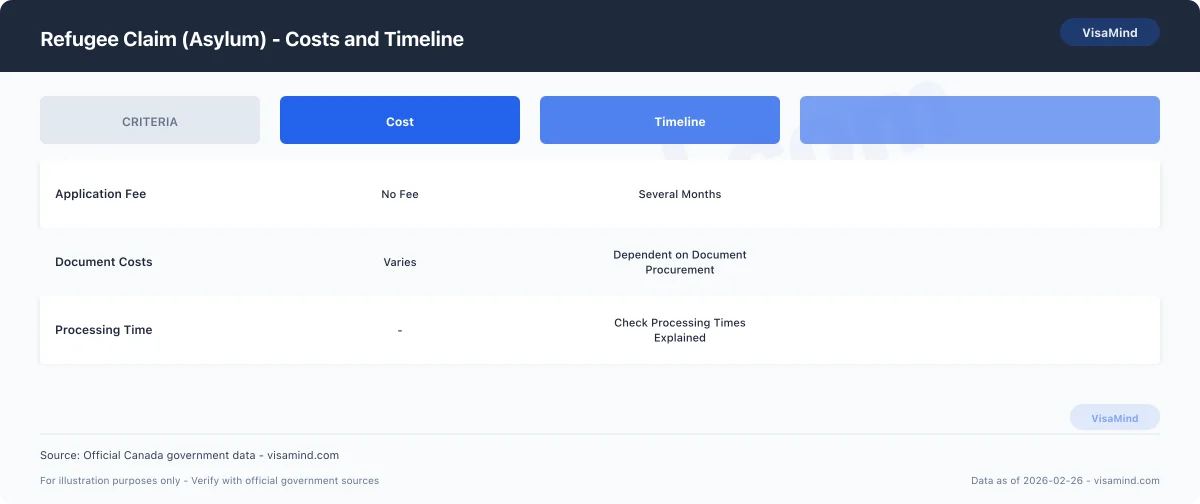
You pay no government fee to submit an asylum claim in Canada, but you should prepare for related expenses and a waiting period that can last years.
Processing times depend on the claim type and where authorities handle your file.
Estimated timelines
As of March 2026, the standard processing time for asylum claims is 12 to 36 months.
The exact timeline depends on your claim type and the location handling your case.
Processing times vary for:
- In‑Canada refugee claims
- Government-Assisted Refugee (GAR) cases
- Private Sponsorship of Refugees applications
- Permanent residence applications after protection is granted
If you apply from outside Canada or the United States, add 3 to 4 months for mailing and document transfer.
IRCC publishes estimated times based on the month and year you apply.
These are projections, not guarantees.
Times may increase if application volumes exceed Canada’s annual immigration targets or if your case requires non‑routine review.
| Application Type | Estimated Time (as of Mar 2026) | Notes |
|---|---|---|
| Standard asylum claim | 12–36 months | Varies by claim type and location |
| Applications outside Canada/U.S. | +3–4 months | Mailing time added |
| Non‑routine cases | Varies | Additional review required |
Fees and related costs
You do not pay a government application fee to file an asylum claim.
The official application fee is CA$0 (as of February 2026).
However, you should budget for indirect expenses, such as:
- Medical exams (if required later in the process)
- Translation of documents
- Certified copies of identity records
- Legal representation
- Travel costs to hearings or interviews
If you later apply for permanent residence after receiving protection, separate fees may apply.
Confirm current amounts directly with IRCC before submitting payment.
For certain processes, such as Private Sponsorship of Refugees, sponsors—not the refugee—usually commit to financial support.
Government-Assisted Refugee (GAR) cases involve government-funded settlement support, but this does not change the CA$0 asylum filing fee.
If you apply under Humanitarian and Compassionate Considerations, you must review the specific fee structure listed by IRCC for that application type.
How processing time is calculated
Processing time starts the day IRCC receives your complete application. It ends when a decision is made.
A complete application means you’ve submitted all required forms, supporting documents, signatures, and any declarations like Form IMM 5507 if needed.
Submitting an incomplete file can pause processing or get your application returned.
IRCC bases its posted timelines on how long it took to finalize similar applications submitted in the same month and year. These are averages, not guarantees for individual cases.
Processing might take longer if your case needs extra review, if more documents are requested, or if annual immigration intake limits affect scheduling.
What Happens Next
#After you file your asylum claim, Immigration, Refugees and Citizenship Canada (IRCC) or the Canada Border Services Agency (CBSA) continues processing. You’re expected to follow all instructions, attend appointments, and respond to document requests promptly.
IRCC reviews your claim for completeness and eligibility. If you applied inside Canada, you might get instructions for biometrics, medical exams, or extra forms.
Check your account and mail for updates. Missing deadlines can delay or harm your case.
Typical steps include:
-
File review by IRCC
-
Biometrics collection (if required)
-
Medical examination
-
Submission of supporting documents
Hearing or interview notice (if applicable)
If IRCC asks for proof of family members, you may need to complete Form IMM 5507 (Family Information Form). Give accurate details about your spouse, children, parents, and siblings.
| Stage | What You Must Do | Who Handles It |
|---|---|---|
| Application review | Respond to document requests | IRCC |
| Admissibility checks | Attend biometrics/medical exam | IRCC / CBSA |
| Border issues (if any) | Comply with examination | CBSA |
Keep your contact information current with IRCC. If you don’t, you could miss important notices or have decisions made without your input.
Related immigration pathways
If your asylum claim is refused, Canadian law offers a few limited options. Each one comes with strict eligibility criteria.
You might consider:
- Humanitarian and Compassionate Considerations (H&C) if you can show hardship or compelling personal factors.
- Government-Assisted Refugee (GAR) program if you’re referred from outside Canada through official channels.
- Private Sponsorship of Refugees if a sponsoring group agrees to support you financially and socially.
| Pathway | Who Initiates | Key Feature |
|---|---|---|
| Humanitarian and Compassionate Considerations | You apply directly to IRCC | Based on hardship and establishment in Canada |
| Government-Assisted Refugee (GAR) | Referral through resettlement process | Government financial support |
| Private Sponsorship of Refugees | Private sponsor submits undertaking | Community financial support |
Each pathway has its own forms, eligibility requirements, and steps. You’ll need to review the specific program requirements from IRCC before applying.
Eligibility Criteria
#You must show a real risk of harm if you return to your home country, and support that claim with clear evidence. IRCC looks at both your personal circumstances and the country conditions you describe.
Who qualifies
You qualify if you fear persecution or serious danger in your home country and can explain why returning would put you at risk.
Your fear needs to relate to specific threats against you. General hardship or economic trouble isn’t enough. You’ll need to describe what happened, who targeted you, and why.
IRCC reviews claims made inside Canada as well as applications linked to programs like the Government-Assisted Refugee (GAR) and Private Sponsorship of Refugees streams. Each pathway still requires proof that going home would expose you to persecution or danger.
You can also raise Humanitarian and Compassionate Considerations if compelling personal circumstances support your need to stay in Canada. These factors add to your case but don’t replace the need to show risk.
| Core Requirement | What IRCC Looks For |
|---|---|
| Fear of return | A clear explanation of why you cannot safely go back |
| Personal risk | Specific threats directed at you |
| Country conditions | Evidence that the danger exists in your home country |
| Supporting factors | Humanitarian and Compassionate Considerations, where applicable |
Evidence you need
You’ll need documents that support your story and the conditions in your country.
Focus on evidence that shows:
- Direct threats, harm, or targeting against you
- Ongoing danger in your home country
- Attempts to seek protection, if any
- Any documents that confirm your identity and background
Use written statements to explain events in order. Be specific about dates, places, and people involved.
If you apply through a sponsorship pathway, include required forms like Form IMM 5507 when needed. Incomplete forms can slow down your file with IRCC.
Organize your evidence clearly. Label documents and match them to the events in your statement. Consistency between your written account and your documents is important.
Credibility and Procedural Risks
#Your asylum claim depends on credible evidence and a clear account of risk. Filing with IRCC doesn’t guarantee approval, and weak documentation can lead to refusal.
Evidence and credibility
You must back up your claim with evidence showing you face persecution or danger.
If you don’t provide convincing proof, IRCC may decide your claim doesn’t meet the standard. Your written statements, supporting documents, and forms should align and be consistent.
Inconsistent details can damage your credibility. Missing documents can weaken your case, even if your fear is real.
Here’s what helps:
- Submit documents supporting your identity and personal history.
- Provide detailed written statements explaining the risk you face.
- Make sure all forms are accurate and consistent.
- Review forms like Form IMM 5507 carefully before submitting.
| Risk Factor | Impact on Your Claim |
|---|---|
| Missing evidence | Claim may be refused |
| Contradictory statements | Credibility concerns |
| Incomplete forms | Delays or negative inferences |
Programs such as the Government-Assisted Refugee (GAR) or Private Sponsorship of Refugees have their own steps, but credibility is always central.
Outcomes and limits
Submitting an asylum claim doesn’t guarantee protection status.
IRCC decides if your evidence establishes a real risk. If you don’t demonstrate persecution or danger, your application can be refused.
Approval depends on the strength of your documentation and the consistency of your account.
If your asylum claim fails, you may look at other pathways like Humanitarian and Compassionate Considerations, if available. Each option needs its own supporting evidence and won’t automatically fix problems in your original claim.
Accuracy, completeness, and consistency matter from the start. Your outcome depends on what you prove.
Fees
#| Component | Amount |
|---|---|
| Application feeNo fee for refugee claims | CA$0 |
Fees change; always verify on IRCC.
Required forms
#Next steps
#Use Find My Visa to build a sequenced plan with official sources and deadlines.
FAQs
Can you apply on Humanitarian and Compassionate Considerations?
You may request consideration on Humanitarian and Compassionate Considerations if IRCC allows it in your situation. IRCC reviews these requests according to its legal framework and application guidelines.
What is Form IMM 5507?
Form IMM 5507 is an IRCC form used in some refugee and protected person cases.
Refer to IRCC instructions to determine if you need to complete and submit this form.
What is the Canada asylum (refugee claim) route?
The Asylum - Refugee Claim form allows individuals to apply for refugee protection from within Canada if they fear persecution or danger upon returning to their home country; it is managed by Canada’s immigration system and is specific to those seeking asylum inside Canada.
Who can apply from inside Canada?
You can apply from inside Canada as a refugee if you fear persecution or if you are in danger if you return to your home country; the applicant’s fear of persecution or danger is the core basis for a claim.
Where do I get the asylum form and instructions?
Download the current asylum form and instructions from the official IRCC website; this form is used by applicants filing with IRCC.
What documents and information will I need to include?
You’ll typically provide personal information (telephone, email, SIN, financial, medical, or work details), extra documents such as residence documents, and valid medical/exam records for everyone required; gather evidence of persecution or danger to support your claim.
Is there a fee to file an asylum claim?
The application fee is CA$0 (as of 2026-02). Other fees can apply for related permits (for example, work permit fees such as a per-person fee of $155 or specific group fee rules).
How long does the refugee claim process take?
Processing times vary by category and processing location; under the Standard category the processing time is estimated at 12 to 36 months (claim-type dependent); verify current processing times with the issuing authority.
If I file an asylum claim, am I guaranteed approval?
Filing an asylum claim does not guarantee approval; failing to provide evidence of persecution or danger can affect the outcome.
How can I check processing times and my application status?
Check current processing times and your application status through IRCC’s services and information pages; note that some processing time services require a web browser with JavaScript enabled.
What are common next steps after a claim or related status?
Typical related pathways include applications from a Temporary Resident Visa (visitor visa) or eTA, and after protection is granted, Humanitarian and Compassionate Considerations and other next steps may follow.
Official sources referenced
Last reviewed: 2026-03-11
VisaMind provides informational guidance only and is not a government agency. This is not legal advice. Requirements can change and eligibility depends on your specific facts. If your case is complex or high-stakes, consult a licensed immigration attorney.
Next steps
Every Canada visa case depends on your nationality, purpose, and timeline. Get a personalized plan with official sources and deadlines.
Get my Refugee Claim (Asylum) plan