
On this page
- What the Government-Assisted Refugee (GAR) Covers — Canada GAR refugee
- Your Rights During Processing
- When to Consult a Professional
- Processing Times and Costs
- Check Fees and Costs — Government-Assisted Refugee fees
- How to Apply for Protection
- Who Qualifies for Protection
- Credibility and Procedural Risks
- Fees
- Required forms
- Related visa types
- Related goals
- Next steps
What the Government-Assisted Refugee (GAR) Covers — Canada GAR refugee
#The GAR program is for refugees selected for resettlement by the Government of Canada.
You apply through Immigration, Refugees and Citizenship Canada (IRCC) using the required refugee application forms, including Form IMM 0008.
Purpose and scope
The GAR program is available if the Government of Canada identifies you for resettlement.
You can’t apply independently under this stream without government identification.
You submit your application to Immigration, Refugees and Citizenship Canada (IRCC).
The core application form, IMM 0008, collects your personal, family, and background details.
| Key Element | Details |
|---|---|
| Administered by | Immigration, Refugees and Citizenship Canada (IRCC) |
| Main form | IMM 0008 |
| Typical pathway | Refugee Claim (Asylum) |
| Processing time | 12–36 months (program-dependent; confirm with IRCC) |
Processing times usually range from 12 to 36 months, depending on the program and your case.
You should check current timelines directly with IRCC before making any travel or relocation plans.
This program is not the same as the Private Sponsorship of Refugees program.
Under GAR, the government identifies and supports your resettlement, not private groups.
Who the program serves
The GAR program is for individuals the Government of Canada has identified for resettlement as refugees.
You need to be selected through the Canadian immigration system to qualify under this stream.
This isn’t a substitute for other immigration options such as:
- Private Sponsorship of Refugees
- A standard Refugee Claim (Asylum) made independently
- An application based on Humanitarian and Compassionate Considerations
Each of those has its own eligibility rules and processes.
To qualify under GAR, you must:
- Be identified for resettlement by the Government of Canada
- Apply through IRCC using the required forms, including IMM 0008
- Follow the instructions specific to the Government-Assisted Refugees Program
If you haven’t been identified for government-assisted resettlement, you’ll need to look at other refugee or humanitarian pathways through IRCC.
Your Rights During Processing
#
You retain certain rights while IRCC processes your Government-Assisted Refugee (GAR) application.
You also have to meet strict document and examination requirements for IRCC to keep your file moving.
Work and permit basics
You may apply for work authorization as part of your permanent residence process.
Submit your forms together and through the same channel so IRCC can assess them in one file.
Use the correct forms, including Form IMM 0008 (Generic Application Form for Canada), and make sure every family member is included if they’re part of your application.
If submissions are incomplete or separated, processing will likely slow down.
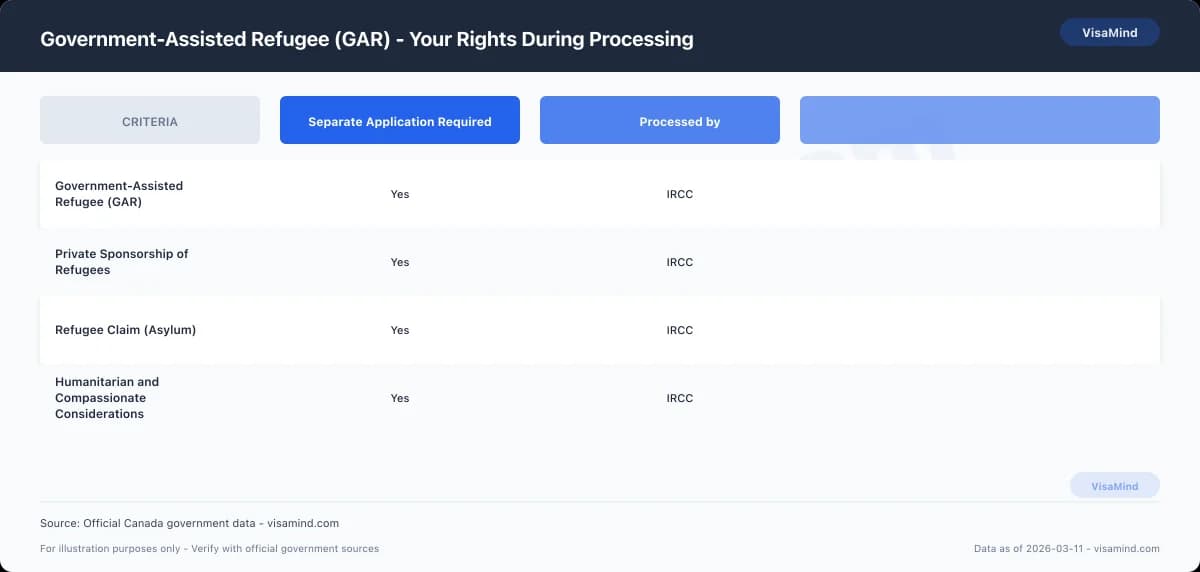
If you’re considering other pathways, keep them separate:
| Program | Separate Application Required | Processed by |
|---|---|---|
| Government-Assisted Refugee (GAR) | Yes | IRCC |
| Private Sponsorship of Refugees | Yes | IRCC |
| Refugee Claim (Asylum) | Yes | IRCC |
| Humanitarian and Compassionate Considerations | Yes | IRCC |
Don’t combine a GAR application with a Refugee Claim (Asylum) or a request based on Humanitarian and Compassionate Considerations unless IRCC tells you to do so.
Follow IRCC’s official form instructions for current requirements and any associated CA$ fees.
Timing and medical/exam requirements
Every person included in your application needs to complete required examinations.
All exams must remain valid at the same time for IRCC to finalize processing.
This applies to each family member listed on your IMM 0008, whether they travel with you or join later.
If one person’s results expire before the others, IRCC may require updated exams.
Stick to these rules:
-
Arrange required exams for all family members.
-
Complete them so results are valid together.
-
Submit proof as IRCC instructs.
You can’t finalize your GAR case if examination validity doesn’t line up across all applicants.
Monitor expiration dates and act early to avoid repeat testing or delays.
For current medical and examination instructions, check with Immigration, Refugees and Citizenship Canada (IRCC).
When to Consult a Professional
#You’re dealing with strict documentation rules and shifting country conditions in the GAR process.
Legal advice is important if your case involves errors, parallel applications, or rapidly changing conditions that could affect processing.
Situations to get legal help
Seek legal help if you’ve submitted incorrect or incomplete forms to IRCC, especially Form IMM 0008 (Generic Application Form for Canada).
Even small inconsistencies can delay or disrupt your case.
Consult a professional if your case involves:
- A prior Refugee Claim (Asylum) in Canada or another country
- A refused application under Private Sponsorship of Refugees
- A possible request for Humanitarian and Compassionate Considerations
- Missing identity or civil documents
- Concerns about admissibility raised by border authorities
A lawyer or regulated consultant can review your full package before you submit.
They make sure you include all required documents and follow IRCC’s official instructions exactly.
If you plan to pursue more than one pathway, like a GAR referral while exploring Private Sponsorship of Refugees, get coordinated advice.
Parallel processes can create conflicting information on file if you don’t manage them carefully.
Country-specific or evolving contexts
Consult a professional if your country of origin faces rapidly changing political or security conditions.
Sometimes IRCC can’t provide reliable processing timelines due to instability in certain regions.
Use this table to consider when evolving conditions justify legal review:
| Situation | Why Legal Advice Matters |
|---|---|
| Active conflict or sudden regime change | Documentation and eligibility assessments may shift |
| Disrupted embassies or visa offices | Application routing and communication may change |
| Mass displacement to neighboring countries | Processing priorities may adjust |
| Unclear identity or civil records due to conflict | Alternative evidence may be required |
If you’re affected by conditions in Afghanistan or nearby countries, expect uncertainty in processing timeframes.
A professional can monitor IRCC updates and adjust your approach.
Don’t rely on informal guidance when conditions are changing quickly.
Your application needs to stay consistent, complete, and in line with current IRCC guidance.
Processing Times and Costs
#IRCC publishes estimated timelines for Government-Assisted Refugees (GARs) and updates them regularly.
You don’t pay private sponsorship costs under this stream, but you should monitor official sources for current timelines and any required fees in CAD.
Standard processing timelines
As of March 2026, the processing time for a Government-Assisted Refugee under the “Standard” category is:
| Program | Estimated Processing Time |
|---|---|
| Government‑Assisted Refugee (Standard) | 12 to 36 months |
This estimate reflects how long IRCC expects to take to make a decision if it receives your complete application today.
Processing times vary by category and by the office handling your file.
Applications processed outside Canada may require extra time for documents and logistics.
You should check current timelines directly with IRCC before making plans.
For comparison, timelines for the Private Sponsorship of Refugees, a Refugee Claim (Asylum) made inside Canada, or applications based on Humanitarian and Compassionate Considerations follow different models and are calculated separately.
How processing times are calculated
Your processing time starts the day IRCC receives a complete application and ends when it makes a decision.
For permanent residence under the GAR program, IRCC estimates how long it may take to finalize applications submitted in a specific month and year.
The estimate reflects current inventory and operational capacity.
If your application is incomplete, IRCC may return it.
The clock doesn’t start until you submit a complete package, including required forms such as Form IMM 0008.
IRCC may also take longer to process:
- Non-routine applications
- Files needing extra review
- Applications submitted during high-volume periods
Annual immigration levels can affect timelines.
If more people apply than Canada can admit in a year, wait times may increase.
Regional, program and system notes
Processing times differ based on where IRCC processes your file.
| Factor | Impact on Timeline |
|---|---|
| Processing location | Timelines vary by office and region |
| Application volume | Higher intake can increase wait times |
| Application type | GAR, Private Sponsorship, and Asylum follow different systems |
| Completeness | Missing forms or documents delay start of processing |
If you apply from outside Canada, plan for extra time related to document transmission and coordination.
GAR applicants don’t pay private sponsorship support costs.
You should confirm any applicable government fees directly with IRCC.
If you need exact fee amounts in CA$, check IRCC’s official fee schedule before paying.
Rely on IRCC’s current published figures.
Processing estimates change and are not guarantees.
Check Fees and Costs — Government-Assisted Refugee fees
#Government-Assisted Refugees (GARs) pay certain processing fees to IRCC.
The main costs are for the permanent residence application (Form IMM 0008), biometrics, and any work permit applications.
Application and biometrics fees
You submit IMM 0008 (Generic Application Form for Canada) as part of your permanent residence process.
IRCC charges a processing fee for this application.
| Fee Type | Amount (CAD) |
|---|---|
| IMM 0008 filing fee | CA$1,525 |
| Biometrics (per person) | CA$85 |
You pay biometrics if IRCC requires fingerprints and a photo.
Each person included in the application pays the biometric fee separately.
A reduced maximum fee of CA$500 may apply if:
- All family members apply at the same time
- Everyone applies at the same location
- Your children qualify as dependent children
If you also pursue other pathways—such as Private Sponsorship of Refugees, a Refugee Claim (Asylum) inside Canada, or an application based on Humanitarian and Compassionate Considerations—separate fees may apply.
Check current amounts through IRCC’s official fee schedule before paying.
Work permit and group fee notes
As a Government-Assisted Refugee, you may apply for a work permit if eligible.
IRCC charges a fee for each work permit application or extension.
| Work Permit Fee | Amount (CAD) |
|---|---|
| Work permit (per person) | CA$155 |
You pay this fee per applicant, including extensions.
A maximum group fee may apply only if:
- You are a group of three or more performing artists, and
- The group includes associated staff
This group cap doesn’t apply to most GAR applicants.
If you file both permanent residence (IMM 0008) and a work permit, you pay each fee separately.
Always check the total before submitting payment to IRCC.
How to Apply for Protection
#Start with the correct IRCC forms and instructions.
Complete every required section accurately.
You must sign the application and submit it with all required identification and supporting evidence to the right office.
Download and start the form
Download the current Government-Assisted Refugee application package from Immigration, Refugees and Citizenship Canada (IRCC).
Use only the version available from IRCC to avoid delays.
Review the instructions carefully before you begin.
Make sure you’re applying under the right category, such as Government-Assisted Refugees, and not Private Sponsorship of Refugees, a Refugee Claim (Asylum) made inside Canada, or an application based on Humanitarian and Compassionate Considerations.
Gather your documents before filling out the forms.
This typically includes:
- Identity documents
- Civil status documents
- Any evidence supporting your need for protection
If the package includes Form IMM 0008 or other required forms, complete the most current version provided by IRCC.
Don’t use outdated copies from previous applications.
| Step | What You Must Do | Why It Matters |
|---|---|---|
| 1 | Download forms from IRCC | Ensures you use the correct version |
| 2 | Review eligibility category | Prevents filing under the wrong program |
| 3 | Collect documents | Avoids incomplete submission |
Complete the forms electronically if possible so your answers are clear and legible.
Complete, sign and submit
Fill out every required field. If a question doesn’t apply, follow the form instructions rather than leaving it blank.
Provide accurate and consistent information across all forms, including IMM 0008 if required. Inconsistent details about identity, family, or background can slow things down.
Before you send anything, make sure you’ve:
- Completed all required sections
- Signed and dated each signature field
- Included all required supporting documents
Submit the full application package to the office specified in the IRCC instructions for your category. Only send it after confirming it’s complete.
| Final Check | Confirm Before Sending |
|---|---|
| Signatures | All required signatures included |
| Forms | Correct and current versions used |
| Documents | Identity and supporting evidence attached |
| Category | Government-Assisted Refugee selected, if applicable |
Keep copies of everything you submit.
Who Qualifies for Protection
#To qualify as a Government-Assisted Refugee (GAR), you need to show that you face serious risk if you return to your home country and that you meet Canada’s protection standards. IRCC reviews your reasons for seeking protection and the documents that confirm who you are and where you’ve lived.
Grounds and reasons for a claim
Explain clearly why you cannot return to your home country. Describe the danger you face and what could happen if you go back.
Focus on specific facts:
- Events that caused you to flee
- Threats, harm, or risks you experienced
- Why authorities in your home country cannot or will not protect you
- Your current country of residence and whether you are safe there
Include a written statement that explains your fear of persecution in direct, detailed terms. General statements aren’t enough.
IRCC assesses these reasons when processing your application, including Form IMM
- If you do not qualify under the refugee category, other pathways exist, such as the Refugee Claim (Asylum) process inside Canada or an application based on Humanitarian and Compassionate Considerations. Some people may pursue the Private Sponsorship of Refugees program instead of government assistance.
You or a family member may be found ineligible if you do not meet program requirements.
Identification and supporting evidence
You must prove your identity, background, and place of residence. Provide documents that confirm who you are and where you’ve lived.
Key evidence includes:
- Passport or national identity documents
- Residence records from your current country
- Civil documents for accompanying family members
- A detailed personal statement explaining your fear
You can also submit documents that support your history and circumstances, such as medical or work records, if they relate to your claim.
The table below outlines common document types and their purpose:
| Document Type | Purpose in Application |
|---|---|
| Identity documents | Confirm your identity and nationality |
| Residence documents | Show where you currently live or previously lived |
| Personal statement | Explain risk and fear of persecution |
| Family member documents | Confirm relationship and eligibility |
Provide accurate personal details, including your telephone number and email address. Make sure all information in Form IMM 0008 matches your supporting documents.
Incomplete or inconsistent information can delay processing or affect eligibility.
Credibility and Procedural Risks
#IRCC denies or delays many Government-Assisted Refugee (GAR) applications because of avoidable form errors and credibility concerns. Submit complete, consistent, and current information to protect your case.
Common filing errors that cause denials
You risk refusal if you submit incomplete forms or missing documents. IRCC expects every required field and attachment to be present at filing.
Common errors include:
- Leaving sections of Form IMM 0008 blank
- Failing to include required identity documents
- Using an outdated version of a form
- Providing inconsistent personal details across documents
Even small discrepancies in names, dates of birth, or family details can trigger delays. IRCC may pause processing while it requests clarification, which slows your case.
Use this checklist before submission:
| Item | What to Verify |
|---|---|
| Form version | Confirm you use the current IMM 0008 from IRCC |
| Completeness | All questions answered; no unexplained gaps |
| Identity documents | All required IDs included and legible |
| Consistency | Dates and names match across every document |
Filing as a Government-Assisted Refugee does not guarantee approval. IRCC still assesses eligibility and credibility.
How credibility and form issues affect outcomes
IRCC reviews your statements for internal consistency and alignment with your documents. If your written answers conflict with your identification or prior immigration history, officers may question your credibility.
For example, if details in your GAR file differ from information in a prior Refugee Claim (Asylum) or a request based on Humanitarian and Compassionate Considerations, IRCC will scrutinize the differences. Explain any changes clearly and directly.
Form issues also affect how officers assess reliability. Incomplete answers or vague responses can appear evasive, even when that wasn’t your intent.
Credibility concerns can lead to:
- Procedural delays
- Requests for additional documents
- Refusal of the application
Accuracy strengthens your position. Review every answer for clarity, consistency, and completeness before submitting to IRCC.
Fees
#| Component | Amount |
|---|---|
| Filing fee (IMM-0008)Includes processing fee ($950) + Right of Permanent Residence Fee ($575). Spouse: $1,525. Dependent child: $260. | CA$1,525 (approx $1,113 USD) |
| BiometricsBiometrics: CA$85 (approx $62 USD) (as of 2026-02). Verify the current fee on the official schedule before filing. | CA$85 (approx $62 USD) |
Fees change; always verify on IRCC.
Required forms
#Next steps
#Use Find My Visa to build a sequenced plan with official sources and deadlines.
FAQs
Can you make a Refugee Claim (Asylum) instead of applying as a GAR?
A Refugee Claim (Asylum) is a separate in-Canada protection process.
GAR cases are resettlement applications processed outside Canada through IRCC.
Can you apply under Humanitarian and Compassionate Considerations instead?
Humanitarian and Compassionate Considerations fall under a separate application stream.
IRCC reviews each program based on its specific legal criteria.
What is the Government-Assisted Refugee (GAR) form used for?
The GAR form is used to apply for refugee status in Canada under government assistance and is designed for refugees identified through the Canadian immigration system and those identified for resettlement by the Government of Canada. It is filed with IRCC.
Who is eligible for GAR resettlement?
GAR resettlement applies to individuals who have been identified by the Government of Canada for resettlement under the Government-Assisted Refugees Program; eligibility can depend on identification and program rules and family members may have specific conditions.
How do I start an application?
Download the current government-assisted-refugee form and instructions from the official IRCC website, review the instructions for your eligibility category, then fill out all required sections with accuracy and completeness.
What must I include with my application?
Include identification and residence evidence, a statement explaining reasons for seeking refugee status and any potential danger if returned, and any extra residence documents or required supporting evidence listed in the instructions.
Are there fees to file a GAR application or related items?
Yes. Example fees noted include the filing fee (IMM-0008) at CA$1,525 and biometrics at CA$85. There are also work permit fees (e.g., CA$155 per person) and specific notes about maximum/group fees and eligibility conditions.
How long will processing take?
Processing times vary by category and location. Under 'Standard' the government-assisted-refugee processing time is estimated at 12–36 months; processing time starts when a complete application is received and ends when a decision is made. Processing times can be affected by location and mailing delays for applicants outside Canada and the U.S.
Does filing the GAR form guarantee approval?
No. Filing the government-assisted-refugee form does not guarantee approval. Incomplete or incorrect information, missing identification documents, or using outdated forms can delay or harm an application.
Where should I get the official form and instructions?
Download the form and instructions from the official IRCC website; applicants file the government-assisted-refugee with IRCC and should follow the current instructions for their eligibility category.
Are there special processing notes or exceptions I should know about?
Processing notes include that times are estimates and how they were calculated, regional differences may apply, and for certain evolving situations (for example, Afghanistan) accurate processing times may not be available—consult official notices and instructions.
Official sources referenced
Last reviewed: 2026-03-11
VisaMind provides informational guidance only and is not a government agency. This is not legal advice. Requirements can change and eligibility depends on your specific facts. If your case is complex or high-stakes, consult a licensed immigration attorney.
Next steps
Every Canada visa case depends on your nationality, purpose, and timeline. Get a personalized plan with official sources and deadlines.
Get my Government-Assisted Refugee (GAR) plan