
On this page
- Overview — Canada refugee sponsorship
- Application Process
- After Approval
- Getting Legal Help — private sponsorship refugees Canada
- Eligibility Criteria
- Rights While Pending
- Processing Times and Costs
- Credibility and Procedural Risks
- How Long It Takes
- Checking Processing Times
- Fees
- Required forms
- Related visa types
- Related goals
- Next steps
Overview — Canada refugee sponsorship
#Canada refugee sponsorship allows people in Canada to help refugees come to Canada and start a new life. IRCC manages the application process and required forms.
This pathway often connects to a Refugee Claim (Asylum) process and may involve different sponsorship categories, including private sponsorship and Government-Assisted Refugee (GAR) cases.
What this pathway is
Canada refugee sponsorship is a process that lets individuals or groups in Canada sponsor a refugee for resettlement. You take formal responsibility by submitting the required application forms to IRCC.
In private cases, sponsors use specific IRCC forms, which can include:
- Form IMM 0008 (Generic Application Form for Canada)
- Form IMM 5289 (Schedule related to sponsorship)
- Form IMM 5481 (Sponsorship financial evaluation, where applicable)
IRCC reviews the application to determine whether it meets program requirements. The refugee’s situation may relate to a prior Refugee Claim (Asylum) or may raise Humanitarian and Compassionate Considerations, depending on the case.
| Element | Description |
|---|---|
| Managing authority | Immigration, Refugees and Citizenship Canada (IRCC) |
| Main pathway link | Refugee Claim (Asylum) |
| Sponsorship type | Private sponsorship or Government-Assisted Refugee (GAR) |
| Key forms | IMM 0008, IMM 5289, IMM 5481 |
You must follow the official IRCC form instructions for current requirements and submission details.
Who is involved
Several parties take part in a refugee sponsorship case. Each has a defined role in the process.
You (the sponsor) may apply as:
- An individual in Canada
- A group in Canada
You submit the sponsorship application and supporting forms to IRCC. Your role includes completing the required documentation accurately and meeting program conditions set by IRCC.
The refugee applicant completes required forms such as IMM 0008 and provides personal information for assessment. Their case may connect to a Refugee Claim (Asylum) or other humanitarian grounds.
IRCC reviews the sponsorship and refugee applications. IRCC makes decisions on eligibility and admissibility under Canadian immigration law.
In some cases, the refugee may fall under the Government-Assisted Refugee (GAR) category rather than private sponsorship. In all cases, IRCC remains the decision-making authority.
Application Process
#
You must use the correct IRCC forms, complete every required field, and submit a full package with supporting evidence. IRCC will not process incomplete or unsigned applications.
Forms and instructions
Start on the Immigration, Refugees and Citizenship Canada (IRCC) website and select the refugee sponsorship category that matches your case. Private sponsors use different packages than applicants making a Refugee Claim (Asylum) inside Canada or requesting Humanitarian and Compassionate Considerations.
Download the most recent versions of all required forms and their instruction guides. IRCC updates forms regularly, so check the date modified before you begin.
Common forms include:
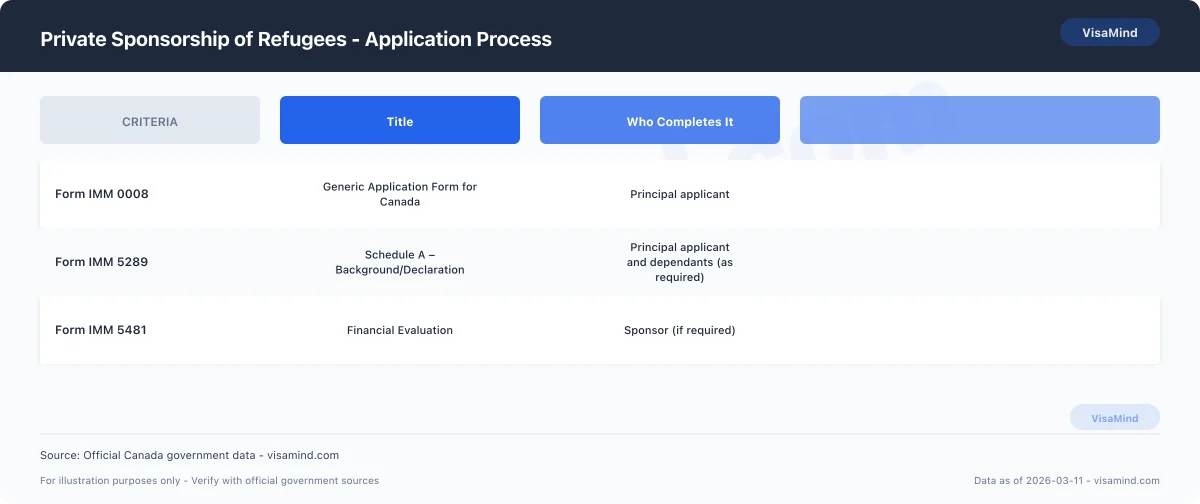
| Form Number | Title | Who Completes It |
|---|---|---|
| Form IMM 0008 | Generic Application Form for Canada | Principal applicant |
| Form IMM 5289 | Schedule A – Background/Declaration | Principal applicant and dependants (as required) |
| Form IMM 5481 | Financial Evaluation | Sponsor (if required) |
Sponsors must also complete the correct Sponsorship Undertaking and Settlement Plan form, depending on whether they apply as a Sponsorship Agreement Holder, Group of Five, or Community Sponsor.
Read the instruction guide line by line before you fill out anything. The guide explains eligibility rules, required signatures, and which documents you must attach.
Filling and submitting the package
Complete every section of each form. Do not leave gaps unless the form instructs you to write “Not Applicable.”
You must:
-
Answer all background and personal history questions fully.
-
Provide current contact details, including telephone and email.
-
Sign and date all signature fields.
-
Include forms for each family member, if required.
Exams and supporting documents for every person in the application must be valid at the same time when you submit.
Before sending your package, review the document checklist for your category. Use it to confirm that you included all forms and supporting documents in the correct order.
Submit the complete application to the office specified in your instruction guide. Do not send it to a general IRCC address unless the guide directs you to do so.
If you appoint a representative, include the Use of a Representative form in the same package.
Required sponsor evidence
IRCC requires proof that you can financially and practically support the refugee for the full sponsorship period.
You must provide clear evidence of financial capacity. This typically includes:
- Recent financial documents showing income or available funds
- Proof of employment or other income sources
- Documents confirming your legal status in Canada
- A completed financial evaluation form, such as IMM 5481, if required
Sponsors must also submit a detailed settlement plan. This plan explains how you will provide housing, income support, and basic settlement assistance after arrival.
If you apply as a Group of Five or Community Sponsor, include the correct Sponsorship Undertaking and Settlement Plan form for that category. Each sponsor listed must meet eligibility requirements and provide supporting documents.
Incomplete financial evidence or missing settlement details often lead to delays or returned applications.
After Approval
#Once IRCC approves the sponsorship, your legal and practical responsibilities begin immediately. You must provide both financial and emotional support for the full commitment period you agreed to in your application forms.
Sponsor obligations on arrival
You take responsibility for supporting the refugee or refugee family from the moment they arrive in Canada. This obligation forms part of the undertaking you submitted to IRCC.
Your role includes:
- Providing financial support for basic living needs
- Offering emotional support and settlement assistance
- Following the terms set out in your sponsorship forms, such as Form IMM 5289 and Form IMM 5481
- Ensuring the information provided in forms like Form IMM 0008 remains accurate where applicable
If you are part of a group sponsorship, IRCC assesses the group’s ability to meet these obligations before approval. That assessment focuses on your financial capacity and your plan to support the refugee’s adjustment.
This commitment differs from a Government-Assisted Refugee (GAR) case, where the government provides support. In a private sponsorship, you—not the government—carry that responsibility.
| Responsibility Type | Your Role as Sponsor |
|---|---|
| Financial support | Cover basic living costs for the agreed period |
| Emotional support | Help with adjustment and integration |
| Compliance | Follow terms approved by IRCC |
Support expectations
You must deliver the level of support you promised in your application. IRCC expects consistency between what you declared and what you provide.
Financial support must be sufficient to meet essential needs throughout the agreed period. Emotional support must be ongoing, practical, and responsive to the refugee’s situation.
Your obligation is separate from other immigration processes such as a Refugee Claim (Asylum) made inside Canada or an application based on Humanitarian and Compassionate Considerations. In a sponsorship case, IRCC approved your undertaking based on your stated ability to support.
If you fail to meet your obligations, IRCC can review your compliance. You should keep clear records of the support you provide and ensure your sponsoring group remains actively involved for the entire commitment period.
Getting Legal Help — private sponsorship refugees Canada
#Private sponsorship cases often turn on eligibility and past sponsorship history. Legal help becomes important when IRCC questions your ability to sponsor or raises concerns about previous undertakings.
When to get help
Seek legal advice before you submit forms if you are unsure about your eligibility as a sponsor. IRCC reviews your past sponsorships and their outcomes, and problems in earlier cases can affect your current application.
You should also get help if IRCC requests clarification about forms such as Form IMM 0008, Form IMM 5289, or Form IMM 5481. Errors or inconsistent information can delay processing or lead to refusal.
Consider legal support if:
- You previously sponsored someone and the outcome was negative or unresolved
- You are unsure whether your past undertakings affect your current eligibility
- A family member included in the application may not meet eligibility rules
- IRCC sends procedural fairness or eligibility concerns
A lawyer can review your file before submission and identify risks that could make you ineligible as a private sponsor.
| Situation | Why Legal Help Matters |
|---|---|
| Prior sponsorship refused or withdrawn | May affect current eligibility |
| Sponsored person did not meet obligations | IRCC may reassess your suitability |
| Unclear answers on required forms | Inconsistencies can trigger review |
Complex eligibility or history
Complex history requires careful analysis. If you or a co-sponsor have prior sponsorships, IRCC will assess how those cases concluded and whether you met your obligations.
Issues can arise when:
- A previous sponsored refugee did not complete the process
- You signed past undertakings with unresolved outcomes
- A family member’s eligibility is uncertain
Legal counsel can review your sponsorship record and explain how IRCC may interpret it. This is especially important if your case intersects with other processes such as a Refugee Claim (Asylum) in Canada, a Government-Assisted Refugee (GAR) file, or an application based on Humanitarian and Compassionate Considerations.
If eligibility concerns exist, address them before filing. You reduce the risk of refusal by submitting a complete and consistent application that accounts for your full sponsorship history.
Eligibility Criteria
#You must qualify as an approved sponsor type and meet IRCC’s requirements before you submit a refugee sponsorship application. IRCC assesses both who you are and the category under which you apply.
Who can sponsor
IRCC recognizes specific private sponsor types. You cannot sponsor a refugee unless you fall into one of the approved categories.
Eligible sponsors include:
- Sponsorship Agreement Holders (SAHs)
- Groups of Five
- Community Sponsors
Each type has its own structure and application process, but all must submit required forms and supporting documents to IRCC. These may include forms such as Form IMM 0008, Form IMM 5289, and Form IMM 5481, depending on the case and sponsorship stream.
You must follow IRCC’s document checklist exactly. Incomplete applications delay processing or result in refusal.
This process applies to private refugee sponsorship. It does not replace a Refugee Claim (Asylum) made inside Canada, nor does it convert a case into a Government-Assisted Refugee (GAR) referral. Applications based on Humanitarian and Compassionate Considerations follow separate legal criteria.
Sponsor categories
IRCC groups private sponsors into three main categories.
| Sponsor Category | Who Forms It | Key Feature |
|---|---|---|
| Sponsorship Agreement Holder (SAH) | Incorporated organization with a formal agreement with IRCC | Ongoing authority to sponsor refugees |
| Group of Five | Five or more eligible individuals | Joint responsibility for one or more refugees |
| Community Sponsor | Organization, association, or corporation | Sponsors without a formal SAH agreement |
If you apply as a Group of Five, you act collectively. Each member shares responsibility for the sponsorship undertaking submitted to IRCC.
If you apply as a Community Sponsor, your organization assumes legal responsibility for supporting the sponsored refugee under IRCC’s terms.
IRCC reviews the sponsor category first. If you do not meet the structural requirements of your chosen category, IRCC will not process the sponsorship further.
Rights While Pending
#While IRCC processes your application, you may seek authorization to work and must continue meeting any conditions tied to your status. You also need to keep your application complete and consistent with the forms you submitted, such as Form IMM 0008, Form IMM 5289, or Form IMM 5481, depending on your pathway.
Work and permits
You may apply for a work permit while your refugee sponsorship, Refugee Claim (Asylum), or Humanitarian and Compassionate Considerations application remains in process with IRCC.
IRCC charges the following fee for a work permit, including extensions:
| Permit Type | Fee (CA$) | Per Person |
|---|---|---|
| Work permit (including extensions) | 155 | Yes |
You must submit the correct forms and pay the required fee for each person applying. If your family members apply together at the same time and place, and your children qualify as dependants, you may qualify to pay a maximum total fee of CA$500 for the group.
If you apply under a Government-Assisted Refugee (GAR) program or through private sponsorship, confirm with IRCC which work authorization steps apply to your file. Check the official IRCC fee schedule for any updates before you pay.
Other interim requirements
You need to keep your application accurate and up to date while it’s pending.
That means:
- Ensuring all required forms (like IMM 0008, IMM 5289, or IMM 5481) are complete and truthful
- Paying all required fees in full
- Applying at the same time and location if you want family fee caps
- Confirming that each child qualifies as a dependant before including them in a capped fee request
IRCC reviews your eligibility based on what you provide.
If your situation changes, follow IRCC’s instructions to update your file.
Processing Times and Costs
#IRCC processing times depend on the sponsorship stream and the complexity of your case.
Your total cost varies based on which forms you file and whether biometrics are required.
You’ll need to budget for government filing fees and be ready for delays if IRCC asks for more documents.
Fees and payment notes
IRCC charges specific fees depending on your application.
For example, the filing fee for Form IMM 0008 (Generic Application Form for Canada) is CA$1,525.
If biometrics are needed, you must also pay:
| Fee type | Amount (CAD) |
|---|---|
| Filing fee (IMM 0008) | CA$1,525 |
| Biometrics | CA$85 |
Fees are paid directly to IRCC when you apply.
If your payment is incomplete, IRCC can return your package without processing.
Government-Assisted Refugee (GAR) and private sponsorship cases may involve different forms, including Form IMM 5289 and Form IMM 5481, depending on sponsor type.
For the correct fee, refer to the IRCC fee calculator before submitting.
If you’re making a Refugee Claim (Asylum) inside Canada or applying under Humanitarian and Compassionate Considerations, requirements differ by pathway.
Group fee rules
Most refugee sponsorship applications don’t qualify for group rate reductions.
IRCC does set a maximum group fee for certain work permit applications.
To qualify for the maximum group fee, you must meet all of these:
- You’re a group of three or more performing artists and their staff
- You apply at the same time
- You apply at the same location
If you don’t meet every condition, IRCC charges individual fees.
This rule doesn’t automatically cover private refugee sponsorship groups or GAR cases.
When preparing group applications tied to refugee resettlement, check if each person must pay separate biometrics fees.
IRCC usually assesses biometrics per applicant unless there’s a specific exemption.
Credibility and Procedural Risks
#Mistakes in documentation and unrealistic expectations often cause sponsorship files to stall or fail.
You have to submit complete, current forms—IRCC reviews every case independently, even if sponsors meet eligibility.
Common filing mistakes
IRCC often delays files because sponsors send incomplete or outdated forms.
This happens with older versions of Form IMM 0008, Form IMM 5289, or Form IMM 5481 that don’t match current requirements.
Review each form carefully and fill out every field.
Missing signatures, blank sections, or inconsistent answers can stop processing.
Financial documentation is another trouble spot.
If you don’t provide full and accurate proof of your financial situation, IRCC can’t assess your eligibility as a sponsor.
Common errors include:
- Outdated application forms
- Blank required fields
- Incomplete financial records
- Missing supporting documents
| Risk Area | What Goes Wrong | Result |
|---|---|---|
| Forms | Outdated or unsigned IMM forms | Application returned or delayed |
| Financial proof | Missing documentation | Inability to assess sponsorship eligibility |
| Information accuracy | Incomplete or inconsistent details | Processing delays |
Even minor inconsistencies can trigger credibility concerns.
IRCC expects accuracy across all documents.
Approval is not guaranteed
Submitting a private refugee sponsorship application doesn’t guarantee approval.
IRCC evaluates the refugee’s eligibility and admissibility separately from your willingness to sponsor.
This applies whether it’s a privately sponsored refugee, a Government-Assisted Refugee (GAR), or a related pathway like a Refugee Claim (Asylum) or an application based on Humanitarian and Compassionate Considerations.
Completing paperwork isn’t enough.
IRCC must determine that the refugee meets legal requirements.
-
Sponsorship eligibility and refugee eligibility are separate.
-
A complete file doesn’t ensure a positive decision.
-
IRCC may refuse the application if requirements aren’t met.
Prepare your application knowing review is discretionary and evidence matters.
How to avoid delays
You lower your risk by following IRCC’s official instructions for each form and document.
Don’t rely on old checklists or informal advice.
Before submitting, take these steps:
- Use the latest versions of IMM 0008, IMM 5289, and IMM 5481
- Check every answer for completeness and consistency
- Include all required financial documentation
- Make sure all signatures and dates are present
Here’s a structured review process:
| Step | Action |
|---|---|
| 1 | Download current forms directly from IRCC |
| 2 | Complete every section, even if the answer is “Not Applicable” |
| 3 | Cross-check financial information for accuracy |
| 4 | Match supporting documents to each checklist item |
Accuracy supports your credibility.
Careful preparation reduces the risk of return, delay, or refusal.
How Long It Takes
#Canada refugee sponsorship processing times depend on the program and the complexity of your case.
Most complete private sponsorship applications fall within a defined range, but external factors can lengthen your wait.
Standard processing ranges
For refugee private sponsorship, the typical processing time is 12 to 36 months as of March 2026.
This range is program‑dependent, and IRCC posts current estimates through its processing times tool.
| Program type | Standard processing time |
|---|---|
| Refugee – Private Sponsorship | 12–36 months |
IRCC aims to process most complete applications within the posted timeframe.
This applies when you submit required forms like Form IMM 0008, Form IMM 5289, and Form IMM 5481, and your file doesn’t need extra review.
If the sponsored person lives outside Canada or the United States, add 3 to 4 months for mailing and document transfer.
That extension covers logistics, not decision-making.
In some regions, including Afghanistan and neighboring countries, IRCC has indicated timelines may not be available due to changing conditions.
You should check current timelines with Immigration, Refugees and Citizenship Canada (IRCC) before submitting.
Factors affecting timelines
Your case may take longer if IRCC classifies it as non-routine.
Non-routine cases often need more review, updated documentation, or further eligibility assessment.
Processing times can also go up when:
- Annual immigration targets are reached or nearly full
- Application volumes exceed the number of refugees Canada can admit that year
- Required forms or supporting documents are incomplete
Program type matters.
For example:
- Government-Assisted Refugee (GAR) cases follow different intake and allocation processes.
- A Refugee Claim (Asylum) made inside Canada uses a separate system.
- Applications based on Humanitarian and Compassionate Considerations are assessed under different criteria.
IRCC controls application processing.
Canada Border Services Agency (CBSA) handles border admissibility, which can affect timelines if concerns arise during screening.
You can reduce delays by submitting a complete, accurate application and responding quickly to any IRCC requests.
Checking Processing Times
#IRCC measures processing times from the day it receives your complete application to the day it makes a decision.
Times vary by program, category, and location, especially for private sponsorship and permanent residence cases.
How processing time is calculated
IRCC starts the clock the day it gets your complete application package.
It stops when a decision is made.
A “complete application” means you sent all required forms and documents, such as:
- Form IMM 0008 (Generic Application Form for Canada)
- Form IMM 5289 (Schedule A – Background/Declaration, if required)
- Form IMM 5481 (Sponsorship Evaluation, for private sponsors)
If IRCC returns your package as incomplete, processing doesn’t begin.
The time only starts once IRCC receives a complete resubmission.
IRCC publishes estimated times based on the month and year applications were submitted.
The estimate shows how long similar applications have taken to reach a decision.
| Start Date | End Date | What It Covers |
|---|---|---|
| Date IRCC receives complete file | Date IRCC makes a decision | Full assessment and decision-making period |
For permanent residence under refugee streams, the same start‑to‑decision rule applies.
Technical and location notes
You need a web browser with JavaScript enabled to view current processing times on the IRCC system.
If the tool doesn’t load, update your browser settings.
Processing times differ by:
- Program type (e.g., Government-Assisted Refugee (GAR) vs. private sponsorship)
- Processing office location
- Application category
Private sponsorship cases may move at different speeds depending on where IRCC processes the file.
Refugee Claim (Asylum) applications use a separate protection process from overseas sponsorship.
Always check the current estimate directly with Immigration, Refugees and Citizenship Canada (IRCC).
Posted times are projections, not guarantees.
Special cases and exceptions
Different refugee pathways have different timelines.
- Government-Assisted Refugee (GAR) cases go through coordinated government processing.
- Private sponsorship cases depend on sponsor eligibility and submitted financial assessments like IMM 5481.
- Refugee Claim (Asylum) applications made inside Canada follow a separate protection system.
- Applications based on Humanitarian and Compassionate Considerations may involve extra review.
If your file needs additional documents or clarification, IRCC may pause until you respond.
Delays also happen if forms are missing signatures or required details.
Processing time estimates reflect typical cases.
Complex histories, incomplete forms, or extra review needs can extend your timeline.
Monitor your application status through IRCC and respond promptly to any requests.
Fees
#| Component | Amount |
|---|---|
| Filing fee (IMM-0008)Includes processing fee ($950) + Right of Permanent Residence Fee ($575). Spouse: $1,525. Dependent child: $260. | CA$1,525 (approx $1,113 USD) |
| BiometricsBiometrics: CA$85 (approx $62 USD) (as of 2026-02). Verify the current fee on the official schedule before filing. | CA$85 (approx $62 USD) |
Fees change; always verify on IRCC.
Next steps
#Use Find My Visa to build a sequenced plan with official sources and deadlines.
FAQs
Can you apply under Humanitarian and Compassionate Considerations instead?
Humanitarian and Compassionate Considerations are reserved for specific, limited situations.
Applicants need to demonstrate compelling personal circumstances.
Check eligibility requirements with IRCC before submitting an application.
Who is eligible to be a private sponsor?
Eligible sponsors include Community Sponsors, Groups of Five, and Sponsorship Agreement Holders.
What is the Private Sponsorship of Refugees form used for?
The form is used by individuals or groups in Canada who wish to sponsor refugees so they can come to Canada and start a new life, and it is filed with IRCC.
What obligations do sponsors take on?
Sponsors commit to provide financial and emotional support to the refugee or refugee family for a specific period and must provide details about their ability to support the refugee.
Where do I find the application forms and instructions?
Download the current refugee-private-sponsorship form and instructions from the official IRCC website and follow the program-specific instructions; there may be multiple forms to submit together.
What documents should sponsors include with their application?
Sponsors should include proof of ability to support the refugee (financial documents), required personal information (telephone, email, SIN, financial, medical, or work details), and any extra documents such as residence documents; exams for every person must all be valid at the same time when applicable.
What are common mistakes that delay processing?
Common mistakes include failing to include complete financial documentation and submitting outdated versions of the sponsorship forms.
How long does private sponsorship processing usually take?
Processing time for refugee-private-sponsorship under the standard category is typically 12 to 36 months; processing times vary by category and location, so verify with IRCC.
What fees apply to sponsorship and related permits?
Relevant fees include the IMM-0008 filing fee (CA$1,525 as of 2026-02) and biometrics (CA$85 as of 2026-02); other fee notes apply for work permits and group maximums under certain conditions.
Does filing a sponsorship application guarantee approval?
No — filing refugee-private-sponsorship does not guarantee approval.
How should I check current processing times and are there technical notes?
Check IRCC processing times online; processing time estimates start the day a complete application is received. Note technical requirements (for example, a browser with JavaScript enabled) and special location or country exceptions that can affect accuracy.
Official sources referenced
Last reviewed: 2026-03-11
VisaMind provides informational guidance only and is not a government agency. This is not legal advice. Requirements can change and eligibility depends on your specific facts. If your case is complex or high-stakes, consult a licensed immigration attorney.
Next steps
Every Canada visa case depends on your nationality, purpose, and timeline. Get a personalized plan with official sources and deadlines.
Get my Private Sponsorship of Refugees plan