Rural Northern Immigration Pilot: Overview
#The Rural and Northern Immigration Pilot (RNIP) creates a direct pathway to permanent residence for skilled foreign workers who want to settle in smaller Canadian communities. IRCC manages permanent residence applications under this pilot.
Program summary
The Rural and Northern Immigration Pilot (RNIP) is a community-driven immigration program. It allows skilled foreign workers to pursue permanent residence if they plan to live and work in participating smaller communities in Canada.
Communities play a central role in identifying candidates who meet local labour needs. IRCC then processes the permanent residence application.
RNIP operates separately from federal pathways like Express Entry (Federal Skilled Worker) and the Provincial Nominee Program (PNP). It’s its own stream and doesn’t require you to apply through those programs.
| Feature | Rural and Northern Immigration Pilot |
|---|---|
| Managed by | Immigration, Refugees and Citizenship Canada (IRCC) |
| Focus | Smaller Canadian communities |
| Outcome | Permanent residence |
| Approach | Community-driven selection |
You must submit the required permanent residence forms to IRCC, including Form IMM 0008 and any program-specific forms such as Form IMM 5911, as applicable.
Who the program targets
RNIP is designed for skilled foreign workers who want to live and work in smaller Canadian communities rather than large urban centres.
You need to show a genuine intention to reside in the participating community that supports your application. The program’s focus is filling local workforce needs identified by those communities.
The pilot is a good fit if:
- You are a skilled foreign worker.
- You want to live and work in a smaller Canadian community.
- You seek permanent residence through a community-supported pathway.
- You’re ready to submit a permanent residence application to IRCC.
Unlike broader federal programs, RNIP emphasizes your commitment to a specific community. Your application must reflect that community’s labour needs and long-term settlement goals.
Application Process (RNIP Canada)
#You apply for permanent residence through IRCC after you receive a community recommendation under the Rural and Northern Immigration Pilot. Submit the correct forms, supporting documents, and, if eligible, you may request a work permit to work while your file is in process.
Before you apply
Confirm you meet the eligibility criteria for the Rural and Northern Immigration Pilot and that a participating community has recommended you. Review the program instructions provided by IRCC before completing any forms.
Download the most current application package and guide directly from IRCC. Outdated versions can cause problems.
Focus on these steps:
- Review instructions for your specific eligibility category
- Download the document checklist
- Gather civil, employment, and residence documents
- Prepare personal details (telephone, email, SIN, financial, medical, work history)
Complete each task in the order listed on the official checklist. This approach helps reduce errors and missing documents.
RNIP is separate from the Provincial Nominee Program (PNP) and Express Entry (Federal Skilled Worker). Unless IRCC specifically instructs you otherwise, don’t submit forms for those programs.
Forms, checklist and submission
You must complete all required IRCC forms included in the RNIP package. This typically includes:
| Form | Purpose |
|---|---|
| Form IMM 0008 | Generic Application Form for Canada (permanent residence) |
| Form IMM 5911 | RNIP-specific form and instructions |
| Document Checklist | Lists required forms and supporting documents |
Answer every question fully and truthfully. If a section doesn’t apply, follow the form instructions.
As you prepare your package:
- Check each item off the document checklist
- Arrange documents in the order shown
- Place the completed checklist on top
- Sign all required forms
Submit your complete package to IRCC as instructed in the guide. Missing signatures or documents can lead to your application being returned without processing.
For current processing fees in Canadian dollars, refer to the IRCC fee schedule.
Work permits and employer requirements
If you qualify, you may apply for a work permit at the same time as your permanent residence application. This lets you work while IRCC processes your RNIP file.
You need to include the required personal and employment information with your work permit request. Prepare:
- Employer details
- Job information
- Proof of residence documents, if requested
- Financial and medical information, where required
Your employer must meet the RNIP employer requirements set by the participating community. You must continue to meet the conditions tied to your job offer while your application is in process.
IRCC assesses your permanent residence application. The Canada Border Services Agency (CBSA) determines admissibility if you seek entry at a port of entry.
Path to Citizenship
#
After you receive permanent residence through the Rural and Northern Immigration Pilot, you can work toward Canadian citizenship by maintaining your status and meeting federal requirements. Your route depends on how you obtained permanent residence and whether you later use programs such as Express Entry or a Provincial Nominee Program.
Common pathways after RNIP
The Rural and Northern Immigration Pilot leads to permanent residence once IRCC approves your application. You apply using forms such as Form IMM 0008 and Form IMM 5911, plus supporting documents required by IRCC.
After becoming a permanent resident, you may later pursue options for family members or career mobility, including:
- Express Entry (Federal Skilled Worker Program)
- Provincial Nominee Program (PNP)
- Other federal or provincial economic streams managed by IRCC
These programs do not replace your RNIP status. They may offer additional options if you change provinces or want to support a spouse’s separate immigration plan.
| Pathway | Managed By | Purpose |
|---|---|---|
| Rural and Northern Immigration Pilot | IRCC + participating communities | Direct path to permanent residence |
| Express Entry (Federal Skilled Worker) | IRCC | Points-based federal economic immigration |
| Provincial Nominee Program (PNP) | Provinces + IRCC | Provincial nomination leading to PR |
You must continue to meet your permanent resident residency obligations to keep your status valid.
Next steps toward citizenship
Permanent residence through the Rural and Northern Immigration Pilot allows you to apply for Canadian citizenship once you meet federal eligibility rules set by IRCC.
You must:
- Maintain valid permanent resident status
- Meet physical presence requirements in Canada
- File required taxes, if applicable
- Meet language and knowledge requirements, if required by law at the time you apply
IRCC processes citizenship applications separately from your RNIP file. Citizenship is not automatic.
You submit a formal citizenship application to IRCC after confirming you meet all criteria. Processing times, document checklists, and requirements are set by IRCC and may change.
CBSA may assess admissibility issues at the border, but IRCC decides citizenship applications. Keep your records organized and make sure you comply with residency and legal obligations before applying.
When to Get Help
#Some Rural and Northern Immigration Pilot applications move smoothly. Others raise issues that require careful review of your forms, documents, and eligibility pathway.
Complex cases and red flags
Seek professional guidance if your situation does not fit a straightforward application under the Rural and Northern Immigration Pilot.
Common red flags include:
- Incomplete or inconsistent answers on Form IMM 0008 or Form IMM 5911
- Missing supporting documents required by IRCC
- Uncertainty about whether you qualify under the Rural and Northern Immigration Pilot, the Provincial Nominee Program (PNP), or Express Entry (Federal Skilled Worker)
- Prior refusals from IRCC
Errors on core forms can delay processing or lead to refusal. IRCC expects clear, consistent information across all documents. If your employment history, identity documents, or immigration history contain gaps or discrepancies, address them before submission.
| Issue | Why It Matters | What to Do |
|---|---|---|
| Incomplete forms | IRCC may return or refuse the application | Review official form guides carefully |
| Conflicting information | Raises credibility concerns | Align all dates and details |
| Multiple possible programs | Risk of applying under the wrong stream | Confirm correct pathway before filing |
If you are unsure, consult the official IRCC instructions or seek qualified advice.
Expert tips
Start with the official IRCC application guide for the Rural and Northern Immigration Pilot. Follow every document checklist exactly as written.
You must:
- Complete all required forms, including IMM 0008 and IMM 5911, fully and accurately
- Provide every document listed in the instructions
- Ensure your information matches across all forms and supporting records
Do not assume requirements mirror the Provincial Nominee Program (PNP) or Express Entry (Federal Skilled Worker). Each program has distinct criteria and documentation standards.
Before you submit:
-
Review each form line by line.
-
Confirm all signatures and dates are present.
-
Compare your application against the official IRCC document checklist.
If you can’t confirm that your file meets every listed requirement, get help before you apply. Fixing mistakes after submission is much more difficult.
Fees and Processing Times
#You will pay government processing fees to IRCC and should expect a long processing period. Costs depend on your application type and family size, and processing under this pilot typically takes more than a year.
Fees overview
IRCC charges fees at the permanent residence stage under the Rural and Northern Immigration Pilot.
| Fee type | Amount (CA$) | Notes |
|---|---|---|
| Permanent residence application (Form IMM 0008) | 1,525 | Per principal applicant |
| Biometrics | 85 | Per person, if required |
| Work permit (including extensions) | 155 | Per person |
You submit your permanent residence application using Form IMM 0008. The CA$1,525 fee applies to the principal applicant. IRCC also charges CA$85 for biometrics if you must provide fingerprints and a photo.
If you include eligible family members, you must pay applicable fees for each person. A maximum fee of CA$500 may apply in limited cases when all family members apply together at the same time and place and the children qualify as dependants.
Some candidates apply for a work permit while waiting for permanent residence. IRCC charges CA$155 per person for a work permit or extension.
Always confirm current fees using the IRCC fee schedule before you submit. Fees can change without notice.
High-level processing time estimate
IRCC lists a standard processing time of 12 to 24 months for applications under the Rural and Northern Immigration Pilot, as of March 2026.
This range reflects permanent residence processing after you submit a complete application, including Form IMM 0008 and supporting documents. Actual timelines vary based on:
- Your application category
- The visa office or processing location
- Whether IRCC requests additional documents
You do not apply through Express Entry (Federal Skilled Worker) for this pilot. It operates outside the Express Entry system and is separate from the Provincial Nominee Program (PNP), although both also lead to permanent residence.
IRCC updates timelines regularly, and your case may move faster or slower than the posted range.
Eligibility Requirements
#To qualify under the Rural and Northern Immigration Pilot, you must meet both federal standards set by IRCC and the specific requirements of the community where you plan to live and work. You also need a valid job offer from an employer located in a participating community.
IRCC and community criteria
You must meet two layers of eligibility: IRCC rules and community-based criteria.
At the federal level, IRCC checks if you satisfy program requirements and confirms admissibility for you and your accompanying family members.
When applying for permanent residence, submit the required forms, including Form IMM 0008, and any pilot-specific documents like Form IMM 5911, as directed by IRCC.
All required exams and supporting documents for you and your family members must remain valid at the same time. If one person’s results expire, it can affect the entire application.
You must:
- Meet IRCC eligibility requirements for the Rural and Northern Immigration Pilot
- Keep all required exams valid for every included person
- Ensure no one in your family is ineligible under IRCC rules
Each participating community sets its own criteria. You must meet those local requirements before the community will recommend you to IRCC.
| Requirement Type | Who Sets It | What You Must Do |
|---|---|---|
| Federal eligibility | IRCC | Meet program rules and submit complete application |
| Community criteria | Participating community | Meet local requirements and obtain recommendation |
| Document validity | IRCC | Keep all required exams valid at the same time |
The Rural and Northern Immigration Pilot operates separately from programs such as the Provincial Nominee Program (PNP) and Express Entry (Federal Skilled Worker), even though all are managed by IRCC.
RNIP Canada: participating communities
You need an eligible job offer from an employer located in a participating rural or northern community.
Without a qualifying job offer in a participating community, you can’t apply under this pilot. The employer must operate within the geographic boundaries of that community.
Your steps are:
-
Identify a participating community.
-
Obtain an eligible job offer from an employer in that community.
-
Meet both IRCC and that community’s specific criteria.
Each community applies its own screening standards before issuing a recommendation. You’ll need to follow the local process and provide the required documentation.
If you or a family member fails to meet either IRCC or community requirements, your application under the Rural and Northern Immigration Pilot will not proceed.
Why PR Applications Fail
#Most refusals under the Rural and Northern Immigration Pilot stem from missing mandatory elements or failing to meet a specific community’s criteria.
IRCC assesses both your eligibility and the completeness of your application.
Common refusal reasons
IRCC refuses applications that do not meet community-specific requirements. Each participating community sets its own criteria, and you must meet those exact standards before you apply for permanent residence.
A frequent problem is the absence of a valid job offer from a participating community. Without this, your application under the Rural and Northern Immigration Pilot does not meet core program requirements.
IRCC also returns or delays files with incomplete or incorrect forms. Common errors include:
- Missing answers on Form IMM 0008
- Incorrect or incomplete information on Form IMM 5911
- Omitted supporting documents required in the checklist
- Inconsistencies between forms and supporting records
Filing under this pilot doesn’t guarantee approval. IRCC reviews your application independently, even if you qualify under other pathways such as the Provincial Nominee Program (PNP) or Express Entry (Federal Skilled Worker).
| Refusal Trigger | What Happens |
|---|---|
| No valid job offer from a participating community | Application refused |
| Failure to meet community criteria | Application refused |
| Incomplete forms (IMM 0008, IMM 5911) | Return or processing delay |
| Missing documents | Return or refusal |
How to avoid refusals
Start by confirming you meet all requirements set by your specific community. Eligibility under Express Entry (Federal Skilled Worker) or a Provincial Nominee Program (PNP) doesn’t make you eligible for this pilot.
Before you submit, take these steps:
-
Review every field on IMM 0008 and IMM 5911 for accuracy and completeness.
-
Match your answers across all forms to ensure consistency.
-
Follow the document checklist exactly as issued by IRCC.
-
Confirm that your job offer comes from an employer in a participating community.
Use a simple verification table before filing:
| Item to Verify | Confirmed (Yes/No) |
|---|---|
| Job offer from participating community | |
| All community criteria met | |
| IMM 0008 complete and signed | |
| IMM 5911 complete and signed | |
| All required documents attached |
Submit only after you can check “Yes” to every item. Careful review helps prevent avoidable delays and refusals.
How processing times work
#IRCC measures processing times from the day it receives your complete application to the day it makes a decision.
Times are estimates and can change based on application volume and completeness.
How IRCC calculates times
IRCC starts the clock the day it receives your full application package for the Rural and Northern Immigration Pilot. This includes required forms such as Form IMM 0008 and, where applicable, Form IMM 5911, along with all supporting documents.
The clock stops when IRCC makes a decision on your permanent residence application.
IRCC publishes processing times as estimates. These estimates reflect how long it may take to finalize applications submitted in a specific month and year. They also show how long IRCC expects it would take to process an application received today.
- Incomplete applications delay processing.
- Non-routine files take longer to review.
- Higher annual application volumes can extend timelines beyond posted estimates.
| Stage | When It Starts | When It Ends |
|---|---|---|
| Permanent residence processing | Date IRCC receives your complete application | Date IRCC makes a decision |
The same general calculation method applies whether you apply through the Rural and Northern Immigration Pilot, the Provincial Nominee Program (PNP), or Express Entry (Federal Skilled Worker), but timelines differ by program.
Exceptions, location and mailing delays
Your location affects how long the full process takes.
If you live outside Canada or the United States, add 3 to 4 months to account for mailing time. This applies to permanent residence applications, including those under the Rural and Northern Immigration Pilot.
Mailing delays also affect applications for:
- Minors (under 18) who live outside Canada or the United States
- Applicants submitting paper-based packages
IRCC can’t always provide accurate processing times during rapidly changing international situations. In those cases, published timelines may not reflect real-time conditions.
Processing times may increase if:
- IRCC receives more applications than annual immigration levels allow
- Your file requires additional review as a non-routine case
Fees
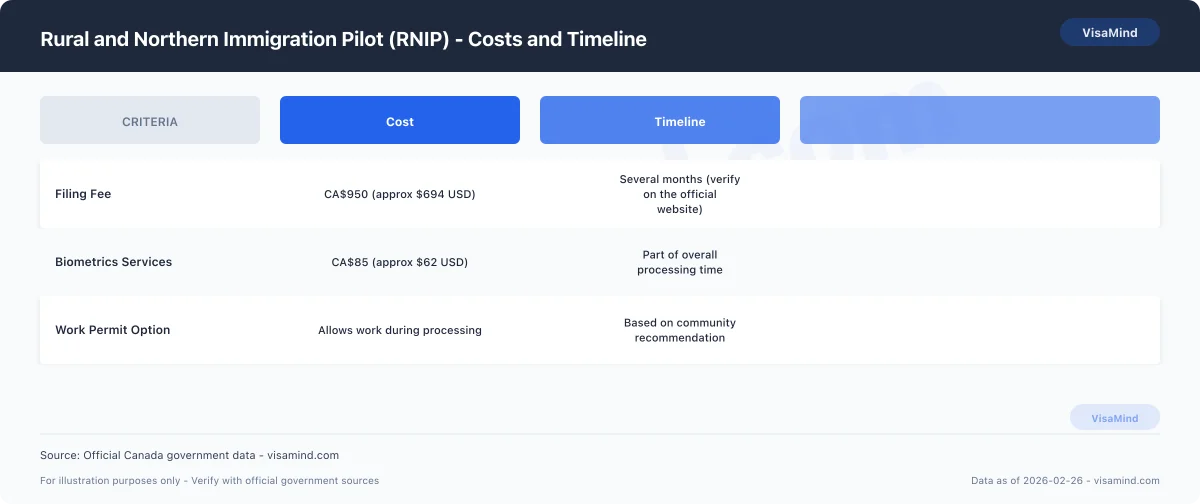
#| Component | Amount |
|---|---|
| Filing fee (IMM-0008)Includes processing fee ($950) + Right of Permanent Residence Fee ($575). Spouse: $1,525. Dependent child: $260. | CA$1,525 (approx $1,113 USD) |
| BiometricsBiometrics: CA$85 (approx $62 USD) (as of 2026-02). Verify the current fee on the official schedule before filing. | CA$85 (approx $62 USD) |
Fees change; always verify on IRCC.
Next steps
#Use Find My Visa to build a sequenced plan with official sources and deadlines.
FAQs
Who decides admissibility to Canada?
IRCC reviews your application and the documents you submit.
The Canada Border Services Agency (CBSA) makes the final call on admissibility when you arrive at the border.
You’re expected to satisfy all medical, criminal, and security requirements set by Canadian law.
What is the Rural Northern Immigration Pilot?
It is a community-driven program that provides a pathway to permanent residence for skilled foreign workers who want to live and work in smaller Canadian communities.
Do I need a job offer to apply?
Yes — you must find an eligible job with an employer in one of the participating communities and meet both IRCC and the community-specific requirements.
Can I work while my RNIP permanent residence application is processing?
If you’re eligible, you can apply for a work permit so you can work while the application is processed.
What are the government fees I should expect?
Filing fee (IMM-0008) is CA$1,525 and biometrics are CA$85. Work permit fees are listed separately (work permit including extensions — per person CA$155), and some group fee rules (maximum CA$500) apply in limited circumstances.
How long does RNIP processing usually take?
Standard RNIP processing is estimated at 12 to 24 months; processing times can vary by category and location, so verify current times with IRCC. If you live outside Canada or the U.S., add 3–4 months for mailing in some cases.
What are common reasons applications are refused?
Common refusal reasons include failing to meet community-specific requirements and not submitting a job offer from a participating community. Filing does not guarantee approval.
What common mistakes delay applications?
Incomplete or incorrect information is a common cause of delay; review the official instructions and include all required documents to avoid delays.
Where do I get the forms and checklist for RNIP?
Download the current RNIP forms and instructions from the official IRCC website, and use the document checklist (downloadable) to gather documents and complete forms in the prescribed order.
Are there special notes about simultaneous applications?
Some rules require applicants or family members to apply at the same time and place (for example, to qualify for certain maximum group fees); ensure exams and other required documents are valid at the same time where required.
Official sources referenced
Last reviewed: 2026-03-11
VisaMind provides informational guidance only and is not a government agency. This is not legal advice. Requirements can change and eligibility depends on your specific facts. If your case is complex or high-stakes, consult a licensed immigration attorney.
Next steps
Every Canada visa case depends on your nationality, purpose, and timeline. Get a personalized plan with official sources and deadlines.
Get my Rural and Northern Immigration Pilot (RNIP) plan