
When to Read This
#In Germany, acquiring a Settlement Permit can be a significant step for many residents. It allows for permanent residence, while German Citizenship offers additional rights like voting. Understanding the differences can guide you in making the best decision for your future.
Ideal for New Arrivals
If you have recently moved to Germany, deciding between a Settlement Permit and German Citizenship can shape your long-term plans. The Settlement Permit grants permanent residency and is often the first step for those who wish to stay in Germany more permanently.
Important: New arrivals should note that language proficiency at level B1 CEFR is required for both options.
Tip: Consider starting with the Settlement Permit if you are not yet eligible for citizenship but plan to make Germany your long-term home.
Tip: For those employed in Germany, ensure you've contributed to the pension scheme for at least 36 months.
Families Considering Future in Germany
For families, the decision between a Settlement Permit and German Citizenship involves considering the future of your children and spouse. Citizenship can offer them additional security and rights, including the ability to travel freely within the EU. If your spouse holds a settlement permit for skilled workers, this could influence your decision.
Warning: Ensure your family has sufficient living space, as this is a common requirement for both permits.
Choose Option B If...
#In Germany, the choice between a Settlement Permit and German Citizenship often hinges on personal circumstances and future plans. Understanding the nuances of each can help you navigate your immigration journey effectively.
Planning to Stay Temporarily
If your plans in Germany are not long-term, opting for a Settlement Permit might be more suitable. This permit allows you to reside and work in Germany indefinitely without becoming a citizen, which can be ideal if you're uncertain about your future in the country. For example, a software engineer on an EU Blue Card who intends to work in Germany for a few years before returning to their home country might find a Settlement Permit advantageous. It provides the flexibility to live and work without the need to renounce their original citizenship.
Tip: A Settlement Permit can be a practical choice for those who wish to maintain ties to their home country while enjoying the benefits of living in Germany.
Desire to Retain Original Citizenship
For many, retaining their original citizenship is a priority due to personal, familial, or professional reasons. A Settlement Permit in Germany allows you to do just that, unlike the naturalization process, which often requires renouncing previous citizenships. Consider a scenario where a British academic working at a German university wants to maintain her UK citizenship to easily travel and work within the UK. By obtaining a Settlement Permit, she can continue to reside in Germany without giving up her UK passport.
Important: Check if your home country allows dual citizenship. While Germany often requires renunciation, exceptions exist, and some countries have agreements with Germany concerning dual citizenship.
Focus on Employment Flexibility
If employment flexibility is your primary concern, a Settlement Permit might offer the best balance. It allows you to change jobs within Germany without the need to update your visa status continuously. Imagine a freelance graphic designer who often switches between projects and employers. With a Settlement Permit, they can smoothly transition between jobs without the bureaucratic hurdles of altering their residency status each time. This can be especially beneficial for those in dynamic industries where career paths can change direction quickly, providing peace of mind and professional agility.
Key Differences Explained
#Germany offers two primary pathways for long-term residence: the Settlement Permit and German Citizenship. Understanding the differences between these options can guide your decision on which path to pursue. The Settlement Permit allows for permanent residency, while German Citizenship offers full membership in the German state. Each option has distinct benefits and requirements.
Voting Rights and Political Participation
One of the most significant distinctions between a Settlement Permit and German Citizenship is the ability to participate in political life. German citizens enjoy full voting rights in federal, state, and local elections. In contrast, holders of a Settlement Permit do not have the right to vote in national elections. However, they may participate in municipal elections if they are citizens of another EU country.
Important: Obtaining German Citizenship grants you the right to run for public office, a privilege not extended to Settlement Permit holders.
Eligibility Criteria and Required Documents
The eligibility requirements for a Settlement Permit and German Citizenship differ significantly. For a Settlement Permit, you typically need to have held a residence title for at least four years, such as under Section 18a of the Residence Act [AufenthG]. - Proof of German language skills at level B1 CEFR
- Evidence of contributions to the statutory pension insurance scheme for at least 36 months
- Documents proving sufficient living space German Citizenship requires a longer residency period, usually eight years, along with a naturalization test. Unlike the Settlement Permit, you must renounce your previous citizenship unless you qualify for dual citizenship.
Important: All application procedures must be conducted in German.
When to Pick the First Option
#In Germany, more than 8.7 million foreign nationals reside, with many opting for either a Settlement Permit or German Citizenship to secure their stay. Choosing between these options can be influenced by various personal goals and circumstances.
Intending Permanent German Residency
For individuals looking to remain in Germany indefinitely without the full responsibilities of citizenship, a Settlement Permit may be ideal. This option is often chosen by those who meet certain employment and residence requirements. - You have been employed in Germany for at least 27 months and contributed to the statutory pension scheme. - You wish to maintain your original citizenship while enjoying permanent residency benefits. - You are married to a German national or another settlement permit holder.
Tip: A Settlement Permit allows you to reside and work in Germany indefinitely, without the need to apply for visa extensions.
Desire for Full Civic Participation
If you aim to fully integrate into German civic life, obtaining German Citizenship might be the best path. This provides not only the right to live and work permanently but also offers voting rights and the ability to participate in political life. - You wish to vote in federal and local elections to influence Germany's political landscape. - You are committed to renouncing your former citizenship if required, to become a full German citizen. - You have lived in Germany for an extended period and wish to formalize your commitment to the country.
Important: German citizenship grants you an EU passport, allowing free movement and work within the EU member states.
Long-Term Integration into German Society
For those planning to integrate deeply into German society, a Settlement Permit is often the first step. This choice supports long-term residency without immediate pressure to acquire citizenship. - You have strong professional ties in Germany and plan to continue your career here. - You are committed to learning the German language and culture, fulfilling integration course requirements. - You have family connections in Germany, such as a spouse or children attending German schools.
Warning: Failure to demonstrate sufficient language skills can delay your settlement process. Ensure you meet the B1 German language requirement.
What People Get Wrong
#In Germany, the path to permanent residency and citizenship involves distinct processes and requirements. Many individuals often confuse a Settlement Permit (Niederlassungserlaubnis) with German Citizenship, leading to misunderstandings about their rights and obligations.
Confusion Between Residency and Citizenship
A common misconception is that a Settlement Permit grants similar rights to citizenship. However, while a Settlement Permit allows you to live and work in Germany indefinitely, it does not confer the right to vote or obtain a German passport. - Settlement Permit: Permanent residency; no voting rights. - German Citizenship: Full rights, including voting and EU freedom of movement.
Important: Holding a Settlement Permit does not exempt you from needing a visa when traveling outside the EU.
Assuming Dual Citizenship is Automatic
Another frequent error is assuming that acquiring German citizenship automatically allows for dual citizenship. In reality, Germany generally requires you to renounce your previous nationality, except in specific cases like EU citizens or those from countries where renunciation is impossible.
Tip: Consult the Federal Office for Migration and Refugees (BAMF) for exceptions to dual citizenship rules.
Misunderstanding Residency Duration Requirements
Many people believe that the path to citizenship or a settlement permit is purely time-based. In addition to the duration of residency, both processes require meeting specific criteria, such as language proficiency and financial stability. - Settlement Permit: Typically after five years of residency, with proof of financial independence and language skills. - German Citizenship: Minimum of eight years of residency, with integration course completion potentially reducing this to seven years.
Warning: Failure to meet language requirements can delay or prevent obtaining both permits and citizenship. Refer to Skilled Worker Visa for language skill requirements.
Can You Switch Later?
#In Germany, holding a Settlement Permit can be a stepping stone toward obtaining German Citizenship. While both options provide stability, they offer different rights and responsibilities.
Process of Upgrading Residency
Converting a settlement permit into German citizenship involves several steps. Initially, you must have lived in Germany for a specified period, usually eight years, although this can be reduced under certain circumstances. - Proof of German language skills at level B1 CEFR
- Evidence of financial stability
- Participation in an integration course may reduce the residency requirement 1. Gather the necessary documentation, including language certificates and financial records.
-
Submit an application for naturalization through your local foreigners' authority.
-
Attend an interview to verify your eligibility and understanding of German culture.
Challenges in Transitioning to Citizenship
Transitioning from a settlement permit to citizenship can pose challenges. Language proficiency and financial stability are critical requirements.
Important: Ensure you meet all requirements, including 36 months of pension contributions, to avoid delays in processing.
Warning: Failure to demonstrate sufficient German language skills could result in application rejection.
Legal Considerations and Timeframes
The legal framework for upgrading to citizenship involves strict adherence to the Residence Act (AufenthG). Timeframes can vary based on individual circumstances.
| Requirement | Timeframe |
|---|---|
| Residence in Germany | 8 years (may be reduced) |
| Pension Contributions | 36 months |
| German Language Skills | B1 Level |
Tip: Consult the Federal Office for Migration and Refugees (BAMF) website for current requirements and updates.
Side-by-Side Comparison
#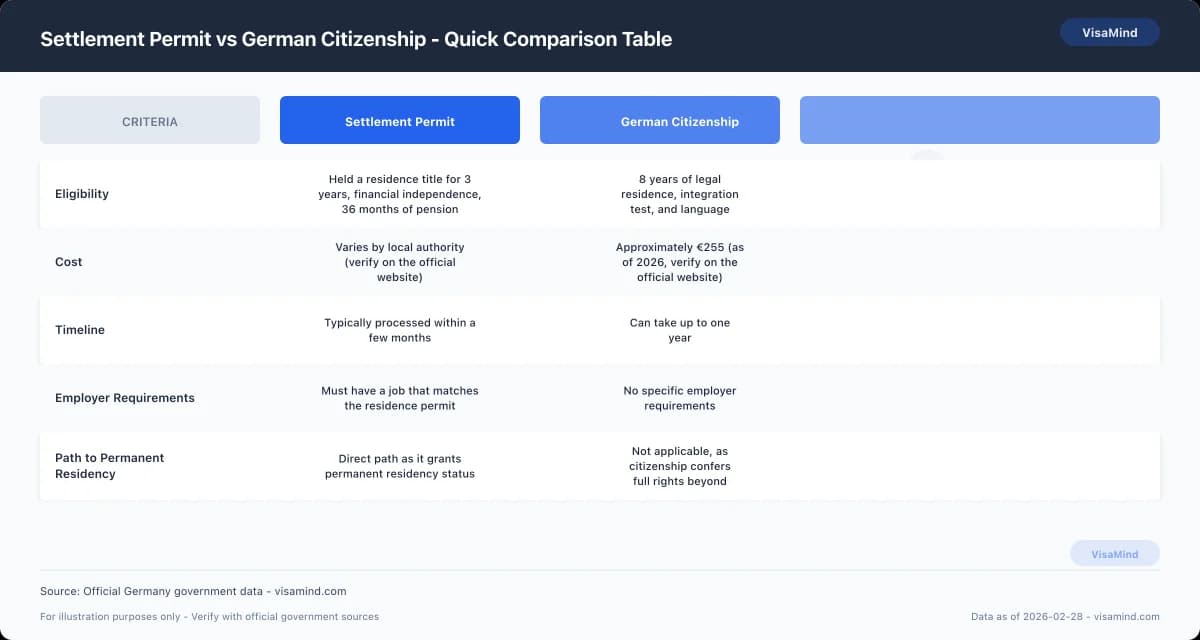
In Germany, obtaining a Settlement Permit or achieving German Citizenship offers distinct pathways for long-term residency and integration. Each option has specific eligibility criteria and benefits, shaping the decision-making process for individuals seeking permanent residence in Germany. Both pathways involve commitments such as language proficiency and financial contributions, but differ significantly in terms of rights and obligations. Understanding these differences can help you determine the most suitable option for your situation.
Eligibility Criteria Overview
Eligibility for a Settlement Permit generally requires holding a residence title under specific sections of the Residence Act for three years and fulfilling employment and insurance contributions. On the other hand, German Citizenship involves a longer period of residency and additional requirements like the citizenship test.
| Criteria | Settlement Permit | German Citizenship |
|---|---|---|
| Residence Requirement | 3 years | 8 years |
| Employment | Qualified employment for 27 months | Not required |
| Language Skills | B1 CEFR | B1 CEFR |
| Insurance Contributions | 36 months | Not required |
| Citizenship Test | Not required | Required |
Tip: You must conduct the entire application procedure in German.
Cost Implications and Fees
Both processes involve fees that applicants must be prepared to cover. It's necessary to budget for these expenses in advance to avoid unexpected financial strain. - Settlement Permit: Approximately €113 for the application. - German Citizenship: Around €255 for the application process.
Important: Always verify the current fees on the BAMF website.
Processing Time Expectations
The processing times vary between the two options. Factors such as application completeness and local foreigners authority workload can affect timelines.
| Process | Settlement Permit | German Citizenship |
|---|---|---|
| Typical Processing Time | 3-4 months | 6-12 months |
| Authority Involved | Local foreigners authority | Local citizenship authority |
Tip: Check with your local foreigners authority for the most accurate processing times.
Employer Sponsorship Requirements
While employer sponsorship is not a requirement for either the settlement permit or citizenship, previous employment plays a role in eligibility for the settlement permit. - Settlement Permit: Requires proof of qualified employment for 27 months.
- German Citizenship: No direct employer requirement.
Warning: Ensure you maintain proper records of your employment and insurance contributions for the settlement permit application.
Who Chose What and Why
#In Germany, over 200,000 individuals obtain a Settlement Permit each year, offering them the opportunity for permanent residence. However, many also pursue German Citizenship, which grants broader rights and responsibilities. Understanding the distinctions between these two options can help applicants make informed decisions based on their personal goals.
Young Professional Seeking Career Growth
A young software engineer from India, having worked in Germany for three years under the EU Blue Card, was looking to solidify her status in the country. Keen on long-term career growth and stability, she evaluated the benefits of obtaining a Settlement Permit versus pursuing German Citizenship. While the Settlement Permit would allow her to live and work in Germany indefinitely, she was also attracted to the broader European work rights that come with citizenship. After consulting with the local Ausländerbehörde and reviewing her employment status, she decided to first apply for the Settlement Permit, allowing her the flexibility to apply for citizenship later without disrupting her career.
Family Planning for Children's Education
A couple from Turkey, residing in Germany for several years, faced a choice between a Settlement Permit and German Citizenship, primarily influenced by their children's education. With their children integrated into the German school system, they initially obtained a Settlement Permit due to its quicker processing. However, considering the long-term educational benefits, including easier access to scholarships and university admission, they decided to apply for German Citizenship. The process required ensuring their children met the language requirements, and after successfully naturalization process through their local foreigners' office, the family gained citizenship within a year.
Retiree Looking for Stability
A retired American couple, residing in Germany on a temporary residence permit, sought stability during their retirement years. Having contributed to the German statutory pension insurance scheme for several years, they were eligible for a Settlement Permit. This option provided them with the security of permanent residency without the need to renounce their American citizenship. After consulting with the Federal Office for Migration and Refugees (BAMF) and gathering necessary documentation, they secured their Settlement Permit, allowing them to enjoy their retirement without the pressure of frequent renewals.