Overview — Germany settlement permit
#
A Germany settlement permit allows you to stay in Germany on a permanent basis after holding a temporary residence permit. You must already live in Germany under a valid Aufenthaltstitel and apply through your local Ausländerbehörde.
What it is
The Germany settlement permit is a permanent residence status for non-German nationals who already hold a temporary residence permit. It removes the time limit attached to your previous Aufenthaltstitel and allows you to continue living in Germany long term.
You apply from within Germany through your local immigration office (Ausländerbehörde), not through a consulate. The Federal Office for Migration and Refugees (Bundesamt für Migration und Flüchtlinge – BAMF) oversees asylum matters, while residence permits are handled locally.
You submit a formal Form Aufenthaltstitel Application and complete any required registration steps, including your Form Residence Declaration if applicable. If you’re unsure about documentation or procedure, confirm requirements directly with your local authority or the Federal Foreign Office for consular matters abroad.
Many applicants also consider the EU Long-term Residence Permit, which may offer a different long-term status within the European Union.
Who it's for
This permit is designed for people who already live in Germany under a temporary residence title and want to make their stay permanent.
You may qualify if you currently hold one of the following:
Highly skilled workers and certain self-employed individuals often use this route after meeting the conditions of their temporary status. Family members who joined a sponsor in Germany under a Family Reunion Visa may also pursue permanent residence if they remain eligible under their category.
Your eligibility depends on the type of residence permit you currently hold and whether you continue to meet its conditions.
Typical pathways
Most applicants reach the settlement permit after first holding a temporary residence permit. The pathway depends on your original visa category.
| Starting Permit | Purpose in Germany | Leads to Settlement Permit |
|---|---|---|
| EU Blue Card | Qualified employment | Yes |
| Skilled Worker Visa | Skilled employment | Yes |
| Self-Employment Visa | Business or freelance work | Yes |
| Family Reunion Visa | Join family member in Germany | Yes |
You typically:
-
Enter Germany with a national visa issued by the Federal Foreign Office.
-
Receive a temporary residence permit from the local Ausländerbehörde.
-
Apply for a settlement permit once eligible under your category.
Each pathway follows its own legal framework. You must verify the specific requirements tied to your current residence status before filing your application.
Application Process
#You must confirm that you meet the legal requirements, collect the correct documents, and file your application with the local foreigners authority (Ausländerbehörde). Accuracy and preparation determine how smoothly your settlement permit application moves forward.
Check requirements & prepare documents
Start by confirming that you meet the general conditions under Section 5 (1) of the Residence Act (AufenthG). You must show:
- Secure livelihood (sufficient funds to cover living expenses)
- Proof of identity and nationality
- Adequate living space for you and your family
Your current residence title matters. If you hold an EU Blue Card, Skilled Worker Visa, Self-Employment Visa, or entered through a Family Reunion Visa, ensure your status remains valid at the time of application.
Prepare a complete Form Aufenthaltstitel Application file. Requirements vary by city, so verify the document list with your local Ausländerbehörde before submitting.
| Core Requirement | What You Must Provide |
|---|---|
| Identity | Valid passport or recognized ID |
| Financial security | Evidence of income or financial means |
| Housing | Proof of sufficient living space |
| Current status | Valid residence permit |
If you previously filed forms with the Federal Office for Migration and Refugees (Bundesamt für Migration und Flüchtlinge – BAMF), ensure your records are consistent. Review official instructions carefully and include every required document.
Booking & filing with local authority
You must apply for a settlement permit at your local Ausländerbehörde in Germany. Book an appointment as early as possible, as availability can be limited.
Follow this sequence:
- Confirm eligibility based on your current residence title.
2. Collect all required documents.
-
Book an appointment with your local authority.
-
Attend the appointment and submit your application in person.
If you apply from abroad for an entry visa that leads to residence in Germany, the Federal Foreign Office processes the visa through the relevant German consulate. Once in Germany, the local Ausländerbehörde handles your settlement permit.
If you are eligible for the EU Long-term Residence Permit, clarify with the authority which status you are requesting. The application procedure may differ.
Practical tips for applicants
Submit only complete and organized documents. Missing paperwork can delay your decision.
Bring both originals and copies of key documents, including:
- Passport
- Current residence permit
- Financial evidence
- Housing confirmation
Ensure your personal data matches across all documents, including any prior Form Residence Declaration filings. Inconsistent information can trigger additional review.
Arrive on time for your appointment and respond promptly to any follow-up requests. For updated procedural details, consult your local Ausländerbehörde or the Federal Foreign Office, depending on where you apply.
Your Rights as a Permanent Resident
#A settlement permit gives you an open-ended right to live in Germany and places you on a stronger legal footing than temporary permit holders. You gain stability of residence and access to core legal protections under German law.
Length of stay
Your settlement permit allows you to stay in Germany without a time limit. Unlike a Skilled Worker Visa, Self-Employment Visa, or EU Blue Card, your right of residence no longer depends on a fixed validity period.
You do not need to submit repeated Aufenthaltstitel applications to extend your stay. The local Ausländerbehörde remains your main authority for residence matters inside Germany.
If you previously held:
| Previous Status | Nature of Stay | After Settlement Permit |
|---|---|---|
| EU Blue Card | Time-limited | Unlimited residence |
| Skilled Worker Visa | Time-limited | Unlimited residence |
| Self-Employment Visa | Time-limited | Unlimited residence |
| Family Reunion Visa | Linked to sponsor | Independent, unlimited residence |
You may also consider applying for the EU Long-term Residence Permit if you want a status recognized across other EU Member States. The Ausländerbehörde can advise on the differences.
You must still comply with registration rules, including your local Form Residence Declaration (Anmeldung) obligations.
General protections
A settlement permit gives you a secure legal status under German residence law. Authorities cannot treat your stay as temporary or conditional in the same way as fixed-term permits.
Your residence rights exist independently of the visa category that first brought you to Germany. For example, if you entered with a Family Reunion Visa or EU Blue Card, your status no longer depends on that underlying purpose.
The following protections are central:
- Indefinite right of residence in Germany
- Recognition as a lawful permanent resident by the Ausländerbehörde
- Equal application of general German laws and regulations
The Federal Office for Migration and Refugees (Bundesamt für Migration und Flüchtlinge – BAMF) handles asylum matters, not standard residence permits. For most residence issues, you deal with your local Ausländerbehörde.
Your permanent status strengthens your legal position in administrative procedures, including any future residence-related applications.
When to Get Help
#You should seek guidance when your eligibility is unclear or your paperwork is incomplete. Delays often result from missing information, incorrect forms, or confusion about which authority handles your case.
Borderline eligibility cases
You need legal guidance if your residence history does not fit neatly into one category. This often happens when you switch from an EU Blue Card to a Skilled Worker Visa, hold a Self-Employment Visa, or previously entered on a Family Reunion Visa.
Unclear status transitions can affect how the local Ausländerbehörde reviews your Form Aufenthaltstitel Application. If your residence periods involve multiple permit types, confirm that your status supports a settlement permit rather than an EU Long-term Residence Permit.
You should also verify which authority manages your matter:
| Authority | Role |
|---|---|
| Local Ausländerbehörde | Handles residence permits inside Germany |
| Federal Office for Migration and Refugees (BAMF) | Handles asylum matters |
| Federal Foreign Office | Processes consular visa applications abroad |
If your case involves prior asylum procedures, coordinate carefully because BAMF decisions may influence your file.
Act early if your eligibility is not straightforward. Waiting until submission increases the risk of refusal or delay.
Document gaps causing delays
Incomplete or inconsistent information causes frequent processing delays. You must review every section of your application before filing.
Common issues include:
- Missing signatures on the Form Residence Declaration
- Inconsistent personal details across documents
- Failure to include all required supporting records
- Submitting outdated versions of forms
The local Ausländerbehörde expects complete documentation at the time of submission. Officers may pause processing if required documents are absent or unclear.
Use this checklist before filing:
| Item | Action |
|---|---|
| Personal data | Ensure all fields are complete and consistent |
| Supporting documents | Match each requirement to a document |
| Form accuracy | Confirm you used the correct Aufenthaltstitel Application form |
| Copies | Provide legible copies where required |
You reduce delays when you verify every field and attachment before submission.
When to consult an expert
Consult an expert if you have already received a request for additional documents. A formal notice often signals that your file lacks required information.
You should also seek help if:
- You previously submitted incomplete information
- Your residence status changed during processing
- You are unsure whether to apply for a settlement permit or an EU Long-term Residence Permit
- Your case intersects with prior BAMF proceedings
An expert reviews your full immigration history and ensures your application aligns with the correct authority. This is especially important if you previously dealt with the Federal Foreign Office abroad and now apply through the local Ausländerbehörde.
Professional review reduces avoidable errors and strengthens your submission before authorities make a final decision.
Renewing Your PR Card
#Your settlement permit remains valid, but your physical residence card has an expiry date and must be renewed. You apply through your local Ausländerbehörde, which issues the updated electronic residence permit (eAT).
When to renew
You should renew your electronic residence card before the expiry date printed on the card. The settlement permit itself does not expire, but the plastic card that proves your status does.
Submit your Form Aufenthaltstitel Application to your local Ausländerbehörde. This applies whether you originally held an EU Blue Card, Skilled Worker Visa, Self-Employment Visa, Family Reunion Visa, or converted from an EU Long-term Residence Permit.
Prepare the following:
- Valid passport
- Current electronic residence card
- Completed application form from your Ausländerbehörde
- Any updated Form Residence Declaration (if your address changed)
If you have questions about your underlying status, contact your local Ausländerbehörde. The Federal Office for Migration and Refugees (Bundesamt für Migration und Flüchtlinge – BAMF) does not process settlement permit card renewals.
Apply early enough to avoid gaps in documentation, especially if you plan to travel.
Fees for extensions
You must pay a government fee to receive a renewed electronic residence card. The amount depends on the type of card issued.
| Type of issuance | Fee (EUR) |
|---|---|
| Electronic residence permit (eAT) extension | €124 |
| Physical card issuance | €113 |
Fees apply per person. Confirm the exact amount and accepted payment methods with your local Ausländerbehörde before your appointment.
If you are unsure which fee applies to your case, ask the authority directly. They determine the correct charge based on your specific permit record.
Maintaining PR Status
#You keep your settlement permit by following German residence rules and avoiding conduct that can lead to removal. Authorities review your status if legal or security concerns arise.
Conditions to keep status
You have to keep meeting the legal conditions tied to your settlement permit (Niederlassungserlaubnis). The most important thing is that there can't be any reason under German law to expel you.
This means:
- You must not commit serious criminal offenses.
- You must not pose a threat to public safety or constitutional order.
- You must comply with German laws and official requirements.
The local Ausländerbehörde keeps track of your residence status while you're in Germany. In cases involving protection status, the Federal Office for Migration and Refugees (BAMF) might get involved.
If you apply for an EU Long-term Residence Permit later, authorities will check again for any public security concerns.
| Requirement | What It Means for You |
|---|---|
| No expulsion grounds | No serious criminal convictions or security risks |
| Legal compliance | Follow German laws and official obligations |
| Valid documentation | Keep your residence records accurate with the Ausländerbehörde |
You don't need to file a new Form Aufenthaltstitel Application just to keep your status, but you do need to maintain lawful conduct at all times.
What may affect your residency
Certain events can trigger a review of your permanent residence. The main risk is any conduct that creates legal grounds for expulsion.
Examples include:
- Criminal convictions
- Activities that threaten public order or security
- Providing false information in residence-related procedures
If authorities find that expulsion grounds exist, your settlement permit can be withdrawn.
Changes in your previous immigration pathway—like if you originally held an EU Blue Card, Skilled Worker Visa, Self-Employment Visa, or entered on a Family Reunion Visa—don't automatically impact your permanent residence. Violations connected to fraud or misrepresentation in earlier applications can lead to consequences.
If your case is under review, the Ausländerbehörde decides on residence permits within Germany. You have to cooperate fully and provide accurate documentation if requested.
Path to Citizenship
#Holding a German settlement permit removes time limits on your stay, but it doesn't grant citizenship. You'll need to file a separate naturalization application with your local authority and meet the required residence, language, and integration rules.
Typical timeline
Your timeline toward citizenship depends on the type and length of your lawful residence in Germany. Authorities look at your continuous residence under a valid Form Aufenthaltstitel Application and proper Form Residence Declaration if that's required.
If you previously held one of the following, your path may differ:
| Residence status | Authority involved | Relevance for citizenship timeline |
|---|---|---|
| EU Blue Card | Local Ausländerbehörde | Counts toward lawful residence period |
| Skilled Worker Visa | Local Ausländerbehörde | Counts toward lawful residence period |
| Self-Employment Visa | Local Ausländerbehörde | Counts toward lawful residence period |
| Family Reunion Visa | Local Ausländerbehörde | Counts if residence was lawful and continuous |
| EU Long-term Residence Permit | Local Ausländerbehörde | Confirms long-term legal residence in Germany |
You must submit your naturalization application to your local citizenship authority, not to BAMF.
For the statutory residence period and current processing expectations, refer to the Federal Foreign Office or your local authority.
Language and integration requirements
You have to show sufficient German language ability and integration into German society. Authorities require formal proof.
Typical evidence includes:
- Recognized German language certificates
- Completion of an integration course coordinated by BAMF
- Proof of civic knowledge through a naturalization test
- Evidence of lawful income and no serious criminal record
If you completed a BAMF-supported integration course, keep those certificates. The authority will want to see them during your citizenship assessment.
Requirements can vary depending on your residence history, including time spent under an EU Blue Card, Skilled Worker Visa, or Family Reunion Visa. Always confirm which documents and certificates are accepted with your local naturalization authority before you file.
Fees and Processing Times
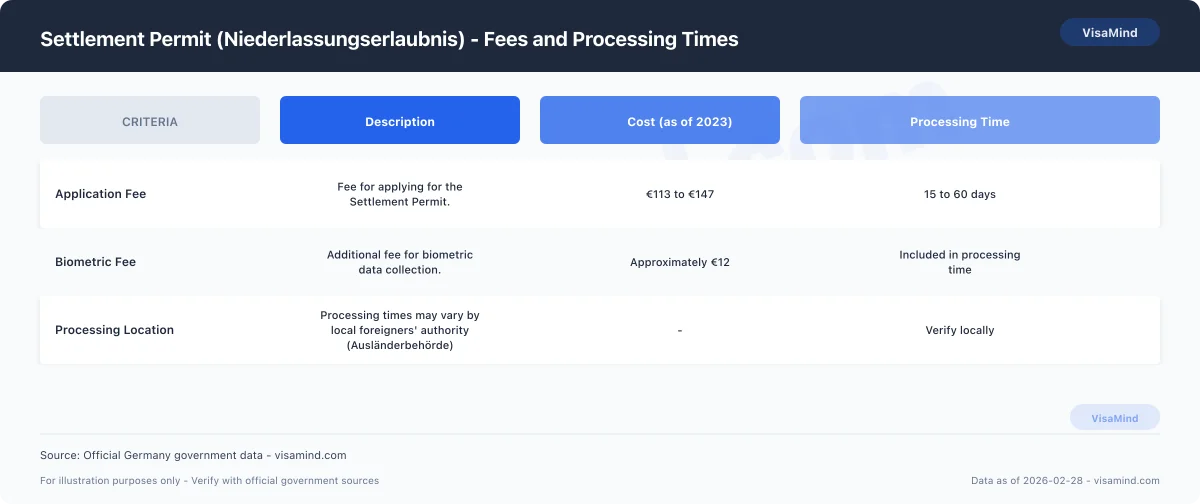
#You have to pay government fees when you submit your Form Aufenthaltstitel Application for a settlement permit. Processing times depend on location and permit category, but there’s a standard range.
Application & biometric fees
You pay the main application fee when you file your settlement permit request with your local Ausländerbehörde. The authority won’t process your case until you’ve paid.
| Fee type | Amount (EUR) | When you pay |
|---|---|---|
| Settlement permit application | €147 | At the time of application |
| Biometric data (fingerprints and photo) | €15 | During your in-person appointment |
Fingerprints and a biometric photo are part of the process. The authority verifies your identity before issuing the permit.
These amounts apply to standard settlement permit cases. If you're applying for a related status like the EU Long-term Residence Permit, check the amount with your local Ausländerbehörde before filing.
If you previously held an EU Blue Card, Skilled Worker Visa, Self-Employment Visa, or entered through a Family Reunion Visa, the settlement permit fee is separate from your earlier residence permit costs.
Extension fees
A settlement permit itself is permanent. You might pay fees later for related administrative actions.
Examples include:
- Reissuing a residence card after loss or damage
- Updating personal data after a legal name change
- Replacing an expired electronic residence card
Fee amounts for these services vary by authority. Your local Ausländerbehörde sets and collects these charges.
If you move within Germany and file a new Form Residence Declaration (Anmeldung), this doesn’t replace the need to pay card reissuance fees if your residence document needs updating.
For current administrative fees, check directly with the issuing authority.
Processing time expectations
The standard processing time for a settlement permit is 3 to 6 months.
| Application type | Standard processing time |
|---|---|
| Settlement permit (standard cases) | 3–6 months |
The processing times depend on:
- Your permit category
- The workload of your local Ausländerbehörde
- Whether your file is complete
Applicants transitioning from an EU Blue Card or other residence titles are processed by the same local authority. The Federal Office for Migration and Refugees (BAMF) does not issue settlement permits; local immigration offices handle these decisions.
You should check current processing times directly with your issuing authority before applying, especially if you have employment or travel deadlines.
Who Qualifies — Niederlassungserlaubnis
#You qualify for a German settlement permit (Niederlassungserlaubnis) if you meet the residence, employment, pension, and language requirements. The rules differ depending on whether you hold a Skilled Worker Visa, an EU Blue Card, or another qualifying residence title.
Skilled workers
If you hold a residence title under Sections 18a, 18b, 18d, or 18g, you can apply after three years of lawful residence in Germany.
You must meet all of the following:
- Hold a valid residence title under one of the listed sections
- Have lived in Germany for at least 3 years with that title
- Have paid 36 months of compulsory or voluntary contributions to the statutory pension insurance scheme
- Demonstrate German language skills at level B1
- Prove you can support yourself without state assistance
You also need to show proof of employment and financial stability. The local Ausländerbehörde reviews your Form Aufenthaltstitel Application. BAMF oversees broader migration policy but doesn't issue settlement permits.
| Requirement | Skilled Workers |
|---|---|
| Minimum residence | 3 years |
| Pension contributions | 36 months |
| Language level | B1 |
| Financial self-sufficiency | Required |
EU Blue Card holders & facilitations
If you hold an EU Blue Card, you get accelerated eligibility.
You may apply after:
- 21 months if you demonstrate sufficient German language skills
- 27 months if you meet the standard Blue Card residence requirement
You must provide:
- Proof of continuous employment
- Evidence of required residence duration
- Confirmation of pension contributions
- Proof that you can cover your living costs without public benefits
The reduced timeline makes the EU Blue Card one of the fastest routes to permanent residence in Germany.
| Requirement | EU Blue Card Holders |
|---|---|
| Minimum residence | 21–27 months |
| Pension contributions | Required |
| Language level | Affects 21 vs. 27 months eligibility |
| Financial self-sufficiency | Required |
Other eligible categories
Certain applicants with other qualifying residence titles may also obtain a settlement permit if they meet similar residence and contribution standards.
You generally need to show:
- A qualifying long-term residence title
- Proof of sustained employment or lawful economic activity
- Pension insurance contributions
- Sufficient financial resources
- Compliance with residence conditions
If you previously entered Germany on a Skilled Worker Visa, Self-Employment Visa, or under a Family Reunion Visa, your eligibility depends on your current residence title and whether it falls under the right legal sections.
Some applicants may also qualify for the EU Long-term Residence Permit, which is different from the Niederlassungserlaubnis. The Ausländerbehörde decides which status applies based on your record and documentation.
Application Weaknesses
#Most settlement permit refusals happen because applicants are missing core eligibility evidence. You need to prove language ability, financial stability, and adequate living space. Submitting an application doesn't guarantee approval.
Common refusal reasons
Authorities reject applications if you can't prove the required German language level. Weak documentation is a frequent reason for refusal.
Financial documentation is another issue. You have to show you can support yourself without public funds, whether you previously held an EU Blue Card, Skilled Worker Visa, Self-Employment Visa, or Family Reunion Visa.
Housing evidence is also checked. If you can't demonstrate enough living space for yourself and any dependents, the local Ausländerbehörde may deny your Form Aufenthaltstitel Application.
Filing a Form Residence Declaration or submitting a complete file doesn't guarantee approval. Each case is reviewed under the applicable residence category, including the EU Long-term Residence Permit.
| Weakness | How It Affects Your Case |
|---|---|
| Missing language proof | Application likely refused |
| Insufficient financial evidence | Authorities question self-sufficiency |
| Inadequate housing proof | Non-compliance with residence requirements |
| Assuming approval is automatic | Misjudging legal discretion |
How to avoid delays
Submit clear and verifiable proof of your German language ability. Don't rely on informal statements or incomplete certificates.
Document your financial position thoroughly. Provide records that show stable income or sustainable self-employment activity, depending on your current residence status.
Check that your housing meets requirements before you file. Include formal proof showing the size and occupancy of your accommodation.
Before submitting your Aufenthaltstitel Application, review your documents:
- Valid language certificate
- Complete financial records
- Evidence of adequate living space
- Accurate Residence Declaration
If you're unsure about specific documentary standards, consult BAMF or your local Ausländerbehörde for guidance.
Fees
#| Component | Amount |
|---|---|
| Application feeExtracted from guide content — verify against official source | €147 (approx $159 USD) |
| Extension fee (electronic)Electronic residence permit — verify against Ausländerbehörde | €124 (approx $134 USD) |
| Extension fee (card)Physical card issuance — verify against official schedule | €113 (approx $122 USD) |
| Biometric feeFingerprints and photo — verify against Auswärtiges Amt | €15 (approx $16 USD) |
Fees change; always verify on AA.