
What the ICT Card (Intra-Corporate Transfer) Covers — Germany ICT card
#
The Germany ICT Card lets multinational companies transfer certain employees to a German branch for a limited period.
It applies to defined roles and operates under Germany’s Residence Act with oversight from the relevant authorities.
Who it's for
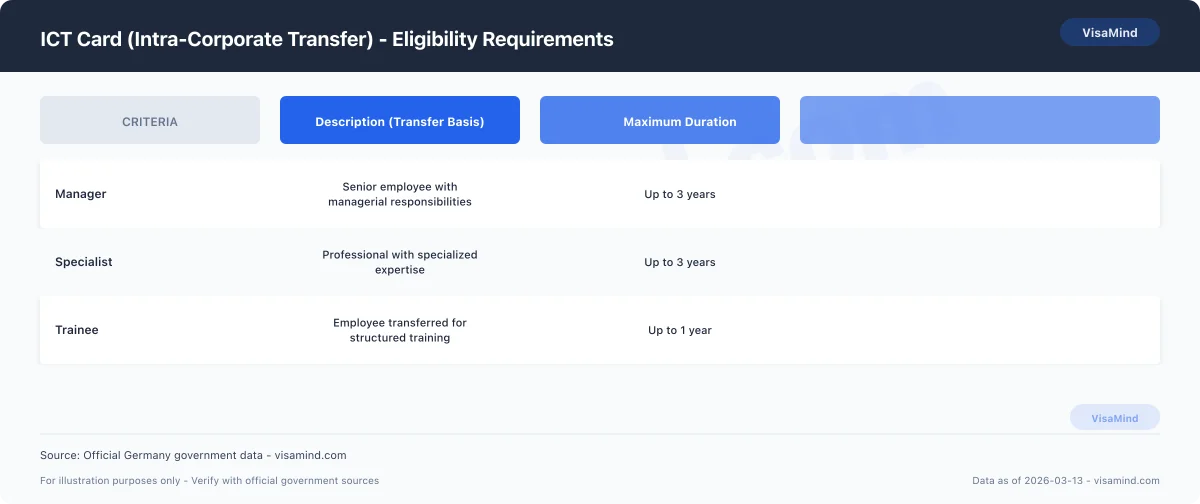
You qualify for the ICT Card if your employer transfers you from a non-EU branch of a multinational company to a branch in Germany.
It’s limited to these roles:
- Managers
- Specialists
- Trainees
Your transfer must be temporary and tied to your employment within the same corporate group.
You can’t use this permit for independent job changes in Germany or for employment outside the transferring company.
This permit does not replace other residence titles such as the EU Blue Card, Skilled Worker Visa, Opportunity Card, or Self-Employment Visa. Those permits serve different purposes.
The ICT Card strictly covers intra-company transfers.
| Eligible Role | Transfer Type | Employer Requirement |
|---|---|---|
| Manager | Temporary assignment | Same multinational group |
| Specialist | Temporary assignment | Same multinational group |
| Trainee | Structured training transfer | Same multinational group |
If you don’t fit into one of these three categories, you’ll need to look at a different residence permit.
Legal basis & authority
The ICT Card is issued under Germany’s Residence Act.
It’s part of the country’s regulated framework for corporate mobility.
The Federal Office for Migration and Refugees (Bundesamt für Migration und Flüchtlinge – BAMF) oversees immigration at the federal level.
If you apply from abroad, the Federal Foreign Office handles your visa application through the German mission in your country.
Once you arrive in Germany, your local Ausländerbehörde (Foreigners’ Authority) issues the residence permit and makes related decisions.
You may need to submit your visa application through the Form VIDEX system, depending on your location.
Always follow instructions from the German mission responsible for your case.
Duration & scope
The ICT Card allows a temporary transfer of up to three years.
Your residence status remains tied to:
- The transferring multinational company
- The specific German branch
- Your approved role (manager, specialist, or trainee)
The permit does not grant open access to the German labor market.
You can’t use it to switch employers freely.
A related option, the Mobile ICT Card, may apply if you already hold an ICT permit from another EU Member State and are assigned to Germany within the same corporate group.
It serves a distinct mobility function but remains limited to intra-company transfers.
| Aspect | ICT Card Coverage |
|---|---|
| Maximum duration | Up to 3 years |
| Employer flexibility | Limited to transferring company |
| Employment scope | Approved managerial, specialist, or trainee role |
| Purpose | Temporary intra-corporate transfer only |
Eligibility Requirements
#You must qualify under the rules that govern intra-corporate transfers to Germany.
The ICT framework limits eligibility to specific roles within a corporate group and requires a clear relationship between the sending and receiving entities.
Eligible roles
The Germany ICT Card applies only to defined categories of employees transferred within a corporate group.
You must work in one of the following roles:
- Manager
- Professional (specialist)
- Trainee
These roles must exist within the applying corporate group.
You can’t use this permit for independent employment or roles outside the group structure.
| Role Type | Core Requirement |
|---|---|
| Manager | Employment within the corporate group in a managerial capacity |
| Professional | Employment within the corporate group as a qualified specialist |
| Trainee | Transfer from a non‑EU branch to Germany for training purposes |
If your position doesn’t clearly fall into one of these categories, you should review the detailed conditions published by the Federal Office for Migration and Refugees (Bundesamt für Migration und Flüchtlinge – BAMF).
This permit does not replace other residence options such as the EU Blue Card, Skilled Worker Visa, Opportunity Card, or Self-Employment Visa.
Each category follows separate rules.
Corporate-group relationship
You must transfer within the same corporate group.
The German host entity and the sending entity abroad must belong to that group structure.
The ICT framework covers transfers from non‑EU branches to Germany.
The relationship between entities must support an intra-company transfer, not a new external hire.
You should confirm that:
- The sending branch is located outside the European Union.
- The German entity forms part of the same corporate group.
- The transfer reflects an internal reassignment, not independent recruitment.
Authorities will assess whether your employment remains tied to the corporate group during your stay.
For official conditions and interpretations, consult BAMF guidance before submitting your application.
Category-specific checks
Each role—manager, professional, or trainee—requires you to meet the specific conditions tied to that category.
You must:
-
Review the eligibility criteria for your exact role.
-
Make sure your position aligns with the ICT Directive framework.
-
Prepare documentation that reflects your category accurately.
Trainees must transfer from a non‑EU branch under the ICT conditions.
Managers and professionals must show that their function fits within the corporate group structure.
If you plan mobility within the EU under a Mobile ICT Card, confirm that your status qualifies under the same ICT framework before applying.
When applying from abroad, you submit your visa application through the Federal Foreign Office.
If you apply inside Germany, the local Ausländerbehörde processes your residence permit.
Always verify current procedural requirements and forms, including Form VIDEX where applicable, before filing.
The Dual-Track Application
#You and your employer may both play a role in the Germany ICT Card process.
One track focuses on the employer’s petition, and the other centers on your personal residence application with the competent authority.
Employer petition vs worker application
The process involves two distinct but connected steps: the employer’s submission and your individual application.
Your employer initiates the process by preparing and filing the required ICT-related documentation.
This filing does not guarantee approval. The authority reviews each case on its own merits.
You must then submit your own application for the residence title.
This step confirms your identity, purpose of stay, and eligibility for the ICT Card.
| Step | Who Acts | Purpose |
|---|---|---|
| Employer filing | Employer | Requests authorization for your ICT transfer |
| Personal application | You | Applies for the ICT residence permit |
If you apply from abroad, you deal with the Federal Foreign Office through the German consulate.
If you apply inside Germany, you file with your local Ausländerbehörde.
This structure differs from programs such as the EU Blue Card, Skilled Worker Visa, Opportunity Card, or Self-Employment Visa, which generally rely primarily on the applicant’s direct filing rather than a transfer-based framework.
Where to file
Where you submit your application depends on your location at the time of filing.
If you are outside Germany, you apply for the appropriate visa through the Federal Foreign Office at the German mission responsible for your place of residence.
If you are already in Germany, you submit your residence permit application to your local Ausländerbehörde.
Certain ICT-related forms are submitted to the Federal Office for Migration and Refugees (Bundesamt für Migration und Flüchtlinge – BAMF).
You must use the correct version of the required form.
Submitting the form alone does not secure approval.
For visa applications processed abroad, you may need to complete the online Form VIDEX form before your consular appointment.
Confirm filing instructions with the responsible authority before submission.
Requirements vary depending on whether you apply for a standard ICT Card or a Mobile ICT Card.
Application outcomes
Approval is never automatic.
The authority reviews the employer’s submission and your personal eligibility separately but in coordination.
Possible outcomes include:
- Approval of the ICT Card or Mobile ICT Card
- Request for additional documents
- Refusal
If approved abroad, you receive a national visa for entry and later obtain your residence permit from the local Ausländerbehörde.
If you apply inside Germany and receive approval, the Ausländerbehörde issues your residence title directly.
For current processing times and fees in EUR (€), consult the Federal Foreign Office or your local Ausländerbehörde.
What Documents Do You Need?
#You must submit the official ICT application form together with signed declarations and supporting evidence.
Use the correct form issued by the Federal Office for Migration and Refugees (Bundesamt für Migration und Flüchtlinge) (BAMF) and follow the instructions exactly.
Download the ICT form & instructions
Get the current ICT Card application form and guidance directly from the Federal Office for Migration and Refugees (BAMF).
Do not rely on outdated copies from third-party websites.
If you apply from abroad, the Federal Foreign Office handles your visa application through the German consulate.
If you already live in Germany, your local Ausländerbehörde manages the residence permit process.
Use the version that matches your situation:
| Situation | Authority Involved | Form Source |
|---|---|---|
| Applying from abroad | Federal Foreign Office (consulate) | Official ICT form and instructions |
| Applying inside Germany | Local Ausländerbehörde | Official ICT form and instructions |
| Transferring within the EU | Mobile ICT Card | Official ICT form and instructions |
Do not confuse the ICT Card with the EU Blue Card, Skilled Worker Visa, Opportunity Card, or Self-Employment Visa.
Each category uses different eligibility rules and forms.
Always download the most recent form before you apply.
Complete, sign the form
Fill out every required field clearly and accurately.
Do not leave mandatory sections blank.
You must provide your personal details, passport information, and information about your assignment in Germany.
Follow the instructions line by line.
Complete the form in the format required by the issuing authority.
If the instructions allow or require digital pre-completion, use the designated system.
Before submission:
-
Review all entries for accuracy.
-
Confirm that names and passport numbers match exactly.
-
Sign the form where indicated.
-
Add the date in the correct format.
Unsigned forms or incomplete sections delay processing.
The authority will not finalize your ICT Card without a properly completed and signed application.
Supporting evidence to submit
Submit all required evidence together with your application.
Missing documents can lead to delays or refusal.
Your supporting documents must match the details in your form.
Provide clear and complete copies as instructed.
Use this checklist to prepare your file:
- Completed and signed ICT application form
- Valid passport
- Assignment documentation from your employer
- Any additional documents listed in the official instructions
If you apply for a Mobile ICT Card, include documentation that proves your existing ICT status in another EU Member State.
Check the official instructions issued by BAMF or the Federal Foreign Office for the full document list.
Requirements differ from other residence permits such as the EU Blue Card or Skilled Worker Visa, so don’t reuse document sets from those categories.
Fees and Processing Times
#You must pay a fixed government fee and plan for a processing period that typically lasts several months.
The exact timeline depends on where and how you apply, and which authority handles your case.
Filing fee
You pay a €75 filing fee when you submit your national visa application through the Form VIDEX-NATIONAL system.
| Item | Amount (EUR) | Notes |
|---|---|---|
| ICT Card visa application fee | €75 | Paid at time of application (VIDEX-NATIONAL) |
This fee applies to the Germany ICT Card application filed as a national visa.
You submit the application through the Federal Foreign Office if you apply from abroad.
If you apply for related permits, such as the EU Blue Card, Skilled Worker Visa, Opportunity Card, Self-Employment Visa, or a Mobile ICT Card, fee structures may differ.
Check the Federal Foreign Office or your local Ausländerbehörde for the correct amount before you file.
German authorities may update fees. Confirm the current amount with the Federal Foreign Office before submitting your application.
Standard processing timeline
You should expect a processing time of 1 to 3 months for a standard ICT Card application.
| Application Type | Standard Processing Time |
|---|---|
| ICT Card | 1–3 months |
The timeline starts once you submit a complete application and attend your visa appointment. Incomplete documents can delay review.
If you apply from outside Germany, the Federal Foreign Office processes your visa in coordination with the relevant local immigration authority in Germany. If you apply inside Germany, your local Ausländerbehörde handles the residence permit stage.
The Federal Office for Migration and Refugees (Bundesamt für Migration und Flüchtlinge – BAMF) does not process ICT Card visa applications. It handles asylum matters.
When times vary
processing times vary based on:
- Your application category (e.g., ICT Card vs. Mobile ICT Card)
- The location where you apply
- The workload of the responsible German mission or Ausländerbehörde
Applications filed at high-volume consulates often take longer. Cases that require additional internal review in Germany may also extend beyond the standard 1–3 month window.
If you switch from another status, such as the EU Blue Card or Skilled Worker Visa, your local Ausländerbehörde determines the timeline. Each office manages its own caseload.
Dependents
#Your spouse and minor children can join you in Germany if they meet the entry and passport rules. Each family member must apply separately and hold the correct travel document before departure.
Bringing family members
You must arrange entry visas for each dependent through the Federal Foreign Office if they require a visa to enter Germany. Each family member files an individual application, typically through the Form VIDEX system, and attends a consular appointment.
Visa requirements depend on nationality and passport type. Some nationals may enter Germany without a visa for short stays, but this exemption applies only under strict conditions.
Key points to verify before travel:
- Each dependent holds a biometric passport, where required.
- Serbian nationals qualify for visa‑free entry only if their passport was not issued by the Serbian Coordination Directorate.
- Taiwanese passport holders qualify for visa‑free entry only if the passport includes a national identity card number.
If a visa is required, your family members must apply before travel. Inside Germany, the local Ausländerbehörde issues their residence permits after arrival.
The table below summarizes passport-specific rules:
| Nationality | Visa Waiver Condition | Important Limitation |
|---|---|---|
| Serbia | Biometric passport required | Not valid if issued by Serbian Coordination Directorate |
| Taiwan | Passport must include ID card number | No exemption without ID number |
Work rights for dependents
Your dependents’ ability to work depends on the residence permit issued by the local Ausländerbehörde. The work authorization appears directly on their residence document.
Do not assume that rights attached to an EU Blue Card, Skilled Worker Visa, Opportunity Card, Self‑Employment Visa, or Mobile ICT Card automatically apply to family members. Each permit is issued individually and may contain specific employment conditions.
Check the wording on your dependent’s residence card. If it states that employment is permitted, your spouse may work within the limits shown. If it restricts employment, your spouse must follow those limits.
For official policy guidance, consult the Federal Foreign Office for entry visas and the competent Ausländerbehörde for residence conditions. The Federal Office for Migration and Refugees (BAMF) oversees migration policy but does not issue residence cards for dependents.
Passport & entry notes
Each dependent must travel with a valid passport that meets Germany’s entry standards. Border officials verify passport type and issuing authority.
Visa‑free entry applies only where all stated conditions are met. A non‑biometric passport, or a passport issued by an excluded authority, removes the exemption and requires a visa in advance.
Before booking travel, confirm:
- Passport validity and biometric status
- Correct issuing authority (for Serbian passports)
- Presence of a national ID number (for Taiwanese passports, if relying on visa‑free entry)
If any requirement is unclear, contact the Federal Foreign Office before departure. Entry refusal can occur if passport conditions are not satisfied.
Changing Employers — intra-company transfer Germany
#Your Germany ICT Card ties you to a specific host entity and assignment. Changing employers within Germany or moving between EU entities requires careful timing, especially within the 180‑days framework that applies to certain mobility situations.
You cannot treat the ICT Card like an open work permit. Your authorization depends on the approved intra-company transfer arrangement.
Portability & job change rules
The Germany ICT Card authorizes you to work only for the host entity named in your permit.
If you want to change employers, the new role must still qualify as an intra-company transfer. You cannot simply switch to an unrelated German company.
Key limits you must understand:
- Your ICT status is employer‑specific.
- A change to a different corporate group requires a new legal basis.
- You cannot use the ICT Card to take up regular employment outside the transfer structure.
If your career plans shift beyond an intra-company transfer, you may need to apply for a different residence title, such as:
| Situation | Possible Alternative |
|---|---|
| Direct hire by a German company | EU Blue Card |
| Skilled employment outside ICT structure | Skilled Worker Visa |
| Seeking new employment after assignment ends | Opportunity Card |
| Independent business activity | Self-Employment Visa |
Each option has its own eligibility criteria and approval process through the local Ausländerbehörde or, if applying from abroad, the Federal Foreign Office.
The Mobile ICT Card may apply if you move within the EU framework, but you must remain within the permitted mobility period.
Timing limits & gaps
The 180‑days period is central to ICT mobility planning.
If your stay or mobility falls within a 180‑day window, you must calculate your time carefully. Exceeding permitted days can invalidate your legal stay.
You should:
-
Track your physical presence in Germany and other EU states.
-
Align your employment contract dates with your authorized period.
-
Avoid employment gaps without valid residence status.
A break between assignments does not automatically preserve your ICT status.
If your employment ends before your permit expires, your right to work may end immediately. The residence title remains conditional on the approved transfer purpose.
When timing becomes tight, consult the local Ausländerbehörde before your employment change takes effect. Informal grace periods don’t apply in this context.
Notifying authorities
You must notify the competent Ausländerbehörde of material changes to your employment.
This includes:
- Change of host entity
- Early termination of assignment
- Significant change in role or duties
Failure to report changes can affect future applications, including an EU Blue Card or Skilled Worker Visa.
If you applied using the Form VIDEX system for your initial visa, any new visa application abroad requires a fresh submission through the Federal Foreign Office.
Keep written confirmation of any notifications you submit.
German immigration authorities, including the Federal Office for Migration and Refugees (Bundesamt für Migration und Flüchtlinge) (BAMF) in its respective areas of responsibility, expect accurate and timely reporting of status changes.
Common Petition Challenges
#Most ICT Card refusals result from inconsistent forms and avoidable filing errors. You reduce risk by aligning every document detail, selecting the correct permit type, and reviewing your application before submission.
Frequent reasons for rejection
Authorities refuse petitions when your information does not match across forms and supporting documents. Even small differences in passport numbers, spelling of names, or employment dates can trigger doubts about credibility.
Incomplete sections in the Form VIDEX form or missing fields in paper submissions also lead to delays or denials. You must complete every question, even if the answer is “not applicable,” and ensure the same data appears in all attachments.
Confusion between the ICT Card, Mobile ICT Card, EU Blue Card, Skilled Worker Visa, Opportunity Card, and Self-Employment Visa creates additional problems. If your job role and transfer structure do not match the ICT framework, the authority may determine that another residence title is more appropriate.
| Issue | How It Affects Your Case |
|---|---|
| Inconsistent passport details | Raises identity concerns |
| Missing answers on forms | Application considered incomplete |
| Wrong residence category selected | Petition assessed under incorrect legal basis |
| Mismatched employment data | Questions about eligibility |
Inside Germany, your local Ausländerbehörde reviews residence permits. If you apply from abroad, the Federal Foreign Office processes the visa stage.
How to avoid mistakes
Start by entering your passport details exactly as printed. Copy names, numbers, and dates character for character into VIDEX and all supporting forms.
Review your employment information carefully. Your job title, host entity, and transfer duration must match across your contract, assignment letter, and application.
Use this checklist before submission:
- Confirm passport number and expiration date match every document
- Ensure spelling of your name is identical everywhere
- Check that all form questions have responses
- Verify that your selected permit is the correct ICT category
If you are unsure whether you qualify for an ICT Card or a different permit such as the EU Blue Card or Skilled Worker Visa, confirm the correct path before filing. Filing under the wrong category wastes time and may require a new application.
Practical review tips
Set aside time to review your full packet in one sitting. Read each form slowly and compare it to your passport and employment documents.
Print a copy of your completed VIDEX form and check it line by line. Pay close attention to dates, document numbers, and employer details.
Use a side‑by‑side comparison table like this during your review:
| Document | Items to Cross-Check |
|---|---|
| Passport | Name, number, issue/expiry dates |
| Employment contract | Job title, host entity, start date |
| Assignment letter | Duration, location in Germany |
| Application form | All biographical and employment data |
If you apply inside Germany, confirm that your local Ausländerbehörde receives consistent information in every submission.
Fees
#| Component | Amount |
|---|---|
| Filing fee (VIDEX-NATIONAL)Verify at auswaertiges-amt.de. | €75 (approx $81 USD) |
Fees change; always verify on AA.