
Overview: Germany internship visa
#
The Germany internship visa allows you to complete an internship in Germany when it forms part of your university studies or vocational training. German authorities expect the internship to connect directly to your academic or training program and to provide structured workplace experience.
Who the visa is for
You qualify for this visa if you are:
- A student enrolled outside the European Union
- Completing an internship that relates directly to your university studies or vocational training
- Seeking practical experience in a German workplace as part of your education
This visa isn’t for general job seekers. It’s for students who must complete or supplement their studies with hands-on training in Germany.
You do not use this visa for unrelated employment, long-term skilled work, or tourism. If your goal differs, you may need a different category, such as a Student Visa, Vocational Training Visa (Ausbildung), Language Course Visa, Working Holiday Visa, or Au Pair Visa, depending on your circumstances.
Purpose and scope
This visa allows you to gain structured work experience in Germany within the limits of your approved internship. It supports academic or vocational development rather than open employment.
Your internship must align with your field of study or training program. Authorities expect a clear educational connection, not casual or unrelated work.
The Federal Office for Migration and Refugees (Bundesamt für Migration und Flüchtlinge) (BAMF) oversees migration policy at the federal level. If you apply from abroad, the Federal Foreign Office processes your visa application.
After arrival, your local Ausländerbehörde handles residence matters. You typically complete the national visa application process using the Form VIDEX system when applying through a German mission abroad.
Context of use
Use this visa when your academic institution or vocational program requires or formally supports an internship in Germany. It fits situations where practical training forms part of your curriculum.
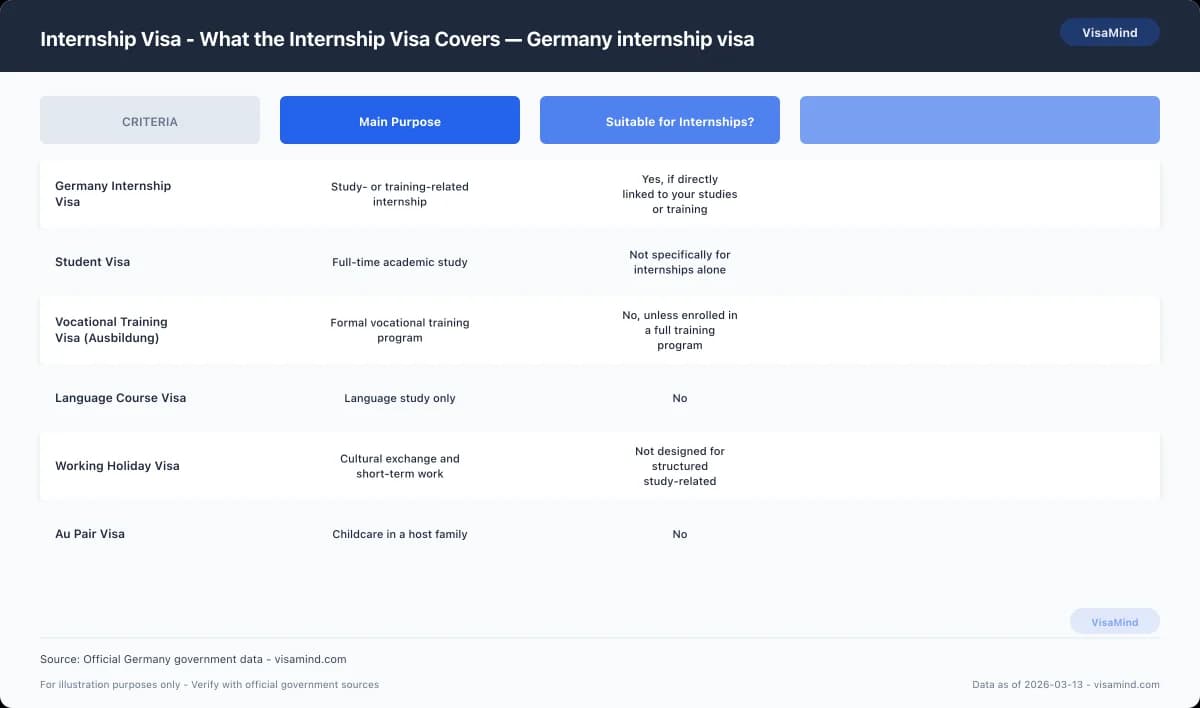
The table below clarifies how this visa differs from other common categories:
| Visa Type | Main Purpose | Suitable for Internships? |
|---|---|---|
| Germany Internship Visa | Study-related internship | Yes, if tied to studies or training |
| Student Visa | Full-time academic study | Not primarily |
| Vocational Training Visa (Ausbildung) | Formal vocational training program | Only if internship is built into training |
| Language Course Visa | Intensive language study | No |
| Working Holiday Visa | Cultural exchange with flexible work | Not study-specific |
| Au Pair Visa | Childcare in host family | No |
You should choose this visa when your primary reason for coming to Germany is to complete a defined internship connected to your education.
Eligibility Requirements
#You must meet clear academic, financial, and legal standards before the German authorities issue an internship visa. The rules focus on your student status, the connection between your studies and the internship, and your ability to support yourself during your stay.
Student / recent graduate status
You qualify only if you fit into one of these categories at the time of application:
- You are currently enrolled at a university outside Germany, or
- You completed your degree no more than two years before submitting your visa application.
If you graduated more than two years ago, you do not meet this requirement.
Your status must align with a residence title under Section 16e of the Residence Act (AufenthG). The German mission abroad, under the Federal Foreign Office, will review this during the visa process.
After entry, your local Ausländerbehörde handles your residence permit.
This visa differs from other residence titles.
| Visa Type | Main Purpose | Target Group |
|---|---|---|
| Internship Visa (Section 16e) | Study-related internship | Current students or recent graduates |
| Student Visa | Full-time academic study | Admitted university students |
| Vocational Training Visa (Ausbildung) | Structured vocational training | Trainees in recognized programs |
| Language Course Visa | Intensive language study | Language students |
| Working Holiday Visa | Cultural exchange with work | Young nationals of partner countries |
| Au Pair Visa | Cultural exchange in host family | Young adults providing childcare |
You cannot use another visa category as a substitute if your main purpose is a study-related internship.
Internship relevance
Your internship must directly relate to your course of study. The authorities expect a clear academic connection.
The tasks, department, and host institution should match your field. An unrelated placement does not qualify.
You should be able to show:
- Your field of study
- The content of the internship
- How the internship supports your academic or professional training
The host organization must provide a written commitment confirming the internship and agreeing to cover specific costs. This document forms a central part of your application.
The Federal Foreign Office reviews this documentation during the visa process. If you apply from within Germany for a residence permit, your local Ausländerbehörde assesses whether the internship meets the legal standard under Section 16e.
Financial and legal conditions
You must satisfy the general requirements for a residence title under Section 5(1) of the Residence Act.
The key conditions include:
- Secure livelihood: You must prove you can cover your living expenses.
- No grounds for expulsion: There must be no public interest in removing you from Germany.
As part of the internship arrangement, the host institution must commit in writing to cover:
- Your living expenses
- Your travel costs
You must also complete the required visa procedure before entry. The process typically involves:
-
Checking that you meet the legal requirements.
-
Completing the application form, often through the Form VIDEX system used by German missions abroad.
-
Submitting supporting documents to the competent German mission under the Federal Foreign Office.
If you plan to change your status after entry, your local Ausländerbehörde becomes responsible for the residence permit decision.
The Federal Office for Migration and Refugees (BAMF) does not process standard internship visa applications but oversees broader migration matters under federal law.
Required Documents
#You must show a signed internship agreement, confirm your academic status or recent degree, and prove your identity and nationality without doubt. Incomplete or inconsistent documents lead to delays or refusal by the German consulate or local authorities.
Internship agreement and employer commitments
You must submit a written internship agreement with a company or institution in Germany. The agreement must clearly identify you and the German host organization.
It should state:
- Your full name
- The name and address of the German facility
- The internship period
- The nature of the internship
The document must show that the host organization accepts you as an intern. Verbal offers or informal emails do not meet this requirement.
If you previously applied under a different category—such as a Student Visa, Vocational Training Visa (Ausbildung), Language Course Visa, Working Holiday Visa, or Au Pair Visa—the purpose of stay must match the internship agreement. Authorities review consistency across your applications.
You file your visa application through the Federal Foreign Office abroad. If you later apply for a residence permit inside Germany, your local Ausländerbehörde reviews the same internship documentation.
| Document | Must Include | Who Reviews It |
|---|---|---|
| Internship agreement | Host details, your identity, internship period, confirmation of placement | Federal Foreign Office / Ausländerbehörde |
Proofs of enrollment / degree
You must prove your academic connection to qualify for the internship visa.
Provide one of the following:
- Valid proof of enrollment at a university, or
- A degree obtained within the last two years
Enrollment confirmation must show that you currently study at a recognized institution. The document should clearly display your name and the institution’s details.
If you graduated, your degree certificate must show the date of completion. Authorities verify that the degree falls within the two-year limit.
This requirement distinguishes the internship visa from other categories such as the Vocational Training Visa (Ausbildung) or Language Course Visa, which serve different purposes.
Your academic proof must align with the internship agreement and your declared purpose of stay.
If your documents raise questions about status or authenticity, authorities may request clarification before issuing a decision.
Identity, nationality and forms
You must prove your identity and nationality without doubt. Your documents must clearly confirm who you are and which country you hold citizenship in.
Provide:
- A valid passport
- Completed visa application forms
Applicants filing forms connected to the Federal Office for Migration and Refugees (Bundesamt für Migration und Flüchtlinge) (BAMF) must ensure that all personal details match their passport exactly. Inconsistent spellings, dates, or nationality information create delays.
You may need to complete the Form VIDEX application form for consular processing through the Federal Foreign Office. Enter your data exactly as shown in your passport.
Your identity documents must remain valid throughout the application process. If your passport details change, update your forms immediately to avoid complications with your visa or residence permit.
How to Apply
#You must apply through the correct German authority in your country of residence and submit a complete, accurate file. Careful preparation and timely booking of your appointment prevent avoidable delays.
Where to submit your application
You must submit your Germany internship visa application to the German embassy or consulate responsible for your place of residence.
The Federal Foreign Office manages visa applications abroad through its embassies and consulates. You cannot submit your internship visa application to the Federal Office for Migration and Refugees (Bundesamt für Migration und Flüchtlinge) (BAMF), as BAMF primarily handles asylum matters.
If you are already in Germany with a valid residence status, the local Ausländerbehörde handles residence permits. First-time internship visa applicants generally apply from abroad.
| Situation | Where You Apply | Authority Responsible |
|---|---|---|
| Outside Germany | German embassy or consulate | Federal Foreign Office |
| Inside Germany with valid status | Local Ausländerbehörde | Municipal immigration office |
| Asylum matters | Not applicable for internship visa | BAMF |
Always apply in your country of legal residence. Applying in the wrong jurisdiction can result in refusal to accept your application.
If you are unsure whether your internship fits another category—such as a Student Visa, Vocational Training Visa (Ausbildung), Language Course Visa, Working Holiday Visa, or Au Pair Visa—confirm the correct visa type with the embassy before booking your appointment.
Preparing your application
You must prepare all required documents before attending your appointment. Incomplete files can delay processing or lead to rejection.
At minimum, you should:
- Confirm you meet all eligibility requirements for the internship visa
- Gather all required supporting documents
- Complete the official visa application form (such as Form VIDEX, if instructed by the embassy)
- Book your appointment early
- Allow sufficient time for processing
Do not wait until your intended travel date approaches. Appointment availability and processing times vary, and delays are common if you apply late.
Review each document carefully before submission. Your documents must be consistent, complete, and properly filled out.
If requirements are unclear, consult the German embassy handling your case. Do not rely on requirements for other visa types, as each category has different criteria.
Tips for completing forms
Complete every section of the application form accurately. Do not leave fields blank unless the form clearly allows it.
Before submission:
-
Review each answer for accuracy.
-
Check names, dates, and passport numbers carefully.
-
Ensure your information matches your supporting documents.
Errors or inconsistencies can delay processing or require additional clarification.
Use clear and truthful information. Do not guess or approximate details. If you use the VIDEX system, verify all entries before finalizing the form.
Submit your application only after you confirm that all sections are complete and correct. Careful review reduces the risk of avoidable delays.
Fees and Processing Times
#You must pay a national visa fee and plan for several weeks of processing before you can start your internship in Germany. The exact timeline depends on your visa category and the German authority handling your file.
Visa fee
You pay a €75 national visa fee when you submit your Germany internship visa application through the Form VIDEX system and attend your appointment at the German mission abroad.
| Item | Amount |
|---|---|
| National internship visa fee | €75 |
You complete the application using VIDEX (National Visa application form) and submit it to the Federal Foreign Office through the relevant German embassy or consulate.
The €75 fee applies to national visas. If you later apply for a residence permit after entering Germany, the local Ausländerbehörde sets separate fees.
Fees for related categories—such as the Student Visa, Vocational Training Visa (Ausbildung), Language Course Visa, Working Holiday Visa, or Au Pair Visa—may differ. Confirm the correct amount for your specific category with the German mission handling your case.
Typical processing timeline
You should expect 4 to 8 weeks for standard internship visa processing.
| Stage | Typical Timeframe |
|---|---|
| Internship visa (standard processing) | 4–8 weeks |
Processing starts after you submit a complete application and attend your visa appointment. Incomplete documents delay the review.
The German mission abroad reviews your application and may coordinate with authorities in Germany. In some cases, local immigration offices or other competent bodies review the internship placement.
You should not book non-refundable travel until you receive your visa.
Variations by category or office
processing times vary based on:
- Your visa category
- The German mission handling your application
- Whether additional internal approvals are required
An internship linked to university studies may follow a different review path than one categorized under vocational training or another national visa type.
Applications filed under categories such as the Vocational Training Visa (Ausbildung) or Language Course Visa may involve different internal checks. Similarly, Working Holiday Visa and Au Pair Visa applications can move at different speeds depending on workload and documentation.
The Federal Office for Migration and Refugees (BAMF) primarily handles asylum matters, not standard internship visas. Your initial visa decision comes from the Federal Foreign Office through the German mission abroad, and any residence permit after arrival is issued by the local Ausländerbehörde.
Can You Work? (internship Germany)
#Your right to work during an internship in Germany depends on your nationality, passport type, and the visa or residence title you hold. Visa‑free entry does not automatically grant unrestricted work rights, and passport details can determine whether you qualify for a waiver.
Visa waivers and passport rules
Some nationals may enter Germany without a visa for short stays, but strict passport conditions apply.
The visa waiver applies only if you hold a biometric passport. It does not apply to holders of Serbian passports issued by the Serbian Coordination Directorate (Koordinaciona uprava).
For Taiwanese nationals, the waiver applies only if your passport includes an identity card number. Without that number, you must apply for a visa before travel through the Federal Foreign Office.
Visa‑free stays operate within a 180‑day period. If your internship requires a longer stay, you must apply for the appropriate national visa before entering Germany.
| Situation | Visa Required Before Travel? | Key Condition |
|---|---|---|
| Biometric passport holder (eligible country) | Not for short stays | Passport must be biometric |
| Serbian passport (Coordination Directorate) | Yes | Waiver does not apply |
| Taiwan passport without ID number | Yes | ID number required for waiver |
| Stay beyond 180 days | Yes | National visa required |
If you are unsure, confirm your status with the Federal Foreign Office before making travel plans.
Duration-related limits
Visa‑free entry allows short stays within a rolling 180‑day period. You cannot exceed this limit without a national visa.
If your internship extends beyond that timeframe, apply for a long‑stay visa before arrival. Inside Germany, the local Ausländerbehörde manages residence permits linked to longer internships.
Different visa categories may apply depending on your purpose:
- Student Visa
- Vocational Training Visa (Ausbildung)
- Language Course Visa
- Working Holiday Visa
- Au Pair Visa
Each category carries its own work permissions and restrictions. Your internship must match the purpose of your visa.
You cannot rely on visa‑free entry if your planned activity exceeds short‑stay limits. Submit your national visa application using the Form VIDEX system when required.
The Federal Foreign Office processes visa applications abroad.
Employer obligations
Your host company must verify that you have the correct immigration status before you begin the internship. They cannot allow you to start work if your visa or residence title does not permit it.
Employers should:
- Check your passport type and visa status
- Confirm the 180‑day calculation if you entered visa‑free
- Ensure your internship aligns with your visa category
If your stay converts to a residence permit, the local Ausländerbehörde oversees compliance.
The Federal Office for Migration and Refugees (BAMF) handles asylum matters, not standard internship permissions. You remain responsible for holding valid authorization at all times.
Why Student Visas Get Denied
#Most denials trace back to three issues: you apply for the wrong visa category, you fail to prove secure finances, or you submit incomplete or conflicting information.
Purpose mismatch
German authorities expect your visa type to match your actual plan in Germany. If your activities do not align with the visa you request, the Federal Foreign Office can refuse your application.
For example:
| Your Actual Plan | Correct Visa Type |
|---|---|
| Enrolled academic studies | Student Visa |
| Company-based vocational training | Vocational Training Visa (Ausbildung) |
| Full-time language study only | Language Course Visa |
| Cultural exchange with host family | Au Pair Visa |
| Short-term cultural/work exchange | Working Holiday Visa |
If you apply for a Student Visa but intend to complete vocational training, your purpose does not match the category. The same applies if you request a Language Course Visa while planning to begin formal university studies.
You must clearly show that your admission, training contract, or program documents support the visa you select. The purpose stated in your Form VIDEX form must match every supporting document.
Financial shortfalls
You must prove that you can support yourself during your stay. German authorities require evidence of a secure livelihood before issuing a visa.
If you fail to provide acceptable proof of financial means, your application will likely be denied. It is not enough to state that your family will support you; you must submit formal evidence that demonstrates access to sufficient funds.
Common problems include:
- Missing financial documents
- Submitting unclear or incomplete proof
- Providing documents that do not clearly show available funds
Your financial evidence must be consistent across your application. If the amounts shown in your documents differ from what you declare in VIDEX, the inconsistency raises concerns.
The Federal Foreign Office assesses financial documentation carefully. If you cannot demonstrate secure funding for your intended stay, you do not meet a core visa requirement.
Incomplete or inconsistent information
Incomplete or contradictory information is a frequent reason for refusal. Even small discrepancies can damage your credibility.
Pay close attention to:
- Passport number accuracy
- Name spelling and order
- Dates of birth
- Program start and end dates
- Purpose of stay descriptions
Your VIDEX application must match your passport and supporting documents exactly. If your admission letter lists one start date but your form shows another, the authorities will question the reliability of your submission.
Before you submit:
-
Review every field in VIDEX.
-
Cross-check all dates and identification numbers.
-
Confirm that your stated purpose matches your documents.
The Federal Foreign Office expects precise and consistent information. Errors suggest carelessness or misrepresentation, both of which can result in denial.
When to Get Help
#You increase your chances of approval when you ask for guidance at the right time. Seek support if your eligibility is unclear, your application faces refusal, or your employer’s offer lacks clear terms.
Complex or uncertain cases
You should consult a qualified immigration professional if your situation does not fit a standard internship profile.
Common risk factors include:
- You previously held a Student Visa, Language Course Visa, or Vocational Training Visa (Ausbildung) and want to change status.
- You are unsure whether your internship qualifies under the correct visa category instead of a Working Holiday Visa or Au Pair Visa.
- Your internship forms part of a broader academic program with unclear documentation.
- You have gaps, inconsistencies, or prior visa issues in Germany.
German consulates abroad process visa applications through the Federal Foreign Office, while your local Ausländerbehörde handles residence permits after arrival. Misunderstanding who decides what often causes delays.
If your case touches asylum or protection history, the Federal Office for Migration and Refugees (Bundesamt für Migration und Flüchtlinge) (BAMF) may also be relevant.
You must also complete the Form VIDEX online application accurately. Even small data inconsistencies can undermine credibility. Filing an application does not guarantee approval.
After a rejection
A refusal requires immediate review of the written decision. Do not guess at the reason.
You should:
-
Read the refusal notice carefully.
-
Identify the exact legal or factual ground cited.
-
Compare it to the documents you submitted.
If the decision refers to missing proof, inconsistent internship terms, or doubts about your purpose of stay, seek professional analysis before reapplying.
Repeated weak applications damage credibility. A structured reassessment often works better than a quick resubmission.
An advisor can determine whether you should submit a new application, provide additional documentation, or adjust your visa category. For procedural rules and formal remedies, confirm details with the Federal Foreign Office or your responsible German mission.
Ambiguous employer commitments
You need clear, written commitments from your host organization. Vague internship letters frequently cause problems.
Review the offer for:
- Defined start and end dates
- Clear description of duties
- Working hours
- Compensation or confirmation of unpaid status
- Supervisor name and contact details
If the employer avoids putting terms in writing, reconsider proceeding. German authorities assess whether your internship is structured and genuine.
Unclear arrangements can also affect your visa classification. For example, training-focused roles may resemble Vocational Training Visa (Ausbildung) cases, while cultural exchange roles may overlap with Au Pair Visa rules.
Ask the employer to clarify expectations before you submit your VIDEX form and supporting documents. Precise documentation reduces the risk of refusal.
Fees
#| Component | Amount |
|---|---|
| Filing fee (VIDEX-NATIONAL)Verify at auswaertiges-amt.de. | €75 (approx $81 USD) |
Fees change; always verify on AA.