
What the Vocational Training Visa (Ausbildung) Covers — Germany vocational training visa
#
This visa covers structured vocational training in Germany, including both school-based and in-company dual training. It generally permits a stay of up to three years, assuming you meet the B1 German language requirement.
Who this visa is for
Apply for this visa if you have a recognized vocational training place (Ausbildungsplatz) in Germany. The training must be either school-based or part of the dual system that combines on-the-job training with classroom instruction.
German language skills at B1 level are mandatory. This ensures you can follow lessons, handle workplace instructions, and communicate daily during your training.
This visa is distinct from residence titles for general study, cultural exchange, or job searching. Its sole purpose is to let you complete formal vocational training for skilled employment in Germany.
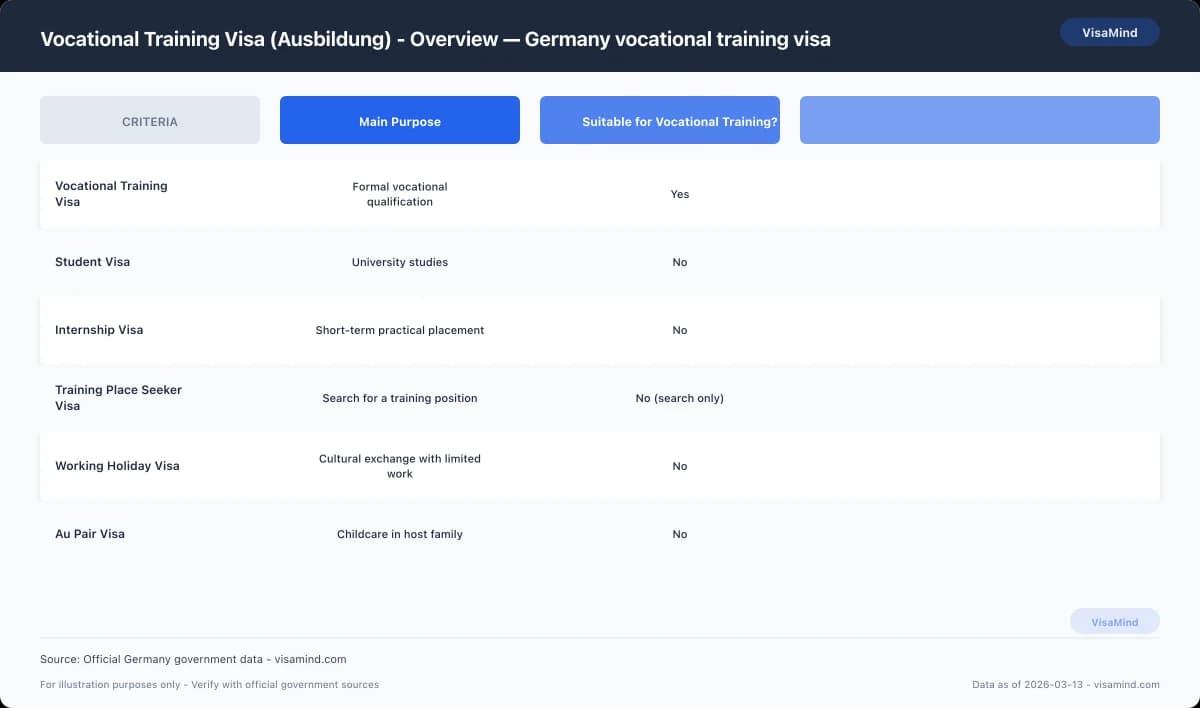
| Visa Type | Main Purpose | Suitable If You Want To |
|---|---|---|
| Vocational Training Visa (Ausbildung) | Complete formal vocational training | Qualify in a skilled trade or occupation in Germany |
| Student Visa | Academic study | Attend a university program |
| Internship Visa | Temporary practical placement | Gain short-term work experience |
| Training Place Seeker Visa | Search for a training position | Find an Ausbildung before it begins |
| Working Holiday Visa / Au Pair Visa | Cultural exchange | Travel and gain limited work experience |
Your visa application is submitted abroad through the Federal Foreign Office. After arrival, the Ausländerbehörde in your area handles your residence permit.
Training formats covered
The visa applies to:
- Dual (in-company) vocational training
- School-based vocational training
Dual training combines practical work in a company with theoretical instruction at a vocational school. You'll sign a training contract with an employer and take coursework alongside hands-on training.
School-based programs are primarily at a vocational school. Some practical elements may be included, but the structure is centered on classroom instruction.
Both formats prepare you for skilled work in Germany. The program must be a recognized vocational qualification with an organized training plan.
This visa doesn't convert automatically from other short-term stays. If you previously held a Student Visa, Internship Visa, Working Holiday Visa, or Au Pair Visa, your status must match the vocational training purpose.
Typical duration & language
The Vocational Training Visa usually allows a stay in Germany for up to three years. The exact period depends on your training program.
You must provide proof of B1-level German language proficiency before the visa is issued. You'll need to understand lessons, workplace safety rules, and written materials for your occupation.
Visa validity matches the official training period. If your program is shorter than three years, your residence permit will reflect that.
For application procedures, use the Form VIDEX system when applying abroad. Inside Germany, the local Ausländerbehörde manages your residence status.
Student Visa Document Checklist (vocational training Germany)
#You need to prove your identity, secure a confirmed training place, show German language skills at B1, and demonstrate complete financial coverage for your stay. Missing or incomplete documents can lead to delays or refusal by the German mission abroad.
Identity and passport documents
Clear proof of identity and nationality is required. The German embassy or consulate won't process your Student Visa for vocational training without it.
You'll need:
- Valid national passport
- Copies of your passport’s data page
- Completed visa application form (via Form VIDEX, if required)
- Recent biometric passport photos (if requested)
Your passport must be valid throughout the visa process. If there's inconsistency in your documents, clarification may be requested before a visa is issued.
If you've held another German visa—like an Internship Visa, Training Place Seeker Visa, Working Holiday Visa, or Au Pair Visa—include copies to establish your travel history and lawful status.
Applications are submitted abroad via the Federal Foreign Office. After entry, your local Ausländerbehörde issues your residence permit. The Federal Office for Migration and Refugees (BAMF) sets migration policy but doesn't process consular visas.
Proof of training place and language
You must show that you've been accepted for a specific vocational training place. A general intention to train in Germany isn't enough.
Provide:
- Signed training contract or official confirmation of your training place
- Details of the training provider and program
- Start date and duration of the training
The offer must identify you and confirm your participation.
Proof of German language skills at B1 level (CEFR) is required.
Include:
- Official language certificate confirming B1 level
- Test result document with your name and exam details
The mission will assess whether your language skills are sufficient for the training. Without valid B1 proof, your application doesn't meet the requirements.
| Requirement | What You Must Show |
|---|---|
| Training place | Signed contract or official confirmation |
| Language level | B1 (CEFR) certificate |
| Program details | Named applicant, start date, duration |
Proof of finances
You must show you can cover your living expenses for the entire duration of your stay in Germany. Partial funding isn't accepted.
Accepted financial proof:
- Blocked bank account
- Declaration of commitment
- Scholarship confirmation (for school-based training)
Financial evidence must show your living costs are secured for the whole training period.
Documents should state:
- Your full name
- The funding source
- The covered time period
If financial proof is unclear or incomplete, additional documentation may be requested.
Who Can Apply
#Eligibility requires a recognized vocational training place in Germany, plus age, approval, and lawful stay conditions. German authorities check your training contract, age, and any legal bars to entry or residence.
Required training place & approvals
A confirmed vocational training place in Germany is necessary before applying. This can be:
- School-based vocational training
- In-company (dual) vocational training
For in-company training, the Federal Employment Agency must approve your placement. Without this, a visa won't be issued.
Your training place must be specific and documented. If you're still searching, consider the Training Place Seeker Visa instead.
Visa applications are submitted abroad through the Federal Foreign Office using Form VIDEX. If you later change status within Germany, the Ausländerbehörde handles your residence permit.
| Requirement | Mandatory? | Notes |
|---|---|---|
| Confirmed training contract | Yes | Must be school-based or in-company |
| Federal Employment Agency approval | Yes (for in-company training) | Required before visa issuance |
| Use of VIDEX for application | Yes (abroad) | Submitted via German consulate |
This visa category isn't interchangeable with the Student Visa, Internship Visa, Working Holiday Visa, or Au Pair Visa.
Age and legal grounds
Applicants must be under 35 years old at the time of application. Those 35 or older don't qualify under this category.
Authorities also check for any grounds for expulsion. There must be no public interest in your removal from Germany, including legal circumstances that would justify denying entry or residence.
The 180‑day reference period is used to assess your legal standing. Issues during that period can affect eligibility.
Applications may be refused if:
- You're outside the permitted age range
- Expulsion grounds are identified
- Your legal history conflicts with residence requirements
The Federal Office for Migration and Refugees (BAMF) oversees migration policy, but visa issuance abroad is the responsibility of the Federal Foreign Office.
Minimum salary / financial conditions
For in-company vocational training, your position must meet the approval requirements set by the Federal Employment Agency. Approval confirms the training arrangement meets legal and financial standards.
School-based training doesn't require Federal Employment Agency approval, but the arrangement must be legitimate and properly documented.
Unlike the Working Holiday Visa or Au Pair Visa, this visa is tied directly to a formal vocational qualification path. Authorities check that your training structure complies with German regulations before granting residence permission.
For current financial thresholds or administrative details, refer to the Federal Foreign Office or your local Ausländerbehörde.
How to Apply
#Eligibility, accurate forms, and proper submission to the correct German authority are essential. Complete documentation and accuracy affect whether your application moves forward smoothly.
Check requirements and prepare documents
You must meet the basic residence title conditions under Section 5 (1) of the Residence Act (AufenthG). The key requirement is a secure livelihood—proof you can cover living expenses during your vocational training.
Prepare documents that clearly back up your case. Incomplete files often cause delays or refusals.
Key requirements:
- Sufficient financial resources
- Valid passport (check if visa waiver applies to your nationality and passport type)
- You meet the conditions for a Germany vocational training visa, not another category
Refer to the table below for visa distinctions:
| Visa Type | Purpose | When to Choose It |
|---|---|---|
| Germany Vocational Training Visa | Recognized vocational training in Germany | You have a confirmed training placement |
| Training Place Seeker Visa | Search for a training position | You do not yet have a contract |
| Student Visa | Academic university studies | You enroll in higher education |
| Internship Visa | Short-term training placement | You complete a defined internship |
| Working Holiday Visa | Cultural exchange with work | You qualify under a bilateral program |
| Au Pair Visa | Cultural exchange with host family | You work as an au pair |
If uncertain, check guidance from the Federal Foreign Office or consult the Federal Office for Migration and Refugees (BAMF) for clarification on residence categories.
Download and complete forms
Download and complete the required visa application forms before your appointment. Many use the Form VIDEX online system to fill out the national visa form electronically.
Steps to follow:
-
Enter personal data as shown in your passport.
-
Complete every field accurately.
-
Review answers before finalizing.
-
Print and sign where required.
Some forms may be used in procedures involving BAMF, depending on your case. All sections must be filled; missing information can delay processing.
If you qualify for a visa waiver, check if it applies to your passport type. Certain exemptions are limited to biometric passports or specific issuing authorities.
Don't submit handwritten corrections or inconsistent information. Consistency across forms and documents is required.
Where to submit your application
Apply for your visa in your country of residence. The Federal Foreign Office processes visa applications through German embassies and consulates abroad.
Submit your application in person, unless instructed otherwise by the mission. Procedures can vary by location.
After arrival in Germany, the Ausländerbehörde in your area manages your residence permit. The Federal Office for Migration and Refugees (BAMF) deals primarily with asylum, not standard vocational training visa applications.
If you're already in Germany under another status, confirm if you can switch categories within the country or must apply from abroad. Follow instructions from the German mission responsible for your residence.
Fees and Processing Times
#A set application fee is required. Processing typically takes several months, depending on your visa category and the German mission handling your case.
Visa application fee
You pay a €75 national visa fee when applying for a Germany vocational training visa through the Form VIDEX system (National Visa application).
This fee applies to long-stay visas, including vocational training. It's separate from residence permit fees you may later pay to your local Ausländerbehörde after you arrive in Germany.
| Item | Amount |
|---|---|
| National visa application fee (VIDEX) | €75 |
Most applicants pay the fee when submitting their application at the German embassy or consulate, operating under the Federal Foreign Office. The fee is non-refundable, even if your visa is refused.
Other long-stay visas—like the Student Visa, Internship Visa, Training Place Seeker Visa, Working Holiday Visa, and Au Pair Visa—also use national visa procedures. Consulates control local payment methods, so the exact way you pay can differ.
Standard processing time
Expect a standard processing time of 1 to 3 months for a vocational training visa.
Processing starts after you submit a complete application and attend your appointment at the German embassy or consulate. Missing or incomplete documents will delay your review and can stretch out the timeline.
| Stage | Estimated Time |
|---|---|
| Standard processing | 1–3 months |
The Federal Foreign Office manages visa decisions abroad. If German authorities need to review your case, coordination with local offices can add to the waiting period.
Avoid booking non-refundable travel until you have visa approval.
Processing time variations
The processing time depends on:
- The visa category you choose
- The German mission handling your application
- Case volume at the time you apply
Even though all these are national visas, the vocational training category may move at a different pace than a Student Visa or Training Place Seeker Visa.
Different embassies or consulates may process at varying speeds. Sometimes, internal consultations with German authorities influence how long you wait.
Work Rights While Studying (Ausbildung)
During company-based vocational training, you work under a formal training contract and receive a fixed monthly salary. Your right to stay depends on meeting minimum pay rules and training with an approved employer.
In-company training salary rules
If you complete a company-based Ausbildung, you must receive a minimum training salary.
| Type of Amount | Minimum per Month |
|---|---|
| Gross salary | €1,048 |
| Net salary | €822 |
Your contract needs to meet at least one of these thresholds. If your salary falls below this level, authorities may refuse or question your residence permit.
The salary comes directly from your training company. This forms the financial basis of your stay, in contrast to the Student Visa, which usually requires separate proof of funds.
This rule applies to company-based training. Other residence types—such as the Internship Visa, Training Place Seeker Visa, Working Holiday Visa, or Au Pair Visa—have different financial structures.
When you apply abroad through the Federal Foreign Office, you declare your training details in the VIDEX system. After arrival, your local Ausländerbehörde reviews your contract as part of the residence permit process.
Approval requirements for training employers
Your employer must offer a legitimate company-based vocational training position. The contract must clearly state:
- The occupation you will train in
- The duration of training
- Your monthly salary (meeting the required minimum)
Authorities check whether the training arrangement matches a recognized vocational structure. If the position doesn't qualify as formal vocational training, you can't receive or extend your residence permit for Ausbildung.
You can't replace the required salary with informal payments or unpaid arrangements. Volunteer roles or unpaid internships don't meet the criteria.
The Federal Office for Migration and Refugees (BAMF) sets overall migration policy. Your local Ausländerbehörde decides your residence status inside Germany.
You need to submit accurate employer details both during your visa process and when applying for your residence permit.
When to Consult a Professional
#A vocational training visa application requires accurate documents and choosing the correct visa category. Mistakes or using the wrong path can delay or block your plans.
Cases to Get Expert Help
Seek professional advice if you aren't sure which visa fits your situation. Many applicants confuse the Vocational Training Visa with a Student Visa, Internship Visa, Training Place Seeker Visa, Working Holiday Visa, or Au Pair Visa.
Each serves a different purpose.
| Situation | Why Legal Guidance Helps |
|---|---|
| You do not yet have a confirmed training contract | You may need a Training Place Seeker Visa instead |
| You plan to combine training with short-term work | The correct visa category must match your main purpose |
| You previously held another German visa | Status changes can affect eligibility |
| Your Form VIDEX form contains inconsistencies | Errors can trigger delays or refusal |
Submitting an application never guarantees approval. A professional can review your documents before you file with the Federal Foreign Office abroad or your local Ausländerbehörde in Germany.
If your case involves prior refusals or a complicated residence history, get help.
Tips to Avoid Common Pitfalls
Reduce risk by preparing carefully and following official guidance. Start with the correct authority.
- Apply for entry visas through the Federal Foreign Office.
- Handle residence permits in Germany at your local Ausländerbehörde.
- BAMF (Federal Office for Migration and Refugees) deals with asylum, not vocational training visas.
- Complete the VIDEX form accurately and consistently.
Programs that seem similar often have different rules. The requirements and intent for a Student Visa or Internship Visa are not the same as for a vocational training residence permit.
Check every document for matching dates, names, and training details before you submit. Even small inconsistencies can cause questions, delays, or refusal.
What Comes After Your Degree
#After completing vocational training in Germany, you need a new residence status if you want to stay. Your next steps depend on whether you have a job offer, plan further study, or qualify for another visa category.
Post-training pathways
Once you finish your recognized vocational training, your training-based residence permit doesn't automatically continue. You must apply for a new residence permit at your local Ausländerbehörde before your current permit expires.
Your main options include:
- Residence permit for employment if you have a job offer in your trained occupation
- Student Visa if you're enrolling in a university program
- Internship Visa if you secure a qualifying internship
- Working Holiday Visa (if you meet nationality and age requirements)
- Au Pair Visa if you switch to an approved host family placement
If you don't yet have a training contract but want to start a new vocational program, you may qualify for a Training Place Seeker Visa.
The local Ausländerbehörde handles your residence permit inside Germany. The Federal Office for Migration and Refugees (BAMF) deals with broader migration matters but doesn't issue your residence card.
Next-permit options
Your next permit depends on your concrete plan. Apply before your current permit expires to avoid gaps in lawful stay.
| Situation | Appropriate Status | Where to Apply |
|---|---|---|
| Job offer in trained field | Employment residence permit | Local Ausländerbehörde |
| University admission | Student Visa / residence permit for study | Ausländerbehörde (if in Germany) or Federal Foreign Office (if abroad) |
| Approved internship | Internship Visa | Same as above |
| Seeking new vocational training | Training Place Seeker Visa | Federal Foreign Office (abroad) |
| Cultural exchange placement | Au Pair Visa | Federal Foreign Office |
If you leave Germany and apply from abroad, you submit your visa application through the Federal Foreign Office. The Form VIDEX online form is part of that process.
For current fees in EUR (€) and document checklists, refer to the Federal Foreign Office or your local Ausländerbehörde. Requirements differ by status and your personal background.
Why Student Visas Get Denied
#Most refusals result from missing language proof or inconsistent information in your application. Even small discrepancies between your documents and your Form VIDEX form can cause a denial.
Documentation gaps
German consulates expect complete and consistent evidence with your Student Visa application. For vocational training, you must prove the required German language level.
Common reasons for refusal include:
- No language certificate
- A certificate below B1 (CEFR) when B1 is required
- A certificate that doesn't match the training program’s language expectations
If your training contract requires B1 and you provide A2, the Federal Foreign Office may refuse your visa. The same issue can affect related categories such as the Training Place Seeker Visa, Internship Visa, Au Pair Visa, or Working Holiday Visa if language ability is part of eligibility.
Use this checklist before submission:
| Document Area | What to Verify |
|---|---|
| Language proof | At least B1 CEFR if required |
| Name details | Match passport exactly |
| Dates | Consistent across all forms |
| Program details | Match training contract |
If you have questions about recognition standards, consult the Federal Office for Migration and Refugees (Bundesamt für Migration und Flüchtlinge) (BAMF) or the Federal Foreign Office guidance.
Common application errors
Inconsistent or incomplete information across your application causes denials you could avoid. Many applicants enter different spellings, dates, or passport numbers in the VIDEX form compared to their supporting documents.
Common errors include:
- Spelling your name differently than in your passport
- Entering an incorrect passport number
- Leaving sections blank
- Providing conflicting dates for education or residence
Even minor discrepancies raise credibility concerns. The visa officer compares your VIDEX form, passport, and supporting documents line by line.
Before you submit, review your full application:
-
Check every data field against your passport.
-
Confirm all dates match across documents.
-
Ensure no section remains incomplete.
Accuracy and consistency matter as much as eligibility. A precise application reduces your risk of refusal.
Fees
#| Component | Amount |
|---|---|
| Filing fee (VIDEX-NATIONAL)Verify at auswaertiges-amt.de. | €75 (approx $81 USD) |
Fees change; always verify on AA.