What Reviewers Look For
#Germany processes numerous visa applications annually through the Federal Office for Migration and Refugees (BAMF). This office provides a detailed checklist to ensure that all necessary documents accompany your visa application, streamlining the process and reducing delays. Before applying, you should gather all required documents as outlined by the BAMF. This proactive approach helps in meeting the specific criteria laid out for various visa categories, such as the Skilled Worker Visa and Student Visa.
Document Authenticity Standards
Documents submitted for a German visa must be authentic and verifiable. The BAMF expects original documents or certified copies, especially for critical records such as birth certificates and diplomas. Translations of documents not in German must be completed by certified translators. This ensures that the content is accurately represented. Counterfeit documents can lead to immediate rejection of the application.
Warning: Submitting forged documents is a serious offense and can lead to a ban from entering Germany.
Compliance with German Regulations
German visa document requirements are governed by strict regulations. The BAMF outlines specific criteria that applicants must meet, such as providing proof of financial means and health insurance. Compliance with these regulations is critical. For instance, financial documents must show sufficient funds for the duration of your stay, aligned with the standards set by the German authorities.
Tip: Ensure all documents comply with the latest guidelines by regularly checking the BAMF website.
Understanding Visa Application Criteria
Each visa category has specific criteria that applicants must meet. For example, the Skilled Worker Visa requires proof of professional qualifications and a job offer in Germany. The Student Visa mandates proof of university admission and financial support. Understanding these criteria helps in preparing a complete application, minimizing the risk of delays. - Skilled Worker Visa: Job offer, professional qualifications
- Student Visa: University admission, financial proof
- Family Reunion Visa: Proof of relationship
Important: Stay informed about the specific requirements for your visa category by visiting the respective visa pages such as Family Reunion Visa.
Photo Requirements
#This ensures that your application is processed without unnecessary delays. The Federal Office for Migration and Refugees (BAMF) outlines precise specifications for visa photos.
German Visa Photo Dimensions
Visa photos for Germany must adhere to strict size requirements. The dimensions are designed to fit standardized processing systems.
| Specification | Requirement |
|---|---|
| Width | 35 mm |
| Height | 45 mm |
| Head Size | 32-36 mm from chin to crown |
Tip: Measure the head size carefully, as even slight deviations can lead to rejection.
Background and Lighting Rules
Your visa photo must have a plain, light-colored background. White or light gray is preferred to ensure contrast with facial features. - Avoid shadows or reflections. - Ensure uniform lighting. - Do not use patterned or textured backgrounds.
Important: Photos with uneven lighting may be rejected by BAMF.
Photo Format and Quality
Photos must be of high quality to meet BAMF standards. This includes specific format and clarity requirements. - Use high-resolution print. - Ensure photo is not pixelated or blurry. - Submit photos in color, not black and white.
Warning: Digital alterations or enhancements can lead to rejection of the application.
Category-Specific Requirements
#Germany's visa application process requires specific documents to verify your employment, academic, and family status. The Federal Office for Migration and Refugees (BAMF) oversees the documentation requirements for these categories.
Employment Contract Requirements
If you're applying for a work visa, presenting a valid employment contract is essential. This document confirms your job offer and details the terms of your employment in Germany. - Job title and job description
- Salary and employment duration
- Employer's contact information
- Start date of employment
Important: Ensure your employment contract is signed by both you and your employer and is written in German or accompanied by a certified translation.
Academic Acceptance Documents
For those pursuing studies in Germany, proof of academic acceptance is required. This confirms your admission to a recognized educational institution. - Official acceptance letter from the German university or college
- Course details and duration
- Confirmation of tuition fee payment, if applicable
Tip: Verify that your acceptance letter includes the institution's official stamp or seal for authenticity.
Proof of Family Relations
For family reunion visas, demonstrating your family relationship with a resident in Germany is necessary. Proper documentation helps establish this connection. - Marriage certificate for spouses
- Birth certificates for children
- Official documents proving family ties, such as adoption papers
Warning: All documents must be original or certified copies, and non-German documents should be accompanied by a certified German translation.
Proof of Funds
#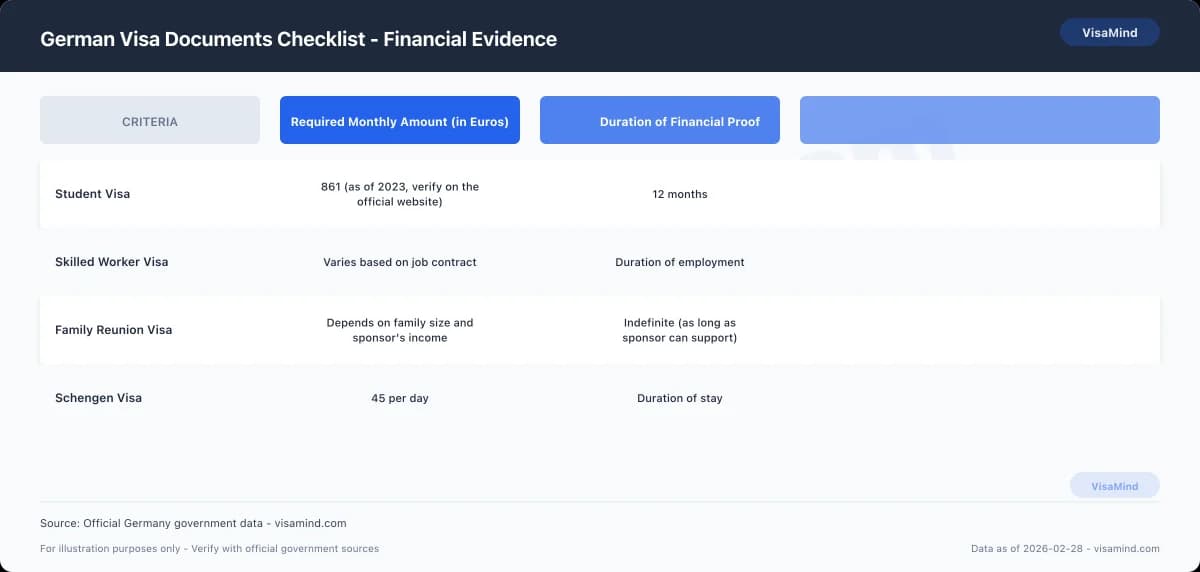
For those applying for a visa to Germany, demonstrating financial capacity is required. This is typically done by providing bank statements that meet certain criteria set by the German authorities.
Minimum Balance Requirements
The amount of funds you need to show varies depending on the type of visa you are applying for. For example, a Student Visa typically requires proof of around €11,208 per year, which is roughly €934 per month as of 2026. If you are applying for a Skilled Worker Visa the financial requirements might differ, often influenced by your employment contract and salary. It is important to ensure that your bank balance consistently reflects the minimum required funds.
Important: Check the specific financial requirements for your visa type on the official BAMF website to ensure you meet the latest standards.
Duration of Account Statements
When submitting bank statements, you are generally required to provide documents covering a period of at least three months. This helps demonstrate a stable financial situation over time. Ensure that the bank statements include all transactions, as incomplete records might raise questions about your financial stability. Consistency in account activity is often scrutinized.
| Visa Type | Required Duration | Monthly Balance |
|---|---|---|
| Student Visa | 3 months | €934 |
| Skilled Worker Visa | 3 months | Varies by salary |
| Family Reunion Visa | 3 months | Varies |
Tip: Keep printed copies of your statements as well as digital versions, as some visa centers may require physical documents.
Acceptable Financial Institutions
The German authorities typically accept bank statements from recognized financial institutions. These include major banks with international operations and local banks in Germany. - Deutsche Bank
- Commerzbank
- Sparkasse
- International banks with operations in Germany If your bank is not listed among the commonly accepted ones, ensure that it is reputable and that the statements are clear and detailed. This will help prevent any delays in the processing of your visa application.
Warning: Using non-traditional financial accounts, such as cryptocurrency wallets, is not recommended as they may not be accepted by the German authorities.
Common Document Mistakes
#In Germany, ensuring all visa documents meet specific requirements is critical for a successful application. Common errors, such as incorrect photo specifications or missing translations, can cause delays or rejections.
Incorrect Photo Specifications
Photos submitted for visa applications must adhere to strict guidelines set by German authorities. Incorrect photo dimensions or outdated styles can lead to application setbacks. - Photos must be 35mm x 45mm in size. - Face should cover 70-80% of the photo. - Neutral facial expression with closed mouth.
Tip: Always use a recent photo taken within the last six months to ensure compliance with current standards.
Outdated Financial Statements
Financial proof is a vital part of most German visa applications, but using outdated documents can lead to issues. Financial statements must be current to demonstrate your ability to support yourself. - Bank statements should be no older than three months. - Include all pages to show complete account activity. - Ensure the statements are officially stamped by your bank.
Important: For specific visas like the Skilled Worker Visa, additional financial documentation may be required. Check the specific requirements.
Missing Certified Translations
Any non-German documents must be accompanied by a certified translation. Missing these translations can halt the application process. - Use a certified translator recognized by the German authorities. - Verify that the translation is complete and accurate. - Attach both the original document and its translation.
Warning: Failing to provide certified translations for essential documents can result in immediate rejection of your visa application.
Health and Character Requirements
#In Germany, health and character assessments are key components of the visa application process, ensuring public safety and wellbeing. The Federal Office for Migration and Refugees (BAMF) requires specific documentation for tuberculosis (TB) tests, medical exams, and police clearances.
TB Test Documentation
For certain visas, you may need to provide proof of a negative TB test. This requirement is particularly pertinent for applicants from countries with a high incidence of tuberculosis. - TB test results must be from a recognized medical institution. - The results should clearly state the test type and outcome. - TB tests are valid for a limited time, often six months.
Tip: Check with your local German embassy or consulate to confirm if a TB test is required for your specific visa category. Requirements may vary based on your country of origin.
Approved Medical Examination Centers
Medical examinations for German visas must be completed at approved centers. These centers are authorized to conduct the necessary health checks and provide valid documentation. - Locate an approved medical center via the German embassy's website. - Schedule an appointment well in advance to avoid delays. - Bring identification and any relevant medical history to your appointment.
Warning: Only exams from approved centers will be accepted. Using an unapproved facility may lead to application delays or rejection.
Police Clearance Certificate Guidelines
A police clearance certificate (PCC) is required to demonstrate good character. This certificate should be issued by the appropriate government authority in your home country. - Ensure the PCC is recent, typically not older than three months. - The document should be translated into German if issued in another language. - You may need PCCs from countries where you have lived for more than six months in the past year.
Important: If you have lived in Germany, you may also need a PCC from the Federal Central Register (Bundeszentralregister).
Passport and ID Requirements
#In 2026, Germany ranked among the top destinations for skilled migrants. One of the first steps in the application process involves confirming that your passport and identity documents meet the specific requirements set by German authorities.
Passport Validity for Germany
To apply for a visa to Germany, your passport must be valid for at least three months beyond your planned departure date from the Schengen Area. This ensures that you have sufficient validity for your stay and any unforeseen circumstances. - Passport must be issued within the last 10 years. - Must contain at least two blank pages for visa stamps.
Important: Ensure your passport is not damaged, as this might result in delays or refusal at border control.
Required Identity Document Copies
When applying for a German visa, you must provide copies of certain identity documents to support your application. These documents help verify your identity and support your eligibility for the visa category you are applying for. - Copy of the passport data page. - Copies of previous visas, if applicable. - Two recent passport-sized photographs as per German specifications.
Tip: Ensure that all photocopies are clear and legible to avoid unnecessary delays in processing.
Additional Local Requirements
#Germany requires certain additional documents for visa applications that are specific to the applicant's situation and nationality. These requirements can vary and may include translations or certifications of documents. Be sure to verify any unique entry conditions or document requirements on the Federal Office for Migration and Refugees (BAMF) website before applying for your visa.
Special Entry Conditions for Nationals
Some nationals may face special entry conditions when applying for a German visa. For instance, nationals from countries like India, China, and Russia might require additional documentation such as proof of accommodation or a detailed itinerary. - Proof of accommodation (e.g., hotel reservation or invitation letter)
- Detailed travel itinerary
- Bank statements showing sufficient funds
Tip: Check with the Federal Foreign Office for any updates on entry conditions specific to your country.
Local Document Authentication
In Germany, certain documents must be authenticated locally to be considered valid for visa applications. This often includes birth certificates, marriage certificates, and educational qualifications.
-
Locate a certified translator to translate your documents into German.
-
Have the translations certified by a notary or the local court.
-
Submit the certified translations with your application.
Important: Ensure that your documents are translated by a certified translator recognized by German authorities to avoid any delays.
Country-Specific Forms and Fees
When applying for a visa in Germany, you may need to complete specific forms that are unique to your situation. These forms often accompany the standard application and vary depending on the visa type.
| Visa Type | Specific Form | Fee |
|---|---|---|
| EU Blue Card | Application for the Blue Card EU | €140 |
| Family Reunion Visa | Declaration of Commitment | €75 |
| Student Visa | Proof of Financial Resources | €60 |
Tip: Consult the Student Visa page for detailed information on forms and fees applicable for students.