On this page
- About the Self-Employment Visa — Germany self-employment visa
- Documentation Checklist
- How to Apply
- Fees and Wait Times
- When to Get Help
- Your Tax Situation — self-employed visa Germany
- Who Can Apply
- Renewal and Path to Residency
- Why Applications Get Denied
- Fees
- Required forms
- Related visa types
- Related guides
- Related goals
- Next steps
About the Self-Employment Visa — Germany self-employment visa
#
The Germany self-employment visa allows you to obtain a residence permit to start or run your own business in Germany.
You must show a viable business plan and demonstrate economic interest in your activity.
Purpose
The self-employment visa exists for individuals who want to establish or operate a business in Germany or work independently as a freelancer.
You apply for a residence permit for self-employment under Germany’s immigration framework.
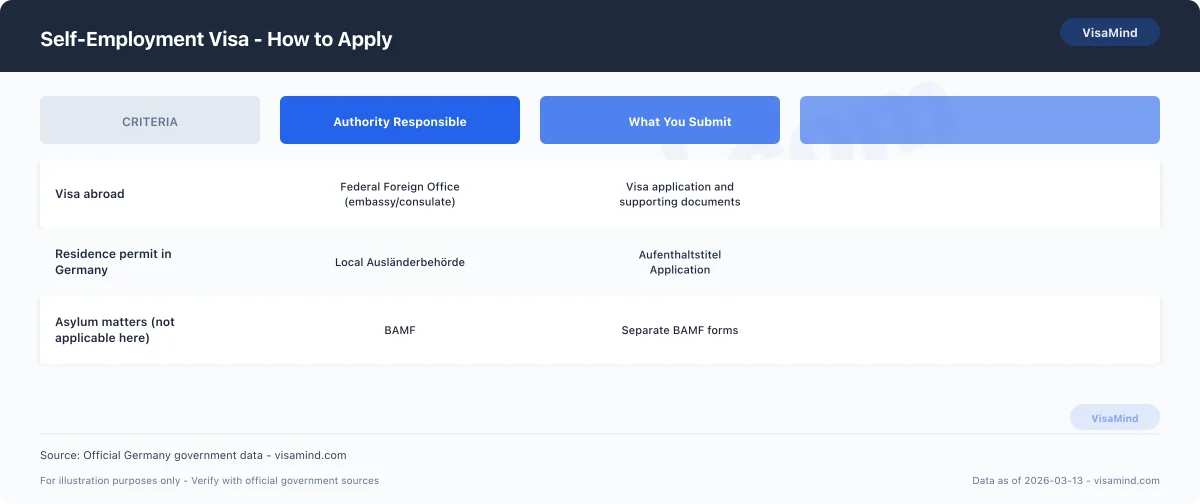
If you apply from abroad, you submit your visa application through the Federal Foreign Office at the responsible German consulate.
After entering Germany, the local Ausländerbehörde issues your residence permit.
Your application must include:
- A detailed business plan
- Evidence that your activity serves an economic interest in Germany
- Documentation supporting your self-employment project
You typically complete the national visa application using the Form VIDEX system and later submit the formal Form Aufenthaltstitel Application for your residence permit inside Germany.
The Federal Office for Migration and Refugees (Bundesamt für Migration und Flüchtlinge, BAMF) oversees migration policy at the federal level.
Local authorities decide residence permits.
Who it's for
This visa fits you if you intend to:
- Start a new business in Germany
- Take over or run an existing business
- Work independently as a freelancer
It does not apply if you plan to work as an employee.
In that case, you would consider other residence titles.
The table below clarifies how this pathway differs from other common German residence options:
| Residence Pathway | Main Purpose | Employment Type |
|---|---|---|
| Self-Employment Visa | Start or run a business | Self-employed |
| Freelance Visa | Independent professional activity | Self-employed |
| EU Blue Card | Qualified employment | Employee |
| Skilled Worker Visa | Employment based on qualifications | Employee |
| Job Seeker Visa | Search for employment | Not employed |
| Opportunity Card (Chancenkarte) | Seek work opportunities | Not employed |
You must choose the residence title that matches your actual activity.
German authorities assess your application based on the category you select.
Key context
Germany treats self-employment as a regulated immigration pathway.
Authorities review whether your business activity aligns with economic interests in the country.
Your approval depends on the strength and credibility of your business plan.
You must clearly explain:
-
What your business will do
-
How it will operate in Germany
-
Why it serves an economic purpose
You apply for the visa abroad through the Federal Foreign Office.
Once in Germany, you file your Aufenthaltstitel Application with the local Ausländerbehörde to receive your residence permit.
Documentation Checklist
#You must prove that your business serves Germany’s economic interests and that you can finance both your company and your living costs.
The authorities will also verify your identity, qualifications, and—if applicable—your long-term financial security.
Financial proof
German authorities assess whether your business meets an economic interest or regional need.
You must document how your product or service fits the local market.
Prepare clear evidence such as:
- A detailed business concept explaining your service or product
- Documentation showing regional demand or economic benefit
- Proof that you can finance the business launch and operations
- Bank statements or other evidence showing you can cover your living expenses
If you apply for a Freelance Visa, you must show sufficient funds to complete your planned projects.
The focus remains on financial sustainability, not future speculation.
If you are over 45 years old, you must also provide proof of adequate old-age pension provision.
Submit your completed Form VIDEX form and Form Aufenthaltstitel Application with these documents.
| Requirement | Who Must Provide It |
|---|---|
| Business financing proof | All self-employed applicants |
| Living expense proof | All applicants |
| Project funding proof | Freelancers |
| Pension provision proof | Applicants over 45 |
Identity & licences
You must prove your identity and nationality without doubt.
A valid passport serves as the primary document.
Your file should include:
- A valid passport
- Supporting identity documentation if requested
- Evidence confirming your nationality
Authorities must clearly establish who you are before issuing a residence permit.
In Germany, the local Ausländerbehörde reviews residence applications, while the Federal Foreign Office handles visa issuance abroad.
You must also provide any professional licences required for your occupation.
Regulated professions require documented authorization before you begin work.
If you previously held another residence category—such as an EU Blue Card, Skilled Worker Visa, Job Seeker Visa, or Opportunity Card (Chancenkarte)**—you still must meet the self-employment documentation standards independently.
Conditional documents
Some documents apply only in specific situations.
You must include them when relevant to avoid delays.
Provide additional documentation if:
- You are over 45 years old (proof of pension provision required)
- Your profession requires official authorization or chamber registration
- The authorities request clarification of your identity or qualifications
Freelancers must demonstrate concrete project financing.
Business founders must show credible funding for startup and operating costs.
Authorities evaluate your documents based on economic viability and legal compliance.
Missing conditional documents can result in requests for further evidence.
Include every required document at the time of filing to prevent processing delays.
How to Apply
#You apply through the correct authority based on where you live and prepare a complete residence title request.
You must confirm that you meet the legal requirements before you submit any forms.
Where to apply
Your place of residence determines the authority that handles your application.
| Your situation | Where you apply | Authority |
|---|---|---|
| Living outside Germany | German embassy or consulate in your country of residence | Federal Foreign Office (consular section) |
| Already in Germany with valid status | Local immigration office | Ausländerbehörde |
| Asylum matters (not business visas) | Federal level | Federal Office for Migration and Refugees (BAMF) |
If you apply from abroad, submit your national visa application to the German embassy or consulate responsible for your place of residence.
Some applicants may qualify for visa-free entry, but this depends on nationality and passport type.
Inside Germany, you file your Form Aufenthaltstitel Application with the local Ausländerbehörde.
The EU Blue Card, Skilled Worker Visa, Job Seeker Visa, Opportunity Card (Chancenkarte), and Freelance Visa each follow different legal bases, so apply under the correct category.
Application steps
You must follow a structured process.
Incomplete files delay decisions.
-
Check the legal requirements under Section 5 (1) of the Residence Act (AufenthG).
-
Prepare your documents, including proof of secure livelihood.
-
Complete the required application forms, including the Aufenthaltstitel application.
-
Submit your application online (if available) or in person at the competent authority.
-
Attend any required appointment and provide supporting documents.
You must prove that you can cover your living expenses.
Authorities assess whether your income or available funds are sufficient to support you without public assistance.
If you plan to set up a business or work as a freelancer, clearly state this in your application.
Indicate whether you seek a self-employment residence permit rather than an EU Blue Card or Skilled Worker Visa, which apply to employed positions.
Pre-application checks
Before you file, confirm that you meet the core residence title requirements.
Basic legal requirements include:
- A secure livelihood
- A valid passport (biometric passport required where visa waiver rules apply)
- Compliance with nationality-specific entry rules
Some visa exemptions apply only to holders of biometric passports.
Certain passport issuers are excluded from visa-free travel.
You must also confirm that your intended activity qualifies as self-employment rather than employment.
If your plan resembles salaried work, the Skilled Worker Visa or EU Blue Card may be more appropriate.
If you are still exploring options in Germany, review whether the Job Seeker Visa or Opportunity Card (Chancenkarte) better fits your situation before submitting a self-employment request.
Fees and Wait Times
#You pay a fixed government fee and should plan for a multi‑month review period.
Processing speed depends on where you apply and which authority handles your case.
Application fee
You pay a €75 government fee for a Germany self-employment visa application.
This fee applies to the national visa issued for long-term stays, including the Freelance Visa category.
You usually pay the fee when you submit your application through the German mission abroad via the Form VIDEX system and attend your consular appointment with the Federal Foreign Office.
| Item | Amount |
|---|---|
| Self-employment visa application fee | €75 |
If you apply for your residence permit (Form Aufenthaltstitel Application) inside Germany, the local Ausländerbehörde may charge separate fees.
Do not assume that fees for other permits—such as the EU Blue Card, Skilled Worker Visa, Job Seeker Visa, or Opportunity Card (Chancenkarte)—match this amount.
Standard processing time
You should expect a 2 to 4 month processing period for a self-employment visa under standard handling.
This timeframe applies as of March 2026.
The clock typically starts once you submit a complete application and attend your visa appointment.
| Stage | Typical Timeframe |
|---|---|
| Self-employment visa processing | 2–4 months |
Processing often involves coordination between the German mission abroad and the competent authority in Germany.
If you apply from within Germany for your residence permit, the Ausländerbehörde manages the review.
Do not book non-refundable travel or sign long-term contracts until you receive a decision.
Variations and verification
processing times vary by:
- The German mission or city where you apply
- The specific self-employment category (for example, classic self-employment vs. Freelance Visa)
- The completeness of your business plan and financial documentation
Applications linked to other pathways, such as switching from a Job Seeker Visa or Opportunity Card (Chancenkarte), may follow different internal workflows.
Each authority reviews your case individually.
The Federal Office for Migration and Refugees (Bundesamt für Migration und Flüchtlinge, BAMF) handles asylum matters, not standard self-employment visa issuance.
For visa applications abroad, rely on the Federal Foreign Office.
For residence permits inside Germany, confirm timelines directly with your local Ausländerbehörde before you apply.
When to Get Help
#You can prepare many applications on your own, but certain situations increase the risk of delays or refusal.
Errors in forms or missing documents often cause avoidable setbacks.
Common complex cases
You should consider professional help when your situation does not fit a standard self-employment profile.
This often applies if you are:
- Switching from a Job Seeker Visa, Opportunity Card (Chancenkarte), EU Blue Card, or Skilled Worker Visa to a self-employed status
- Applying for a Freelance Visa while holding another residence status
- Submitting both a visa application abroad through the Federal Foreign Office and a later Form Aufenthaltstitel Application with the local Ausländerbehörde
These cases require careful coordination between your visa history, your current status, and your new self-employment plans.
| Situation | Why Assistance Helps |
|---|---|
| Status change inside Germany | You must align your current residence permit with self-employment rules. |
| Mixed employment and freelance plans | Authorities expect clear documentation and consistent declarations. |
| Prior incomplete filings | You must correct earlier records without creating contradictions. |
If your case involves multiple permits or transitions, precision matters.
When mistakes need assistance
Incomplete or incorrect information is a common reason for processing delays.
You must review every section of your forms carefully before submission.
Pay close attention when completing:
- The Form VIDEX online visa form
- Any residence permit forms for your local Ausländerbehörde
- Supporting documents required for your Aufenthaltstitel application
Double-check that:
-
Every required field is completed.
-
All required documents appear in the correct format.
-
Information remains consistent across forms.
If you already submitted incorrect or incomplete information, seek help immediately.
Correcting errors after submission can require formal clarification with the authority handling your case, whether that is the Federal Foreign Office or your local immigration office.
Your Tax Situation — self-employed visa Germany
#Your residence status and compliance record play a direct role in whether you can keep a self-employed residence permit. German authorities expect you to maintain lawful status and avoid any grounds that could justify removal.
Residence & tax status
Your tax situation connects to your residence status because your right to stay in Germany depends on lawful conduct.
If authorities determine there’s a public interest in your expulsion, your residence permit can be at risk. This includes situations assessed within a 180-day period.
The Federal Office for Migration and Refugees (Bundesamt für Migration und Flüchtlinge) (BAMF) handles asylum matters. Your local Ausländerbehörde manages residence permits.
The Federal Foreign Office processes visa applications abroad, including your initial Form Aufenthaltstitel Application submitted through Form VIDEX.
| Factor | Why It Matters for Your Residence |
|---|---|
| No grounds for expulsion | Required to maintain your self-employed residence permit |
| 180-day assessment period | Authorities review conduct within this timeframe |
| Public interest test | Can affect approval or extension decisions |
This requirement applies regardless of whether you previously held a Freelance Visa, EU Blue Card, Skilled Worker Visa, Job Seeker Visa, or Opportunity Card (Chancenkarte).
Legal requirements
You must ensure that no public interest justifies your expulsion. German immigration law treats this as a core condition for granting or extending your self-employment residence permit.
Authorities assess whether grounds for removal exist during a 180-day period. If such grounds exist, your Aufenthaltstitel application or extension can be refused.
Key compliance expectations include:
- No conduct that creates legal grounds for expulsion
- No circumstances that trigger removal proceedings
- Continuous lawful stay during the review period
Your local Ausländerbehörde evaluates these conditions when you apply for or renew your residence permit. If issues arise, they can deny your application even if your business plan meets other requirements.
Who Can Apply
#Germany grants a self-employment residence permit to entrepreneurs and freelancers who meet clear economic and financial standards. You must show that your work benefits the German economy and that you can fund your project independently.
Your application moves through the Federal Foreign Office if you apply abroad. If you apply inside Germany, your local Ausländerbehörde handles your case.
You submit forms such as the Form VIDEX and the Form Aufenthaltstitel Application as part of the process.
Business criteria
You qualify as a business founder if you plan to establish or actively manage a company in Germany and your project serves an identifiable economic interest.
You must demonstrate:
- Economic interest or regional demand for your product or service
- A positive impact on the German economy that appears realistic and sustainable
- Secured financing, either through your own capital or a confirmed loan commitment
- Proof that you have sufficient funds to carry out your business plan
Authorities assess whether your concept is viable and whether the funding covers your planned activities. If you cannot show reliable financing, your application will not succeed.
This pathway differs from the EU Blue Card, Skilled Worker Visa, Job Seeker Visa, and Opportunity Card (Chancenkarte) because you do not rely on an employer. You rely on your own business model and capital.
Freelancer criteria
You qualify as a freelancer if you plan to work independently in Germany without forming a traditional commercial enterprise.
You must provide:
- Evidence that your freelance services meet an economic interest or regional need
- A clear explanation of how your work will have a positive economic effect
- Proof of sufficient funds to finance your professional activity
- Documentation of secured financing, if applicable
Your application must show that you can sustain your activity without public support. The standard focuses on economic contribution and financial stability, not on an employment contract.
The self-employment route is separate from employment-based residence permits. If you intend to work for a German employer, you should review options such as the Skilled Worker Visa or the EU Blue Card instead.
Age-related conditions
If you are over 45 years old, you must provide proof of adequate old-age pension provisions.
This requirement applies in addition to all business or freelance criteria. You must show that you have arranged sufficient retirement coverage to avoid future reliance on public funds.
| Requirement | Business Founder | Freelancer |
|---|---|---|
| Economic interest or regional demand | Required | Required |
| Positive economic impact | Required | Required |
| Secured financing (capital or loan) | Required | Required |
| Proof of sufficient funds | Required | Required |
| Pension proof (if over 45) | Required | Required |
Renewal and Path to Residency
#You must extend your residence permit before it expires and show that your self-employment remains viable. Long-term residence depends on maintaining lawful status and meeting the conditions set by your local immigration office.
Renewal overview
You renew your self-employment residence permit (Aufenthaltstitel) through your local Ausländerbehörde, not through the Federal Office for Migration and Refugees (BAMF).
Submit your renewal application before your current permit expires. Many offices require an in-person appointment and updated documentation.
Prepare to provide:
- Proof your business or freelance activity is active
- Evidence of sufficient income to support yourself
- Valid health insurance coverage
- Updated passport and current residence permit
- Any forms required by your local office, including the Form Aufenthaltstitel Application
If you originally entered Germany with a national visa issued by the Federal Foreign Office, your renewal takes place entirely inside Germany.
| Authority | Role in Renewal |
|---|---|
| Ausländerbehörde | Decides extensions of residence permits |
| Federal Foreign Office | Issued initial entry visa abroad |
| BAMF | Handles asylum matters, not self-employment renewals |
If your status changes—for example, from a Freelance Visa to employment under an EU Blue Card or Skilled Worker Visa—you must apply for the appropriate residence title before starting the new activity.
processing times and fees vary by municipality. Your local Ausländerbehörde will have current amounts in EUR (€) and appointment availability.
Settlement pathway
Long-term residence requires continuous lawful stay and compliance with your permit conditions. You must maintain valid registration, health insurance, and financial self-sufficiency.
Your path may differ depending on your residence category:
| Current Status | Possible Long-Term Direction |
|---|---|
| Self-Employment / Freelance Visa | Extension and later permanent residence if eligible |
| EU Blue Card | Separate settlement rules under that category |
| Skilled Worker Visa | Transition based on employment criteria |
You cannot rely on time spent in Germany under a Job Seeker Visa or Opportunity Card (Chancenkarte) alone for business-based settlement unless you changed to an approved residence permit.
Your local Ausländerbehörde evaluates:
- Duration of lawful residence
- Stability of your business income
- Compliance with tax and registration obligations
- Integration requirements, if applicable
Check eligibility criteria and required documentation directly with your Ausländerbehörde before filing.
Why Applications Get Denied
#Most denials stem from missing financial proof, weak business justification, or avoidable filing mistakes. You must show a secure livelihood, clear economic benefit, and fully consistent information across every document you submit to the German authorities.
Documentation gaps
Incomplete documentation is one of the most common reasons your Germany self-employment visa application fails.
You must prove that your livelihood in Germany is secure. If you do not show sufficient financial resources to support yourself, the Federal Foreign Office can refuse your visa, or your local Ausländerbehörde can deny your residence permit.
If you are over 45, you must also provide evidence of adequate old-age pension provisions. Missing this document alone can lead to rejection.
Pay close attention to consistency. Your Form VIDEX form, business plan, passport details, and Form Aufenthaltstitel Application must match exactly.
Common documentation gaps include:
- No proof of secure livelihood
- No evidence of pension provisions (if over 45)
- Missing supporting financial records
- Inconsistent personal data across forms
| Requirement | What Happens If Missing |
|---|---|
| Proof of livelihood | Visa refusal |
| Pension proof (45+) | Automatic concern about long-term stability |
| Matching passport details | Application returned or denied |
Authorities review your file as a whole. Even small omissions raise doubts about credibility.
Business viability issues
German authorities assess whether your business serves an economic interest or meets regional demand. If you fail to demonstrate this clearly, your application will likely be denied.
Your business plan must show:
- Concrete demand for your services
- A realistic revenue structure
- Clear benefit to the regional economy
A vague idea or generic market description does not meet this standard.
You must also apply for the correct residence category. Submitting a Freelance Visa application when your activity qualifies as employment, or when another route such as the EU Blue Card, Skilled Worker Visa, Job Seeker Visa, or Opportunity Card (Chancenkarte) fits better, can delay or derail your case.
| Issue | Impact on Application |
|---|---|
| No proof of economic interest | High risk of denial |
| Weak revenue projections | Doubts about livelihood security |
| Wrong visa category | Processing delays or refusal |
The Federal Office for Migration and Refugees (BAMF) does not issue these permits, but policy standards influence how economic benefit is evaluated. Your local Ausländerbehörde applies those standards strictly.
Form errors
Form mistakes cause preventable denials.
Inconsistent answers across your VIDEX form, business plan, and supporting documents signal unreliability. If your passport number, spelling of your name, or dates differ even slightly, officers may reject the application.
Review every entry before submission. Use the exact details shown in your passport and official records.
Frequent form errors include:
-
Mismatched passport numbers
-
Different spellings of names
-
Conflicting dates of residence or activity
-
Incomplete sections left blank
These errors create unnecessary doubt. Accuracy and consistency protect your application from avoidable refusal.
Fees
#| Component | Amount |
|---|---|
| Application feeExtracted from guide content — verify against official source | €75 (approx $81 USD) |
Fees change; always verify on AA.
Next steps
#Use Find My Visa to build a sequenced plan with official sources and deadlines.
FAQs
How do you submit the application?
You fill out the national visa application form, usually using the Form VIDEX system, and send it to the German consulate.
If you're already in Germany, you submit an Form Aufenthaltstitel Application at your local Ausländerbehörde.
Procedural requirements can change, so refer to the Federal Foreign Office for the latest details.
What does the Germany self-employment visa allow me to do?
It is the form used by people who want to start a business or work as a freelancer in Germany and allows applicants to apply for a residence permit for self-employment; it is intended for starting or running a business and requires a business plan and evidence of economic interest.
What are the main eligibility criteria for this visa?
For a business you must show an economic interest or regional demand and that the company will likely have a positive effect on the economy; you must be able to finance the business with your own capital or a loan commitment; freelancers must show proof of sufficient funds to finance projects. Applicants over 45 have additional pension-proof requirements.
Which documents should I submit with my application?
Typical required items include proof of economic interest or regional demand, evidence of ability to finance the business concept, proof of sufficient funds for projects and living expenses, a valid passport and proof of identity, any required professional licences, and conditional documents such as proof of old-age pension provisions for applicants over 45.
How and where do I apply?
You can submit your visa application online or directly at the German embassy; you must apply in your country of residence; the form is used by applicants filing with the Federal Office for Migration and Refugees (BAMF), and you must indicate whether you will set up a business or work as a freelancer. Verify the specific requirements that apply to your purpose of entry and residence before applying.
How much does the application cost and how long does it take?
The application fee is €75 (approx $81 USD) as of 2026-02. Standard processing time for self-employed applications is 2 to 4 months (as of March 2026); processing times can vary by category and location, so verify current times with the issuing authority.
What are the most common reasons for rejection or delays?
Common problems include not providing proof of a secure livelihood, applying for the wrong type of visa, missing required old-age pension provisions if over 45, failing to show economic interest or regional demand for the business, and incomplete or inconsistent information across the form.
Do freelancers need to show proof of funds?
Yes. Freelancers must provide proof of sufficient funds to finance their projects and must also prove sufficient funds to cover living expenses as part of the visa process.
What if I am over 45 years old?
Applicants older than 45 must provide proof of adequate old-age pension provisions; missing that proof is a conditional ground that can lead to issues in the application.
What comes after the self-employment visa?
A common next step after this visa is applying for a Settlement Permit (Niederlassungserlaubnis).
Official sources referenced
Last reviewed: 2026-03-13
VisaMind provides informational guidance only and is not a government agency. This is not legal advice. Requirements can change and eligibility depends on your specific facts. If your case is complex or high-stakes, consult a licensed immigration attorney.
Next steps
Every Germany visa case depends on your nationality, purpose, and timeline. Get a personalized plan with official sources and deadlines.
Start my Self-Employment Visa plan