
Quick summary
#You apply through an Indonesian sponsor and hold the matching visa for your stay category (work, investment, family, or retirement).
KITAS-WORK: Limited Stay Permit - Work (KITAS)
Include it with your application package and follow official instructions for submission.
Names, dates of birth, and passport details on other forms Program checklist requirements Supporting documents and translations
Overview (What is Form KITAS Application?)
#To apply for a KITAS in Indonesia, a foreigner first obtains the correct visa for their purpose — for example a work, investor, spouse, or retirement visa — enters the country, and then converts that visa into a limited stay permit (ITAS) with the Directorate General of Immigration. Applicants in Bali and other regions follow the same national procedure through their local Indonesian immigration office. The visa authorises entry; the Izin Tinggal Terbatas authorises the stay itself, and the KITAS card is simply the evidence a foreigner carries once the permit is granted.
It is advisable to stay informed about any changes in immigration policies or procedures that may affect your application, as described in the Form E-VISA APPLICATION guide.
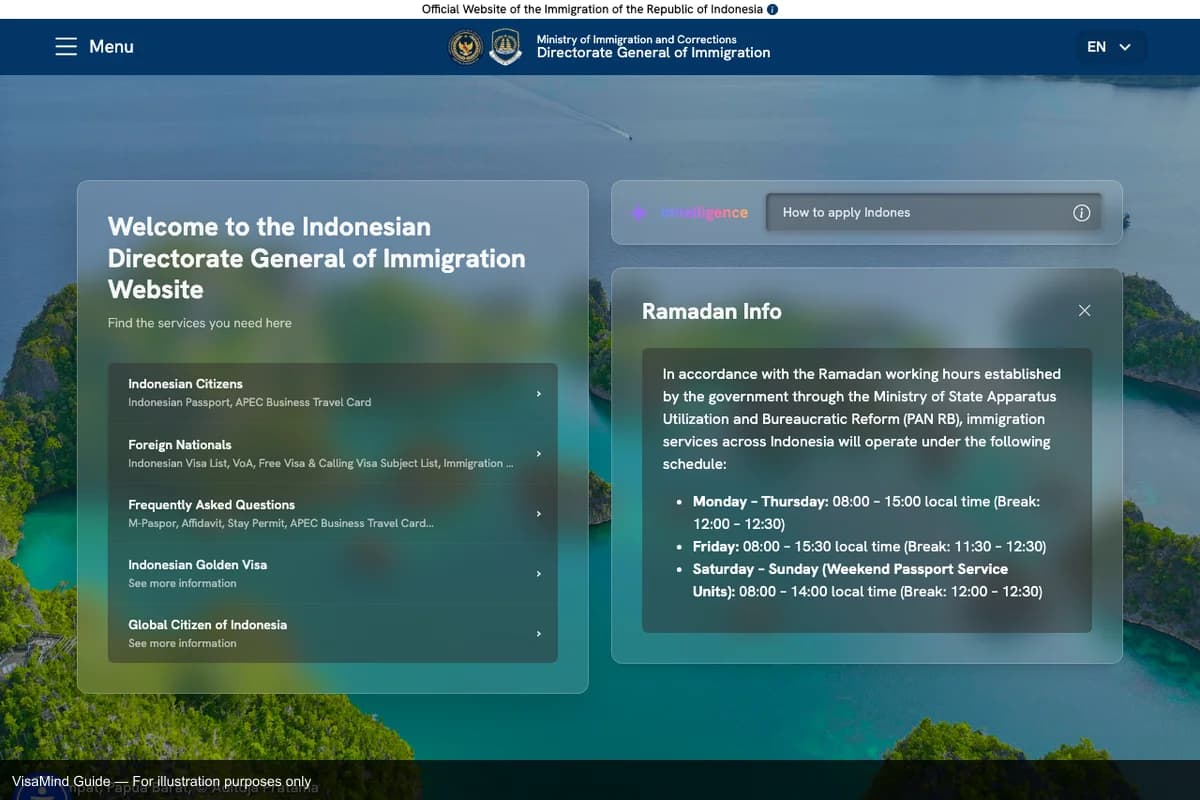
First page of KITAS Application form
Source: KITAS Application online portal
Context and workflow
#Processing times for the KITAS Application depend on the specific case type and current workload. Always consult the official Ditjen Imigrasi processing time tool, as outlined in the Form KITAS APPLICATION guide.
Why this matters
- This form helps confirm that the application matches the program’s requirements and checklist.
- This form acts as a cross-check point: details here must match other forms and supporting documents.
Where it fits in the workflow
- Application receipt
- Provide biometrics at Immigration office
- KITAS/KITAP card issuance
- KITAS Application is commonly filed alongside the employer's employment authorisation (IMTA).
Who uses it
you apply through an Indonesian sponsor and hold the matching visa for your purpose of stay (work, investment, family, or retirement).
When it is used
- KITAS-WORK: Limited Stay Permit - Work (KITAS)
Requirements snapshot
#- To allow foreigners to reside in Indonesia for a limited time.
- To provide a pathway to more permanent residency options like KITAP.
Failure prevention (What causes Form KITAS Application rejections?)
#Technical rejections
- Ensure form edition is current
Substantive weaknesses
- Insufficient evidence of employment
What you need (What do you need for Form KITAS Application?)
#- The current edition of KITAS Application
- Proof of identity
- Photos meeting specifications
- Complete all required sections, sign, and submit with required evidence.
- Copy of the filed or approved employment authorisation (IMTA), required for a work KITAS
Checklist (What is the Form KITAS Application checklist?)
#- Access the latest KITAS Application form and accompanying instructions by visiting the official Ditjen Imigrasi website.
- Gather required supporting documents per the instructions
- Complete all required sections of KITAS Application
- Sign, date, and submit KITAS Application with all required supporting evidence
Fees
#| Component | Amount |
|---|---|
| Filing FeeThe standard filing fee for form kitas application. Check the current fee on the official DGIM fee schedule. | See official schedule |
| Biometrics Services FeeA biometrics fee may be required depending on your category. Check the official fee schedule. | See official schedule |
Can the Form KITAS Application fee be waived?
Fee waivers may be available for qualifying applicants. See official instructions for eligibility.
What happens if I submit the wrong fee?
Ditjen Imigrasi will reject your application if the incorrect fee is submitted. Verify the current fee on the official schedule before filing.
Fee waiver: Fee waivers may be available for qualifying applicants. See official instructions for eligibility. For related guidance, see Limited Stay Permit – Work (KITAS).
View the official Ditjen Imigrasi fee schedule
Fees change; always verify on Ditjen Imigrasi.
Processing times
#- Ditjen Imigrasi does not publish a single fixed processing time for the KITAS; timeframes vary by category and by the immigration office handling your application.
- Processing times for KITAS Application vary by category and processing location. Verify current processing times with the issuing authority.
- Processing times differ significantly by eligibility category. Initial applications, renewals, and replacements each go through different adjudication queues, and some categories consistently take longer than others.
- Processing times for this form vary by Ditjen Imigrasi office and current workload. Verify current processing times with Ditjen Imigrasi.
- While pending: track your case status using your application reference number, respond promptly to any requests for additional documents, and update your contact information with Ditjen Imigrasi if it changes.
Check current processing times on the official Ditjen Imigrasi site
Where to file
#Submit your application at the designated Ditjen Imigrasi office, embassy, or consulate. Check the official website for the location with jurisdiction over your place of residence.
Submit application
Submit your application at the Ditjen Imigrasi office or designated embassy/consulate in your country of residence. Check the official instructions for the correct location.
Filing locations and procedures may change. Always verify on the official Ditjen Imigrasi website before submitting. For related guidance, see Limited Stay Permit – Work (KITAS).
Strategy tips
#Examples (What are examples for Form KITAS Application?)
#- Strong application: An applicant submits a KITAS Application with a valid work contract, proof of identity, and all supporting documents, resulting in a successful permit issuance.
- Weak application: An applicant submits a KITAS Application without complete supporting documents for their stated purpose of stay, leading to a rejection.
- A foreigner whose KITAS is expiring files KITAS Application to renew their limited stay permit before it lapses
- An applicant in the Kitas-work category files KITAS Application as part of their immigration process
Common misconceptions (What misconceptions surround Form KITAS Application?)
#- A KITAS is a temporary stay permit — it does not grant permanent residence or the right to stay indefinitely
- Having a KITAS does not automatically allow you to work — you typically need a separate work permit (IMTA) unless your KITAS is specifically work-based
- A KITAS is not a visa. The visa authorises a foreigner's entry into Indonesia; the Izin Tinggal Terbatas (ITAS) is the limited stay permit that governs the stay once you are inside the country
- Approval of the underlying visa does not pre-approve the permit — the Directorate General of Immigration reviews the limited stay permit application on its own record, including the Indonesian sponsor's standing
- KITAS APPLICATION has more than one fee component (e.g. Filing Fee and Biometrics Services Fee); paying only one or paying the wrong amount can result in rejection of the entire filing.
- A fee waiver for KITAS APPLICATION is not automatic — only specific qualifying categories are eligible, and a waiver request can be denied while the underlying form is still expected to be filed.
Edge cases and variations
#- If you are asked to submit or update KITAS Application, treat it as a package update: check every place the same details appear and keep them consistent.
In-depth guidance
#How to complete this form reliably
Treat KITAS Application as part of a system, not a standalone document. Most delays happen when details conflict across the form, supporting documents, and other parts of the application package. Before you start, gather the documents you will reference and decide which one is the source of truth for each field.
Fill the form in one sitting if possible. Partially-completed forms are where inconsistent edits creep in. When you finish, review each section and ask "what evidence in my package proves this statement?"
KITAS, ITAS, and KITAP: how Indonesia's stay permits fit together
Indonesia separates the document that gets a foreigner into the country from the permit that governs the stay. A visa authorises entry. Once you are inside the country, that visa is converted into a limited stay permit — the Izin Tinggal Terbatas, usually shortened to ITAS — granted by the Directorate General of Immigration (Direktorat Jenderal Imigrasi, or Ditjen Imigrasi). The KITAS, or Kartu Izin Tinggal Terbatas, is the card issued as evidence of that ITAS.
The two names are used interchangeably in everyday conversation even though they refer to different things, which is why guidance about "getting a KITAS" is really guidance about being granted an izin tinggal.
Above the limited stay permit sits the permanent stay permit — the Izin Tinggal Tetap, evidenced by the KITAP card. A foreigner normally holds a KITAS before becoming eligible to apply for a KITAP, and the eligibility conditions are set by the Directorate General of Immigration rather than by the sponsor; see the Permanent Stay Permit Application guide for that route. Below it sits the visit permit (izin tinggal kunjungan), which covers short visits and is not intended for residence or employment.
Knowing which layer you are in determines which form you file. If your ITAS is still valid and you want more time in the same category, the Stay Permit Extension route generally applies rather than a fresh KITAS application, and travelling in and out while the permit is live is handled by a re-entry permit — see the Re-Entry Permit (MERP) guide. Confirm the current permit structure and terminology on the official Directorate General of Immigration site, linked in the Sources section below, before filing.
Sponsorship: who files the KITAS application with you
Almost no KITAS is filed by the foreigner alone. Every limited stay permit is attached to an Indonesian sponsor (penjamin) who takes on legal responsibility for the foreigner during the stay, and the Directorate General of Immigration assesses the sponsor's standing as part of the application. Who the sponsor is follows from your purpose of stay.
For work, the Indonesian company employing you sponsors the permit, with separate employment authorisation (the IMTA) behind it; see the Limited Stay Permit – Work (KITAS) guide. For investment, the Indonesian company you hold shares in sponsors the permit; see Limited Stay Permit – Investor (KITAS). For family, an Indonesian spouse or family member sponsors the permit; see Limited Stay Permit – Spouse/Family (KITAS). For retirement, a sponsor or agency recognised for the retirement category files on your behalf; see Limited Stay Permit – Retirement (KITAS).
A frequent failure pattern sits on the sponsor side of the file rather than with the applicant's own documents. If the sponsor's paperwork does not establish the relationship being claimed — an employment contract that conflicts with the job title on the work permit, a marriage that has not been registered in Indonesia, or company records that no longer reflect current ownership — the limited stay permit application fails even when the foreigner's identity documents are flawless.
Gather the sponsor's documents before your own and treat the Sponsor Declaration as part of the same package.
Foreign workers: the work permit and the limited stay permit are two separate approvals
The single most expensive misunderstanding on this route is treating employment authorisation and residence authorisation as one approval. They are not. A foreign worker in Indonesia needs employment authorisation, which an Indonesian employer secures on the manpower side of government, as well as a limited stay permit, the Izin Tinggal Terbatas granted by the Directorate General of Immigration (Direktorat Jenderal Imigrasi). The KITAS card evidences only the second of those.
Holding a valid KITAS does not by itself make you employable, and holding employment authorisation does not by itself make your stay lawful.
One caution about names. The employment authorisation is still widely called the IMTA, but the manpower-side process has been reorganised more than once and is now usually described in terms of an approved foreign worker plan (RPTKA) and the notification issued against it. Treat IMTA as familiar shorthand for the employment half rather than as a current form name, and take the manpower requirements from your employer's own filing or from the responsible ministry — this guide is sourced to immigration, which governs the stay permit and not the work authorisation.
The practical consequence is that the two approvals are tied to the same Indonesian sponsor (penjamin) but are assessed by different bodies against different records. The employer's side of the file — the job title, the work location, the company's standing — has to describe the same arrangement in both places. Where a foreigner's employment authorisation names one role and the limited stay permit application implies another, immigration treats it as an unresolved discrepancy rather than a clerical slip.
See the Limited Stay Permit – Work (KITAS) guide for how the two sit together in one package.
Because both approvals hang off the employer, they also end with the employer. If the sponsoring relationship ends, the basis for the limited stay permit ends with it — the permit does not travel to a new company on its own, and the new employer starts a fresh sponsorship rather than inheriting the old one. Confirm the current division of responsibilities between the manpower ministry and the Directorate General of Immigration, whose site is linked in the Sources section below, before you rely on any sequence you were given for an earlier hire.
Where a foreigner files the limited stay permit application
The KITAS is a national permit, so the procedure is the same whether you settle in Jakarta, Bali, Surabaya, or Batam. What changes is the immigration office (kantor imigrasi) with jurisdiction over the address where you will live. Applicants often assume there is a regional variant — a "Bali KITAS" or a "Jakarta KITAS" — but the Directorate General of Immigration issues one limited stay permit under one set of national rules. Only the filing office and its local workload differ.
In practice the sequence runs: the Indonesian sponsor lodges the application and supporting documents with the office covering your address, you attend in person for biometrics and photographs, the office adjudicates the Izin Tinggal Terbatas, and the KITAS card is issued as evidence once the permit is granted. Because you must appear in person, plan around the address you have actually registered rather than one carried over from an earlier filing — a mismatch between the registered address and the office you approach is a common source of wasted trips.
Some steps now run through the immigration portal rather than the counter, and which parts are online varies by office and by category. Check the office list and the current filing channel on the official Directorate General of Immigration site, linked in the Sources section below, before you travel, and see the E-Visa Application guide for the online step that precedes entry.
Scenarios
#A software engineer submitted their application with all supporting documents
The case was approved within the standard timeline
Prepare all evidence before filing to avoid delays
Key differentiators
#- Unlike Employment authorisation (IMTA) for a foreign worker: Filed together: employment authorisation (IMTA) is required for a work KITAS (Sponsor Filed pathway)
- Unlike Form KITAP APPLICATION: Permanent Stay Permit Application: Related form in this immigration process (Sponsor Filed pathway)
- Unlike Form STAY PERMIT EXTENSION: Stay Permit Extension Application: Related form in this immigration process (Sponsor Filed pathway)
What happens after you submit
#- Application receipt
- Provide biometrics at Immigration office
- Wait for KITAS approval
- Receive KITAS card
- Begin employment legally in Indonesia
Verification
#This guide is derived from official Ditjen Imigrasi instructions for KITAS Application and is updated when form editions or filing rules change. Always verify current requirements at the official Ditjen Imigrasi website.