Retirement Visa Options
#Retirement Visa Options for Mexico
Did you know that Mexico is one of the top destinations for retirees, offering a range of visa options tailored to fit different retirement plans? Whether you're looking to enjoy a few years of sun-kissed beaches or make Mexico your permanent home, understanding your visa options is key.
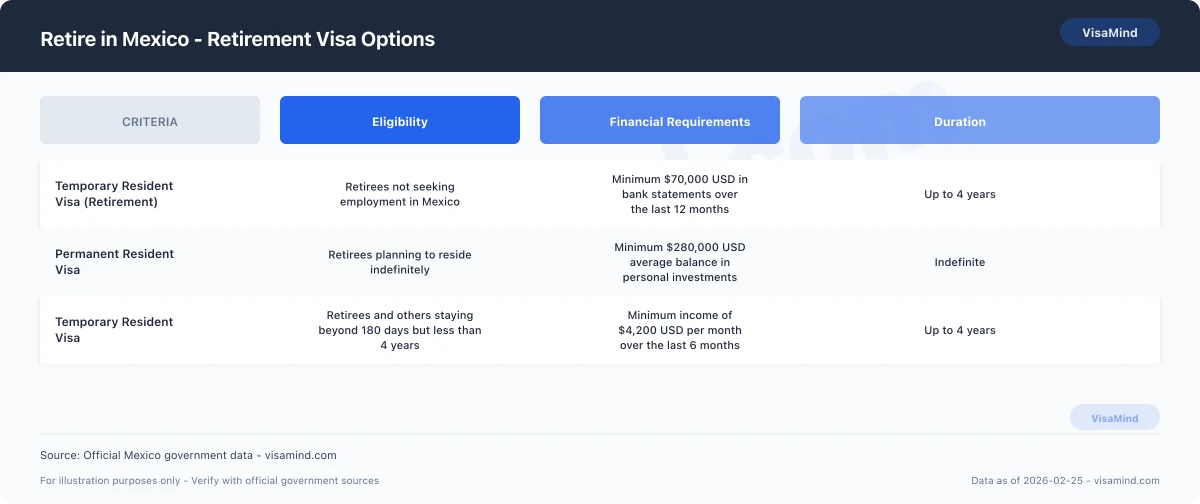
Here's a quick comparison of the retirement visa options available for those considering retirement in Mexico:
| Visa Type | Eligibility | Cost | Timeline |
|---|---|---|---|
| Temporary Resident Visa (Retirement) | Live in Mexico for more than 180 days but less than 4 years without employment | Fees vary, verify on the official website | Valid up to 4 years |
| Permanent Resident Visa | Retired, intending permanent residence, with economic solvency | Fees vary, verify on the official website | Permanent |
Which Visa Suits Your Retirement Plan?
Temporary Resident Visa (Retirement)
The Temporary Resident Visa is ideal if you're planning a prolonged stay without permanent relocation. This visa allows you to live in Mexico for more than 180 days and less than 4 years, perfect for those wanting to test the waters before making a lifetime commitment. However, you won't be allowed to work in Mexico under this visa.
Requirements include:
- Valid passport and a copy
- Economic solvency proof such as last 12 months of bank statements with a minimum balance of $70,000 USD
- Permission letter if working remotely
- Application form in English or Español
Explore more about the Temporary Resident Visa to see if it fits your lifestyle.
Permanent Resident Visa
For those ready to settle in Mexico indefinitely, the Permanent Resident Visa is the right choice. This visa is designed for retirees with the intention of making Mexico their permanent home. It requires proof of retirement and economic solvency, such as the last 12 months of bank statements or personal investments with an average balance of $280,000 (verify the current fee on the official website) USD, or paystubs/social security pension with a minimum amount of $7,100 (verify the current fee on the official website) USD.
Key features:
- Valid indefinitely
- No need for renewal
- No work authorization
If you're sure about calling Mexico your home, consider the Permanent Resident Visa to make your transition smooth.
Navigating the Application Process
While choosing the right visa is crucial, ensuring you meet all application requirements is equally important. Here are some common pitfalls to avoid:
- Economic Solvency: Ensure you have all documentation proving your financial stability.
- Document Accuracy: Provide a valid passport and visa/ESTA copy.
- Application Completeness: Ensure all required documents, including a passport-size photo, are submitted.
For more detailed guidance, visit our Retirement Guide to understand the specifics of applying for a retirement visa in Mexico.
Embarking on your retirement journey in Mexico can be a fulfilling experience, and selecting the right visa is the first step towards enjoying a vibrant and relaxed lifestyle.
Financial and Pension Requirements
#Understanding Financial and Pension Requirements for Retiring in Mexico
When considering retirement in Mexico, it's essential to understand the financial and pension requirements set by the Instituto Nacional de Migración (INM). Different visas are available depending on whether you intend to retire temporarily or permanently, each with specific financial criteria. This section outlines the key requirements you need to meet for each visa category.
Financial Requirements for Visa Eligibility
To apply for a retirement visa in Mexico, you must demonstrate economic solvency. This can be achieved through various financial proofs. Here's a comparison of the requirements for different visa types:
| Visa Type | Proof of Financial Solvency |
|---|---|
| Temporary Resident Visa | - Employment letter allowing remote work with last 6 months of paystubs showing at least $4,200 USD monthly income. <br> OR <br> - Last 12 months of bank statements with a balance of at least $70,000 USD. |
| Permanent Resident Visa | - Last 12 months of bank statements or personal investments showing an average balance of $280,000 (verify the current fee on the official website) USD. <br> OR <br> - Last 6 months of paystubs or social security pensions with a minimum monthly amount of $7,100 (verify the current fee on the official website) USD. |
Pension and Income Documentation
For both visa types, providing adequate documentation of your financial status is crucial. This includes:
- Bank Statements: Ensure your bank statements reflect the required minimum balances over the specified periods.
- Paystubs or Pensions: If relying on income, your paystubs or pension receipts must clearly display the required income levels.
Common Pitfalls
Applicants often face obstacles due to missing or inadequate financial documentation. Below are common pitfalls to avoid:
- Incomplete Bank Statements: Ensure your bank statements cover the entire required period and show consistent balances.
- Insufficient Income Proof: If submitting paystubs or pension statements, your documentation must clearly meet the minimum income thresholds.
For further details on how to apply and ensure you meet all financial requirements, consult our Retirement Guide and Financial Requirements.
Related Information
For more information on other visa types and their requirements, you might also be interested in Temporary Resident Retirement and Permanent Resident visas.
Understanding and preparing the right financial documents is crucial for a smooth application process. Ensure you have everything in order to enjoy a peaceful and fulfilling retirement in Mexico.
Healthcare Access
#
Healthcare Options for Retirees in Mexico
Retiring in Mexico offers diverse healthcare options that cater to varying needs and budgets. Understanding the difference between public and private healthcare, as well as mandatory insurance requirements, is crucial for making informed decisions about your healthcare access as a retiree.
Public vs. Private Healthcare
Mexico provides a well-structured healthcare system comprising both public and private sectors. If you opt for public healthcare, you can access services through the Instituto Mexicano del Seguro Social (IMSS) or the Instituto de Seguridad y Servicios Sociales de los Trabajadores del Estado (ISSSTE). These services are generally more affordable but may involve longer wait times.
On the other hand, private healthcare facilities in Mexico are known for their high-quality services and shorter waiting periods. While more expensive than public options, private healthcare can offer a level of comfort and speed that many retirees prefer. Popular cities for retirees, such as Guadalajara and Mexico City, host numerous private hospitals and clinics.
Is Health Insurance Mandatory?
While Mexico does not mandate health insurance for retirees, having coverage is strongly recommended to avoid high out-of-pocket expenses. Both public and private insurance options are available, and many expats choose to supplement public healthcare with private insurance to ensure comprehensive coverage.
- Public Health Insurance: You can enroll in the IMSS system voluntarily. This requires an annual fee, which varies based on your age and health status.
- Private Health Insurance: Numerous international and local insurers offer plans tailored for retirees, often with coverage that extends beyond Mexico.
Quality of Medical Facilities
The quality of medical facilities in Mexico can vary significantly between urban and rural areas. Major cities are equipped with state-of-the-art medical facilities and highly qualified healthcare professionals. Many doctors in private hospitals are trained internationally and fluent in English, which can ease communication for non-Spanish speaking retirees.
Here's a quick comparison of healthcare options:
| Feature | Public Healthcare | Private Healthcare |
|---|---|---|
| Cost | Generally lower | Higher |
| Waiting Times | Longer | Shorter |
| Quality | Standard care, varies by location | High-quality, consistent in cities |
| Language | Primarily Spanish | Often English-speaking staff |
For more detailed information on retirement options and financial planning, you can visit our Retirement Guide and learn about the Permanent Resident Visa pathway, which can enhance your access to healthcare facilities. Always verify the latest requirements and options on the official INM website to ensure you have the most current information.
The Application Process
#How to Apply for Retirement in Mexico
If you're planning to retire in Mexico, you'll need to apply for the appropriate residency visa through the Instituto Nacional de Migración (INM). This section provides a step-by-step guide to the application process, covering where to apply, necessary documents, and expected timelines.
Step-by-Step Application Process
-
Determine Your Eligibility and Visa Type
Start by determining whether you qualify for a Temporary Resident Visa or a Permanent Resident Visa. The Temporary Resident Visa is suitable if you plan to stay in Mexico for more than 180 days but less than four years without working. If you are retiring permanently, consider the Permanent Resident Visa, which requires proof of retirement income and supports longer stays. For more, visit the Temporary Resident Retirement page.
-
Gather Required Documents
Before lodging your application, ensure you have all necessary documents ready. You will need:
- Completed application form (available in English or Español)
- Valid passport and one copy
- Valid U.S. visa or ESTA (if applicable)
- Passport-size photo with a white background
- Proof of economic solvency:
- For Temporary Residency: Last six months of paystubs or bank statements
- For Permanent Residency: Last 12 months of bank statements or proof of pension income
Additional documents may be required for family unification or if you plan to work remotely. For more details, refer to the Documents Checklist.
-
Submit Your Application
Applications must be submitted to the Consulate General of Mexico in your region. This can often be done in person or by mail, depending on the consulate's procedures. Make sure to review the specific instructions for your eligibility category before submission.
-
Attend a Consular Interview
An interview at the consulate may be required as part of the application process. Be prepared to discuss your plans in Mexico and provide any additional documentation requested.
-
Wait for Processing
Processing times can vary, so it's best to plan ahead. Temporary Resident Visas might take a few weeks, while Permanent Resident Visas can take longer. Check the Processing Times for the most current estimates.
Common Pitfalls to Avoid
- Incomplete Documentation: Ensure all documents are complete and accurate to avoid delays.
- Consular Fees: Be prepared to pay the exact consular fee in cash when required.
- Passport Photo Requirements: Submit a photo that meets the consulate's specifications (white background, no glasses).
Additional Resources
For more information on financial requirements, visit the Financial Requirements guide. To compare different types of temporary resident visas, refer to the Temporary Resident Vs Visitor Tourist guide.
By following these steps and ensuring all requirements are met, you can successfully apply for retirement in Mexico.
Tax Implications
#Understanding Tax Obligations for Retirees in Mexico
Retiring in Mexico involves understanding the tax implications that come with your new residency status. While Mexico offers a welcoming environment for retirees, it's essential to familiarize yourself with the country's tax policies, especially if you plan to spend a significant portion of your retirement years there.
Pension Taxation and Worldwide Income
In Mexico, pension income is generally subject to taxation. However, the actual tax obligations may vary depending on the source of the pension. It is crucial to check if there are any applicable tax treaties between Mexico and your home country, which might offer relief or preferential rates on pension income.
- Pension from foreign sources: Typically, foreign pensions are subject to Mexican taxes, but tax treaties can affect this.
- Local pensions: If you receive a pension from a Mexican source, it will be taxed according to local regulations.
As a resident of Mexico, you are subject to Mexican tax laws on worldwide income. This means all your global income, including pensions, investments, and other earnings, might be taxable in Mexico. However, specific exemptions and deductions may apply, so consulting a tax advisor familiar with Mexican and international tax laws is advisable.
Tax Treaties and Double Taxation
Mexico has signed several tax treaties with other countries to prevent double taxation. These treaties can significantly impact how your pension and other income are taxed, potentially reducing your overall tax burden. For instance, if you are a retiree from the United States or Canada, you might benefit from these treaties, which often include provisions for pensions.
To determine how a tax treaty might affect your situation:
- Review the specific provisions of the treaty between Mexico and your home country.
- Consider seeking advice from a tax professional who understands both jurisdictions' tax laws.
Practical Steps for Managing Tax Obligations
To effectively manage your tax obligations while retiring in Mexico, consider the following steps:
- Assess your income sources: Identify all potential income streams, such as pensions, investments, and other earnings.
- Consult with a tax advisor: Work with a professional to understand how Mexican tax laws apply to your situation and explore any tax treaties.
- Stay informed: Tax laws can change, so regularly check for updates or changes that might affect your tax situation.
For further insights into the financial requirements and other aspects of retiring in Mexico, you may find our Financial Requirements Guide and Retirement Guide helpful.
Understanding these tax implications will help ensure that your retirement in Mexico is both enjoyable and financially sound. Always verify the latest tax rules and treaty provisions on the official website or through a qualified tax advisor.
Where Retirees Live
#Where Do Retirees Choose to Live in Mexico?
Mexico offers a range of vibrant and diverse locations that are popular among retirees. These destinations are known for their welcoming communities, affordable living, and stunning landscapes. Let's explore some of the top choices for those considering retirement in Mexico.
Popular Retirement Destinations
-
Lake Chapala: Located in the state of Jalisco, Lake Chapala is home to one of the largest expat communities in Mexico. Its mild climate and scenic views make it an attractive option for retirees. The town of Ajijic, in particular, is famous for its art galleries and cultural events.
-
San Miguel de Allende: Known for its colonial architecture and thriving arts scene, San Miguel de Allende in Guanajuato offers a charming atmosphere. Its vibrant expat community and numerous cultural activities make it a favorite among retirees.
-
Puerto Vallarta: This coastal city is renowned for its beautiful beaches and active nightlife. Puerto Vallarta provides a mix of modern amenities and traditional Mexican culture, appealing to those who enjoy a relaxed yet lively lifestyle.
-
Merida: As the capital of Yucatan, Merida combines rich history with modern conveniences. It's known for its cultural festivals and affordable cost of living, attracting retirees looking for a blend of tradition and contemporary living.
-
Playa del Carmen: Located in the Riviera Maya, Playa del Carmen offers beautiful beaches and a laid-back lifestyle. It's popular among retirees who enjoy outdoor activities and water sports.
Cost of Living Comparison
The cost of living in Mexico can vary significantly depending on the location. Here's a brief comparison of the monthly expenses in some popular retirement spots:
| Destination | Average Monthly Rent (USD) | Utilities and Groceries (USD) |
|---|---|---|
| Lake Chapala | $500 (verify the current fee on the official website) - $800 (verify the current fee on the official website) | $200 (verify the current fee on the official website) - $400 (verify the current fee on the official website) |
| San Miguel de Allende | $600 (verify the current fee on the official website) - $1,000 (verify the current fee on the official website) | $250 (verify the current fee on the official website) - $450 (verify the current fee on the official website) |
| Puerto Vallarta | $700 (verify the current fee on the official website) - $1,200 (verify the current fee on the official website) | $300 (verify the current fee on the official website) - $500 (verify the current fee on the official website) |
| Merida | $400 (verify the current fee on the official website) - $700 (verify the current fee on the official website) | $200 (verify the current fee on the official website) - $350 (verify the current fee on the official website) |
| Playa del Carmen | $600 (verify the current fee on the official website) - $1,000 (verify the current fee on the official website) | $250 (verify the current fee on the official website) - $450 (verify the current fee on the official website) |
Note: These figures are approximate and can change. Verify on the official website or local sources for the most current information.
Expat Communities and Resources
Retirees often find comfort in joining expat communities that provide support and social opportunities. Many of these communities have local clubs and organizations that offer events, volunteer opportunities, and networking. Additionally, resources like the Permanent Resident visa can provide more information on establishing long-term residency in Mexico.
Exploring these destinations and understanding the cost of living can help you choose the perfect spot for your retirement in Mexico. For additional guidance on the application process, check out the How To Apply guide for more details.
Duration and Renewal
#What Is the Duration of a Retirement Visa in Mexico?
If you wish to retire in Mexico, you can apply for either a Temporary Resident Visa or a Permanent Resident Visa. The Temporary Resident Visa permits you to live in Mexico for more than 180 days and up to 4 years, without the option for employment in Mexico. On the other hand, the Permanent Resident Visa is suitable for those who intend to settle in Mexico indefinitely and are retired, using their Social Security Statement as proof of financial means.
- Temporary Resident Visa: Valid for up to 4 years
- Permanent Resident Visa: Indefinite validity
How Can You Renew Your Visa?
Renewal procedures vary depending on the type of visa you hold:
-
Temporary Resident Visa: Initially issued for one year, it can be renewed for up to three more years, totaling a maximum of four years. After this period, you may apply for a transition to a Permanent Resident Visa if you meet the necessary conditions.
-
Permanent Resident Visa: Does not require renewal, as it is valid indefinitely.
For detailed steps on transitioning from a temporary to a permanent visa, refer to our Visa Extension Guide.
Are There Annual Reporting Requirements?
While holding a Temporary Resident Visa, you are required to report any changes in employment status, address, or marital status to the Instituto Nacional de Migración (INM). Failure to report these changes may affect your residency status. Permanent residents, however, are not required to fulfill annual reporting obligations, as their status is meant for indefinite residence.
For further guidance on maintaining your status, please refer to the Permanent Residence section.
Documentation and Economic Solvency
To ensure your visa remains valid, you must demonstrate economic solvency. For retirees, this means showing either personal investments or bank statements with an average balance of $280,000 (verify the current fee on the official website) USD or a pension with a minimum monthly income of $7,100 (verify the current fee on the official website) USD. Proper documentation is crucial to maintaining your residency status.
For more information on financial requirements, see our Documents Checklist.
Understanding these aspects of visa duration, renewal, and reporting will help you enjoy your retirement in Mexico with peace of mind.
Path to Permanent Residence
#Does a Retirement Visa Lead to Permanent Residence?
If you're considering retiring in Mexico, it's important to understand how your visa status can evolve over time. Mexico offers two main types of retirement visas: the Temporary Resident Visa and the Permanent Resident Visa. Both have different implications for your path to permanent residence.
Temporary Resident Visa: A Stepping Stone
The Temporary Resident Visa is suitable if you plan to live in Mexico for more than 180 days but less than four years. While this visa does not immediately lead to permanent residence, it can be a stepping stone. After maintaining your temporary residency for four consecutive years, you may apply for a Permanent Resident Visa. This change is contingent upon meeting specific requirements, including economic solvency and continuous residence in Mexico. For more detailed guidance, refer to the Processing Times and Documents Checklist.
Permanent Resident Visa: Direct Pathway
For those who are moving to Mexico with no intention of working and have the necessary financial means, the Permanent Resident Visa is an ideal choice. This visa allows you to reside in Mexico indefinitely from the start. To qualify, you must provide evidence of financial solvency, such as bank statements showing an average balance of $280,000 (verify the current fee on the official website) USD over the past 12 months or proof of a consistent pension income of $7,100 (verify the current fee on the official website) USD monthly. The Permanent Resident Visa does not require renewal and provides a direct path to Mexican citizenship, should you choose to pursue it.
Timeline to Citizenship
Obtaining Mexican citizenship is a distinct process that follows permanent residency. Once you have a Permanent Resident Visa, you can apply for citizenship after five years of continuous residence in Mexico. This period allows you to immerse yourself in the culture, learn the language, and decide if you wish to become a Mexican citizen. More information can be found in our Permanent Residence section.
Understanding these pathways helps in making an informed decision about your retirement plans. Each step requires careful planning and adherence to specific requirements, so be sure to check the official website and consult with the Instituto Nacional de Migración for the most current information.
Common Challenges
#Financial Proof Challenges
-
Economic Solvency: Applicants may face difficulties in providing the necessary financial proof. For a Temporary Resident Visa, you need to show an employment letter with permission to work abroad and paystubs reflecting a minimum income of $4,200 USD over the last six months, or bank statements with a balance of at least $70,000 USD over the last twelve months. For a Permanent Resident Visa, you must present bank statements or personal investments showing an average balance of $280,000 (verify the current fee on the official website) USD over the past twelve months, or recent paystubs or pension statements totaling at least $7,100 (verify the current fee on the official website) USD.
-
Currency Fluctuations: Changes in currency exchange rates can impact the perceived value of your financial holdings. Ensure that your documents reflect the required amounts consistently.
Healthcare Gaps
-
Insurance Requirements: Securing adequate health insurance in Mexico can be challenging. Ensure your policy covers necessary medical services, as healthcare standards and coverage can differ significantly from your home country.
-
Access to Services: Language barriers and unfamiliarity with the Mexican healthcare system may impede access to services. Consider researching healthcare providers in advance and seeking English-speaking doctors or clinics.
Annual Reporting Obligations
-
Renewal and Reporting: If you hold a Temporary Resident Visa, you must renew your visa annually and report any changes in your circumstances to the INM. Documentation proving continued eligibility, such as financial solvency and residency status, must be kept up-to-date.
-
Permanent Residents: Although permanent residency does not require annual renewal, you must inform the INM of any significant changes in personal status. Regularly review your obligations to avoid compliance issues.
Language Barriers
-
Spanish Proficiency: Limited Spanish skills can lead to misunderstandings during the application process and in daily interactions. Consider enrolling in language courses before or upon arrival in Mexico.
-
Document Translation: Official documents may need certified translations into Spanish. Ensure translations are accurate and meet INM standards to prevent delays.
For further guidance, explore our How To Apply and Visa Refusal Reasons guides. Understanding these challenges can help you navigate the process of retiring in Mexico with greater ease.
Real Scenarios
#What Are the Real-Life Scenarios for Retiring in Mexico?
When considering retirement in Mexico, real-life scenarios offer valuable insights into how the process unfolds for different individuals. One common scenario involves retirees seeking a Permanent Resident Visa. These individuals typically demonstrate their financial stability through bank statements or social security pensions. For instance, retirees must show bank statements from the last 12 months with an average balance of $280,000 (verify the current fee on the official website) USD or social security pensions with a minimum amount of $7,100 (verify the current fee on the official website) USD over the last six months. This financial proof assures the Instituto Nacional de Migración (INM) that the retiree can sustain themselves without employment in Mexico.
Choosing Between Temporary and Permanent Residency
Another scenario might involve someone opting for a Temporary Resident Visa. This is suitable for those wishing to live in Mexico for more than 180 days but less than four years. An essential condition is that you are not planning to be employed within Mexico. These individuals often provide documentation of economic solvency, like an employment letter with permission to work remotely from abroad and the last six months of paystubs showing a minimum income of $4,200 USD. For more detailed guidance on choosing the right visa, you can refer to the Temporary Resident vs Visitor Tourist guide.
Pitfalls to Avoid
Real-life experiences reveal common pitfalls that applicants face. Submitting an application without the exact consular fee can result in delays, as does neglecting to provide a valid passport or visa/ESTA copy. Other frequent issues include missing economic solvency documentation or failing to include a passport-size photo with a white background. Lastly, for those applying under family unification, ensure both parties are present during the interview to avoid any setbacks.
Navigating these scenarios can be complex, but understanding these essential requirements and potential pitfalls can make your transition to retirement in Mexico smoother. For a comprehensive understanding of the process, check out our How To Apply and Visa Refusal Reasons guides.
FAQs
What documents are needed for a Mexican retirement visa?
Can I switch from a Temporary Resident Visa to a Permanent Resident Visa in Mexico?
Can I work remotely while on a retirement visa in Mexico?
What happens if I don't provide the correct documents for my visa application?
Can my family join me if I retire in Mexico?
What are the financial requirements for a Mexican retirement visa?
How can I obtain permanent residency in Mexico after retiring?
Sources
Last reviewed: February 25, 2026
VisaMind provides informational guidance only and is not a government agency. This is not legal advice. Requirements can change and eligibility depends on your specific facts. If your case is complex or high-stakes, consult a licensed immigration attorney.
Next steps
Requirements vary by nationality, purpose, timeline, and case details. VisaMind turns uncertainty into a sequenced checklist with official source citations.
Find my visa