
Who This Guide Is For
#This guide is for people who are not asking only Can I get residence? but Which New Zealand residence route actually fits my case best?
That comparison matters because the strongest residence paths are not interchangeable. Some are driven by work profile, wages, and sector fit. Some are driven by family sponsorship, such as the Parent Resident Visa. Others depend more heavily on investment or other financial strength.
Who should use this guide
This page is most useful if you are trying to compare:
- work-linked and skilled migration routes
- family routes such as parent sponsorship
- broader residence options before you commit to one process
When this guide becomes more useful than a single visa page
Use this guide when your question is still broad, for example:
- Which type of New Zealand residence route is most realistic for me?
- Should I be comparing skilled migration, parent residence, AEWV-linked routes, and investor-style routes side by side?
- What kind of evidence structure will matter most for the route I choose?
If your question is already narrow and family-specific, the better page is usually Bring Parents to New Zealand or the main Parent Resident Visa page.
What You Need to Know
#The easiest way to compare New Zealand residence routes is to sort them by what carries the case.
Three practical route buckets
| Route bucket | What usually drives approval logic | Best fit for |
|---|---|---|
| Work and skilled migration routes | Work history, wage level, occupation fit, points, or sector experience | Applicants whose strongest case is employment-based |
| Family routes | Relationship to an eligible sponsor plus sponsor-side evidence | Families focused on reunification, including the Parent Resident Visa |
| Investor or capital-led routes | Investment level or financial strength | Applicants whose strongest case is financial rather than sponsor-led |
This framework matters because the same person can look promising under one route and weak under another. A sponsor-led parent case should not be planned the same way as a skilled migration case, and a work-to-residence case should not be planned the same way as an investor or retirement-led move.
The biggest route-comparison mistake
The biggest mistake is choosing the route with the most familiar name instead of the route whose evidence structure fits best. A good comparison starts by asking what the file naturally proves:
- work profile and wage strength
- sponsor relationship and sponsor income
- capital or investment strength
- timing and whether the route uses an EOI or invitation stage
If the strongest evidence in your case is family-based, the most useful next pages are Bring Parents to New Zealand and Parent Resident Visa.
Resident visa versus permanent residence
Most New Zealand (NZ) routes first grant a resident visa, which lets you live in New Zealand indefinitely but usually carries travel conditions. After you have held that resident visa and met the criteria Immigration New Zealand sets, you can normally apply for residence on a longer footing through a permanent resident visa, which removes those travel limits. Several skilled routes also draw on the Green List — New Zealand's list of in-demand occupations that can offer a more direct residence pathway. Thinking of immigration as a ladder — temporary work visa, then resident visa, then permanent residence — makes it easier to plan the evidence you will need at each stage. Confirm the current rules for each step on the official Immigration New Zealand website.
Where the Green List fits
The Green List is worth understanding early because it is the single biggest shortcut in the New Zealand system. It is Immigration New Zealand's published list of occupations the country is short of, and it splits into two tiers:
- Straight to Residence roles, where an eligible job offer lets you apply for residence directly rather than spending time on a temporary visa first.
- Work to Residence roles, where you work in the occupation in New Zealand for the qualifying period Immigration New Zealand sets, then apply for a resident visa.
If your occupation appears on either tier, the Green List usually beats a points-based comparison, because the route is shorter and the eligibility test is more concrete. If it does not appear, the Skilled Migrant Category Resident Visa, a family route, or an investor route is likely to be the more realistic way to live in New Zealand long term. Check whether your occupation is currently listed — and which tier it sits in — on the official Immigration New Zealand website, since the list is revised periodically.
New Zealand PR Pathways Explained
#New Zealand's residence system is a two-step ladder, so PR means something specific here. Most people first hold a resident visa, which already lets them live in New Zealand indefinitely, and only later apply for residence on a permanent footing through a permanent resident visa. Knowing which rung you are standing on makes the rest of the immigration process far easier to plan.
What are the PR pathways in New Zealand?
The realistic routes group into three families:
- Skilled and work-linked routes — the Skilled Migrant Category Resident Visa and work-to-residence routes built on an Accredited Employer Work Visa. These turn on your occupation, your wage level, and whether the role sits on the Green List.
- Family and sponsorship routes — the Partner of a New Zealander Resident Visa and the Parent Resident Visa, where an eligible NZ-based sponsor carries the case.
- Investor and capital-led routes — such as the Investor 1 Resident Visa, where financial strength rather than employment or sponsorship decides the outcome.
Whichever family fits, the destination is the same: a resident visa that can later be converted to permanent residence.
What are the requirements to get permanent residency in New Zealand?
There are two layers here, and applicants routinely conflate them.
Layer one — qualifying for the resident visa.
This is route-specific. Work routes look at your occupation, your wage level, your work history in the sector, and Green List status. Family routes look at your relationship to the sponsor and the sponsor's own income and status in NZ. Investor routes look at the size and structure of your investment. Health and character requirements sit across every route.
Layer two — converting that resident visa into permanent residence.
Once you hold a resident visa, Immigration New Zealand asks you to show a genuine commitment to New Zealand before granting the permanent resident visa. That commitment can be evidenced in more than one way — time actually spent living in New Zealand, tax residence, a business or investment base in the country, or established family ties. Because the accepted forms of commitment are set by policy and get revised, confirm which one applies to your situation on the official Immigration New Zealand website before you apply for residence.
How long does it take to become a permanent resident in NZ?
There is no single answer, because two separate clocks run:
- The processing clock — how long Immigration New Zealand takes to decide each application. This varies by visa category, by application volume, and by how complete your file is. Current figures live on the Processing Times guide.
- The residence clock — the qualifying period you spend holding your resident visa, and meeting its conditions, before you can apply for the permanent resident visa.
Both clocks are affected by the route you pick, which is why route choice matters more than raw speed.
What is the easiest way to get PR in New Zealand?
There is no universally easiest route — only the route your existing evidence already supports. Reframed usefully, the easiest pathway is the one with the fewest claims you still have to prove:
- If you already work in, or can be hired into, a Green List occupation, a skilled or work-to-residence route is normally the most direct way to apply for residence.
- If your strongest asset is a relationship to an eligible NZ sponsor, a family route will usually beat a marginal skilled application.
- If your strongest asset is capital, an investor route avoids the wage and occupation tests entirely.
Chasing the route with the best reputation, rather than the route your documents fit, is the most common reason people stall.
Am I eligible for permanent residence?
Run a two-question check.
1. Do you already hold a resident visa?
If yes, your question is narrower than it feels: it is whether you have met Immigration New Zealand's commitment criteria for the permanent resident visa step. 2.
If not, which resident visa route does your evidence fit?
Work out whether work profile, sponsor relationship, or finances is the strongest proof in your file, then read that route's rules. The self-check in the next section walks through this.
Eligibility is decided against the specific instructions in force when you apply, so treat any comparison page — including this one — as a way to shortlist routes, not as a substitute for the official criteria.
Applying for New Zealand permanent residency or citizenship?
These are different steps and are often confused. A permanent resident visa removes the travel conditions on your resident visa and lets you live in New Zealand without a visa expiry hanging over you, but you remain a citizen of your home country. Citizenship is a later and separate status with its own residence, presence, and character requirements, and it is handled by the Department of Internal Affairs rather than by Immigration New Zealand. Most people reach permanent residence first and consider citizenship afterwards — see New Zealand citizenship to compare the two side by side.
Do You Meet the Requirements?
#A better way to compare residence eligibility is to ask which requirement pattern fits you best.
Pattern 1: Work and wage-driven eligibility
Some routes are strongest when your case is mainly about work profile, wage level, time in sector, or long-term employability in New Zealand. In those routes, the core file is usually built around employment records, wage evidence, sector fit, and work history.
Pattern 2: Sponsor and relationship-driven eligibility
Other routes are strongest when the key issue is the relationship to the New Zealand-based sponsor. The Parent Resident Visa is the clearest example in this cluster. There, sponsor status, sponsor income, and relationship proof often matter more than the applicant's work profile.
Pattern 3: Investment or capital-driven eligibility
Some residence routes depend much more on financial capacity or investment structure than on work or sponsor logic. Those routes should usually be evaluated separately rather than mixed into a sponsor-led or work-led strategy.
The practical self-check
Before committing to one route, ask:
-
What is the strongest proof in my case: work, sponsor relationship, or finances?
-
Does the route use an EOI, invitation, or another staged process?
-
Can I support that route with real documents before the case becomes urgent?
-
Am I comparing this route against the true alternatives, or just the most familiar one?
That framework usually produces a better route choice than comparing labels alone.
Your Action Plan
#Determine Your Eligibility
Begin by identifying the visa category that aligns with your circumstances and goals. The New Zealand Residence Pathway includes various options such as the Skilled Migrant Category Resident Visa and the Parent Resident Visa. Check the specific wage thresholds and employment duration requirements for your targeted visa. For instance, to qualify for the Care Workforce Work to Residence Visa, you must currently earn at least NZD $28.25 per hour and have at least 24 months of work experience in this sector.
Create Your INZ Online Account
Once you have confirmed your eligibility, proceed to create an account on the Immigration New Zealand (INZ) online portal. This account will be your primary tool for managing your application process. Ensure that you have a reliable email address since all communications from INZ will be directed there.
Gather Required Documentation
Collect all necessary documents that validate your eligibility. This includes:
- Proof of your wage rate meeting the required threshold for your visa category.
- Evidence of work experience, particularly for sectors requiring at least 24 months of experience.
- Any other supporting documents specified for your chosen visa category. For a comprehensive list, refer to the Documents Checklist.
Tip: Ensure all documents are current and meet INZ's specified format to avoid delays.
Lodge Your Application
With your documents ready, you are prepared to lodge your application. This involves:
- Completing the online application form for your chosen visa category.
- Submitting your expression of interest if applying for a category like the Skilled Migrant.
- Uploading all supporting documentation through the INZ portal. Pay close attention to deadlines and ensure all sections are addressed.
Important: Missing any required document or failing to meet a deadline can result in delays or refusal of your application.
Wait for Processing
After lodging your application, the next step is to wait for processing by INZ. The duration can vary based on the visa type and current processing times. You can monitor your application status through your INZ online account. For updates on expected timelines, check the Processing Times guide.
Respond to INZ Requests
During the processing period, INZ may request additional information or documents. Respond promptly to any such requests to keep your application moving forward. Delay in responding might affect the processing time and outcome.
By following these steps, you can effectively navigate the New Zealand Residence Pathway and increase your chances of securing a residence visa. Be sure to regularly check your INZ account and refer to official sources for any updates or changes in the process.
What It Costs and How Long It Takes
#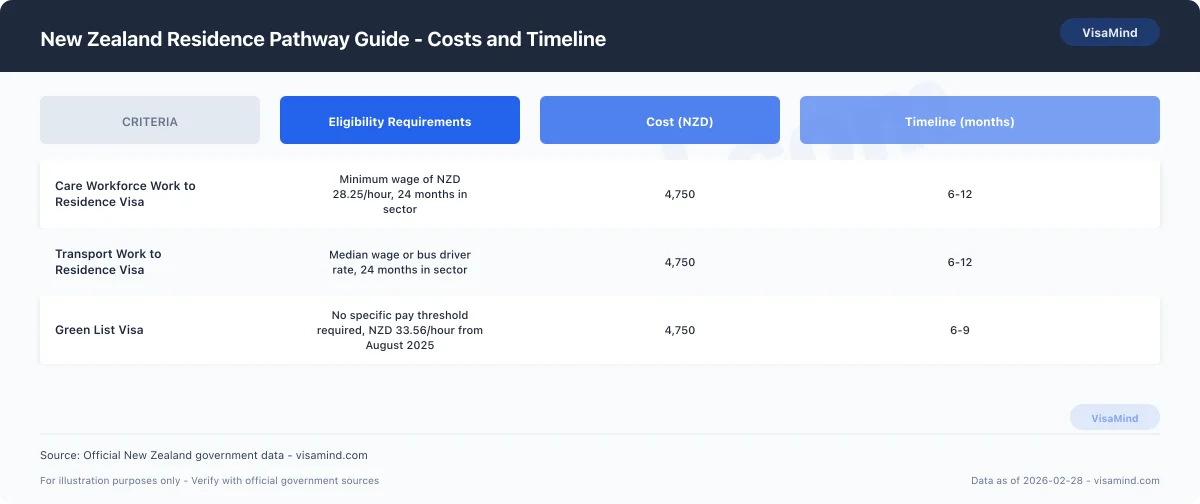
Understanding the costs and timelines associated with applying for New Zealand residence is crucial for effective planning. Here's what you can expect regarding fees and processing times for various New Zealand residence pathways.
Cost and Timeline Comparison
To help you navigate the different residence pathways, here's a side-by-side comparison of some of the key categories, their costs, and expected timelines.
| Visa Type | Cost (NZD) | Processing Time (as of early 2026 — always verify current amounts with the official authority) |
|---|---|---|
| Skilled Migrant Category Resident Visa | $2,710 (verify the current fee on the official website) | 6-9 months |
| Parent Resident Visa | $5,200 (verify the current fee on the official website) | Up to 24 months |
| Partner of a New Zealander Resident Visa | $1,495 (verify the current fee on the official website) | 7-12 months |
| Investor 1 Resident Visa | $6,210 (verify the current fee on the official website) | 4-6 months |
Tip: Fees are subject to change, so always check the official INZ website for the most current information.
What to Expect During Processing
The processing times listed above are estimates and can be influenced by various factors such as the completeness of your documentation and the demand for specific visa categories.
-
Pre-application Preparation: Before applying, ensure you meet all the eligibility criteria for your chosen visa category. This includes wage thresholds and work experience, especially for work-to-residence pathways like the Accredited Employer Work Visa.
-
Document Gathering: Collect all necessary documents, such as proof of income, employment history, and any required sponsorship details. Refer to the Documents Checklist for detailed requirements.
-
Application Submission: Lodge your application through the INZ online portal, where you can track the progress of your application.
Important: Missing required documentation can significantly delay processing times. Double-check all submissions against the INZ requirements.
Factors Affecting Costs and Timelines
Several factors can impact both the cost and timeline of your application:
- Changes in Government Policy: New policies can alter processing times and fees. Stay updated by checking announcements from INZ.
- Application Volume: High numbers of applications in certain categories can extend processing times.
- Complexity of Application: More complex applications, especially those involving dependents or additional verification, may take longer.
For more detailed information on processing times and expectations, visit the Processing Times guide. Be sure to verify all details on the official INZ website for the most accurate and up-to-date information.
Practical Advice
#Tip: Ensure all your documents are in English or translated by a certified translator. This can prevent delays in processing.
Understanding Wage Requirements
- Check Wage Thresholds: Various visas have different wage requirements. For instance, the Care Workforce Work to Residence Visa requires a minimum wage of NZD $28.25 per hour, while the Transport Work to Residence Visa requires at least the median wage or the bus drivers' rate.
- Green List Jobs: From 18 August 2025, jobs on the Green List without specific pay thresholds must offer at least NZD $33.56 an hour.
- Documentation Needed: Provide evidence of your wage rate, such as pay slips or employment contracts, to demonstrate you meet these thresholds.
Work Experience and Sector-Specific Criteria
- Sector Experience: Many residence pathways require a minimum of 24 months work experience in the relevant sector. Ensure you have verifiable proof of this experience, such as reference letters or employment records.
- Parent Resident Visa: If applying as a sponsor for the Parent Resident Visa, you must show earnings above the threshold for 2 out of the 3 years before your expression of interest is selected.
Important: Insufficient evidence of work experience or failure to meet wage thresholds are common reasons for application denial.
Navigating the Application Process
- Create an Account: Start by creating an account on the Immigration New Zealand online portal. This is where you will manage your application process.
- Expression of Interest: For certain categories, like the Skilled Migrant Category Resident Visa, you must lodge an online expression of interest. Ensure you have all necessary details ready.
- Review and Prepare: Before lodging your application, thoroughly review the specific eligibility requirements for your chosen pathway. Use resources like the Documents Checklist to ensure you have everything in order.
Common Pitfalls and How to Avoid Them
- Wage and Experience: Double-check that you meet the wage and experience criteria for your chosen visa category. These are critical elements that can make or break your application.
- Documentation: Ensure all documentation is current, legible, and correctly translated. Missing or incorrect documents can lead to delays or refusals.
- Timeliness: Be mindful of deadlines. For instance, expressions of interest often have specific periods for submission. Missing these can set back your timeline significantly.
Tip: Consider consulting with a licensed immigration advisor if you are unsure about any part of the process. They can provide personalized guidance and help avoid common mistakes.
Pitfalls to Avoid
#Important: Failing to meet the specific wage thresholds for your visa category can result in delays or denial of your application. Always verify the current requirements on the official Immigration New Zealand (INZ) website before proceeding.
Wage Threshold Missteps
-
Insufficient Wage Evidence: One of the most common pitfalls is not providing adequate evidence of meeting the wage threshold for your visa category. For example, the Care Workforce Work to Residence Visa requires you to earn at least NZD $28.25 per hour. Ensure your payslips and employment contract clearly demonstrate this rate.
-
Confusing Wage Requirements Across Visas: Different visas have distinct wage requirements. For instance, the Transport Work to Residence Visa requires you to earn at least the median wage or the specific bus driver's wage rate. Double-check the wage criteria for your intended visa to avoid confusion.
Work Experience Documentation
-
Inadequate Proof of Work Duration: Another frequent error is failing to document at least 24 months of work experience in the relevant sector. Collect and organize all necessary documentation, such as employment letters and contracts, to substantiate your claims.
-
Sector-Specific Experience: Ensure your work experience aligns with the sector specified in your visa application. Misalignment can lead to application issues or rejection.
Sponsorship and Income Proof
- Sponsor Income Verification: For the Parent Resident Visa, sponsors must prove they have met the income threshold for 2 out of the 3 years before the expression of interest is selected. Be prepared with tax returns or employer letters as evidence.
Tip: Regularly update your account on the Immigration New Zealand online portal to track changes in eligibility criteria and document requirements.
Application Process Oversights
-
Not Reviewing Instructions Thoroughly: Before starting your application, carefully review the instructions specific to your eligibility category. Misunderstanding the requirements can lead to incomplete applications.
-
Missing Expression of Interest (EOI) Steps: For some visas, such as the Skilled Migrant Category Resident Visa, submitting an EOI is a crucial initial step. Ensure you understand and complete this process to move forward with your application.
By avoiding these pitfalls and ensuring you have all necessary documents, you can increase your chances of a successful application. For more details on the process, visit the Visa Refusal Reasons and Processing Times guides.
Real Scenarios
#A healthcare assistant named Priya had been working in the aged care sector in New Zealand for nearly two years. She was eager to apply for the Care Workforce Work to Residence Visa. One of her main concerns was ensuring she met the necessary wage requirement of NZD $28.25 an hour. Priya accessed the Immigration New Zealand (INZ) online portal to gather the relevant information and guidance. She meticulously documented her wage slips and employment contracts as evidence of her salary, ensuring all records were up-to-date and accurate. After lodging her application and providing the required proof of her two years of work experience in the healthcare sector, Priya received confirmation of her eligibility within three months. Her application was successful, paving the way to her New Zealand residency.
Scenario: Navigating Wage Thresholds for the Transport Work Visa
Liam, a bus driver in Auckland, was considering the Transport Work to Residence Visa. He was aware that his salary needed to meet either the median wage or the specific bus driver's wage rate. To ensure compliance, Liam consulted the INZ website to verify the current wage thresholds. He also contacted his employer to obtain a formal letter confirming his salary met the required standard. Liam submitted his application through the INZ online portal, providing comprehensive documentation of his wage and two years of employment history. The application process took about four months, during which Liam also prepared for any additional documentation requests from INZ. Eventually, he received the approval, securing his pathway to becoming a resident in New Zealand.
Scenario: Sponsoring a Parent with the Parent Resident Visa
Emma wanted to sponsor her mother for the Parent Resident Visa. As the sponsor, Emma needed to prove her income exceeded the required threshold for at least two of the three years before submitting an expression of interest. She carefully collected her financial statements and tax records to demonstrate her earnings. Emma submitted her expression of interest via the INZ portal, making sure all her financial documentation was both complete and convincing. Her mother’s application was selected from the pool, and after providing additional requested documents, the process was completed within six months. Emma’s mother was granted residency, allowing them to reunite in New Zealand.