
Quick summary
#This form is not intended for general public self-filing, as described in the Form DS-2019 guide.
To authorize a representative to act on your behalf with the agency
Include it with your application package and follow official instructions for submission.
Names, dates of birth, and passport details on other forms Program checklist requirements Supporting documents and translations
Overview (What is Form G-28?)
#By using Form G-28, clients can be assured that their legal representatives are officially recognized and authorized to handle their immigration matters.
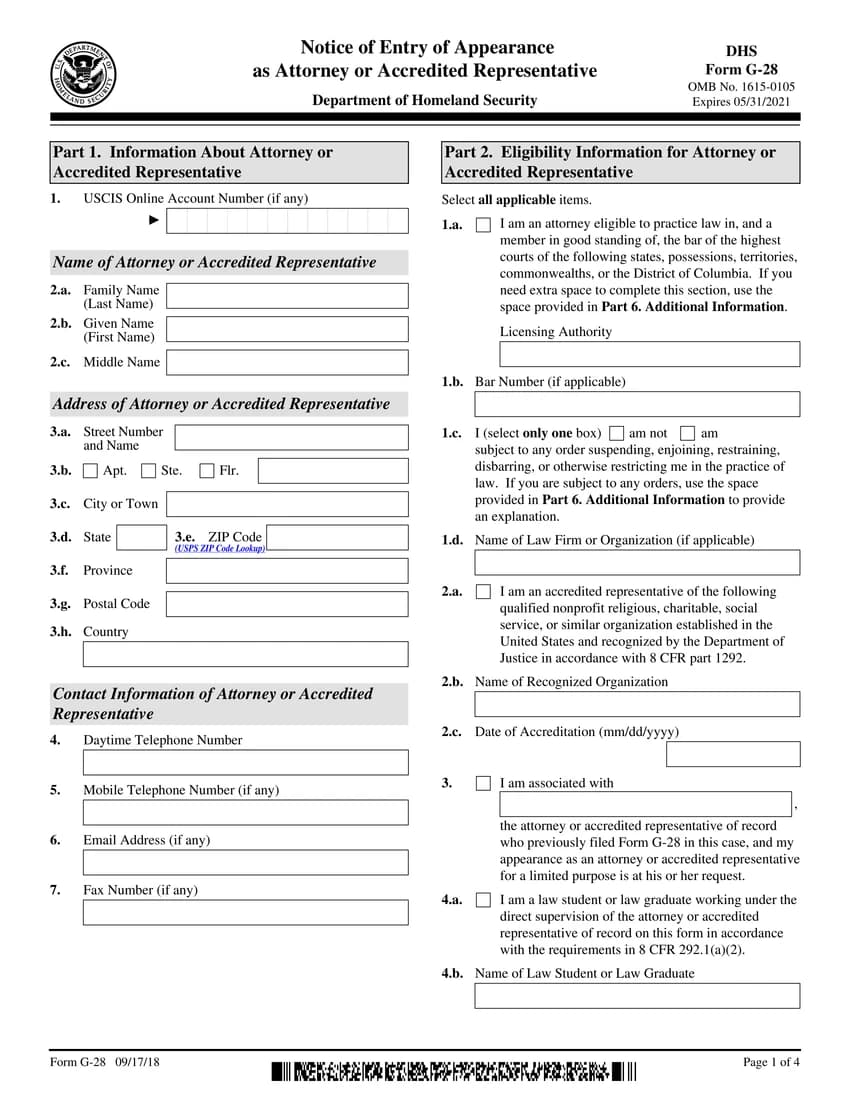
First page of G-28 form
Source: G-28 PDF
Context and workflow
#Supporting document for various immigration applications and petitions, as described in the U.S. Family Immigration Overview guide. Part of the initial submission package to establish representation. Receipt Notice (a related form) acknowledging the form submission.
Why this matters
- This form acts as a cross-check point: details here must match other forms and supporting documents.
- This form helps confirm that the application matches the program’s requirements and checklist.
Where it fits in the workflow
- Processing time for G-28 varies by case type and current workload — always check the official USCIS processing time tool.
- Supporting document for various immigration applications and petitions.
- Part of the initial submission package to establish representation.
- Ensures communication from USCIS is directed to the representative.
Who uses it
Form G-28 is intended for use by an attorney or accredited representative to establish their eligibility to represent a client in immigration matters before the U.S. Department of Homeland Security. It is required for attorneys or representatives appearing before USCIS, CBP, or ICE. Attorneys must provide licensing authority information and bar numbers for all jurisdictions where they are admitted to practice. Accredited representatives must provide the name of their recognized organization and the date of their accreditation. This form is not intended for general public self-filing.
When it is used
- To authorize a representative to act on your behalf with the agency
- When you want an attorney or accredited representative to handle your case
- To allow someone else to receive official correspondence about your case
- When supplementing I-485 — G-28 provides additional required information
Failure prevention (What causes Form G-28 rejections?)
#Technical rejections
- Submitting an unsigned form.
- Using a stamped or typewritten name instead of a handwritten signature.
- Both representative AND client signatures are present
Substantive weaknesses
- Failing to provide required eligibility information in Part 2.
- Case identification (receipt number or A-Number) is correct
- To avoid incomplete or incorrect information: Double-check all fields and include every required document per instructions.
- To avoid missing attorney or representative credentials: Include bar number, accreditation, or registration as required per instructions.
- To avoid g-28 not signed by attorney and client: Both attorney and client must sign; representative must be authorized.
What it asks for (What does Form G-28 ask for?)
#- Details about the client, including name, contact information, and consent to representation.
- Eligibility and licensing information of the attorney or representative
- Contact information for both the attorney and the client
- Applicant identification information
- Supporting documentation inventory
- Eligibility or purpose details
- Declarations and signatures
- The photocopy, fax, or scan must be of the original document containing the handwritten, ink signature
- The full name, mailing address, and contact information of the attorney or accredited representative Form G-28 Instructions 09/17/18 Page 2 of 5 Draft Not for Production 03/05/2018 Part 2
- Any additional information within this form, use the space provided in Part 6
- Using a stamped or typewritten name instead of a handwritten signature.
- Failing to provide required eligibility information in Part 2.
Sources for this section
What you need (What do you need for Form G-28?)
#- The current edition of G-28
- Representative bar admission information and credentials
- Contact information for both representative and client
- Proof of accreditation for representatives from recognized organizations
- Complete all required sections, sign, and submit with required evidence.
- Copy of your filed or approved I-485 (Attorney representation for adjustment of status)
Sources for this section
Checklist (What is the Form G-28 checklist?)
#- Download the current G-28 and instructions from the official USCIS website
- Review the official G-28 instructions before filing
- Gather required supporting documents per the instructions
- Complete all required sections of G-28
- Confirm the form is signed and dated in all required fields
- Confirm all pages are from the same current G-28 edition
- Confirm your mailing address is current and correct
- Sign, date, and submit G-28 with all required supporting evidence
Sources for this section
Fees
#There is no USCIS filing fee for Form G-28.
Where to file
#Online filing is available for some categories — verify on the official form page. Otherwise, file by mail to the address in the instructions.
File online
Check the official G-28 page to see if online filing is available for your category.
Submit application
Paper filing addresses vary by eligibility category and state of residence. Check the official instructions for the correct filing address.
Filing locations and procedures may change. Always verify on the official USCIS website before submitting. For related guidance, see Application to Register Permanent Residence or.
Form sections (What sections does Form G-28 have?)
#Personal Information
Applicant identification.
- Full name and A-Number if applicable
- Date of birth and nationality
- Current address and contact
Eligibility
Basis for the application.
- Category or classification claimed
- Supporting evidence type
- Dates establishing eligibility
Supporting Documents
Required attachments.
- Identity and status documents
- Category-specific evidence
- Fee payment or waiver request
Key terms
#- Accredited Representative
- A person authorized to represent clients in immigration matters, recognized by the Department of Justice.In this form: Must provide organization name and accreditation date on Form G-28.
Strategy tips
#Mistake severity
#| Mistake type | Severity | How to avoid |
|---|---|---|
| Incomplete or incorrect information | Delay | Double-check all fields and include every required document per instructions. |
| Missing attorney or representative credentials | Rejection | Include bar number, accreditation, or registration as required per instructions. |
| G-28 not signed by attorney and client | Delay | Both attorney and client must sign; representative must be authorized. |
| Using G-28 for consular/NVC matters (use G-28I) | Delay | Use G-28I for matters at NVC or consulate; G-28 for domestic USCIS matters. |
Examples (What are examples for Form G-28?)
#- A licensed attorney in good standing with the bar submits Form G-28 with complete eligibility information and handwritten signatures, resulting in successful recognition by USCIS.
- An applicant submits Form G-28 with a stamped signature and missing eligibility details, leading to rejection of the form by USCIS.
- An accredited representative from a recognized organization files Form G-28 with proof of accreditation and all required client information, ensuring smooth processing by USCIS.
- An applicant in the H-1B category files G-28 as part of their immigration process
Common misconceptions (What misconceptions surround Form G-28?)
#- Having a representative does not change the eligibility requirements for your case
- The representative cannot make decisions that require your consent
- G-28 has no separate filing fee, but it is not optional paperwork — failing to include it when required can delay or jeopardize the underlying case.
- G-28 cannot always be filed in any way — the correct filing method depends on the applicant's category, and using the wrong channel can result in rejection.
- G-28 can be rejected before substantive review for technical errors such as “Submitting an unsigned form.”
- A complete G-28 can still be denied on the merits — issues like “Failing to provide required eligibility information in Part 2” are evaluated by the reviewer even when paperwork is clean.
Edge cases and variations
#- If you are asked to submit or update G-28, treat it as a package update: check every place the same details appear and keep them consistent.
Scenarios
#An applicant files the application with all required supporting documents and the correct fee.
Application accepted. Biometrics may be scheduled. Case proceeds to adjudication.
Follow the evidence checklist for your category. Missing documents trigger RFEs or denial.
An applicant files before the eligibility window (e.g., I-751 outside the 90 days before conditional residence expires).
Application rejected. Fee returned. Must refile when eligible.
Verify eligibility dates carefully. Filing too early is as problematic as filing late.
An applicant forgets to sign the form.
Application rejected. Must resubmit with signature. Unsigned forms are not accepted.
Sign and date the form. Review the signature block before mailing.
Key differentiators
#- Unlike Form EOIR-27: Form G-28 is used for representation before DHS, while Form EOIR-27 is for the Board of Immigration Appeals.
- Unlike Form I-485: Application to Register Permanent Residence or Adjust Status: Supporting form: Attorney representation for adjustment of status
- Unlike Form I-130: Petition for Alien Relative: Supporting form: Attorney representation for family petition
- Unlike Form I-129: Petition for a Nonimmigrant Worker: Supporting form: Attorney representation for work petition
Why it matters
#What happens after you submit
#- Receipt Notice (a related form) acknowledging the form submission.
- USCIS communicates directly with the representative regarding the case.
- Representative receives updates and notices about the case.
Verification
#This guide is based on official USCIS instructions for Form G-28 and is updated with changes in form editions or filing rules. Always check the official USCIS website for the latest requirements.
Resources
#Free United States planning tools
#Itemize the government fees that go alongside Form G-28.
United States eligibility checker
See which United States visas your profile fits before you finalize Form G-28.
United States processing times
Get the typical wait time for the visa associated with Form G-28.
United States interview practice
Practice United States interview questions if your filing route includes one.