
Quick summary
#A U.S. citizen petitioner filing for a foreign fiancé(e) in the K-1 process, or in narrower situations for a spouse in a K-3-related case.
At the start of the K-1 petition stage, before consular processing and before the later green-card filing after marriage.
After USCIS approval, the case moves to consular processing, the K visa interview, and later I-485 if the K-1 entrant marries in the United States.
Proof of U.S. citizenship and the petitioner-beneficiary biographic details Relationship evidence, intent-to-marry evidence, and any prior marriage termination documents The in-person meeting record or the waiver explanation if a waiver is claimed
Overview (What is Form I-129F?)
#I-129F is the relationship petition that starts the K-1 pathway. USCIS uses it to assess whether the petitioner is eligible, whether the relationship qualifies, and whether the supporting evidence makes the case believable and complete. It helps to think of I-129F as the first major filing in a chain that may later include I-134, consular processing, and then I-485 if the couple marries in the U.S. If the couple is already married, I-130 is usually the more relevant petition.
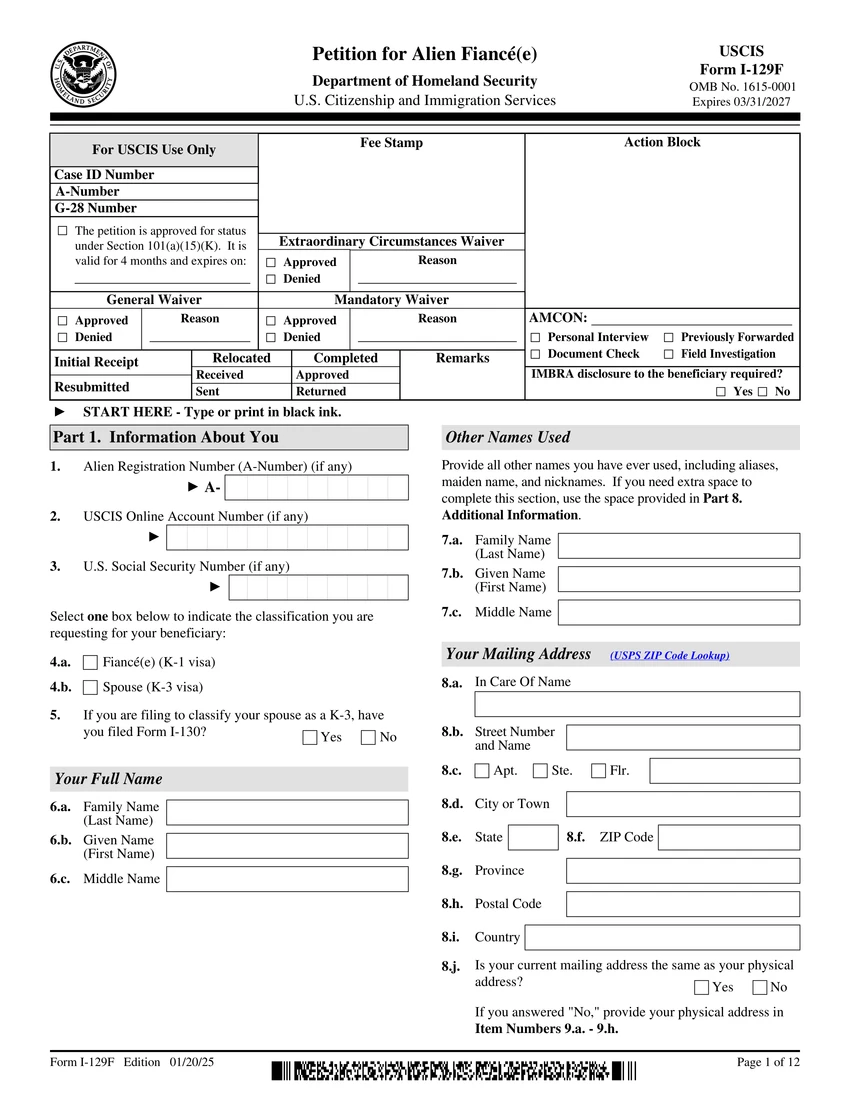
First page of I-129F form
Source: I-129F PDF
Context and workflow
#I-129F is the first major USCIS filing in the K-1 path, but it is only the petition stage. Approval does not itself grant a visa or entry. After USCIS approval, the case still moves through consular processing, the K-1 interview, entry to the United States, and later I-485 after marriage. If the couple is already married, the more common petition is usually I-130, not I-129F.
Where it fits in the workflow
- Starts the K-1 fiancé(e) or limited K-3-related petition process at USCIS.
- Moves next to consular processing after approval rather than directly to a green card.
- Requires a later interview abroad and usually I-134 support evidence at the visa stage.
- For a K-1 entrant who marries in the United States, the later permanent-residence step is usually I-485.
Who uses it
Only a U.S. citizen petitioner uses I-129F for a foreign fiancé(e) in a K-1 case, and in narrower circumstances for a spouse in a K-3-related case. It is not the standard family petition for a couple that is already married; that is usually I-130. For K-1 cases, the petitioner normally needs to show a bona fide relationship, intent to marry within 90 days of admission, and evidence of having met in person within the required period unless a waiver applies.
When it is used
- K-1: K-1 Fiancé(e) Visa
Failure prevention (What causes Form I-129F rejections?)
#Technical rejections
- Submitting the form without a valid signature.
- Failing to provide translations for documents not in English.
- Ensure form edition is current
Substantive weaknesses
- Insufficient evidence of a bona fide relationship.
- Omitting details of previous marriages or their terminations.
What it asks for (What does Form I-129F ask for?)
#- Details about the relationship between the petitioner and the beneficiary.
- Biographic information including ethnicity, race, height, weight, eye color, and hair color.
- Criminal history and any related documents if applicable.
- Applicant identification information
- Supporting documentation inventory
- Eligibility or purpose details
- Declarations and signatures
What you need (What do you need for Form I-129F?)
#- The current edition of I-129F
- Proof of the petitioner's U.S. citizenship
- Evidence of the qualifying relationship and, for many K-1 cases, proof of meeting in person within the required period
- Beneficiary identification documents and photographs
- Certified copies of court and police records for any arrests or convictions where the instructions require them
- A plan for the next stages, including I-134 for the interview and I-485 after marriage, or I-130 if the case is already marriage-based
Checklist (What is the Form I-129F checklist?)
#- Download the current I-129F and instructions from the official USCIS website
- Review the official I-129F instructions before filing
- Gather required supporting documents per the instructions
- Complete all required sections of I-129F
- Confirm the form is signed and dated in all required fields
- Sign, date, and submit I-129F with all required supporting evidence
Fees
#| Component | Amount |
|---|---|
| I-129F filing feeVerify the current USCIS filing fee for the petition itself before mailing the case. | See official schedule |
| Later K-1 stage costsThe petition fee is only the USCIS stage. The full K-1 path later involves visa-stage costs, medical exam expenses, and the later adjustment filing after marriage. | See official schedule |
Always verify the current I-129F filing fee and then separately plan for later K-1 consular and adjustment costs.
Form sections (What sections does Form I-129F have?)
#Part 1. Information About You (the Petitioner)
Identifying and eligibility information about the U.S. citizen petitioner.
- Full legal name, other names used, and any A-Number or USCIS online account number
- Mailing and physical address, date and place of birth, and U.S. citizenship details
- Information about prior marriages and any prior fiancé(e) or spouse petitions filed
Part 2. Information About Your Beneficiary
Identifying information about the foreign fiancé(e) or spouse.
- Beneficiary's full name, date and place of birth, and address abroad
- The beneficiary's prior marriages and how each ended
- Information about the beneficiary's children, if any
Part 4. Biographic Information
Biographic details about the petitioner, collected for identity verification.
- Ethnicity and race
- Height, weight, and eye and hair color
Strategy tips
#Common mistakes (What mistakes are common with Form I-129F?)
#- Submitting a petition without a valid signature.
- Failing to provide a full English translation for documents in a foreign language.
- Not attending the biometric services appointment.
- Submitting original documents when not required, which may be destroyed.
- Failing to provide certified copies of court and police records for any arrests or convictions.
- Submitting incorrect or incomplete evidence.
- Not providing photographs that meet the specified requirements.
Examples (What are examples for Form I-129F?)
#- Strong application: An applicant submits the form with all required documents and receives a timely decision.
- Weak application: An applicant submits Form I-129F without including evidence of meeting their fiancé(e) in person within the last two years, resulting in a request for additional evidence and delayed processing.
Common misconceptions (What misconceptions surround Form I-129F?)
#- Some applicants assume that meeting the eligibility criteria guarantees approval; however, each application is subject to a thorough review process.
- I-129F has more than one fee component (e.g. I-129F filing fee and Later K-1 stage costs); paying only one or paying the wrong amount can result in rejection of the entire filing.
- I-129F can be rejected before substantive review for technical errors such as “Submitting the form without a valid signature.”
- A complete I-129F can still be denied on the merits — issues like “Insufficient evidence of a bona fide relationship” are evaluated by the reviewer even when paperwork is clean.
- Submitting I-129F is the start of the process — applicants should expect follow-up steps such as “Receive the USCIS receipt notice and track the petition while it is pending.”
- Approval of I-129F only establishes the qualifying family relationship — the beneficiary still has to apply for a visa or adjustment of status separately.
Scenarios
#A software engineer submitted their petition with all supporting documents
The case was approved within the standard timeline
Prepare all evidence before filing to avoid delays
Why it matters
#Derivative children in the K process (K-2 for a K-1 case, K-4 for a K-3 case) face age-related limits on adjusting to lawful permanent resident status. The age-out rules are technical and interact with the Child Status Protection Act (CSPA), so confirm a specific child's eligibility with an immigration attorney.
Why it matters: Getting a child's timing wrong can cost permanent-resident eligibility, so it should be confirmed case by case.
The in-person meeting requirement can be waived only in narrow circumstances: (1) if meeting in person would violate strict, long-established customs of the beneficiary's foreign culture or social practice, or (2) if it would cause extreme hardship to the U.S. citizen petitioner. An ordinary or merely inconvenient custom does not qualify.
Why it matters: Banking on a weak waiver basis leads to denials; the standard is narrow and fact-specific.
USCIS requires a valid handwritten (wet-ink) signature, or an electronic signature submitted through the USCIS online account. Since 2021, USCIS no longer accepts photocopied or stamped signatures.
Why it matters: An invalid signature is one of the top reasons petitions are rejected outright.
In practice, the K-3 spouse category rarely produces a usable visa: the Department of State administratively closes the K-3 case once the underlying Form I-130 is approved at the same time or first, which is the usual outcome. If you are already married, treat Form I-130 as the real path rather than relying on K-3.
Why it matters: Chasing K-3 as a shortcut usually wastes time because the I-130 catches up and closes it out.
IMBRA requires disclosure of any permanent protection or restraining orders.
Why it matters: Failure to disclose can result in denial of the petition.
What happens after you submit
#- Receive the USCIS receipt notice and track the petition while it is pending.
- Respond quickly to any request for evidence if USCIS needs more relationship or eligibility proof.
- If approved, continue to K-1 or K-3-related consular processing at the appropriate embassy or consulate.
- Prepare the interview-stage documents such as I-134 and the later I-485 planning if the K-1 path is completed in the United States.
Verification
#This guide is derived from official USCIS instructions for I-129F and is updated when form editions or filing rules change. Always verify current requirements at the official USCIS website.
Resources
#Free United States planning tools
#Itemize the government fees that go alongside Form I-129F.
United States eligibility checker
See which United States visas your profile fits before you finalize Form I-129F.
United States processing times
Get the typical wait time for the visa associated with Form I-129F.
United States interview practice
Practice United States interview questions if your filing route includes one.