Quick summary
#A supporter in a parole-related process when USCIS is actively accepting I-134A for that specific program.
Only in the parole-related categories USCIS allows, and currently subject to the announced acceptance pause.
If and when filing is accepted for the program involved, the supporter submission becomes part of the beneficiary’s larger parole-related case path.
The supporter’s financial and identity records The beneficiary’s identity and program context The current USCIS acceptance rules for the specific parole process
Overview (What is Form I-134A?)
#I-134A is not the same as I-134 or I-864. It was the supporter-side online filing used in the Uniting for Ukraine, CHNV, and Family Reunification Parole programs, where USCIS asked a supporter to demonstrate financial backing and identity information for a beneficiary. USCIS paused acceptance of new filings on January 28, 2025, pending a review of categorical parole processes ordered by the January 20, 2025 executive order "Securing Our Borders," and that pause is still in place as of July 2026.
The CHNV program itself was separately terminated in 2025 after the Supreme Court allowed the termination (decided May 30, 2025), so there is no longer a CHNV case for which I-134A would apply. Uniting for Ukraine remains an active program for existing participants, but USCIS is not accepting new I-134A supporter filings for it either. Anyone reaching this page should treat it as historical/reference information on how the form worked, not as a form you can file today.
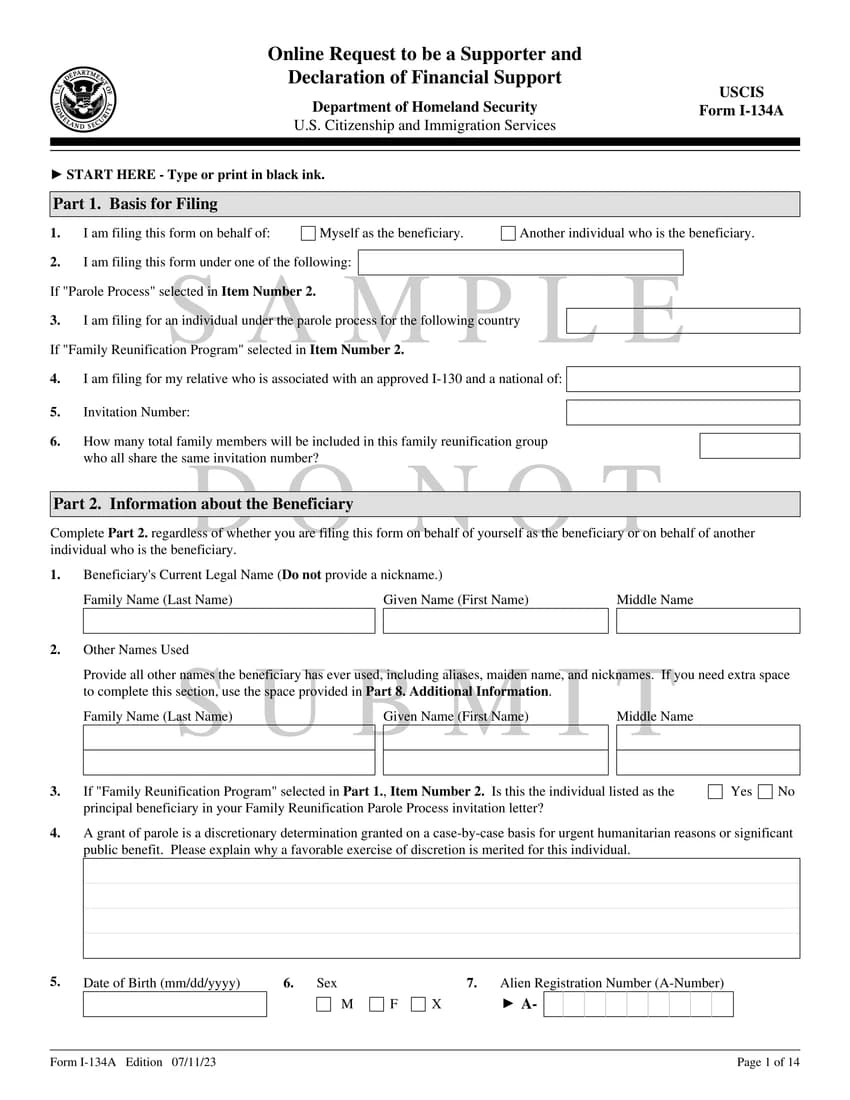
First page of I-134A form
Source: I-134A PDF
Context and workflow
#USCIS posted a formal update saying it paused acceptance of Form I-134A while reviewing categorical parole processes, and that pause has not been lifted as of July 2026. CHNV parole has since been formally terminated, and USCIS has not announced when — or whether — I-134A filings will resume for any remaining program. Anyone researching this page needs to verify current program availability on USCIS.gov before assuming they can file a supporter declaration.
Why this matters
- Background/timeline forms are used to assess continuity; gaps or overlaps can trigger clarification requests.
- This form acts as a cross-check point: details here must match other forms and supporting documents.
Where it fits in the workflow
- Initiating the process of financial sponsorship for an immigrant.
- Receipt Notice (a related form) is typically issued after submission.
- May lead to further processing of immigration benefits for the beneficiary.
- I-134A is commonly filed alongside Form I-589.
Who uses it
I-134A was used by supporters in the Uniting for Ukraine, CHNV, and Family Reunification Parole processes, where USCIS required an online supporter request and declaration of financial support. It is not the same form used for K-1 support or standard immigrant affidavits. USCIS is not currently accepting new I-134A filings for any of these programs, and CHNV parole itself has been terminated, so this page is for reference until (and unless) USCIS reopens filing.
When it is used
- When a sponsor must document financial support obligations for an intending immigrant
- After the underlying petition is approved and financial sponsorship is required
- As part of the immigrant visa or adjustment process where sponsorship applies
Requirements snapshot
#- Supporting evidence must demonstrate the sponsor’s ability to meet the required support level.
Failure prevention (What causes Form I-134A rejections?)
#Technical rejections
- Submitting the form while the acceptance is paused.
- Not signing the form where indicated.
- Ensure form edition is current
Substantive weaknesses
- Failing to provide sufficient evidence of financial support.
- To avoid insufficient income or incomplete financial evidence: Use current poverty guidelines; include all required tax and employment evidence.
- To avoid submitting before beneficiary has confirmation number: Beneficiary needs your I-134A confirmation number; complete your part first.
- To avoid household size or income calculation errors: Count household plus beneficiary; income must meet 100% of poverty guidelines.
- To avoid confusing i-134a with i-134 for k-1 or visitor visa: I-134A is for parole programs only; use I-134 for K-1 and visitor visa support.
What you need (What do you need for Form I-134A?)
#- The current edition of I-134A
- Recent tax returns or income evidence for the sponsor and household members
- Household size documentation and supporting financial evidence
- Evidence of the beneficiary's assets and financial support.
- Complete all required sections, sign, and submit with required evidence.
- Failing to provide evidence of financial support.
- Copy of your filed or approved I-589 (Financial support for asylum/parole beneficiaries)
Sources for this section
Checklist (What is the Form I-134A checklist?)
#- First, confirm on USCIS.gov whether Form I-134A is being accepted at all — as of July 2026, USCIS is not accepting new I-134A filings for any program
- Download the current I-134A and instructions from the official USCIS website
- Review the I-134A instructions for sponsor and household requirements
- Gather sponsor income evidence and required household documentation
- Complete all required sections of I-134A
- Sign, date, and submit I-134A with all required supporting evidence (only once/if USCIS resumes acceptance)
Sources for this section
Fees
#| Component | Amount |
|---|---|
| Filing FeeThe standard filing fee for form i-134a. Check the current fee on the official USCIS fee schedule. | See official schedule |
Can the Form I-134A fee be waived?
Fee waivers may be available for qualifying applicants. See official instructions for eligibility.
What happens if I submit the wrong fee?
USCIS will reject your application if the incorrect fee is submitted. Verify the current fee on the official schedule before filing.
Fee waiver: Fee waivers may be available for qualifying applicants. See official instructions for eligibility. For related guidance, see Application for Asylum and for Withholding.
Fees change; always verify on USCIS.
Where to file
#Online filing is available for some categories — verify on the official form page. Otherwise, file by mail to the address in the instructions.
File online
Check the official I-134A page to see if online filing is available for your category.
Submit application
Paper filing addresses vary by eligibility category and state of residence. Check the official instructions for the correct filing address.
Filing locations and procedures may change. Always verify on the official USCIS website before submitting. For related guidance, see Refugee/Asylee Relative Petition.
Form sections (What sections does Form I-134A have?)
#Sponsor Information
Petitioner or sponsor identity and status.
- Full name and citizenship or LPR status
- Current address and household size
- Relationship to beneficiary
Income and Employment
Financial capacity evidence.
- Employer name and annual income
- Tax returns for the last 3 years
- W-2s and 1099s
- Current employment letter
Assets
If using assets to meet the requirement.
- Bank statements and account balances
- Property valuations
- Evidence of ownership
- 5x shortfall rule for assets when income is insufficient
Key terms
#- Beneficiary
- The person who will receive support and is seeking parole into the U.S.In this form: The individual for whom the supporter is declaring financial support.
Strategy tips
#Mistake severity
#| Mistake type | Severity | How to avoid |
|---|---|---|
| Insufficient income or incomplete financial evidence | Rejection | Use current poverty guidelines; include all required tax and employment evidence. |
| Submitting before beneficiary has confirmation number | Delay | Beneficiary needs your I-134A confirmation number; complete your part first. |
| Household size or income calculation errors | RFE | Count household plus beneficiary; income must meet 100% of poverty guidelines. |
| Confusing I-134A with I-134 for K-1 or visitor visa | Rejection | I-134A is for parole programs only; use I-134 for K-1 and visitor visa support. |
Examples (What are examples for Form I-134A?)
#- Strong application: A sponsor submits the form with all required financial documents and receives a timely decision.
- Common weakness: A sponsor forgets to include tax return documents, leading to a request for additional evidence and delays.
- A sponsor completes I-134A to provide evidence required for the case
- Applicants use I-134A to provide supporting declarations and evidence
- An applicant in the Humanitarian-parole category files I-134A as part of their immigration process
Common misconceptions (What misconceptions surround Form I-134A?)
#- Approval of this form does not grant immigration status by itself
- The financial obligation can continue after filing, depending on the case outcome
- The financial obligation ends once the immigrant enters the country — Obligations under I-134A continue according to the immigration authority rules and do not end automatically after entry.
- Paying the I-134A filing fee does not guarantee acceptance — the fee is generally non-refundable even when the form is rejected for technical errors.
- A fee waiver for I-134A is not automatic — only specific qualifying categories are eligible, and a waiver request can be denied while the underlying form is still expected to be filed.
- I-134A cannot always be filed in any way — the correct filing method depends on the applicant's category, and using the wrong channel can result in rejection.
Edge cases and variations
#- If you are asked to submit or update I-134A, treat it as a package update: check every place the same details appear and keep them consistent.
In-depth guidance
#Background and timeline sections
Schedule/background forms are used to capture histories that must be gap-free. Build a master timeline first, then copy it into the form. If you had periods of unemployment, travel, or caregiving, include them as explicit entries rather than leaving blanks.
Scenarios
#A sponsor with income at 150% of the poverty guideline completes the affidavit with 3 years of tax returns and 6 months of bank statements.
Affidavit accepted. Beneficiary's visa or adjustment application proceeds to approval.
Include complete tax documentation. IRS transcripts are preferred over photocopies of returns.
A sponsor uses a joint sponsor but the household member's Form I-864A is not signed by both parties.
RFE issued. The I-864A must be signed by both the sponsor and the household member.
All parties must sign. Household member income only counts with a properly executed I-864A.
An elderly sponsor has significant assets but low current income. The affidavit includes asset documentation exceeding 5 times the income shortfall.
Assets accepted. The 5x rule for assets applies when income is below the poverty guideline.
When using assets, the value must be 5 times the difference between your income and the poverty guideline for your household size.
Key differentiators
#- Unlike Form I-864: Form I-134A is specifically for declaring financial support for parole, whereas Form I-864 is an affidavit of support for immigrants seeking permanent residency.
- Unlike Form I-589: Application for Asylum and for Withholding of Removal: Filed together: Financial support for asylum/parole beneficiaries
- Unlike Form I-730: Refugee/Asylee Relative Petition: Supporting form: Financial support for refugee/asylee relative petitions (Parole pathway)
Why it matters
#What happens after you submit
#- Receive a Receipt Notice (a related form) from USCIS acknowledging the form submission.
- USCIS reviews the financial information and supporting documents provided.
- If additional information is needed, USCIS may issue a Request for Evidence (RFE).
- Once reviewed, USCIS makes a decision on the financial support declaration.
- If approved, the beneficiary may proceed with the next stage of their immigration process.
Verification
#This guide is based on official USCIS instructions for I-134A and is updated with changes in form editions or filing rules. Always confirm current requirements on the official USCIS website.
Resources
#Free United States planning tools
#Itemize the government fees that go alongside Form I-134A.
United States eligibility checker
See which United States visas your profile fits before you finalize Form I-134A.
United States processing times
Get the typical wait time for the visa associated with Form I-134A.
United States interview practice
Practice United States interview questions if your filing route includes one.