
Quick summary
#This form is not intended for general public self-filing, as described in the Form DS-160 guide.
You should submit a Form I-590, Registration for Classification as Refugee (PDF, 691.55 KB), for your FTJ-R relative along with the Form I-730; your relative does not need to complete Parts 5 or 8 or sign the Form I-590.
Include it with your application package and follow official instructions for submission.
Names, dates of birth, and passport details on other forms Program checklist requirements Supporting documents and translations
Overview (What is Form I-730?)
#Form I-730, Refugee/Asylee Relative Petition, is utilized by individuals who have been granted asylum or refugee status to petition for their qualifying family members, specifically spouses and unmarried children under 21, to join them in the United States. To file this petition, the petitioner must be a principal refugee or asylee who was admitted to the U.S. or granted asylum within the past two years. However, the two-year filing limitation may be waived by USCIS for humanitarian reasons.
It is important to note that beneficiaries in the United States will be interviewed by USCIS officers, while those overseas will be interviewed by either a USCIS officer or a Department of State consular officer. Petitioners must ensure that all documentation is complete and accurate to comply with USCIS requirements.
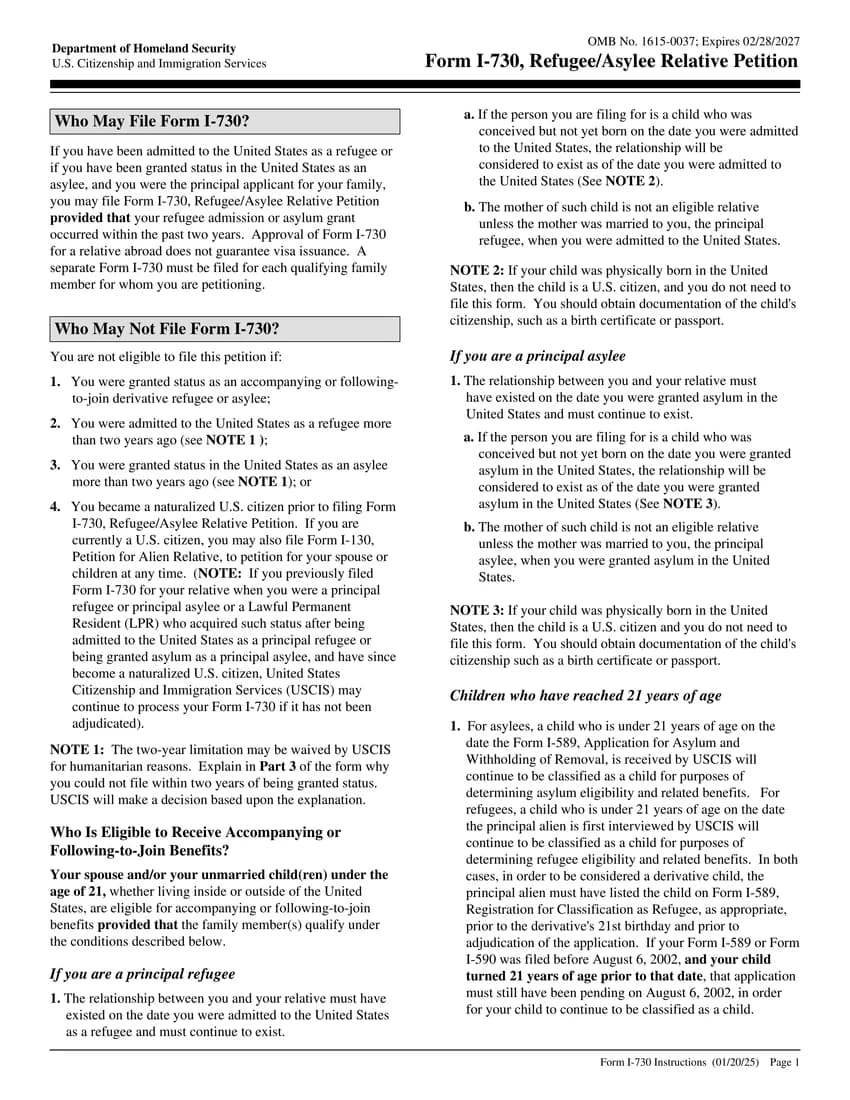
First page of I-730 form
Source: I-730 PDF
Context and workflow
#I-730 processing times vary by category; always consult the official USCIS processing time tool for updates.
Why this matters
- Inconsistencies often trigger returns or follow-up requests because they create uncertainty in the case record.
- This form acts as a cross-check point: details here must match other forms and supporting documents.
Where it fits in the workflow
- Initiating the family reunification process for refugees and asylees.
- Receipt Notice (a related form) is issued after submission.
- Attend biometrics appointment (fingerprints, photo, and signature) if required.
- Approval or denial of the petition.
Who uses it
Form I-730, Refugee/Asylee Relative Petition, is specifically designed for individuals who have been granted asylum or refugee status to petition for their qualifying family members, such as a spouse or unmarried child under 21, to join them in the United States. The applicant must be a principal refugee or asylee and must file the petition within two years of being granted asylum or refugee status, unless there are humanitarian reasons to excuse this deadline. It is important to note that you cannot file if you were granted status as an accompanying or following-to-join derivative refugee or asylee, or if you became a naturalized U.S. citizen prior to filing Form I-730.
When it is used
- You should submit a Form I-590, Registration for Classification as Refugee (PDF, 691.55 KB), for your FTJ-R relative along with the Form I-730; your relative does not need to complete Parts 5 or 8 or sign the Form I-590.
- Asylum — Follow-to-join for asylee relatives
- When filing I-730 alongside I-589 (Principal asylee must have approved I-589 before filing I-730)
- After filing I-730 — I-485 may be the next step (Derivative adjustment of status after I-730 approval)
- After filing I-730 — DS-260 may be the next step (Immigrant visa for derivatives abroad)
Failure prevention (What causes Form I-730 rejections?)
#Technical rejections
- Ensure form edition is current
Substantive weaknesses
- Insufficient evidence of family relationship.
- Providing false information, which may lead to penalties.
- To avoid missing proof of relationship or required documents: Include all required evidence per instructions; match information to civil documents.
What it asks for (What does Form I-730 ask for?)
#- Evidence of your status as a refugee or asylee in the United States.
- Proof of relationship between the petitioner and beneficiaries.
- Primary evidence of a family relationship for each family member you are submitting a petition for.
- Applicant identification information
- Supporting documentation inventory
- Eligibility or purpose details
- Declarations and signatures
- Beneficiary's interview details and signature.
- Documentation related to: Evidence of any legal name changes must also be submitted, if applicable
- Documentation related to: If available, your alien relative must bring some form of identification to the interview, including any passport(s), ot
What you need (What do you need for Form I-730?)
#- The current edition of I-730
- Proof of your own immigration status (citizenship certificate, passport, or green card (Permanent Resident Card))
- Evidence of the qualifying relationship
- Beneficiary identification documents and photographs
- Evidence of any legal name changes must also be submitted, if applicable
- If available, your alien relative must bring some form of identification to the interview, including any passport(s), other travel or identification documents, or Form I-94 (Arrival- Departure Record)
- Evidence of your status as a refugee or asylee in the United States.
- A passport-style photograph or a recent, clear photograph of each family member you are filing for.
- The required photo, we may issue a request for evidence, and it could take longer to process your petition
- The beneficiary's photo.
Checklist (What is the Form I-730 checklist?)
#- Download the current I-730 and instructions from the official USCIS website
- Review the official I-730 instructions before filing
- Gather required supporting documents per the instructions
- Complete all required sections of I-730
- Confirm the form is signed and dated in all required fields
- Confirm your mailing address is current and correct
- Ensure that all pages are from the current edition of Form I-730.
- Sign and date Form I-730, ensuring that all required supporting documents are included before submission.
Fees
#| Component | Amount |
|---|---|
| Filing FeeThere is no filing fee for Form I-730 — the Refugee/Asylee Relative Petition is free to file. | $0 |
| Biometrics Services FeeNo biometrics fee, but unexcused failure of your relative to appear for a required biometrics appointment may result in dismissal of the petition. | $0 |
Can the Form I-730 fee be waived?
Fee waivers may be available for qualifying applicants. See official instructions for eligibility.
What happens if I submit the wrong fee?
USCIS will reject your application if the incorrect fee is submitted. Verify the current fee on the official schedule before filing.
Fee waiver: No fee applies, so no waiver is needed. Budget instead for supporting-document costs like translations and passport photos.
Fees change; always verify on USCIS.
Processing times
#- Submit an 'outside of normal processing times' inquiry if processing exceeds normal times.
- processing times listed for Form I-730 petitions on our Processing Times page, you may submit an “outside of normal processing times” inquiry for your pending Form I-730.
- processing time information for Form I-730 petitions pending with DOS.
- Processing times differ significantly by eligibility category. Initial applications, renewals, and replacements each go through different adjudication queues, and some categories consistently take longer than others.
- Renewal filings are often processed differently than initial applications. If you are renewing, file well before your current authorization expires — some categories allow you to continue working while the renewal is pending if filed on time.
- The service center assigned to your case affects how long it takes. USCIS distributes filings across multiple centers, and each has different workloads. You cannot choose which center processes your case.
Where to file
#Online filing is available for some categories — verify on the official form page. Otherwise, file by mail to the address in the instructions.
Submit application
§ 279(g) and are in removal proceedings;Are among the categories of applicants who must currently file by mail with the Asylum Vetting Center as outlined in the Special Instructions section of our Form I-589 webpage; or Already submitted a Form I-589, which is still pending with USCIS
Filing locations and procedures may change. Always verify on the official USCIS website before submitting. For related guidance, see Application to Register Permanent Residence or.
Form sections (What sections does Form I-730 have?)
#Petitioner Information
US citizen or LPR filing the petition.
- Full name and immigration status
- Address and contact information
- Evidence of citizenship or lawful permanent residence
Beneficiary Information
Person being petitioned for.
- Full name and date of birth
- Current immigration status
- Relationship to petitioner
- A-Number or passport if applicable
Supporting Evidence
Required documentation for the petition type.
- Relationship evidence
- Civil documents
- Category-specific documentation
Strategy tips
#Mistake severity
#| Mistake type | Severity | How to avoid |
|---|---|---|
| Missing proof of relationship or required documents | Rejection | Include all required evidence per instructions; match information to civil documents. |
Examples (What are examples for Form I-730?)
#- Complete all certifications: Ensure all required official certifications are properly signed and dated.
- Verify documentation: All supporting documents must be current and properly formatted.
- Cross-reference information: Information must be consistent across all sections and supporting documents.
- A citizen files I-730 to petition for their spouse to immigrate
- A permanent resident uses I-730 to sponsor their unmarried child under 21
- An applicant in the Asylum category files I-730 as part of their immigration process
Common misconceptions (What misconceptions surround Form I-730?)
#- Some applicants assume that being a naturalized U.S. citizen allows them to file Form I-730; however, this form is only for principal refugees or asylees.
- Filing I-730 allows the beneficiary to immediately enter or remain in the country — The petition only establishes the relationship. The beneficiary must separately apply for a visa or change of status.
- All family relationships qualify for immigration sponsorship — Only certain family relationships are eligible. The sponsoring relative must be a citizen or permanent resident, and the specific relationship must be in a qualifying category.
- I-730 has more than one fee component (e.g. Filing Fee and Biometrics Services Fee); paying only one or paying the wrong amount can result in rejection of the entire filing.
- A fee waiver for I-730 is not automatic — only specific qualifying categories are eligible, and a waiver request can be denied while the underlying form is still expected to be filed.
- I-730 can be rejected before substantive review for technical errors such as “Ensure form edition is current.”
Edge cases and variations
#- If you are asked to submit or update I-730, treat it as a package update: check every place the same details appear and keep them consistent.
Scenarios
#A petitioner files the petition with complete evidence and the correct fee. USCIS accepts the application.
Receipt notice issued. Case proceeds to adjudication. Processing time varies by form type.
Use the current form edition and correct fee. Outdated forms or wrong fees cause rejection.
An applicant receives an RFE for additional evidence and responds fully within the 30-day window.
Response accepted. Adjudication continues. Late responses may result in denial.
Respond to RFEs completely and by the deadline. Extensions are rarely granted.
A petitioner has a typo in the beneficiary's birth date that does not match the birth certificate.
Case delayed for correction. May require amended petition or signed affidavit explaining the error.
Review all dates and names against civil documents. Consistency prevents delays and requests for evidence.
Key differentiators
#- Unlike Form I-589: Application for Asylum and for Withholding of Removal: Required for: Principal asylee must have approved I-589 before filing I-730 (Refugee program pathway)
- Unlike Form I-485: Application to Register Permanent Residence or Adjust Status: Next step after approval: Derivative adjustment of status after I-730 approval (Refugee program pathway)
- Unlike Form DS-260: Online Immigrant Visa Application: Next step after approval: Immigrant visa for derivatives abroad (Refugee program pathway)
Why it matters
#What happens after you submit
#- Receive Receipt Notice (a related form) from USCIS.
- Attend biometrics appointment (fingerprints, photo, and signature) if required.
- USCIS reviews the petition and supporting documents.
- Receive notice of approval or denial.
- If approved, the relative may proceed with consular processing or adjustment of status, depending on their location.
Verification
#This guide is derived from official USCIS instructions for I-730 and is updated when form editions or filing rules change. Always verify current requirements at the official USCIS website.
Resources
#Free United States planning tools
#Itemize the government fees that go alongside Form I-730.
United States eligibility checker
See which United States visas your profile fits before you finalize Form I-730.
United States processing times
Get the typical wait time for the visa associated with Form I-730.
United States interview practice
Practice United States interview questions if your filing route includes one.