Quick summary
#The petitioner (sponsor) files this form on behalf of the beneficiary (the relative), as described in the Form DS-260 guide.
SIJ: Special Immigrant Juvenile Status
Include it with your application package and follow official instructions for submission.
Names, dates of birth, and passport details on other forms Program checklist requirements Supporting documents and translations
Overview (What is Form I-360?)
#Form I-360 is used to petition for Amerasian, Widow(er), or Special Immigrant status in the United States. This form serves various categories of immigrants, including those who have been abused, neglected, or abandoned, as well as certain Afghan and Iraqi nationals who worked for the U.S. government. It also supports VAWA self-petitioners, who are victims of battery or extreme cruelty by U.S. citizens or lawful permanent residents.
Additionally, widows or widowers of U.S. citizens may file this petition if they meet specific conditions regarding the timing of the spouse's death and their marital status. The U.S. Citizenship and Immigration Services (USCIS) oversees the processing of these petitions, ensuring that eligible individuals receive the protection and opportunities they seek.
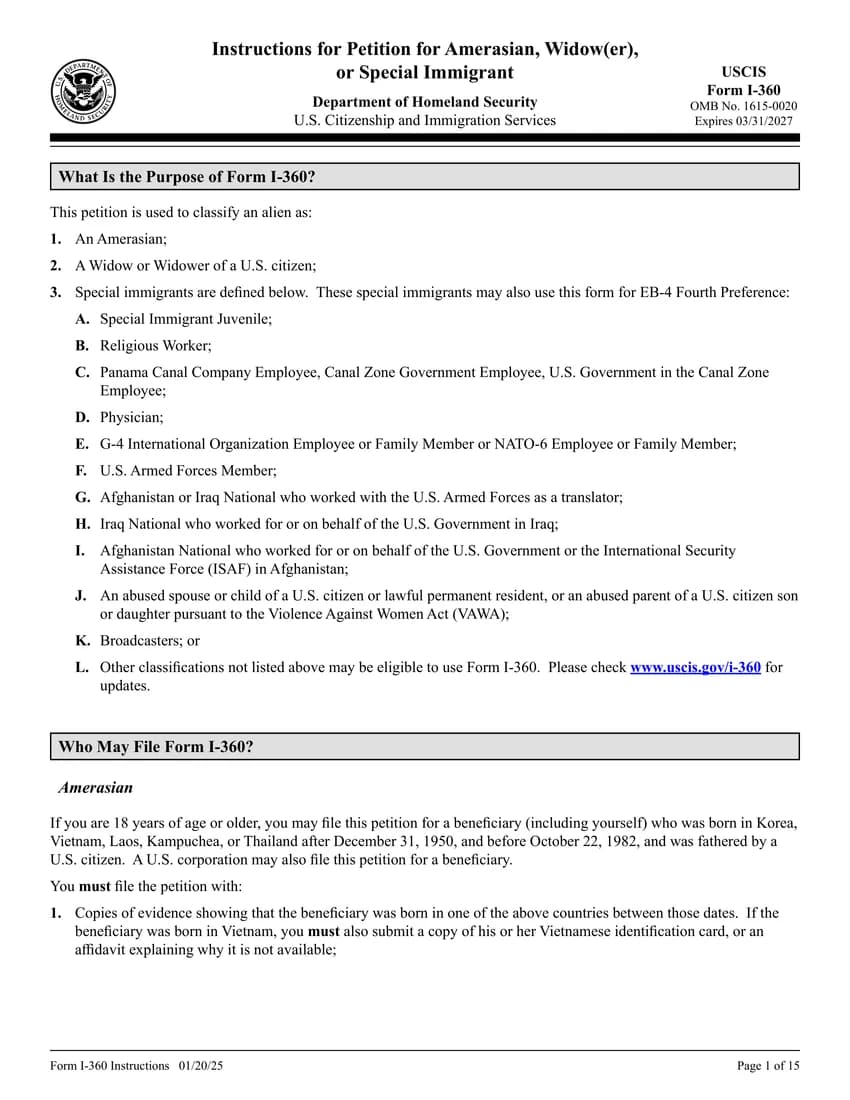
First page of I-360 form
Source: I-360 PDF
Context and workflow
#Processing times for Form I-360 differ by category. Always consult the official USCIS processing time tool for the most accurate information.
Why this matters
- Inconsistencies often trigger returns or follow-up requests because they create uncertainty in the case record.
- Small mismatches inside I-360 (or between I-360 and supporting evidence) can force rework later in processing.
Where it fits in the workflow
- Initiates the immigration process for specific categories of immigrants.
- Receipt Notice (a related form) is typically issued after filing.
- May lead to further processing steps such as biometrics appointments or additional forms.
- I-360 is commonly filed alongside Form I-765.
Who uses it
The petitioner (sponsor) files this form on behalf of the beneficiary (the relative). Common filers: VAWA Self-Petition, Special Immigrant Juvenile Status, Religious Worker.
When it is used
- SIJ: Special Immigrant Juvenile Status
- When petitioning for Sij — approval of I-360 is a step toward this visa category
- After filing I-360 — I-485 may be the next step (Adjustment of status after I-360 approval)
- When filing I-360 alongside I-765 (Work authorization for VAWA self-petitioners)
Requirements snapshot
#- Amerasian: If you are 18 years of age or older, you may file this petition for a beneficiary born in Korea, Vietnam, Laos, Kampuchea, or Thailand after December 31, 1950, and before October 22, 1982, fathered by a U.S. citizen.
- In limited circumstances: special Immigrant Juvenile: You may file this petition for a beneficiary who is present in the U.S. unmarried, under 21, and has been declared dependent by a juvenile court.
- In limited circumstances: special Immigrant Religious Worker: A U.S. employer may file this petition for a beneficiary seeking to work full-time in a religious capacity.
- Amerasian: Individuals born in certain Asian countries to U.S. citizen fathers during specific periods.
Failure prevention (What causes Form I-360 rejections?)
#Technical rejections
- Ensure form edition is current
Substantive weaknesses
- Failure to provide evidence of the beneficiary's eligibility for the specific classification.
- To avoid missing proof of relationship or required documents: Include all required evidence per instructions; match information to civil documents.
- To avoid insufficient abuse evidence (vawa): Document abuse with affidavits, police reports, medical records, and counseling evidence.
- To avoid wrong petition type or classification: Use correct supplement and classification (VAWA, widow, Amerasian, SIJ) per eligibility.
- To avoid missing i-765 when requesting work authorization: File I-765 with I-360 for VAWA; EAD processing is faster when filed together.
What it asks for (What does Form I-360 ask for?)
#- Proof of relationship to a U.S. citizen or lawful permanent resident, if applicable.
- Employment history and evidence of service
- Proof of Chief of Mission Approval
- Applicant identification information
- Supporting documentation inventory
- Eligibility or purpose details
- Declarations and signatures
- Using a stamped or typewritten name instead of a handwritten signature.
- Adjudication and determines that it has a deficient signature, USCIS may deny the request.
Sources for this section
What you need (What do you need for Form I-360?)
#- The current edition of I-360
- Proof of your own immigration status (citizenship certificate, passport, or green card (Permanent Resident Card))
- Evidence of the qualifying relationship
- Beneficiary identification documents and photographs
- Evidence of the beneficiary's eligibility for the specific immigrant classification.
- Information about the applicant's eligibility category and supporting evidence.
- Evidence supporting the eligibility for the requested classification.
- Gather evidence of eligibility and supporting documents.
- The completed form and supporting documents to USCIS.
- Review category-specific information and form instructions to determine eligibility and required supporting evidence.
- Failure to include necessary affidavits or supporting documents.
Checklist (What is the Form I-360 checklist?)
#- Download the current I-360 and instructions from the official USCIS website
- Review the official I-360 instructions before filing
- Collect the necessary supporting documents as outlined in the instructions.
- Complete all required sections of I-360
- Confirm the form is signed and dated in all required fields
- Sign, date, and submit I-360 with all required supporting evidence
Sources for this section
Fees
#| Component | Amount |
|---|---|
| Filing FeeThe standard filing fee for form i-360. Check the current fee on the official USCIS fee schedule. | See official schedule |
| Biometrics Services FeeA biometrics fee may be required depending on your category. Check the official fee schedule. | See official schedule |
Can the Form I-360 fee be waived?
Fee waivers may be available for qualifying applicants. See official instructions for eligibility.
What happens if I submit the wrong fee?
USCIS will reject your application if the incorrect fee is submitted. Verify the current fee on the official schedule before filing.
Fee waiver: Fee waivers may be available for qualifying applicants. See official instructions for eligibility. For related guidance, see Application to Register Permanent Residence or.
Fees change; always verify on USCIS.
Processing times
#| Category | Processing time |
|---|---|
| All other special immigrants | 38 to 43 monthsas of January 2026 |
| Violence Against Women Act (VAWA) | 46 to 50.5 monthsas of January 2026 |
| Religious workers | 8.5 to 10.5 monthsas of January 2026 |
| Afghan or Iraqi Translators and Afghan or Iraqi nationals who worked for on or behalf of the U.S. government | 5 to 8 monthsas of January 2026 |
- Processing times for I-360 vary by eligibility category and service center. Data sourced from the official USCIS processing times tool.
- Processing times differ significantly by eligibility category. Initial applications, renewals, and replacements each go through different adjudication queues, and some categories consistently take longer than others.
- Renewal filings are often processed differently than initial applications. If you are renewing, file well before your current authorization expires — some categories allow you to continue working while the renewal is pending if filed on time.
- The service center assigned to your case affects how long it takes. USCIS distributes filings across multiple centers, and each has different workloads. You cannot choose which center processes your case.
- To check your estimated timeline: visit the official USCIS processing times tool, select your form and eligibility category, and note that the tool shows the filing date of cases currently being worked on — not a countdown from when you filed.
- While pending: track your case status online with your receipt number, respond promptly to any requests for additional evidence, and update your address through your USCIS account if you move.
Where to file
#Online filing is available for some categories — verify on the official form page. Otherwise, file by mail to the address in the instructions.
File online
Check the official I-360 page to see if online filing is available for your category.
Submit application
Paper filing addresses vary by eligibility category and state of residence. Check the official instructions for the correct filing address.
Filing locations and procedures may change. Always verify on the official USCIS website before submitting. For related guidance, see Application for Employment Authorization.
Form sections (What sections does Form I-360 have?)
#Petitioner Information
US citizen or LPR filing the petition.
- Full name and immigration status
- Address and contact information
- Evidence of citizenship or lawful permanent residence
Beneficiary Information
Person being petitioned for.
- Full name and date of birth
- Current immigration status
- Relationship to petitioner
- A-Number or passport if applicable
Supporting Evidence
Required documentation for the petition type.
- Relationship evidence
- Civil documents
- Category-specific documentation
Choose your path
#Choose your path based on your eligibility category. Each block summarizes who qualifies, what to file, common mistakes, and typical processing time.
VAWA Self-Petition
Abused spouses, children, or parents of U.S. citizens or LPRs who self-petition without the abuser's knowledge.
File with:
- Evidence of qualifying relationship
- Evidence of abuse
- Evidence of good moral character
- Evidence of residence with abuser
Common mistakes:
- Insufficient evidence of abuse beyond personal declaration
- Not demonstrating residence with abuser
- Failing to show good moral character
Typical processing: 12-24 months
Special Immigrant Juvenile Status
Minors who have been abused, neglected, or abandoned and have a qualifying state court order.
File with:
- State court order with required findings
- Birth certificate
- Evidence of age
Common mistakes:
- State court order missing required federal findings
- Aging out (turning 21) before adjudication
- Not filing I-485 promptly after I-360 approval
Typical processing: 6-12 months
Religious Worker
Ministers and religious workers with at least 2 years of qualifying employment by a tax-exempt religious organization.
File with:
- Employer attestation
- Tax-exempt determination letter
- Evidence of 2 years religious work
- Job offer letter
Common mistakes:
- Religious organization not qualifying as tax-exempt
- Worker's duties not meeting the definition of religious occupation
- Insufficient evidence of 2-year employment
Typical processing: 6-12 months
Category comparison
#| Category code | Eligibility | Typical filing companion | Auto-extension? | Premium processing? |
|---|---|---|---|---|
| VAWA | Abused spouse/child/parent of U.S. citizen or LPR | Evidence of abuse and qualifying relationship | N/A | No |
| SIJS | Special Immigrant Juvenile — abused/neglected/abandoned minor with state court order | State court order and consent | N/A | No |
| Religious Worker | Minister or religious worker with 2+ years employment by qualifying organization | Employer attestation and evidence of religious work | N/A | No |
| Iraqi/Afghan Translator | Iraqi/Afghan national who served as translator for U.S. military | Military recommendation letter and employment records | N/A | No |
Strategy tips
#Mistake severity
#| Mistake type | Severity | How to avoid |
|---|---|---|
| Missing proof of relationship or required documents | Rejection | Include all required evidence per instructions; match information to civil documents. |
| Insufficient abuse evidence (VAWA) | RFE | Document abuse with affidavits, police reports, medical records, and counseling evidence. |
| Wrong petition type or classification | Rejection | Use correct supplement and classification (VAWA, widow, Amerasian, SIJ) per eligibility. |
| Missing I-765 when requesting work authorization | Delay | File I-765 with I-360 for VAWA; EAD processing is faster when filed together. |
Examples (What are examples for Form I-360?)
#- Strong application: An applicant submits the form with all required documents and receives a timely decision.
- Common weakness: Petitioner forgets to sign; form returned, causing delay.
- Scenario: A software engineer submitted their petition with all supporting documents The case was approved within the standard timeline Prepare all evidence before filing to avoid delays
- A citizen files I-360 to petition for their spouse to immigrate
- A permanent resident uses I-360 to sponsor their unmarried child under 21
- An applicant in the Sij category files I-360 as part of their immigration process
Common misconceptions (What misconceptions surround Form I-360?)
#- Filing I-360 allows the beneficiary to immediately enter or remain in the country — The petition only establishes the relationship. The beneficiary must separately apply for a visa or change of status.
- All family relationships qualify for immigration sponsorship — Only certain family relationships are eligible. The sponsoring relative must be a citizen or permanent resident, and the specific relationship must be in a qualifying category.
- I-360 has more than one fee component (e.g. Filing Fee and Biometrics Services Fee); paying only one or paying the wrong amount can result in rejection of the entire filing.
- A fee waiver for I-360 is not automatic — only specific qualifying categories are eligible, and a waiver request can be denied while the underlying form is still expected to be filed.
- Processing time for I-360 is not one-size-fits-all — different categories see very different timelines (for example, All other special immigrants runs about 38 to 43 months, while Violence Against Women Act (VAWA) runs about 46 to 50.5 months).
- I-360 cannot always be filed in any way — the correct filing method depends on the applicant's category, and using the wrong channel can result in rejection.
Edge cases and variations
#- If you are asked to submit or update I-360, treat it as a package update: check every place the same details appear and keep them consistent.
Scenarios
#A petitioner files the petition with complete evidence and the correct fee. USCIS accepts the application.
Receipt notice issued. Case proceeds to adjudication. Processing time varies by form type.
Use the current form edition and correct fee. Outdated forms or wrong fees cause rejection.
An applicant receives an RFE for additional evidence and responds fully within the 30-day window.
Response accepted. Adjudication continues. Late responses may result in denial.
Respond to RFEs completely and by the deadline. Extensions are rarely granted.
A petitioner has a typo in the beneficiary's birth date that does not match the birth certificate.
Case delayed for correction. May require amended petition or signed affidavit explaining the error.
Review all dates and names against civil documents. Consistency prevents delays and requests for evidence.
Key differentiators
#- Unlike Form I-485: Application to Register Permanent Residence or Adjust Status: Next step after approval: Adjustment of status after I-360 approval (Family-based immigration pathway)
- Unlike Form I-765: Application for Employment Authorization: Filed together: Work authorization for VAWA self-petitioners (Family-based immigration pathway)
- Unlike Form I-751: Petition to Remove Conditions on Residence: Next step after approval: Remove conditions if conditional resident status (Family-based immigration pathway)
Why it matters
#What happens after you submit
#- Receipt Notice (a related form) is issued by USCIS after filing.
- Attend biometrics appointment (fingerprints, photo, and signature) if applicable.
- USCIS reviews the petition and supporting documents.
- Receive a notice of action indicating approval or denial.
- If approved, proceed with next stage forms or processes as applicable to the specific immigrant category.
Verification
#This guide is based on official USCIS instructions for Form I-360 and is updated with changes in form editions or filing rules. Always check the official USCIS website for the latest requirements.
Resources
#Free United States planning tools
#Itemize the government fees that go alongside Form I-360.
United States eligibility checker
See which United States visas your profile fits before you finalize Form I-360.
United States processing times
Get the typical wait time for the visa associated with Form I-360.
United States interview practice
Practice United States interview questions if your filing route includes one.