Quick summary
#A certifying official at a qualifying law enforcement agency, prosecutor, judge, or other authority that investigates or prosecutes the qualifying criminal activity completes and signs Form I-918 Supplement B. Check the form instructions for category-specific requirements.
Completed by a certifying law enforcement agency and filed with Form I-918 to support a petition for U nonimmigrant status (U visa).
Include it with your application package and follow official instructions for submission.
Names, dates of birth, and passport details on other forms Program checklist requirements Supporting documents and translations
Overview (What is Form I-918 Supplement B?)
#Form I-918 Supplement B is the U Nonimmigrant Status Certification — the one part of a U visa petition that a law enforcement agency, not the victim, completes. A certifying official signs it to certify that the person named is a victim of qualifying criminal activity and that they have been, are being, or are likely to be helpful in the investigation or prosecution of that crime.
The certification is what connects a criminal case to an immigration benefit: the certifying agency documents the crime and the victim's cooperation, and USCIS relies on that certification when it reviews the Form I-918 petition for U nonimmigrant status. Certification is discretionary — an agency decides whether to sign — so the practical work for a crime victim is preparing the request: identifying the agency with jurisdiction over the qualifying criminal activity and assembling the reports and evidence of helpfulness that let it certify accurately.
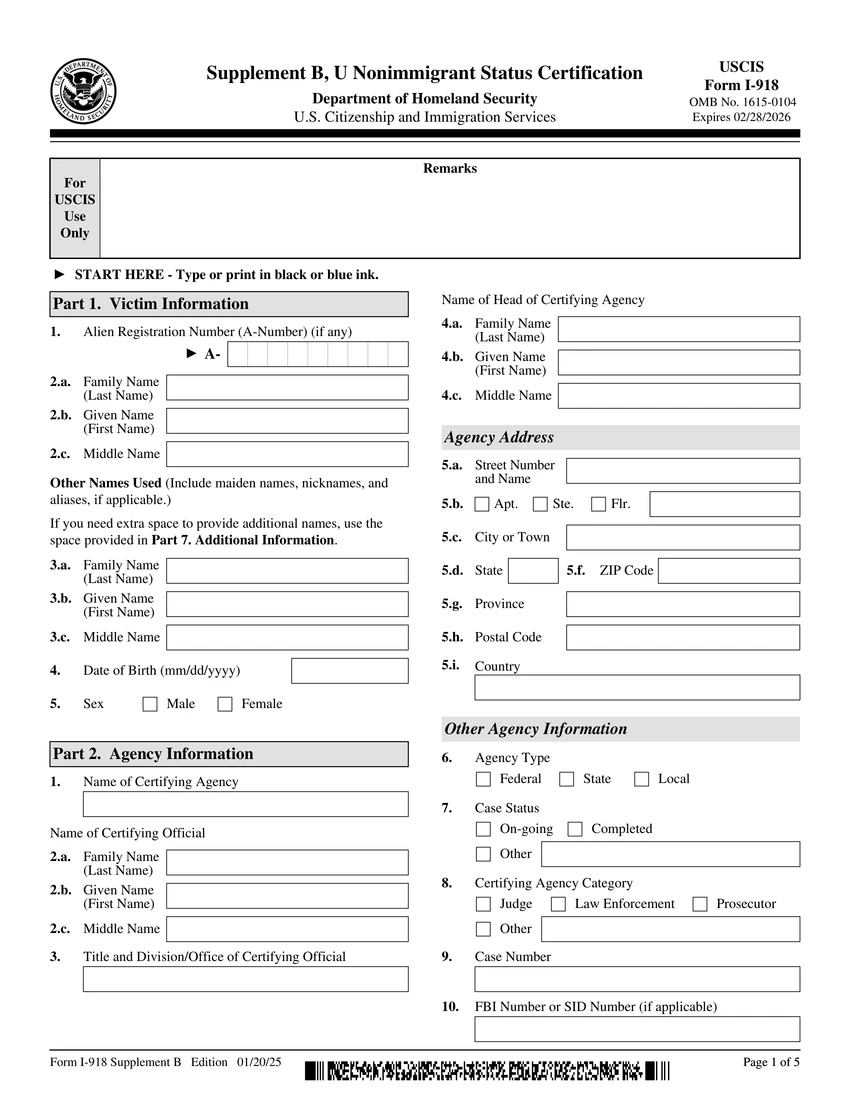
First page of I-918 Supplement B form
Source: I-918 Supplement B PDF
Context and workflow
#Processing time for I-918 Supplement B varies by case type and current workload — always check the official USCIS processing time tool.
Why this matters
- A U visa petition cannot be approved without a signed law enforcement certification, so obtaining Supplement B from the certifying agency is usually the critical path for a crime victim.
- The certification is the bridge between a criminal case and an immigration benefit: the agency describes the qualifying criminal activity and the victim's helpfulness, and USCIS relies on that description when reviewing the petition.
- Certification is evidence, not a decision — USCIS, not the certifying agency, decides the immigration petition — so a signed Supplement B opens the adjudication rather than ending it.
- This form acts as a cross-check point: details here must match other forms and supporting documents.
- Inconsistencies often trigger returns or follow-up requests because they create uncertainty in the case record.
Where it fits in the workflow
- Requesting certification from the qualifying law enforcement agency.
- Filing the signed Supplement B together with the Form I-918 petition.
- USCIS reviewing the Form I-918 petition and Supplement B certification together.
Who uses it
Form I-918 Supplement B is intended for individuals who are victims of qualifying criminal activity and have been, are being, or are likely to be helpful in the investigation or prosecution of that activity. This form is a crucial part of the application process for U Nonimmigrant Status, which offers temporary immigration benefits to victims who assist law enforcement. The certifying agency, which must be a Federal, state, local, or tribal law enforcement agency, prosecutor, authority, or judge, is responsible for confirming the victim's helpfulness. Applicants must demonstrate their role as victims and their cooperation with law enforcement to qualify for these benefits.
When it is used
- U-visa — Required certification for U nonimmigrant status
- Asylum — Crime victims may also pursue asylum relief
- When filing I-918 Supplement B alongside I-918 (Law enforcement certification required for I-918 U visa petition)
- After filing I-918 Supplement B — I-485 may be the next step (Adjustment of status after U visa approval)
Failure prevention (What causes Form I-918 Supplement B rejections?)
#Technical rejections
- Submitting a photocopy of the signature page instead of an original signature.
- Submitting a Supplement B signed by someone other than the head of the certifying agency without evidence that the signer is a designated certifying official.
- Ensure form edition is current
Substantive weaknesses
- Failing to provide sufficient evidence of helpfulness in the investigation or prosecution.
- To avoid filing i-918 without supplement b certification: Obtain law enforcement certification (Supplement B) before or with I-918; application cannot be approved without it.
- To avoid certifying agency not completing supplement b: Build relationship with agency; provide all victimization and cooperation evidence.
- To avoid incomplete certification or wrong agency: Ensure certifying agency has jurisdiction; certification must meet U visa requirements.
- To avoid assuming supplement b alone suffices: I-918 and Supplement B are filed together; Supplement B is one required component.
What it asks for (What does Form I-918 Supplement B ask for?)
#- Details of the qualifying criminal activity.
- Details of the criminal acts, including statutory citations and whether they violated U.S. law.
- Certification from a law enforcement agency that the individual is a victim of a qualifying criminal activity and has been, is being, or is likely to be helpful in the investigation or prosecution.
- Information about the certifying agency and official
- The individual must be a victim of one or more of the crimes listed in Part 3.
- Biographic information about the victim and the certifying agency.
- Whether the signer is the head of the certifying agency or an official designated to sign certifications on the agency's behalf.
- Documentation related to: Evidence of the victim's helpfulness in the investigation or prosecution
What you need (What do you need for Form I-918 Supplement B?)
#- Valid government-issued identification
- Supporting documentation for your case
- A completed Form I-918 Supplement B signed by a law enforcement official
- Copies of relevant reports and findings related to the criminal activity
- The petitioner must be a victim of qualifying criminal activity and provide evidence of being helpful in the investigation or prosecution.
- Evidence of the victim's helpfulness in the investigation or prosecution.
- Evidence of the certifying official's designation if the form is not signed by the head of the agency.
Checklist (What is the Form I-918 Supplement B checklist?)
#- Download the current I-918 Supplement B and instructions from the official USCIS website
- Review the official I-918 Supplement B instructions before filing
- Gather required supporting documents per the instructions
- Complete and sign Form I-918 Supplement B, ensuring all necessary supporting evidence is included, and submit it accordingly.
Fees
#| Component | Amount |
|---|---|
| No separate filing feeForm I-918 Supplement B has no separate filing fee of its own. It is completed by a certifying agency and submitted as part of the Form I-918 petition for U nonimmigrant status. | See official schedule |
Is there a filing fee for Form I-918 Supplement B?
Form I-918 Supplement B does not have its own filing fee. It is submitted as part of the Form I-918 petition, so any applicable fee or fee-waiver rules are those of Form I-918. Verify the current requirements on the official USCIS page.
Fee waiver: Because Supplement B is filed with Form I-918, review the Form I-918 fee and fee-waiver rules on the official USCIS page. For related guidance, see Petition for U Nonimmigrant Status.
Fees change; always verify on USCIS.
Where to file
#Form I-918 Supplement B is not filed on its own. The certifying agency completes and signs it, and you submit it as part of your Form I-918 petition to the address in the Form I-918 instructions.
Submit application
Include the completed, signed Supplement B in your Form I-918 petition package. It is not submitted separately or online on its own.
Submit application
Mail the Form I-918 package to the filing address in the official Form I-918 instructions, which varies by eligibility category and state of residence. Verify the current address before mailing.
Filing locations and procedures may change. Always verify on the official USCIS website before submitting. For related guidance, see Application to Register Permanent Residence or.
Form sections (What sections does Form I-918 Supplement B have?)
#Personal Information
Applicant identification.
- Full name and A-Number if applicable
- Date of birth and nationality
- Current address and contact
Eligibility
Basis for the application.
- Category or classification claimed
- Supporting evidence type
- Dates establishing eligibility
Supporting Documents
Required attachments.
- Identity and status documents
- Category-specific evidence
- Evidence of the victim's helpfulness in the investigation or prosecution
Strategy tips
#Mistake severity
#| Mistake type | Severity | How to avoid |
|---|---|---|
| Filing I-918 without Supplement B certification | Rejection | Obtain law enforcement certification (Supplement B) before or with I-918; application cannot be approved without it. |
| Certifying agency not completing Supplement B | Delay | Build relationship with agency; provide all victimization and cooperation evidence. |
| Incomplete certification or wrong agency | RFE | Ensure certifying agency has jurisdiction; certification must meet U visa requirements. |
| Assuming Supplement B alone suffices | Rejection | I-918 and Supplement B are filed together; Supplement B is one required component. |
Examples (What are examples for Form I-918 Supplement B?)
#- Strong application: An applicant submits the form with all required documents and receives a timely decision.
- Common weakness: Petitioner forgets to sign; form returned, causing delay.
- Scenario: A crime victim's petition was filed with the certifying agency's completed Supplement B and all supporting evidence, and the case proceeded on the standard timeline. Prepare all evidence of helpfulness before filing to avoid delays.
- A domestic violence victim who cooperated with the investigating police department obtains a completed Supplement B and files it with their Form I-918 U visa petition.
- An applicant in the U-visa category files I-918 Supplement B as part of their immigration process
Common misconceptions (What misconceptions surround Form I-918 Supplement B?)
#- Some applicants assume that any law enforcement agency can certify the form, but it must be a Federal, state, local, or tribal law enforcement agency involved in the investigation or prosecution of the qualifying criminal activity.
- Filing I-918 Supplement B guarantees a U visa or protection from removal — Supplement B is one required component of the U visa petition; filing it does not by itself guarantee approval. Eligibility requirements must be met and verified.
- A signed Supplement B has a fixed shelf life that you must beat — signature timing rules for this certification have changed over time, so confirm the current requirement in the official [Form I-918 instructions](https://www.uscis.gov/i-918) rather than relying on third-party summaries or older guidance.
- Once the agency signs, the certification is locked in — a certifying official may withdraw or disavow a Supplement B at any time, even after it has been submitted to USCIS, if the victim unreasonably refuses to assist in the investigation or prosecution.
- Paying the I-918 SUPPLEMENT B filing fee does not guarantee acceptance — the fee is generally non-refundable even when the form is rejected for technical errors.
- A fee waiver for I-918 SUPPLEMENT B is not automatic — only specific qualifying categories are eligible, and a waiver request can be denied while the underlying form is still expected to be filed.
Edge cases and variations
#- If you are asked to submit or update I-918 Supplement B, treat it as a package update: check every place the same details appear and keep them consistent.
In-depth guidance
#How the law enforcement certification works
Form I-918 Supplement B is the only part of a U visa petition you cannot complete yourself. A certifying agency — a Federal, state, local, or tribal law enforcement agency, prosecutor, judge, or other authority that detects, investigates, or prosecutes qualifying criminal activity — reviews its own case record and signs the certification. The agency is certifying two things: that you are a victim of a qualifying crime, and that you have been, are being, or are likely to be helpful in the investigation or prosecution.
Everything you hand the agency should make one of those two points easier to confirm.
In practice that means treating the certification as a request rather than a form-filling exercise. Identify which agency has jurisdiction over the crime, find out whether it has a designated certifying official or a written U visa certification policy, and submit a package with the police or incident report, any case or docket reference, and a short summary of each point of contact you had with investigators or prosecutors. Keep a copy of what you send.
If the agency asks for clarification, answer in writing so the immigration record and the criminal case record tell the same story — inconsistencies between the two are a common source of Requests for Evidence on the underlying Form I-918 petition.
Two things a certifying official is not doing are worth stating plainly, because they change how you frame the request. The official is not deciding your immigration case — USCIS adjudicates the Form I-918 petition, and the certification is evidence within it — and the official is not certifying that a conviction was obtained. A crime that was never charged, or a case closed without a prosecution, can still support a certification if the agency detected or investigated the qualifying criminal activity and you were helpful.
If the agency has never handled a request like this, point it to the DHS law enforcement resource guide on U and T visa certification, which is written for certifying agencies rather than for victims, alongside the official Form I-918 and Supplement B instructions on the USCIS website. The Form I-918 guide covers the petition the certification is filed with.
How to complete this form reliably
Treat I-918 Supplement B as part of a system, not a standalone document. Most delays happen when details conflict across the form, supporting documents, and other parts of the application package. Before you start, gather the documents you will reference and decide which one is the source of truth for each field.
Fill the form in one sitting if possible. Partially-completed forms are where inconsistent edits creep in. When you finish, review each section and ask "what evidence in my package proves this statement?"
Scenarios
#A victim includes a completed, signed Supplement B with a Form I-918 petition and all required supporting evidence.
The certification supports the petition, and USCIS reviews Form I-918 and Supplement B together.
Follow the evidence checklist and file Supplement B with Form I-918. Missing documents can trigger RFEs or denial of the petition.
A victim stops responding to the certifying agency's requests after the agency has signed and the petition has been filed.
The certifying official may withdraw or disavow the Supplement B at any time — even after it has been submitted to USCIS — if the victim unreasonably refuses to assist in the investigation or prosecution.
Helpfulness is ongoing, not a one-time box to tick. Keep answering reasonable requests from the certifying agency after filing, and keep a written record of each contact.
An applicant forgets to sign the form.
Application rejected. Must resubmit with signature. Unsigned forms are not accepted.
Sign and date the form. Review the signature block before mailing.
Key differentiators
#- Unlike Form I-918: Petition for U Nonimmigrant Status: Required for: Law enforcement certification required for I-918 U visa petition
- Unlike Form I-485: Application to Register Permanent Residence or Adjust Status: Next step after approval: Adjustment of status after U visa approval
Why it matters
#What happens after you submit
#- Obtain the completed, signed Supplement B from the certifying official.
- File it together with your Form I-918 petition — Supplement B is not submitted or adjudicated on its own.
- USCIS reviews the Form I-918 petition together with the Supplement B certification and supporting evidence.
- Respond to any Request for Evidence (RFE) USCIS issues on the petition.
- If the U visa petition is approved, proceed with any next-stage forms or processes related to U Nonimmigrant Status.
Verification
#This guide is derived from official USCIS instructions for I-918 Supplement B and is updated when form editions or filing rules change. Always verify current requirements at the official USCIS website.
Resources
#Free United States planning tools
#Itemize the government fees that go alongside Form I-918 Supplement B.
United States eligibility checker
See which United States visas your profile fits before you finalize Form I-918 Supplement B.
United States processing times
Get the typical wait time for the visa associated with Form I-918 Supplement B.
United States interview practice
Practice United States interview questions if your filing route includes one.