
Quick summary
#Check the form instructions for category-specific requirements, as described in the Form DS-2019 guide.
This form is used by approved regional centers to provide required information, certifications, and evidence to support their continued eligibility for regional center designation.
Include it with your application package and follow official instructions for submission.
Names, dates of birth, and passport details on other forms Program checklist requirements Supporting documents and translations
Overview (What is Form I-956G?)
#Regional centers must accurately complete and submit this form on time to avoid sanctions and maintain their participation in the EB-5 program.
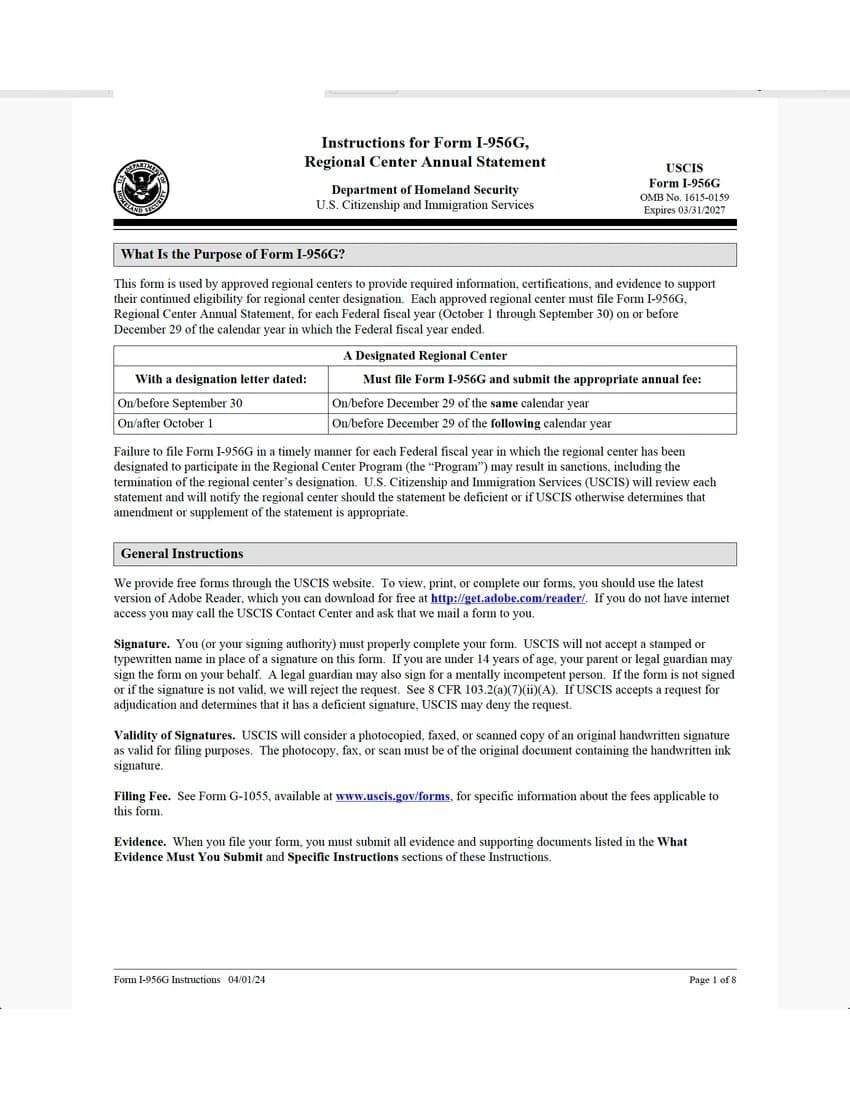
First page of I-956G form
Source: I-956G PDF
Context and workflow
#Processing time for I-956G varies by case type and current workload — always check the official USCIS processing time tool.
Why this matters
- This form helps confirm that the application matches the program’s requirements and checklist.
- Inconsistencies often trigger returns or follow-up requests because they create uncertainty in the case record.
Where it fits in the workflow
- Receipt Notice (a related form)
- Review of submitted documentation
- Determination of continued eligibility for regional center designation
Who uses it
Check the form instructions for category-specific requirements.
When it is used
- This form is used by approved regional centers to provide required information, certifications, and evidence to support their continued eligibility for regional center designation.
- EB-5 — EB-5 job creation
- When filing I-956G alongside I-956 (Required annually after regional center designation)
Eligibility Category Codes
#Eligibility information for this form. Confirm your category in the official instructions before filing.
This is a shortlist of common categories. The official instructions include many more.
| Code | Who applies |
|---|---|
| General | Check the form instructions for category-specific requirements. |
| Eligibility | A qualified certifier must complete the certification section, who is a person in a position of substantive authority for the management or operations of a regional center. |
Failure prevention (What causes Form I-956G rejections?)
#Technical rejections
- Failure to sign the form with an original handwritten signature.
- Submitting the form without all required evidence and supporting documents.
- Ensure form edition is current
Substantive weaknesses
- Failure to notify USCIS of a change of address within the required timeframe.
What it asks for (What does Form I-956G ask for?)
#- Compliance with Federal labor laws and other regulations
- Information on litigation or bankruptcy proceedings
- Accounting of alien investor capital and job creation
- Applicant identification information
- Supporting documentation inventory
- Eligibility or purpose details
- Declarations and signatures
What you need (What do you need for Form I-956G?)
#- The current edition of I-956G
- Evidence of compliance with federal labor laws.
Checklist (What is the Form I-956G checklist?)
#- Download the current I-956G and instructions from the official USCIS website
- Review the I-956G instructions for the follow-up action this form covers
- Complete all required sections of I-956G
- Confirm the form is signed and dated in all required fields
- Confirm your mailing address is current and correct
- Ensure that all pages are from the current edition of Form I-956G.
- Sign, date, and submit I-956G with all required supporting evidence
Fees
#| Component | Amount |
|---|---|
| Filing FeeIf you qualify for an exemption from the requirement to use an electronic payment method, you will need to complete and file Form G-1651, Exemption for Paper Fee Payment, along with submitting the correct payment | See official schedule |
| Biometrics Services FeeA biometrics fee may be required depending on your category. Check the official fee schedule. | See official schedule |
Can the Form I-956G fee be waived?
Fee waivers may be available for qualifying applicants. See official instructions for eligibility.
What happens if I submit the wrong fee?
USCIS will reject your application if the incorrect fee is submitted. Verify the current fee on the official schedule before filing.
Fee waiver: Fee waivers may be available for qualifying applicants. See official instructions for eligibility. For related guidance, see Application for Regional Center Designation.
Fees change; always verify on USCIS.
Where to file
#Online filing is available for some categories — verify on the official form page. Otherwise, file by mail to the address in the instructions.
File online
Check the official I-956G page to see if online filing is available for your category.
Submit application
Paper filing addresses vary by eligibility category and state of residence. Check the official instructions for the correct filing address.
Filing locations and procedures may change. Always verify on the official USCIS website before submitting. For related guidance, see EB-5 Immigrant Investor Visa.
Form sections (What sections does Form I-956G have?)
#Part 2. Information About the Regional Center
Part 2. Information About the Regional Center
- Information on litigation or bankruptcy proceedings
- Information on capital investment projects and their progress
- Documents that support the specific follow-up action you are requesting
- Contact information tied to the prior case
- Failure to sign the form with an original handwritten signature.
- Submitting the form without all required evidence and supporting documents.
- USCIS verifies identity documents.
Part 8. Additional Information
Complete this section as described in the official instructions.
- Evidence supporting continued eligibility
- Failure to sign the form with an original handwritten signature.
- Submitting the form without all required evidence and supporting documents.
- Not providing a full English translation for documents in a foreign language.
- USCIS verifies this section.
Strategy tips
#Common mistakes (What mistakes are common with Form I-956G?)
#- Neglecting to provide an original handwritten signature on the form.
- Submitting Form I-956G without including all necessary evidence and supporting documentation.
- Failing to provide a complete English translation for any document written in a foreign language.
- Neglecting to inform USCIS of an address change within the specified period.
- Submitting original documents when not required can lead to their destruction.
- Submitting forms with pages from different editions.
- Missing pages in the form submission.
Examples (What are examples for Form I-956G?)
#- A regional center submitted Form I-956G with comprehensive documentation of investor capital and compliance with labor laws, resulting in continued eligibility under the EB-5 program.
- An applicant failed to include evidence of compliance with federal labor laws in their Form I-956G submission, leading to a request for additional information from USCIS.
- A regional center provided incomplete information about pending litigation in their Form I-956G, which delayed the processing and required further clarification.
Common misconceptions (What misconceptions surround Form I-956G?)
#- I-956G has more than one fee component (e.g. Filing Fee and Biometrics Services Fee); paying only one or paying the wrong amount can result in rejection of the entire filing.
- A fee waiver for I-956G is not automatic — only specific qualifying categories are eligible, and a waiver request can be denied while the underlying form is still expected to be filed.
- I-956G cannot always be filed in any way — the correct filing method depends on the applicant's category, and using the wrong channel can result in rejection.
- I-956G can be rejected before substantive review for technical errors such as “Failure to sign the form with an original handwritten signature.”
- A complete I-956G can still be denied on the merits — issues like “Failure to notify USCIS of a change of address within the required timeframe” are evaluated by the reviewer even when paperwork is clean.
- Submitting I-956G is the start of the process — applicants should expect follow-up steps such as “Receipt Notice (a related form) confirming submission.”
Edge cases and variations
#- If you are asked to submit or update I-956G, treat it as a package update: check every place the same details appear and keep them consistent.
Scenarios
#A regional center submits their annual statement with complete financial records and compliance certifications.
The center maintains its designation without any issues.
Providing thorough and accurate documentation ensures continued eligibility and avoids processing delays.
Key differentiators
#- Unlike Form I-956: Application for Regional Center Designation: Required for: Required annually after regional center designation (EB-5 Investor pathway)
- Unlike Form I-129: Petition for a Nonimmigrant Worker: Part of employment-based immigration process (EB-5 Investor pathway)
Why it matters
#What happens after you submit
#- Receipt Notice (a related form) confirming submission.
- USCIS reviews the submitted information for completeness and accuracy.
- USCIS may request additional information if needed.
Verification
#This guide is derived from official USCIS instructions for I-956G and is updated when form editions or filing rules change. Always verify current requirements at the official USCIS website.
Resources
#Free United States planning tools
#Itemize the government fees that go alongside Form I-956G.
United States eligibility checker
See which United States visas your profile fits before you finalize Form I-956G.
United States processing times
Get the typical wait time for the visa associated with Form I-956G.
United States interview practice
Practice United States interview questions if your filing route includes one.